On This Date In 1968: The Heidi Game -The Most Fantastic Finish Never Seen

Ever wonder where the moment came that football games wouldn’t finish before shows started?? Remember how the late Pat Summerall would always explain how Sixty Minutes was next for everyone except on the West Coast after football?? Wll there was an inident called The Heidi Game that had a lot to do with it. Have a read….

The Chancellor of Football's avatarTaylor Blitz Times

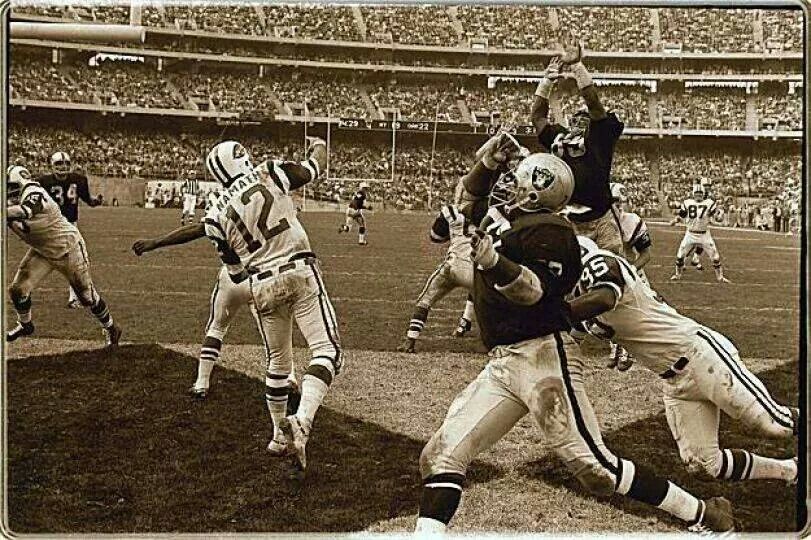
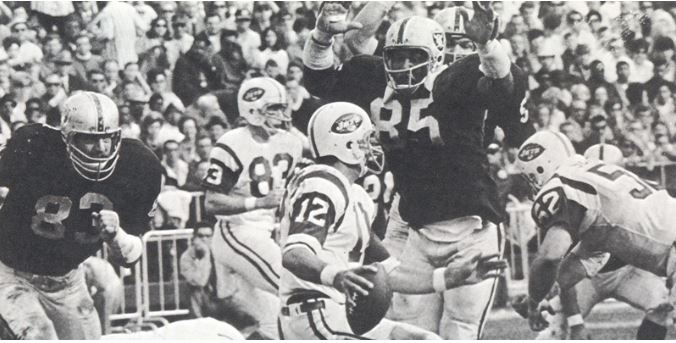
One of the greatest games of football lore was the famous “Heidi Game” of 1968. It was back in the American Football League when the Oakland Raiders and New York Jets were forming quite a rivalry. The interest nationally between these teams actually took root the season before.

Quarterback Joe Namath had been a transcendent figure for the AFL since he was drafted back in 1965. However Jets brass believed they had finally built a team around him that could compete for the league championship. With their glamour quarterback in the media center of New York, there was some animosity brewing with rival teams. One was the Oakland Raiders whose defense, The 11 Angry Men, played a physical style of football that went beyond the whistle.

In what could have been the 1967 AFL Championship match-up, the 11-1 Western Division leading Raiders hosted the East leading 7-3-1 Jets. Oakland…

View original post 279 more words

Protecting The Quarterback: A Knee Jerk Reaction

Remember when Jack Lambert was quoted “Quarterbacks should wear skirts.” back in 1975?? Well with another rule change or two they may actually be doing that. What happened yesterday was a complete travesty that could wind up derailing the season for the San Franciso 49ers.

Drew Brees is about to be sacked by Ahmad Brooks of the 49ers.

Drew Brees is about to be sacked by Ahmad Brooks of the 49ers.

Toward the end of yesterday’s game between the Niners battle with the New Orleans Saints, the game had boiled down to a critical third down. San Francisco had played a brilliant game on the road and were about to put on the finishing touches on what would have been a 20-17 win. Up until the moment of the hit, the Niners had held Drew Brees to just 200 yards passing the entire game.

It was 3rd and 2 from the San Francisco 35. Brees takes a Pistol snap and takes the equivalent of a seven step drop when Ahmad Brooks levels him. The ball comes out and Patrick Willis recovered back at the 48 with 3:17 to go. The first substantial drive of the fourth quarter by the Saints had been squashed and the Niners could run out the clock in a quiet Superdome….right?? Well there was a flag on the prescription turf.

Brooks was flagged for hitting Brees in the head.  Replay clearly showed that he hit him across the chest causing a fumble.

Brooks was flagged for hitting Brees in the head. Replay clearly showed that he hit him across the chest causing a fumble.

Unecessary roughness was called on Brooks indicating he had hit Brees in the head. During the call we heard the ref describe “attacking the neck of the quarterback”. The Saints retained possession and thanks to the 15 yard penalty were in position to tie the game with a field goal, changing the momentum.

The turn of events led to the Saints being in field goal range to tie the game. The subsequent change of momentum stymied San Francisco’s last drive and New Orleans last second kick to win it 23-20. A travesty had occurred with the Niners losing that game. You didn’t go away feeling the best team won, you felt something else. The Niners hadn’t been cheated like that since the 1983 NFC Championship Game.

The over-protection of quarterbacks is at an all time high and it’s ruining the game of football. On the play in question Ahmad Brooks came storming around the strong side and hit Drew Brees high but with his arm and shoulder across the chest. Because Brees wasn’t ready for it and didn’t brace himself causing a whiplash effect doesn’t make it a penalty. Brooks didn’t hit him in the head nor did he use his in making the tackle. Now thanks to a terrible call, the defending NFC Champions may not make the playoffs with a 6-4 record. They now have 3 conference losses and tie breaker advantages to several teams.

If this is a roughing the passer penalty, I'm from Mars.

If this is a roughing the passer penalty, I’m from Mars.

Quarterbacks are playing the game of football too. Personally, I like seeing quarterbacks knocked about, it’s one of the reasons you’re reading the Taylor BLITZ Times and not the Taylor Long Pass Times. We here understand the necessary measures but this is getting ridiculous.

Thanks to the knee injury suffered by Tom Brady in week 1 of 2008, a falling lineman can’t fall into the legs of a quarterback. The league always had a rule where if the defender was reaching to knock down a pass and hit the helmet, it’s a penalty. Now the referee is worried that Brooks hit Brees in the neck when replay showed clearly he didn’t. Never knew a quarterback’s neck was off limits. By the time we put in quarterback hook slides and such….Jack Lambert was 100% right. Not only should they wear skirts, they should take off their shoulder pads and helmets also.

Thanks for reading and please share the article.

On This Date In 1968: The Heidi Game -The Most Fantastic Finish Never Seen

One of the greatest games of football lore was the famous “Heidi Game” of 1968. It was back in the American Football League when the Oakland Raiders and New York Jets were forming quite a rivalry. The interest nationally between these teams actually took root the season before.

Quarterback Joe Namath had been a transcendent figure for the AFL since he was drafted back in 1965. However Jets brass believed they had finally built a team around him that could compete for the league championship. With their glamour quarterback in the media center of New York, there was some animosity brewing with rival teams. One was the Oakland Raiders whose defense, The 11 Angry Men, played a physical style of football that went beyond the whistle.

In what could have been the 1967 AFL Championship match-up, the 11-1 Western Division leading Raiders hosted the East leading 7-3-1 Jets. Oakland won an entertaining game 39-28, which was New York’s third loss in a row. This game was made famous when Ike Lassiter #77 smashed Namath in the face fracturing his cheekbone. Joe finished the game with 370 yards yet threw 3 costly interceptions. The backsliding Jets watched as they were leapfrogged by the Houston Oilers who stole the division and faced Oakland in the title game.

A 40-7 trouncing of the Oilers sent the Raiders (13-1) to take on Vince Lombardi’s Packers in Super Bowl II. However when a league is battling for respectability, it makes for great television when the league can showcase it’s stars in the championship and to a man the Jets believed they could take the Raiders. They would have to wait until the following season to measure themselves against the defending AFL champions. In a week 10 battle, each team came in 7-2 and again leading their divisions with battle lines drawn from the season prior. A national televised audience tuned in to NBC for the game of the year.

The Jets went away from this game knowing they could beat the Raiders and only a miracle finish kept them from winning. That knowledge kept the New Yorkers motivated and they would get revenge in the 1968 AFL Championship where they would win 27-23. From there they would proceed into history with their famous Super Bowl III upset of the Baltimore Colts. The AFL and Heidi gained extensive notoriety from the NBC gaffe and when the television contracts were reworked with the NFL merger, games would be shown in their entirety from then on.

Thanks for reading and please share the article.


Styles Make Great Fights: Kansas City Chiefs v. Denver Broncos Week 11

Now the rest of the sporting press has come to recognize what Taylor Blitz Times readers already knew. The Kansas City Chiefs were going to be a force in the 2013 campaign as we predicted they would win the AFC West. Well, not so fast. Their mission, should they choose to accept it, is to go into Invesco Field and stop Peyton Manning’s 8-1 Denver Broncos. However the Chiefs come in as the NFL’s last unbeaten team and a perfect 9-0 record.

Tamba Hali has 9 sacks in the Chiefs 9 games. Did you know that is only good enough for second on the team??

Tamba Hali has 9 sacks in the Chiefs 9 games. Did you know that is only good enough for second on the team??

The obvious match-up pits the #1 offense of the Broncos with the Chiefs 9th ranked defense. In all 9 games Kansas City hasn’t given up more than 17 points in any game this season. They lead the league with 36 sacks, twenty between Justin Houston (11) and Tamba Hali (9) alone. The Chiefs are also 6th against the pass having intercepted 12 passes and giving up the 3rd fewest passing touchdowns with 9.

Hosting this big time match-up is the NFL’s “point a minute” offense. Peyton Manning has 33 touchdowns in only nine games. Thirty three?? Yikes… The Broncos have scored 371 points so far this season. How significant is that? Last year’s Super Bowl champion Ravens scored 398 the entire season. You were staring at one of history’s finest scoring teams. With five of their last seven being played outside in colder weather, their scoring should slow some.

Moreno has had a big 2013 and may need to be a bigger factor down the stretch.

Moreno has had a big 2013 and may need to be a bigger factor down the stretch.

The real question comes when the Broncos two backup tackles have to line up and take on Hali and Justin Houston. Will they decide to run the ball with Knowshon Moreno (521 yds / 8TDs) to keep the defense honest?? The Chiefs are only 19th against the run and Nose Tackle Dontari Poe (36 tackles /4.5 sack /3 passes defensed) is on the short list of defensive linemen up for Taylor Blitz Times Defensive Player of the Year. Will Denver stay committed enough to the run??

They have to get the ball out of Manning’s hands quick with the Chiefs rush coming at them. Kansas City needs to press the Denver receivers and forcing Manning (nursing a high ankle sprain) to hold onto the football for close to 2 seconds before the ball can be thrown. If they do all of these things, the Chiefs have a big chance to win this game.

To win this game, the Chiefs have to rope them into a defensive slugfest and possess the football. Right now the best the Chiefs can do is a low scoring affair won 20-17 or 17-14. If manning can get to 20 first, the game is over and Kansas City will have to wait for the rubber match in two weeks. Alex Smith can’t turn the football over and the line needs to open holes for Jamaal Charles (726 yards / 6 TDs) and a big play is needed from Dexter McCluster.

Funny how folks shape their arguments huh?? Last year when The Chancellor of Football said the Denver Broncos ran out to a 13-3 record and won the AFC West, they hadn’t played anybody. The rest of the AFC West was mired in a 17 game losing streak. Now Bronco supporters are saying the same thing about Kansas City and they might be right. Yet did you know Denver hasn’t beat a team with a winning record in 2013?? That’s right they were beaten in Indianapolis and are 0-1 against a team with a winning record. They were 1-3 last year against playoff teams.

Let’s face facts…. Peyton Manning and the Denver offense could be off for 50 minutes, then poof score 28 and are well ahead in a rout. The Chiefs coming out party is one where they have to play a grind it out game for all 60 minutes. Possess the football and run it at Denver and keep Manning off the field.

Thanks for reading and please share the article.


The Soul of The Game: Earl Campbell

When it comes to great hitting in the NFL, the first vision that comes to mind are those of defenders teeing off on offensive players. Yet some of the most frightening collisions were those that took place when Earl Campbell ran with the football.

earl.isiahHis aggressive style of play burst onto the NFL scene in 1978 and for the next four seasons was the most dynamic force the league had seen since Jim Brown’s retirement more than a decade before.

In the lineage of great power backs he was Larry Csonka’s successor in the 1970’s while raising the profile of the Houston Oilers. He was used as a bludgeoning weapon to hammer defenses into submission. The only defense he couldn’t beat down with regularity was the Steel Curtain in Pittsburgh. In back to back AFC Championship Games in 1978 and 1979, they kept Campbell short of a deserved Super Bowl visit. Yet against Atlanta’s Gritz Blitz, Denver’s Orange Crush, or even Dallas’ Doomsday Defense, he was the Oilers complete gameplan. Some of his best games came against the best defenses of his day.


In 1977 the Atlanta Falcons had set the record for fewest points given up in a 14 game NFL season with 129. They’re “Gritz Blitz” of Jerry Glanville had first shot at the former Heisman winner in game one of 1978. Campbell smashed off tackle for a 73 yard touchdown in the 1st quarter en route to 137 yards for the game. The fact they were behind for much of the game is why he only carried 15 times. He showed he belonged.

Against the Dallas Cowboys in 1979, a national televised audience tuned in on Thanksgiving to see Earl Campbell vs. Doomsday at Texas Stadium. Again he broke off tackle trampling Cowboys on the way to a 61 yard touchdown that set the tone for the day. His 195 yards rushing was the most ever given up (at that time) in the history of Texas Stadium. He was the star of the game.

Yet when you think of Earl Campbell, it was the collisions that come to mind. He was the most physical runner in NFL history. You’d have to give him the nod over Jim Brown because of the size of the fronts he faced. In the 1960s Brown faced defenses that averaged 250 lbs on the defensive line. He outweighed the linebackers of the time and the contemporary talent was fractured with so much defensive size being displayed over in the AFL. Campbell was facing defensive linemen in the 280 lbs range with middle linebackers outweighing his 225 lbs.

He was able to produce more force than both Brown and Larry Csonka because of the additional room taking the ball on pitches and handoffs back in the I formation and not from a fullback setting. Who was the most punishing runner in NFL history in your eyes?? The Chancellor’s vote is in.

Roger Craig Should Be In Pro Football Hall of Fame

When you think back to Bill Walsh’s great 49er teams, who are the first players you think of?? Right there with the Joe Montanas, the Jerry Rices, and Ronnie Lotts it only takes a fraction of a second to think of Roger Craig. His high knee running style brought a physicality to the San Francisco offense that was seen as a finesse group up until his arrival. In fact he came to San Francisco as a fullback when they drafted him from Nebraska before the 1983 season.

In college he had been primarily a blocking back in the Cornhuskers wishbone offense. Normally he paved the way for Jarvis Redwine and then Mike Rozier. Yet when Bill Walsh decided to revamp San Francisco’s dismal backfield after a 3-6 season in 1982, he drafted Craig in the second round.

Although the 49ers had won it all in 1981, it had become apparent Bill Ring, Amos Lawrence, Walt Easley, and Earl Cooper just wasn’t cutting it in the backfield. To raise the stakes in the NFC for 1983, Craig and newly acquired Wendell Tyler would form a more potent backfield.

After posting the worst yards per carry average (3.4) and yardage (742) in 1982, the new backfield duo of Craig and Tyler turned that around completely. The much improved ground game of 1983 ranked 8th with 2,257 yards rushing and a gaudy 4.4 yard average. Ironically just ahead of the Los Angeles Rams, who had traded Tyler to San Francisco so they could draft Eric Dickerson.

You had to give the nod to Craig who ran for 783 yards a team leading 8 TDs, while catching 42 passes for 427 yards and another 4 scores. This more dynamic backfield, along with Joe Montana, powered San Francisco to the NFC Championship Game. A 24-21 loss to the Washington Redskins was shrouded in controversy, thanks to some questionable calls, yet Walsh had the backfield he envisioned. Craig had reinvented himself from a collegiate player who rarely touched the football to a dual threat pro.
The 1984 49ers were a juggernaut becoming the first team to go 15-1 during the regular season. Everyone of the 49 man roster played their role so no one had outstanding stats. However once the 49ers moved past the New York Giants and Chicago Bears during the playoffs, the stage was set for a coming out party in Super Bowl XIX. With all eyes on Joe Montana’s possible second Super Bowl trophy and the electrifying record setting Dan Marino, Craig’s name didn’t even make the marquee.


Roger Craig graces the cover of Sports Illustrated after his record breaking performance in Super Bowl XIX.

Roger Craig graces the cover of Sports Illustrated after his record breaking performance in Super Bowl XIX.

It was his 1985 that set Craig apart as he amassed his 1,000/ 1,000 yard seasons both rushing and receiving. The first player in league history to do so. Some 27 years later, only Hall of Famer Marshall Faulk shares that accomplishment when he did it in 1999. How dominating was his performance?? Well his 1,050 yards rushing doesn’t jump out at you until you realize he only ran 214 times for a whopping 4.9 yards per carry. The league average is always around 4.0.

Oh by the way, he led the NFL in receiving that year with 92, which set a record for running backs, that amassed 1,016 more yards. His 15 total touchdowns was second to Joe Morris and was 1 better than NFL MVP Marcus Allen. In fact many pundits, including our CEO believes Craig should have been the MVP in 1985 with that dominating performance.

Now buoy his 1985 record setting season not culminating with the league MVP, on the backdrop of a Super Bowl record 3 TDs yet not winning that MVP and you’ll see where we’re going in a minute. Don’t forget he did this on a 10-6 San Francisco team that was a defending champion with Jerry Rice being a rookie that didn’t have 1,000 yards receiving and only 3 touchdowns. Craig quite simply fueled that offense.

Once the 49ers won Super Bowl XIX, they were forced to retool and become a bigger physical team. In 1985, the Chicago Bears emerged with one of the most imposing defenses in NFL history. The Giants followed suit with an overwhelming defense that featured 4 linebackers in the 250 lbs category. When Bill Walsh and his 49ers were dominated 49-3 in the 1986 NFC Divisional Playoffs by the Giants something had to be done.

These were teams the 49ers had beaten on their way to the ’84 championship, now they had taken the game to a new level of brute force. In reinventing the offense from a size perspective, it was Craig who was switched from fullback to halfback to allow for the insertion of Tom Rathman at fullback. The entire offensive line was overhauled.

You have to keep in mind the average career for a runner in pro football is less than 4 years. Yet here Craig was making the switch in year 5 to a position that called for him to be quicker. This at a time where he should have been slowing down from a physical standpoint. Yet he, Jerry Rice and Joe Montana spearheaded one of history’s most accomplished runs. From 1987-1990 the 49ers went 51-12 in the regular season, winning back to back Super Bowls in ’88 & ’89 and were the prohibitive favorites to win it all in 1987 as well as 1990. They finished #1 in offense in ’87 and ’89 and #2 in ’88 and ’90. In each year they made it to at least the divisional round of the playoffs and 3 straight NFC Championship Games as they were trying to threepeat.

Playing in only 12 games due to the ’87 strike, Craig ran for 815 yards which projects out to 1,086 over a full season. The 13-2 Niners were poised to become the greatest team of the modern era yet were upset by the Vikings in the playoffs. They were #1 in both offense and defense yet proved fallible in the playoff loss. Craig went on to his greatest performance in the 1988 campaign. In rushing for a career high and club record 1,502 yards, he also caught 76 passes for an additional 534  yards for his second season with over 2,000 yards from scrimmage. More important, he powered San Francisco to another Super Bowl championship with a win over Cincinnati in the XXIII’d edition.
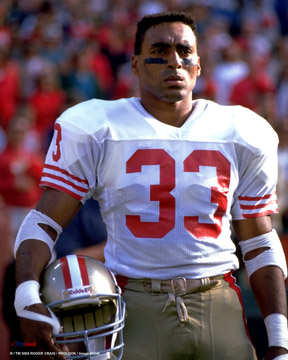
Roger Craig was a hard nosed runner.

Roger Craig was a hard nosed runner.

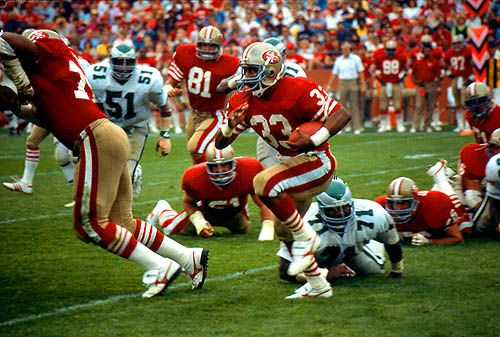
Yet go back to 1988 being his second season with more than 2,000 yards from scrimmage. Keep in mind this was no sleek, make ’em miss halfback. He brought a punishing style to his position where he bludgeoned the opposition. As you’re reading this you can picture his high knee running style like when he trampled through the Rams on his most famous run in 1988.

Yet did you know that Emmitt Smith, Thurman Thomas, and Barry Sanders only had 2 different seasons amassing 2,000 yards from scrimmage also?? Did you also know that Marcus Allen and Adrian Peterson have only had one?? Only Edgerrin James, Marshall Faulk, Ladainian Tomlinson, and Eric Dickerson had more. What do all of these runners have in common?? Peterson and Tomlinson will be in the Hall of Fame and all the others are in. Roger Craig is right there with them.

Now going into the Hall of Fame is based on impact on the game. By the time we bring up the 1989 team that won Super Bowl XXIV, Craig was a driving force behind the team of the decade. Again he was a 1,000 yard rusher as the team won their fourth Super Bowl and Roger had his 3rd ring. When he left the game in 1993, his 566 career receptions was #1 among running backs all time and still remains 7th.

He is in the linear line of great NFL running backs when it comes to catching the football and is a part of the game’s evolution. He took the mantle from Chuck Foreman and propelled it forward. Since then, only a handful of every down running backs have provided that type of versatility. Now everyone has a receiving running back who comes in on 3rd downs where Roger was in every play.

It was Craig’s play that allowed a young Jerry Rice to flourish as teams concentrated their efforts to stop him. If Craig’s move to halfback in 1987 hadn’t panned out, what would have been the legacy of Bill Walsh’s “West Coast Offense”?? It was the run from 1987-1990 that made the offense spread it’s wings throughout the National Football League. During this time is when it proved it could take on the big bad Chicago Bears defense (see 41-0 1987 Monday Night shutout) and 28-3 NFC Championship win in Soldier Field in ’88. Then you add the rivalry with the New York Giants.

From Mike Holmgren to Denny Green to Mike White to Jon Gruden ( who had just begun coaching on the 1990 SF coaching staff) and George Seifert succeeding Bill Walsh. They all could attribute their Head Coaching jobs to some extent to Craig’s performance along with Montana and Rice. Yet the foundation of that offense running and receiving along with goal line and short yardage was #33.

By the way, when did Roger Craig become the the first running back to have a 100 yard receiving game in a Super Bowl?? You guessed it… Super Bowl XXIII against Cincinnati and not his record setting performance against Miami. Now had he won the Super Bowl XIX MVP, or the 1985 NFL MVP, would that have propelled him to winning the NFL MVP in 1988?? Give it some thought.

For induction into the Pro Football Hall of Fame, I present to you…Roger Craig