Legends Of The Fall: Mike Quick

When you talk about the greatest receivers in NFL history, the name undoubtedly at the top of the list is Jerry Rice. Yet when you think of being able to catch passes from back to back Hall of Famers, it made it easier to accomplish what he did. With sporadic quarterbacking what would Rice’s career resemble most?? That of Mike Quick the player who most reminds our CEO of Rice.
Some may scoff but you have to remember in the early 1980’s, the big numbers coming from receivers were all in the AFC. The great quarterback class of ’83, the Air Coryell Charger receivers, Marino and the Marks Bros., and Steve Largent up in Seattle.

From 1983 through 1986, no one was better than Quick who caught 263 passes for 4,647 yards and 42 touchdowns. He was Jerry Rice before Jerry Rice yet was stuck between the aging Ron Jaworski and the emergence of Randall Cunningham which cost him in the end. Think about it… In 1986 Quick had the 4th of his 5 straight Pro Bowl appearances. He totaled 60 receptions for 939 yards and 9 touchdowns. Not great totals until you realize the Eagles set an NFL record allowing 104 sacks.

His 1983 total of 1,409 yards receiving was the most since Hall of Famer Don Maynard in 1967. That was the year Joe Namath became the first quarterback in history to throw for 4,000 yards. Quick played on the 27th (2nd to last) ranked offense in the NFL in contrast. He played for defensive minded head coach Marion Campbell. What would the late Bill Walsh been able to accomplish drawing plays up for Quick??

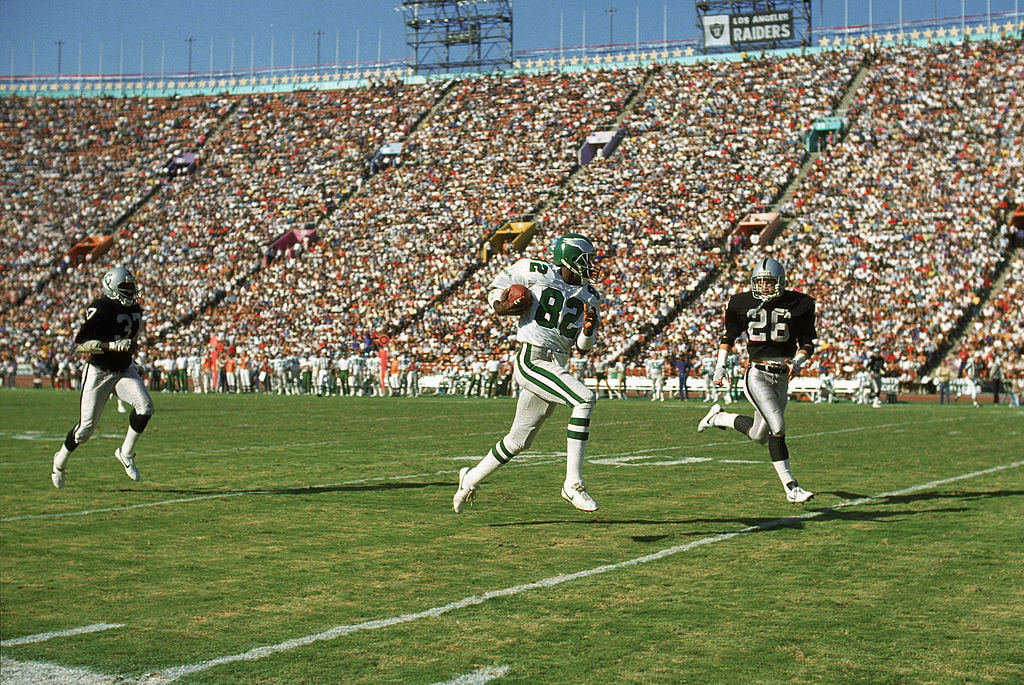
Quick making a big play against the Redskins.

Quick making a big play against the Redskins.

In the end you can understand the dilemma that affects certain careers. The cupboard was bare as he played his first 7 years without a single fellow Pro Bowler on offense. By the time Randall Cunningham made the Pro Bowl in ’88, the Eagles had drafted his heir apparent in Cris Carter.

After injuries robbed Quick of his once lethal speed, he retired after the 1990 season. His 363 catches for 6,464 yards and 61 TDs falls short of Hall of Fame consideration. Yet in his prime, he was an electrifying performer who could score from anywhere.

thanks for reading and please share the article.

Legends Of The Fall: Tony Dorsett

As the National Football League overtook baseball during the 1970’s, the Dallas Cowboys were arguably the most visible team. They appeared in Super Bowls and seemed like they were on Monday Night Football every other week. The star that shined on that Texas Stadium stage the brightest was easily Tony Dorsett.

dorsettFrom 1977-1988, Dorsett ran for 12,739 yards or 527 more than the legendary Jim Brown. At the time, Browns’s mark was the standard every good running back was judged by. However Dorsett was a different type of runner. No back in NFL history broke so many breath-taking big runs. He was quick to the hole and once he broke into the open, he was gone.

The mere mention of his name and everyone pictures his 99 yard record-breaking run against Minnesota. Yet The Chancellor of Football contends the 84 yard bomb he dropped on the Philadelphia Eagles his rookie year was his best. It’s the first touchdown of this clip where Herman Edwards described how difficult it was to catch him. How apropos since he was the Eagle #46 that trailed him on the play.

Amazingly, he never led the NFL in rushing or rushing touchdowns. Of his 8 -1,000 yard seasons, his best was 1,646 in 1981 when he led the Cowboys to their 2nd straight NFC championship appearance. In that season he only rushed for 4 touchdowns. A closer look career-wise,  he scored 72 during his 11 years with the Cowboys. Compare that to 58 by Emmitt Smith in the years 1994-1996. Smith was the battering ram for his team scoring many times from in close. Dorsett was the shot fired from the Cowboys long-range offensive rifle. You didn’t know when he’d explode into the secondary.

Never was this more evident than on Monday Night Football where TD had been the most prolific scorer in its first 20 years.

Ironically TD said in the first video that he was probably taken for granted during his career. Our CEO definitely doesn’t see it that way. He overshadowed the late Walter Payton up until he was about to become the NFL’s all time leading rusher. Playing for such a high-profile team in the Dallas Cowboys gave him great platforms from which to perform. All of those Cowboys playoff games and Super Bowls. Therefore raising his profile.

XII3

Dorsett scoring the opening TD in Super Bowl XII

From winning the Heisman Trophy at Pitt to becoming a member of the Pro Football Hall of Fame, Tony Dorsett was one of the best running backs in NFL history.

tdandthechancellor

Thanks for reading and please share the article.


Legends Of the Fall: James Brooks

From time to time you’ll find NFL teams trying to recreate what they once had and totally undervalue a current player on their roster. Never was this more evident than when the San Diego Chargers overreached for a big back to replace the aging Chuck Muncie. At first they signed late Ricky Bell who couldn’t stay healthy. Then they made one of the worst trades in NFL history, trading the multifaceted James Brooks to Cincinnati for FB Pete Johnson.

James Brooks burst onto the NFL scene in 1981 out of Auburn.

James Brooks burst onto the NFL scene in 1981 out of Auburn.

How lopsided was that trade in 1984?? Pete Johnson only played 3 games with the Chargers before being released. Brooks went on to play 8 seasons for Cincinnati gaining 9,459 combined yards and 64 touchdowns. During that time he ran for 1,000 yards on 3 occasions while compiling 5 seasons with over 1,200 yards from scrimmage. Not only did he make the Pro Bowl 4 times, he broke Johnson’s all time team rushing record and helped the Bengals to Super Bowl XXIII.

Although they brought in another Auburn tailback in Lionel James, this was the end of the Air Coryell reign. Age and injuries derailed their effectiveness where Brooks played on with the Bengals through the 1991 season. Why would you trade a proven commodity that led the league in all purpose yards in his first two years?? One could speculate how Chargers ownership under Gene Klein was dreading impending contract demands. Don’t forget this was only 3 years removed from trading away WR John Jefferson and DE Fred Dean for the same thing.

JamesBrooks2Brooks was one of the toughest and most durable runners at 180 lbs in NFL history. His game was a speed game but he broke tackles when he ran inside traps. He took on linebackers and safeties. His best run ever was a 56 yard TD run against the Patriots in 1986 in which he broke several tackles and drug SS Roland James into the endzone.

James Brooks was a great performer whose numbers will fall just short of Hall of Fame consideration. His trade stands as a cautionary tale to GMs everywhere. He was one of a long line of Auburn running backs that came into the NFL starting with Joe Cribbs, himself, Lionel James, and Bo Jackson during the 1980’s. Yet it was Brooks who out rushed them all.

Thanks for reading and please share the article.

The Soul Of the Game: Leonard Smith

leonard smithOne of the hardest hitting Buffalo Bills of all time was strong safety Leonard Smith. He was acquired in a trade early in the 1988 season as the missing piece to help a young team learn how to win. It wasn’t that Smith was from a winning tradition, but he was an old pro that brought an attitude and intimidating style of play.

Upon his arrival in 1988, Bruce Smith was entering his fourth year. Linebackers Shane Conlan, Cornelius Bennett, were entering their second seasons as was Nate Odomes. All four of these players went on to become Pro Bowl and All Pro performers but not until Smith’s work ethic and attitude had rubbed off on the young Bills.

The day that it was announced that Smith had been traded to the Bills, a young Chancellor of Football told his friends at practice that Buffalo will be in the playoffs. You can’t underscore the importance of a grizzled old pro that has been through the wars who still hunger for a championship. The same as it had with Fred “Hacksaw” Reynolds on the 1981 49ers or Charles Haley with the ’92 Dallas Cowboys.

Here was the thought at the time of his time in St. Louis before the move to Buffalo.

If you want to think of who Smith played most like, think of Rodney Harrsion formerly of the Chargers and Patriots. He was a Strong Safety that blitzed and stuffed the run. His strong suit wasn’t covering speedy receivers but he could put the wood to tight ends and running backs.

In 1986, even though the great Bears were in their heyday, it was St Louis that led the NFL against the pass and was 4th in 1987 which was Smith’s last full season. In 1988 once he moved to Buffalo, their defense ranked 4th against the pass while the Cardinals slipped to 12th. The Bills started 11-1 and won their division by Thanksgiving which was the earliest in league history.

For all the history of “The K-Gun Offense” its largely forgotten the Bills rose to prominence as a defensive group. Smith was the fiery old pro who had never played in a postseason game prior to his trip in ’88. He was an old dawg who led a pack of young pups (Bruce Smith/ Cornelius Bennett/ Nate Odoms/ Shane Conlan / Darryl Talley) to a 4th ranking defensively to the AFC Championship Game.

In ’88 they held 7 teams to 10 points or less and an 8th, the Houston Oilers in a 17-10 AFC Divisional playoff win. As for a glimpse into his time in Buffalo:


Smith played 10 seasons in the NFL with his last being in 1991. A knee injury suffered between the 1991 AFC Championship Game and Super Bowl XXVI abruptly ended his career. Yet the men he influenced went on to play in two more Super Bowls as the team was more offensive minded by then. Everyone forgets that 1988 team was a run oriented with the 4th best defense in football. They didn’t break out into the “K-Gun” until the 1989 NFL playoffs.

...and he had crazy haircuts.

…and he had crazy haircuts.

“Leonard Smith… was a head hunter” – Former Dallas Cowboy great and Cardinals secondary coach Mel Renfro.

Thanks for reading and please share the article.


The Soul Of The Game: Gary Fencik

It’s not written in stone but it has been understood to play defense for the Chicago Bears, you have to be a hitter. Think back to the great Bears Safeties from yesteryear: Doug Plank, the late Todd Bell, the late Dave Duerson, and you have to place Gary Fencik as one of them. Receivers just didn’t cross the middle in Chicago.

Fencik upending Clint Didier in 1985

Fencik upending Clint Didier in 1985

Fencik played with disregard for his body. Over the years programs had him listed between 178-185 lbs. Recently, profootballreference.com had him listed at 194, no way. Anyone who watched him play saw how thin he was and with all the collisions he caused, are surprised at how few games he missed during his career.

In a 12 year career he made the Pro Bowl twice and was voted All Pro once. He may not make the Pro Football Hall of Fame but he has been immortalized as one of the members of the ’85 Bears and the legendary 46 Defense. He was a warrior that manned the last line of defense if you made it past the Bears great front seven. He was a great hitter who lives on in the memory of those historians and fans who tell his story. One whose inclusion in my Soul of the Game series of great defenders took it to their opponents the way it was meant to be played.

Thanks for reading and please share the article.

The Soul of The Game: Greg Lloyd

When you think of the Pittsburgh Steelers defenses of the last twenty years, one of the first players you think of is Greg Lloyd. After the original Steel Curtain defenses of the 1970s, there was a time Pittsburgh’s defense just didn’t scare anyone. Think back to the abysmal defenses from the mid 80s going into the early 90s. Aside from Mike Merriweather few of their defenders played with any distinction.

The most intimidating Steeler of them all.... Greg Lloyd

The most intimidating Steeler of them all…. Greg Lloyd

The one player that brought back the intimidation factor that had been a hallmark of Steeler defenses was Greg Lloyd. From his demeanor down to his disdain for the opposition. He flourished with the coming of Bill Cowher in 1992 and when Kevin Greene was signed a year later, Pittsburgh became Blitzburgh. They were the impetus for a ferocious defense and as for the embodiment of Steeler defensive football:

Unfortunately 1995 was the last year we saw Lloyd at full strength as a knee injury robbed him of his 1996 season and much of his explosiveness. However from 1991-1995 there wasn’t a more active linebacker as he averaged 97.5 tackles, 7.4 sacks, & 5.4 forced fumbles per season. Didn’t we give high consideration for TBT Defensive Player of the year to Navorro Bowman for his 6 forced fumbles??

greg-lloyd1Lloyd had played 8 seasons before that knee injury. He made the Pro Bowl 5 straight years and garnered All Pro distinction in the last three of those five. He played on through 1998 completing an 11 year career with the final played with the Carolina Panthers. It might be time to discuss his Hall of Fame candidacy. If you think about it… you can’t discuss NFL defensive excellence in the 1990’s without Lloyd’s inclusion.

me-lloyd

Thanks for reading and please share the article.