The Chancellor of Football covers NFL football like no one else. The history of the game and how it relates to today's game all under one roof!
Category Archives: Historic Writings
Articles on various games, players, and coaches from the past that had an impact on how the game is played today. Will highlight known and faded legends of the past to shed light on these forgotten contributors to the game.
If you traveled back to the 1980’s in the NFL, Eric Dickerson was described as a running back from the future. Everything from his upright running style to the way he wore so much in the way of protective equipment. He had the speed of a sprinter yet at 6’3 220 lbs he could run over small defensive backs who came up to support the run. Now that we’re 30 years removed from his rookie year of 1983 there is only one player The Chancellor thinks is the 2nd coming of Dickerson. It’s Adrian Peterson.
One of the greatest open field sprinters in NFL history, Dickerson was a threat to break it the distance every time he touched the football. What made him great was his sprinter’s speed in the open field with his size. He’d break into the open field and cornerbacks tried to take angles on him and couldn’t run him down. Only Peterson can be compared to him for how far above the rest of the running backs they competed against.
In 1983, you have to remember the Rams wanted to shake up their offense. You had the great quarterback class of 1983 and the bright star from SMU. The Rams had a 1,000 yard rusher in Wendell Tyler but saw a more explosive runner in Dickerson. It was interesting because we hadn’t seen Dickerson carry the total load since he alternated series with Craig James while in college. With the Rams desperate to catch the 49ers, who had risen to power in the NFC West, they took Dickerson.
The clear understanding was he would pay immediate dividends over the quarterbacks who would take 4 to 5 years to develop. At least that was the NFL’s thinking of QB development at the time. Dickerson took the National Football League by storm rushing for 1,808 yards and 18 TDs as he powered the 9-7 Rams to a wildcard playoff entry. The Rams had missed the playoffs the previous two years and were energized by their rookie rushing champion. He was the first to do so since Earl Campbell and second to do so since Jim Brown in 1957. They were a run oriented team with spartan quarterbacking and Dickerson still got his yards. Going into 1984 most pundits weren’t predicting a sophomore slump but a possible run to the record books. Dickerson delivered in grand style.
Eric Dickerson and Walter Payton in 1984. Payton eclipsed Jim Brown to become the all time leading rusher that year. Not to be outdone Dickerson broke OJ Simpson’s single season record with 2,105 yards.
Although the 2,000 yard season has been achieved several times in the 29 years since Dickerson’s magical 1984, his was the most appreciated because teams saw it coming but couldn’t stop it from happening. Jamal Lewis and Adrian Peterson were both coming off knee reconstructions when they accomplished theirs. He was a sight to behold and led the league in rushing in 3 of his first 4 seasons. Each of which with over 1,800 yards which is amazing. No runner in league history can touch that. The only reason he didn’t do it four straight times was his holdout in a contract dispute before the 1985 season.
Without training camp that year he had a slow start and finished with only 1,234 yards. Marcus Allen led the league in rushing that year with 1,759 yards. Yet he hit his stride as the playoffs loomed. In the divisional round he torched the Dallas Cowboys with a National Football League playoff record 248 yard performance. That 20-0 win sent the Rams to Soldier Field where they lost to the Bears 24-0 in the NFC Championship Game.
However if you’re keeping score, after three years he held league records for most yards rushing as a rookie, most yards in a season, and most ever in a playoff game. Aside from a Super Bowl, the biggest fight he had was with the front office. Yet nothing prepared us for his being traded to the Indianapolis Colts at the beginning of the 1987 season.
For all he had accomplished in Los Angeles it was his 1987 and 1988 seasons that cemented Dickerson as a greatest ever runner. The argument when a player is accomplishing these feats is what fuels it?? Is it the offensive line or the running back?? You just heard that Charles White, in Dickerson’s absence, won the 1987 rushing title with 1,347 yards rushing. Dickerson was second with 1,288. The ’88 year saw him reclaim the rushing title with 1,659 yards and 14 TDs where back in LA, White only gained 328. More importantly he had legitimized the Colts as a franchise in Indianapolis.
Before his arrival in ’86, the Colts were 12-36 in their previous three years in Indianapolis. In fact HBO’s Inside The NFL was there to chronicle if they were going to join the ’76 Bucs as the second winless team after an 0-13 start. They acquire Dickerson and he powers them to the 1987 playoffs with a 9-6 record. His ability to control the ball allowed what was a laughingstock of a defense in ’86 to be the league’s 2nd toughest to score upon at only 15.9 points per game. Ladies and gentlemen that is tilting the field.
The only record he didn’t have at this point of his NFL career was the late Walter Payton’s 275 yards in an individual game. You can blame the Denver Broncos for that. During what was probably the most electrifying game of his career, the Broncos couldn’t keep pace on the scoreboard and eventually he was pulled in a 55-23 blowout. Thanks John Elway. Personally I pulled for Denver to keep scoring so he’d stay on the field for a chance at the record. No such luck….take a look
One of the unique aspects of that game against Denver: Had the Colts beat the Cleveland Browns in the ’87 AFC Divisional Playoff, this would have been the AFC Championship Game the year before. Dickerson would go on to rush for 13,289 yards 90 touchdowns while catching 281 passes for 2,137 yards and another 6 scores. As the game seems to be phasing out the dominant rusher, he starred as the league took to the air.
He was the equivalent of the great quarterback class of 1983 and captured the imagination of NFL fans everywhere. Although I compare him to Adrian Peterson, no other runner ever truly looked like him. If I could splice some film side by side, the person that looked most like him when they ran was Deion Sanders. He ran with an effortless gazelle like stride and when he broke into the open field it was curtains. You weren’t catching him. Well unless you’re Darrell Green.
Dickerson and his former Ram teammate and fellow Hall of Famer, Jackie Slater.
What would he have accomplished had he completed his career in Los Angeles?? Would he have gone past Walter Payton for the all time NFL rushing champion had he stayed?? Would the Colts franchise have moved again without his arrival?? What would he have rushed for had he not spent time off the field fighting for a higher salary?? He was inducted into the Pro Football Hall of Fame in 1999. Ironically when the Colts and Rams were involved in another trade of a Hall of Fame running back in Marshall Faulk.
Eric Dickerson was a one of a kind talent. At his best he was an unstoppable force. Sure his career left us with many questions but at his best none put fear in modern defenses like he did.
Everyone can tell you when an era ends but when was its zenith?? The truly great teams burn bright for some time while winning championships. Others burn almost as bright for a long time but memory fades on those that don’t bring home Super Bowl rings. When it comes to the case of the Houston Oilers between 1987-1993, the zenith came at the end and the fall was so dramatic it killed the franchise.
Yet as we look back at the Houston Oilers of 1993, you have to stretch back a little further and remember what happened during the playoffs of 1991 and 1992.
The Oilers had become one of the most talented teams in football. They were the vanguard of the teams that ran the Run & Shoot offense. Their trigger man, Warren Moon had made it into the upper echelon of NFL quarterbacks. He had orchestrated the league’s #1 offense in 1990 and 1992. in 1991 they dropped to second in the league behind the K Gun of the Buffalo Bills.
Warren Moon was building his Hall of Fame resume with Pro Bowl performances 8 straight years.
Moon was starting at a time when black quarterbacks were just getting their start in the NFL on a league wide basis. Yet despite those pressures he approached Dan Marino’s passing records with 4,689 yards in 1990, and 4,690 yards in 1991. However his team coming up short in the playoffs was starting to become an issue. Similar to what was once a concern of Peyton Manning and continues to dog Tony Romo, Moon had only won 1 playoff game between 1987-1990. In reality, the Oilers were expected to ascend to be the best team in the AFC as they stockpiled talent around him. Make no mistake Moon was playing to erase the stigma that a black quarterback could lead his team to a championship. It hadn’t been done since Doug Williams in 1987.
He had diminutive and quick receivers in Ernest Givins, the late Drew Hill, Curtis Duncan, and a tall wideout in Haywood Jeffires. In 1991, 4 yards kept Moon from having 3 – 1,000 yard receivers as the Oilers opened 7-1 and looked like the AFC’s best rival to knock off the defending champion Bills. However they ran into John Elway and the Denver Broncos in the AFC Divisional Playoff. On a mission they ran out to a 21-6 lead in Mile High Stadium. However Elway rallied his team back to a last second 26-24 win that sent the Oilers home after a total collapse. A team with 7 Pro Bowlers and 3 All Pros was sent home by a hodgepodge rebuilding Denver team that hadn’t made the playoffs in 1990 and wouldn’t in 1992.
Andre Reed scores the go ahead touchdown in the greatest comeback in NFL history.
The team was still in it’s prime as they approached 1992. Age was becoming a factor as the 36 year old Moon missed 6 games during the middle of the year. Houston entered the playoffs with a 10-6 record courtesy of a 27-3 win over Buffalo in a Sunday night finale. It set up a rubber match at Rich Stadium in a wild card game against the two time defending AFC Champion.
Not only were the Bills without future Hall of Fame quarterback Jim Kelly, they would be without Pro Bowlers Cornelius Bennett and Thurman Thomas as well. Moon had a first half for the ages as he went 18 of 22 for over 220 yards and 4 touchdowns in the first half. At an 81% completion rate, broadcasters Charlie Jones and Todd Christensen waxed philosophical about the possibility of breaking the record of 88% Phil Simms had accomplished in Super Bowl XXI. Houston was up 28-7 at the half and then SS Bubba McDowell returned an interception to give the Oilers a 35-3 lead in the 3rd quarter. They had outscored the Bills 62-6 in 6 quarters in less than a week. They were hitting on all 8 cylinders.
Then came the greatest collapse in the history of the NFL. A 32 point lead was washed away as Buffalo just put on a performance for the ages in a 41-38 win. Once the Bills took the momentum from the shell-shocked Oilers the game was almost inevitable. Moon’s crispness in the first half, where he led the Oilers to touchdowns on all four of their drives, went 3 and out on the first four of the second half. Also completely befuddled was defensive coordinator Jim Eddy, who never changed the nickle package or calls for the entire second half of that game. Bills receivers and backup QB Frank Reich knew exactly which plays would work and kept waiting for adjustments that didn’t come.
If the Oilers would have won a Super Bowl between 1987-1993, would Ray Childress be in the Pro Football Hall of Fame??
Psychologically, the jury was in on the Houston Oilers of that era for many pundits. They just couldn’t win the big game despite the talent they had on the field. Pro Bowl defenders Ray Childress, Al Smith were possibly tarnishing Hall of Fame careers at this point. Former Pro Bowl talents such as CB Cris Dishman, DE Willam Fuller, and DE Sean Jones were all on the field in Buffalo and none could make a play to turn that game around. Just as they hadn’t in Denver the year before.
Owner Bud Adams had seen enough and decided the defense was the reason for the collapse and hired Buddy Ryan. That’s right the same Defensive Coordinator of the 1985 Bears and former Head Coach of the Philadelphia Eagles. Adams did this and forced him onto then Head Coach Jack Pardee. Ryan had total autonomy just as he had in Chicago. In fact he was able to hire his own assistants and player requests. In came former Ryan disciple Wilber Marshall, a fiery linebacker that was one of the unsung performers on that ’85 Bears team.
Ryan also forced the team to draft a MLB in Miami Hurricane Michael Barrow and draft a tight end in John Heny Mills. With a defense that had 6 former pro bowlers on it and a soon to be Pro Bowler Lamar Lathon at that point, this was going to be a sight to behold. Ryan resurrected the 46 defense deep in the heart of Texas yet how much of the leadership of that team was stripped of Pardee?? 1993 looked like the last year for the Oilers to make it to the Super Bowl or the team would be broken up. All or nothing.
When Buddy Ryan brought in former All Pro Wilber Marshall, the defense took on a totally different tone.
The preseason began with Ryan firing off comments about Offensive Coordinator Kevin Gilbride and the Run & Shoot offense. The “Chuck & Duck” Ryan scoffed at the high penchant for passing and not running the football and prone to turnovers.
The team however sputtered out of the gate as the defense had some growing pains and the offense started slow.
In fact, a 1-4 start to the 1993 season looked similar to the Houston Texans of this year. A lot of talent, although a little old and they should be able to turn it around. That fourth loss came in a return trip to Buffalo. With Warren Moon’s benching, it looked to all the world this era of Oilers football was about to come to a crashing end.
However the defense not only grew into it’s shoes, it became the scourge of the league. Gone was the passive 4 man rushes of the Jim Eddy defense and in was the confusing blitz packages Ryan had made famous in Chicago. His Philadelphia Eagles didn’t use as many packages as he did in Houston. Over the next eight games they had 35 sacks, 30 takeaways and had knocked 5 quarterbacks from the game. A defense full of star quality talent left opponents without a focal point to game plan against. The league hadn’t seen heavy focus on the 46 defense in over 5 years. They also hadn’t played against this personnel in these new positions. Teams were thoroughly over matched as the last 11 opponents never scored beyond 20 points.
As the defense helped turn the season around Warren Moon came off the bench when his backup Cody Carlson was injured in week 6. His play was more efficient than it was spectacular as defenses had caught up to the Run & Shoot by ’93. However the Oilers were running the ball more and inserted a bigger back to try and wear down defenses. Former special teamer Gary Brown took over due to injuries and rushed for 1,002 yards on 195 carries. He was the first player in league history to rush for 1,000 yards while only starting half the season. Gone was the scat back presence of Lorenzo White and Allen Pinkett and a bruiser was now running the football in the Run & Shoot. Now teams couldn’t go with pass specialists at linebacker with a hammer in the backfield.
However all wasn’t rosey.
The team operated in the awkward vacuum of two camps within a football squad. Buddy Ryan had complete autonomy with his players and coaches. The season long tension was always there as Ryan said what he wanted to at press conferences, even if it wasn’t supportive of the offensive side of the ball or the team as a whole. Head Coach Jack Pardee and Offensive Coordinator Kevin Gilbride acquiesced some of their game planning to accomodate Ryan. Think not?? Brown in half of the ’93 season carried the ball nearly 200 times where in 1991, Allen Pinkett started all 16 games and only ran it 171 times.
What bothered Ryan the most was the offense continuing to pass the football at the end of halves when they should have run the clock out and gone into the locker room. This resulted in two of his starting defensive backs being lost for the season on meaningless plays right before halftime. So when starting FS Marcus Robertson was injured with just seconds left before the half in the last game, Ryan exploded and threw a punch at Gilbride. Now heading into the NFL playoffs he would be missing 3 of his 4 starters in the secondary.
The Oilers of 1993 were a lab experiment about how a team with such disjointed chemistry could actually band together to be the tough minded team no one thought of them as. They survived “Baby-gate” when OT David Williams missed a game early in the season to witness the birth of a child. Media scrutiny was less intense and more forgiving when DT Jeff Alm committed suicide before their week 14 match-up with the Pittsburgh Steelers. Dedicating the game ball to his parents and their fallen teammates memory, they went on the road and whipped the Steelers 26-17 to capture the AFC Central. Ten months after a collapse branded this team as one of the psychologically weak teams in modern history, they had forged an identity tougher than any could remember.
Houston concluded the regular season 12-4, finishing on an 11 game winning streak. Which had only been equaled by the ’72 Dolphins, the ’69 Minnesota Vikings, and the 1934 Chicago Bears in all of NFL history. No question did they look across state and see a possible match-up with the defending champion Cowboys. When they went out and hit Steve Young so often in a 10-7 win out in Candlestick on Christmas Day, league wide fear of this team only grew. This was not going to be the same team that wilted under playoff pressure come playoff time in 1993.
Everyone feared this group except one team, the Kansas City Chiefs. The Oilers had run over the Chiefs 30-0 early in the season and had talked a big game while doing it. As the AFC Divisional slate put these two together again, talk of knocking out Chief quarterback Joe Montana drew the ire of Chief defenders. The late Derrick Thomas and Neil Smith talked about their knocking Moon out if Montana left the game simiarly. What hadn’t been thought of was beating the bully at their own game.
The Chiefs came into the game as a team that didn’t blitz a lot. They stayed with bookend pass rush All Pros Smith and Thomas and played coverage behind them…or so the Oilers thought. The Chiefs threw blitzes at Warren Moon tying an NFL playoff record with 9 sacks and knocking the offense out of continuity from the very start. They held the Oilers to only 277 yards of offense. Their season low?? 246 yards ironically against the Chiefs in their 30-0 loss to the Oilers at the beginning of the season.
It was Joe Montana and moving on half rollouts away from the blitz that kept him upright in this game. A veteran of 20 previous playoff games, with a 15-5 record that featured 4 Super Bowl championships, he may have played his best game at 37 years of age. He completed 22 of 38 passes for 299 yards 3 TDs and 2 interceptions. Once he adjusted to the Oilers and their fleet of second string people in the secondary, he and Marcus Allen kept the ball away from Moon in the second half. The 28-20 win by the Chiefs came at great delight to both Buffalo and Dallas who no longer had to think of facing this monster team from Houston. They would go on to play each other in a second straight Super Bowl once Buffalo DID knock Montana from the AFC Championship Game.
As for the Oilers, they were broken up after 1993. Gone was Warren Moon who went on to sign with the Minnesota Vikings. Buddy Ryan received another Head Coaching position in Arizona taking Wilber Marshall with him. The defense was turned over to Ryan disciple Jeff Fisher, who would succeed Jack Pardee once he was fired in week 10 of 1994. Present Titans coach Mike Munchak played his last game for the Oilers in that 93 playoff loss and began his coaching career that same year. Former Offensive Coordinator Kevin Gilbride was let go once Pardee was dismissed. They had been the men responsible for bringing the Run & Shoot to Houston and it left with them.
Ironically the offense that didn’t win it all as a complete scheme lived on in offenses around the league. It was Gilbride teaching some of the Run & Shoot principles to New York Giant receivers as they have won Super Bowls XLII and XLVI. Even the team of the 2000’s, the New England Patriots run variations of offensive principles that were a staple of Gilbride’s down in Houston. Especially the screen plays that Gilbride designed. Below is a copy of one of the pages from the Patriots Super Bowl playbook of 2003 and you can clearly read “Run and Shoot screen”.
The largest fall had been with the fan base that was there from the Luv ya Blue days through this era of Oiler football. The heart of the fan base drained drastically as the team fell to 2-14 in 1994. Within two years, Bud Adams moved the team to Tennessee and renamed the franchise the Titans. It was a sad and sudden end to the Oiler franchise but it came off the heels of promise that was the best team in Oiler history that didn’t make it to the Super Bowl.
Thanks for reading and please share the article.
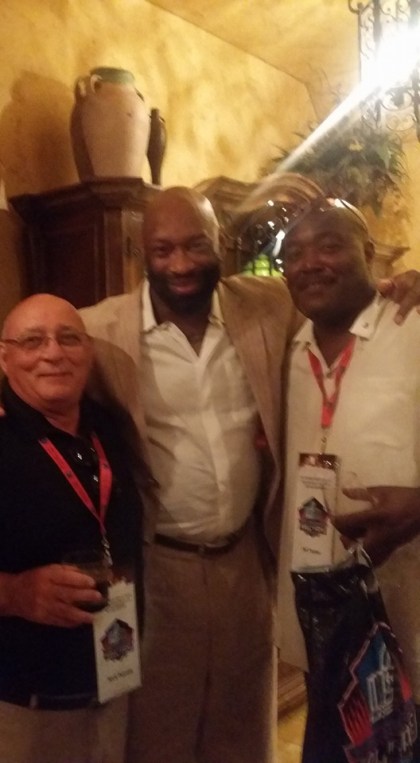
Met Lamar Lathon with Coach Petrillo at 2016 HoF party for KG
Is it me or is it sacrilege to see the Chicago Bears dead last against the run with a #50 on the field?? Take that number off Anderson trying to play linebacker in Chicago!! Number 50 belongs to the heart and soul of the toughest defense in NFL history. When #50 comes to mind you think of some of the best play at Middle Linebacker in history also. That number should be retired and hanging on the wall of fame at Soldier Field.
When we go back to the early 1980’s, the majority of teams were moving to the 3-4 defense and away from the 4-3 that had been a staple for decades. A leader was being developed that revolutionized the play of Middle Linebacker. Before him, Jack Lambert was the first to play deep enough in his middle zone to cover receivers. However Singletary was actually assigned to guard receivers in Buddy Ryan’s 46 defense. When you watch the first series in Super Bowl XX, it was Singletary who wheeled around and knocked down the pass for Patriot wideout Stanley Morgan that kept them from scoring first. He was aiding CB Leslie Frazier on the play.
Yet make no bones about it, this was no third down pass defense specialist. He was the first MLB of the modern era who attacked backs yet had the athleticism to cover receivers crossing his area. Unlike Lambert, Samuari Mike left huge hits in all parts of the field. Collisions that made him a feared defender. Singletary was a great form tackler. Hits that led to his induction into the Pro Football Hall of Fame.
The 1980’s brought 3rd down situation substitution to the NFL like the nickle defense. One where big thick MLBs were replaced by either a 3rd cornerback or a lanky skinnier linebacker who had pass first responsibility. Chicago Defensive Coordinator Buddy Ryan developed the 46 defense first as a nickle, then modified it to fit regular personnel that became the scourge of the league. Ironically he starred in a defense that was originally designed to replace his position.
In 1985 he was the signal caller to the most complex defense in NFL history. The 46 defense had nearly 70 blitzes and 20-30 fronts. While he was directing traffic on the #1 defense, he went on to become NFL Defensive Player of the Year as the 15-1 Bears won Super Bowl XX. This was Singletary at his zenith. Those of us old enough can remember the 4th and 1 attempt by the Rams with Eric Dickerson in the ’85 NFC Championshp. Not only did he stop him, he popped out several screws that held his facemask to his helmet the hit was so hard.
Out of a time capsule, here is what was thought of Mike Singletary’s 1985 season back then.
One of the fiercest hitters in NFL history who starred on one of the storied defenses in NFL history should have his number retired. The Chancellor of Football did get to meet Singletary during his rookie year in coaching in 2003. Was with the Rojas clan and we were guests of Brian Billick’s with sideline passes to enjoy the game as guests of the Ravens. I got the chance to talk some football with him for a few minutes and was glad to see him coaching. Right now he’s on Leslie Frazier’s coaching staff in Minnesota. Yup, that same Leslie Frazier he saved from giving up the first touchdown in Super Bowl XX. Yet today, we’re talking about an earlier incarnation of Mike, one of the best hitters in NFL history.
Hall of Fame linebacker Mike Singletary and The Chancellor of Football on the Ravens sideline in 2003.
Did you know there really is an answer to spread offenses?? As I have watched football over these last two years, I’ve been stricken by the lack of creativity by defensive coordinators to slow teams down. Everyone lines up in the same thing…a 4-2-5 nickel with outside linebackers as down linemen when the answer is situational football with the “Eagle Defense” created by Fritz Shurmer during the Los Angeles Rams 1989 playoff run. Keep lining up where offenses know how to attack you and you’ll get killed. Ask Monte Kiffin in Dallas right now., his Tampa 2 is getting killed. At what point do you throw the conventional book of defense out, look at your personnel and design plays based upon the strength of personnel available??
The NFL has had several geniuses when it comes to coaches. Yet when it comes to coordinators many have not received their due nor have any made the Pro Football Hall of Fame based on their contributions.
One coach that did receive Hall of Fame consideration was Dick LeBeau (enshrined in 2011 as a player), who as a long time defensive coordinator has been credited (with Dom Capers) for creating the zone blitz in the modern NFL. Yes Pittsburgh became Blitzburgh but the true zone blitz, as a scheme, came from the mind of Fritz Shurmur. Another assistant deserving enshrinement in Canton.
In 1989, Shurmur was the defensive coordinator of the Los Angeles Rams. When the team suffered multiple injuries along the front line, yet had all their linebackers healthy, necessity became the mother of invention. His team employed a 3-4 defense that featured Kevin Greene, who had back…
Ever wonder where the moment came that football games wouldn’t finish before shows started?? Remember how the late Pat Summerall would always explain how Sixty Minutes was next for everyone except on the West Coast after football?? Wll there was an inident called The Heidi Game that had a lot to do with it. Have a read….
One of the greatest games of football lore was the famous “Heidi Game” of 1968. It was back in the American Football League when the Oakland Raiders and New York Jets were forming quite a rivalry. The interest nationally between these teams actually took root the season before.
Quarterback Joe Namath had been a transcendent figure for the AFL since he was drafted back in 1965. However Jets brass believed they had finally built a team around him that could compete for the league championship. With their glamour quarterback in the media center of New York, there was some animosity brewing with rival teams. One was the Oakland Raiders whose defense, The 11 Angry Men, played a physical style of football that went beyond the whistle.
In what could have been the 1967 AFL Championship match-up, the 11-1 Western Division leading Raiders hosted the East leading 7-3-1 Jets. Oakland…
One of the greatest games of football lore was the famous “Heidi Game” of 1968. It was back in the American Football League when the Oakland Raiders and New York Jets were forming quite a rivalry. The interest nationally between these teams actually took root the season before.
Quarterback Joe Namath had been a transcendent figure for the AFL since he was drafted back in 1965. However Jets brass believed they had finally built a team around him that could compete for the league championship. With their glamour quarterback in the media center of New York, there was some animosity brewing with rival teams. One was the Oakland Raiders whose defense, The 11 Angry Men, played a physical style of football that went beyond the whistle.
In what could have been the 1967 AFL Championship match-up, the 11-1 Western Division leading Raiders hosted the East leading 7-3-1 Jets. Oakland won an entertaining game 39-28, which was New York’s third loss in a row. This game was made famous when Ike Lassiter #77 smashed Namath in the face fracturing his cheekbone. Joe finished the game with 370 yards yet threw 3 costly interceptions. The backsliding Jets watched as they were leapfrogged by the Houston Oilers who stole the division and faced Oakland in the title game.
A 40-7 trouncing of the Oilers sent the Raiders (13-1) to take on Vince Lombardi’s Packers in Super Bowl II. However when a league is battling for respectability, it makes for great television when the league can showcase it’s stars in the championship and to a man the Jets believed they could take the Raiders. They would have to wait until the following season to measure themselves against the defending AFL champions. In a week 10 battle, each team came in 7-2 and again leading their divisions with battle lines drawn from the season prior. A national televised audience tuned in to NBC for the game of the year.
The Jets went away from this game knowing they could beat the Raiders and only a miracle finish kept them from winning. That knowledge kept the New Yorkers motivated and they would get revenge in the 1968 AFL Championship where they would win 27-23. From there they would proceed into history with their famous Super Bowl III upset of the Baltimore Colts. The AFL and Heidi gained extensive notoriety from the NBC gaffe and when the television contracts were reworked with the NFL merger, games would be shown in their entirety from then on.

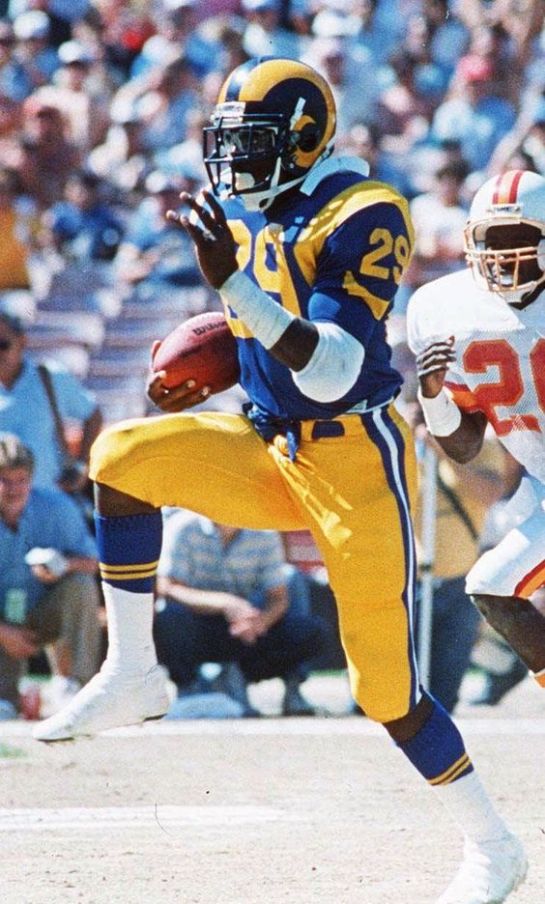 One of the greatest open field sprinters in NFL history, Dickerson was a threat to break it the distance every time he touched the football. What made him great was his sprinter’s speed in the open field with his size. He’d break into the open field and cornerbacks tried to take angles on him and couldn’t run him down. Only Peterson can be compared to him for how far above the rest of the running backs they competed against.


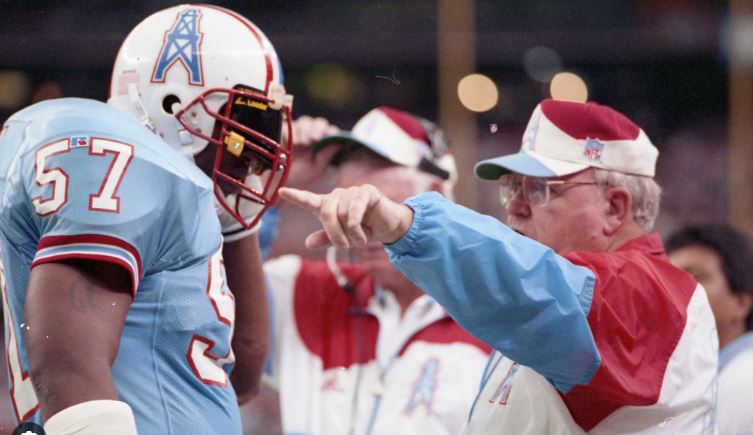 Yet as we look back at the Houston Oilers of 1993, you have to stretch back a little further and remember what happened during the playoffs of 1991 and 1992.


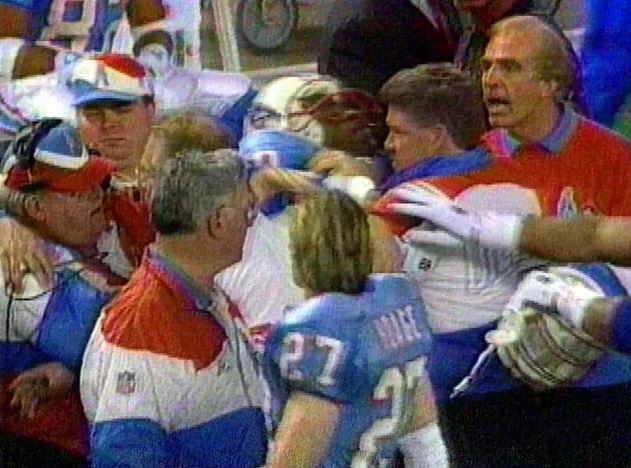
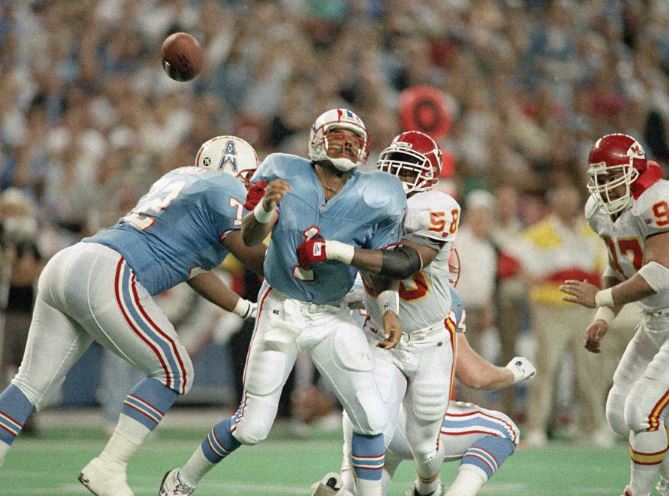 Everyone feared this group except one team, the Kansas City Chiefs. The Oilers had run over the Chiefs 30-0 early in the season and had talked a big game while doing it. As the AFC Divisional slate put these two together again, talk of knocking out Chief quarterback Joe Montana drew the ire of Chief defenders. The late Derrick Thomas and Neil Smith talked about their knocking Moon out if Montana left the game simiarly. What hadn’t been thought of was beating the bully at their own game.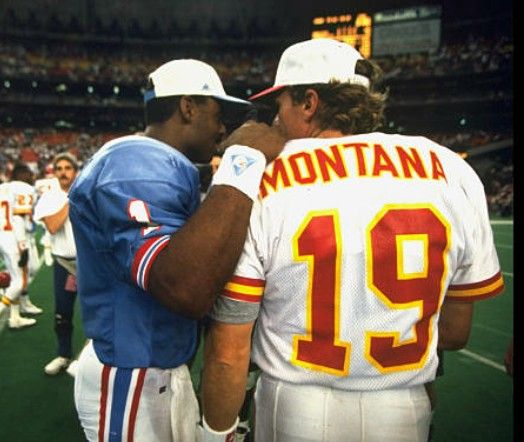

 When we go back to the early 1980’s, the majority of teams were moving to the 3-4 defense and away from the 4-3 that had been a staple for decades. A leader was being developed that revolutionized the play of Middle Linebacker. Before him, Jack Lambert was the first to play deep enough in his middle zone to cover receivers. However Singletary was actually assigned to guard receivers in Buddy Ryan’s 46 defense. When you watch the first series in Super Bowl XX, it was Singletary who wheeled around and knocked down the pass for Patriot wideout Stanley Morgan that kept them from scoring first. He was aiding CB Leslie Frazier on the play.


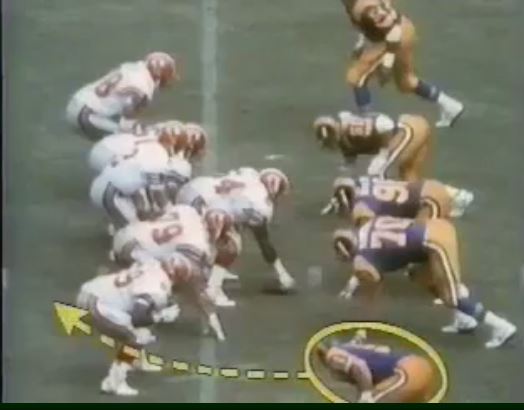 One coach that did receive Hall of Fame consideration was Dick LeBeau (enshrined in 2011 as a player), who as a long time defensive coordinator has been credited (with Dom Capers) for creating the zone blitz in the modern NFL. Yes Pittsburgh became Blitzburgh but the true zone blitz, as a scheme, came from the mind of Fritz Shurmur. Another assistant deserving enshrinement in Canton.
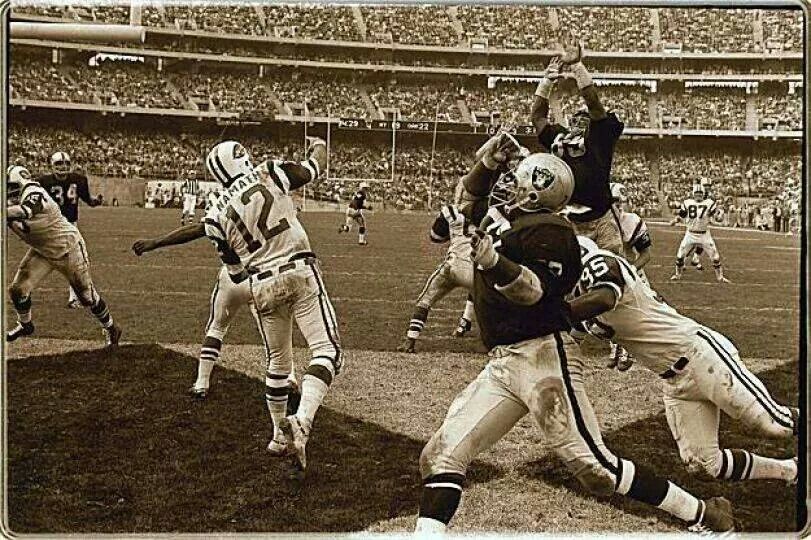 Quarterback Joe Namath had been a transcendent figure for the AFL since he was drafted back in 1965. However Jets brass believed they had finally built a team around him that could compete for the league championship. With their glamour quarterback in the media center of New York, there was some animosity brewing with rival teams. One was the Oakland Raiders whose defense, The 11 Angry Men, played a physical style of football that went beyond the whistle.
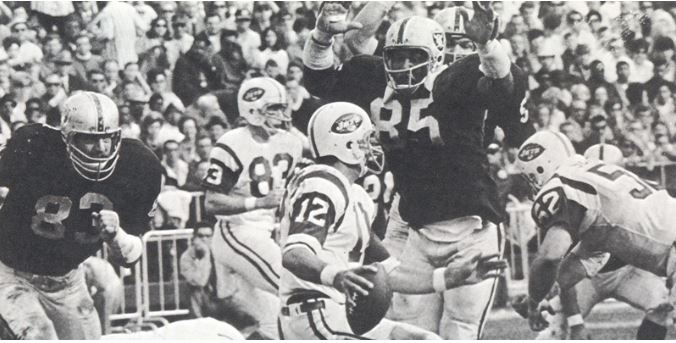 In what could have been the 1967 AFL Championship match-up, the 11-1 Western Division leading Raiders hosted the East leading 7-3-1 Jets. Oakland…


You must be logged in to post a comment.