Roger Craig Belongs in the Pro Football Hall of Fame


Those high knees

Reissue of original Article: 13, November 2013

When you think back to Bill Walsh’s great 49er teams, who are the first players you think of?? Right there with the Joe Montanas, the Jerry Rices, and Ronnie Lotts it only takes a fraction of a second to think of Roger Craig. His high knee running style brought a physicality to the San Francisco offense that was seen as a finesse group up until his arrival. In fact he came to San Francisco as a fullback when they drafted him from Nebraska before the 1983 season.

In college he had been primarily a blocking back in the Cornhuskers wishbone offense. Normally he paved the way for Jarvis Redwine and then Mike Rozier. Yet when Bill Walsh decided to revamp San Francisco’s dismal backfield after a 3-6 season in 1982, he drafted Craig in the second round.

Although the 49ers had won it all in 1981, it had become apparent Bill Ring, Amos Lawrence, Walt Easley, and Earl Cooper just wasn’t cutting it in the backfield. To raise the stakes in the NFC for 1983, Craig and newly acquired Wendell Tyler would form a more potent backfield.

After posting the worst yards per carry average (3.4) and yardage (742) in 1982, the new backfield duo of Craig and Tyler turned that around completely. The much improved ground game of 1983 ranked 8th with 2,257 yards rushing and a gaudy 4.4 yard average. Ironically just ahead of the Los Angeles Rams, who had traded Tyler to San Francisco so they could draft Eric Dickerson.

You had to give the nod to Craig who ran for 783 yards a team leading 8 TDs, while catching 42 passes for 427 yards and another 4 scores. This more dynamic backfield, along with Joe Montana, powered San Francisco to the NFC Championship Game. A 24-21 loss to the Washington Redskins was shrouded in controversy, thanks to some questionable calls, yet Walsh had the backfield he envisioned. Craig had reinvented himself from a collegiate player who rarely touched the football to a dual threat pro.
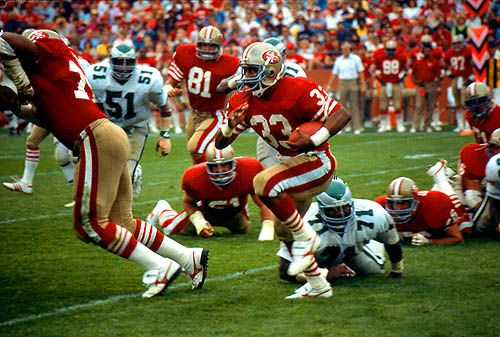
The 1984 49ers were a juggernaut becoming the first team to go 15-1 during the regular season. Everyone of the 49 man roster played their role so no one had outstanding stats. However once the 49ers moved past the New York Giants and Chicago Bears during the playoffs, the stage was set for a coming out party in Super Bowl XIX. With all eyes on Joe Montana’s possible second Super Bowl trophy and the electrifying record setting Dan Marino, Craig’s name didn’t even make the marquee.


Roger Craig graces the cover of Sports Illustrated after his record breaking performance in Super Bowl XIX.

Roger Craig graces the cover of Sports Illustrated after his record breaking performance in Super Bowl XIX.

It was his 1985 that set Craig apart as he amassed his 1,000/ 1,000 yard seasons both rushing and receiving. The first player in league history to do so. Some 27 years later, only Hall of Famer Marshall Faulk shares that accomplishment when he did it in 1999. How dominating was his performance?? Well his 1,050 yards rushing doesn’t jump out at you until you realize he only ran 214 times for a whopping 4.9 yards per carry. The league average is always around 4.0.

Oh by the way, he led the NFL in receiving that year with 92, which set a record for running backs, that amassed 1,016 more yards. His 15 total touchdowns was second to Joe Morris and was 1 better than NFL MVP Marcus Allen. In fact many pundits, including our CEO believes Craig should have been the MVP in 1985 with that dominating performance.

Now buoy his 1985 record setting season not culminating with the league MVP, on the backdrop of a Super Bowl record 3 TDs yet not winning that MVP and you’ll see where we’re going in a minute. Don’t forget he did this on a 10-6 San Francisco team that was a defending champion with Jerry Rice being a rookie that didn’t have 1,000 yards receiving and only 3 touchdowns. Craig quite simply fueled that offense.

Once the 49ers won Super Bowl XIX, they were forced to retool and become a bigger physical team. In 1985, the Chicago Bears emerged with one of the most imposing defenses in NFL history. The Giants followed suit with an overwhelming defense that featured 4 linebackers in the 250 lbs category. When Bill Walsh and his 49ers were dominated 49-3 in the 1986 NFC Divisional Playoffs by the Giants something had to be done.

These were teams the 49ers had beaten on their way to the ’84 championship, now they had taken the game to a new level of brute force. In reinventing the offense from a size perspective, it was Craig who was switched from fullback to halfback to allow for the insertion of Tom Rathman at fullback. The entire offensive line was overhauled.

You have to keep in mind the average career for a runner in pro football is less than 4 years. Yet here Craig was making the switch in year 5 to a position that called for him to be quicker. This at a time where he should have been slowing down from a physical standpoint. Yet he, Jerry Rice and Joe Montana spearheaded one of history’s most accomplished runs. From 1987-1990 the 49ers went 51-12 in the regular season, winning back to back Super Bowls in ’88 & ’89 and were the prohibitive favorites to win it all in 1987 as well as 1990. They finished #1 in offense in ’87 and ’89 and #2 in ’88 and ’90. In each year they made it to at least the divisional round of the playoffs and 3 straight NFC Championship Games as they were trying to threepeat.

Playing in only 12 games due to the ’87 strike, Craig ran for 815 yards which projects out to 1,086 over a full season. The 13-2 Niners were poised to become the greatest team of the modern era yet were upset by the Vikings in the playoffs. They were #1 in both offense and defense yet proved fallible in the playoff loss. Craig went on to his greatest performance in the 1988 campaign. In rushing for a career high and club record 1,502 yards, he also caught 76 passes for an additional 534  yards for his second season with over 2,000 yards from scrimmage. More important, he powered San Francisco to another Super Bowl championship with a win over Cincinnati in the XXIII’d edition.

Roger Craig was a hard nosed runner.

Roger Craig was a hard nosed runner.

Yet go back to 1988 being his second season with more than 2,000 yards from scrimmage. Keep in mind this was no sleek, make ’em miss halfback. He brought a punishing style to his position where he bludgeoned the opposition. As you’re reading this you can picture his high knee running style like when he trampled through the Rams on his most famous run in 1988.

Yet did you know that Emmitt Smith, Thurman Thomas, and Barry Sanders only had 2 different seasons amassing 2,000 yards from scrimmage also?? Did you also know that Marcus Allen and Adrian Peterson have only had one?? Only Edgerrin James, Marshall Faulk, Ladainian Tomlinson, and Eric Dickerson had more. What do all of these runners have in common?? Peterson and Tomlinson will be in the Hall of Fame and all the others are in. Roger Craig is right there with them.

Now going into the Hall of Fame is based on impact on the game. By the time we bring up the 1989 team that won Super Bowl XXIV, Craig was a driving force behind the team of the decade. Again he was a 1,000 yard rusher as the team won their fourth Super Bowl and Roger had his 3rd ring. When he left the game in 1993, his 566 career receptions was #1 among running backs all time and still remains 7th.

He is in the linear line of great NFL running backs when it comes to catching the football and is a part of the game’s evolution. He took the mantle from Chuck Foreman and propelled it forward. Since then, only a handful of every down running backs have provided that type of versatility. Now everyone has a receiving running back who comes in on 3rd downs where Roger was in every play.

It was Craig’s play that allowed a young Jerry Rice to flourish as teams concentrated their efforts to stop him. If Craig’s move to halfback in 1987 hadn’t panned out, what would have been the legacy of Bill Walsh’s “West Coast Offense”?? It was the run from 1987-1990 that made the offense spread it’s wings throughout the National Football League. During this time is when it proved it could take on the big bad Chicago Bears defense (see 41-0 1987 Monday Night shutout) and 28-3 NFC Championship win in Soldier Field in ’88. Then you add the rivalry with the New York Giants.

From Mike Holmgren to Denny Green to Mike White to Jon Gruden ( who had just begun coaching on the 1990 SF coaching staff) and George Seifert succeeding Bill Walsh. They all could attribute their Head Coaching jobs to some extent to Craig’s performance along with Montana and Rice. Yet the foundation of that offense running and receiving along with goal line and short yardage was #33.

By the way, when did Roger Craig become the the first running back to have a 100 yard receiving game in a Super Bowl?? You guessed it… Super Bowl XXIII against Cincinnati and not his record setting performance against Miami. Now had he won the Super Bowl XIX MVP, or the 1985 NFL MVP, would that have propelled him to winning the NFL MVP in 1988?? Give it some thought.

For induction into the Pro Football Hall of Fame, I present to you…Roger Craig

Roger Craig Should Be In Pro Football Hall of Fame

When you think back to Bill Walsh’s great 49er teams, who are the first players you think of?? Right there with the Joe Montanas, the Jerry Rices, and Ronnie Lotts it only takes a fraction of a second to think of Roger Craig. His high knee running style brought a physicality to the San Francisco offense that was seen as a finesse group up until his arrival. In fact he came to San Francisco as a fullback when they drafted him from Nebraska before the 1983 season.

In college he had been primarily a blocking back in the Cornhuskers wishbone offense. Normally he paved the way for Jarvis Redwine and then Mike Rozier. Yet when Bill Walsh decided to revamp San Francisco’s dismal backfield after a 3-6 season in 1982, he drafted Craig in the second round.

Although the 49ers had won it all in 1981, it had become apparent Bill Ring, Amos Lawrence, Walt Easley, and Earl Cooper just wasn’t cutting it in the backfield. To raise the stakes in the NFC for 1983, Craig and newly acquired Wendell Tyler would form a more potent backfield.

After posting the worst yards per carry average (3.4) and yardage (742) in 1982, the new backfield duo of Craig and Tyler turned that around completely. The much improved ground game of 1983 ranked 8th with 2,257 yards rushing and a gaudy 4.4 yard average. Ironically just ahead of the Los Angeles Rams, who had traded Tyler to San Francisco so they could draft Eric Dickerson.

You had to give the nod to Craig who ran for 783 yards a team leading 8 TDs, while catching 42 passes for 427 yards and another 4 scores. This more dynamic backfield, along with Joe Montana, powered San Francisco to the NFC Championship Game. A 24-21 loss to the Washington Redskins was shrouded in controversy, thanks to some questionable calls, yet Walsh had the backfield he envisioned. Craig had reinvented himself from a collegiate player who rarely touched the football to a dual threat pro.

The 1984 49ers were a juggernaut becoming the first team to go 15-1 during the regular season. Everyone of the 49 man roster played their role so no one had outstanding stats. However once the 49ers moved past the New York Giants and Chicago Bears during the playoffs, the stage was set for a coming out party in Super Bowl XIX. With all eyes on Joe Montana’s possible second Super Bowl trophy and the electrifying record setting Dan Marino, Craig’s name didn’t even make the marquee.


Roger Craig graces the cover of Sports Illustrated after his record breaking performance in Super Bowl XIX.

Roger Craig graces the cover of Sports Illustrated after his record breaking performance in Super Bowl XIX.

It was his 1985 that set Craig apart as he amassed his 1,000/ 1,000 yard seasons both rushing and receiving. The first player in league history to do so. Some 27 years later, only Hall of Famer Marshall Faulk shares that accomplishment when he did it in 1999. How dominating was his performance?? Well his 1,050 yards rushing doesn’t jump out at you until you realize he only ran 214 times for a whopping 4.9 yards per carry. The league average is always around 4.0.

Oh by the way, he led the NFL in receiving that year with 92, which set a record for running backs, that amassed 1,016 more yards. His 15 total touchdowns was second to Joe Morris and was 1 better than NFL MVP Marcus Allen. In fact many pundits, including our CEO believes Craig should have been the MVP in 1985 with that dominating performance.

Now buoy his 1985 record setting season not culminating with the league MVP, on the backdrop of a Super Bowl record 3 TDs yet not winning that MVP and you’ll see where we’re going in a minute. Don’t forget he did this on a 10-6 San Francisco team that was a defending champion with Jerry Rice being a rookie that didn’t have 1,000 yards receiving and only 3 touchdowns. Craig quite simply fueled that offense.

Once the 49ers won Super Bowl XIX, they were forced to retool and become a bigger physical team. In 1985, the Chicago Bears emerged with one of the most imposing defenses in NFL history. The Giants followed suit with an overwhelming defense that featured 4 linebackers in the 250 lbs category. When Bill Walsh and his 49ers were dominated 49-3 in the 1986 NFC Divisional Playoffs by the Giants something had to be done.

These were teams the 49ers had beaten on their way to the ’84 championship, now they had taken the game to a new level of brute force. In reinventing the offense from a size perspective, it was Craig who was switched from fullback to halfback to allow for the insertion of Tom Rathman at fullback. The entire offensive line was overhauled.

You have to keep in mind the average career for a runner in pro football is less than 4 years. Yet here Craig was making the switch in year 5 to a position that called for him to be quicker. This at a time where he should have been slowing down from a physical standpoint. Yet he, Jerry Rice and Joe Montana spearheaded one of history’s most accomplished runs. From 1987-1990 the 49ers went 51-12 in the regular season, winning back to back Super Bowls in ’88 & ’89 and were the prohibitive favorites to win it all in 1987 as well as 1990. They finished #1 in offense in ’87 and ’89 and #2 in ’88 and ’90. In each year they made it to at least the divisional round of the playoffs and 3 straight NFC Championship Games as they were trying to threepeat.

Playing in only 12 games due to the ’87 strike, Craig ran for 815 yards which projects out to 1,086 over a full season. The 13-2 Niners were poised to become the greatest team of the modern era yet were upset by the Vikings in the playoffs. They were #1 in both offense and defense yet proved fallible in the playoff loss. Craig went on to his greatest performance in the 1988 campaign. In rushing for a career high and club record 1,502 yards, he also caught 76 passes for an additional 534  yards for his second season with over 2,000 yards from scrimmage. More important, he powered San Francisco to another Super Bowl championship with a win over Cincinnati in the XXIII’d edition.

Roger Craig was a hard nosed runner.

Roger Craig was a hard nosed runner.

Yet go back to 1988 being his second season with more than 2,000 yards from scrimmage. Keep in mind this was no sleek, make ’em miss halfback. He brought a punishing style to his position where he bludgeoned the opposition. As you’re reading this you can picture his high knee running style like when he trampled through the Rams on his most famous run in 1988.

Yet did you know that Emmitt Smith, Thurman Thomas, and Barry Sanders only had 2 different seasons amassing 2,000 yards from scrimmage also?? Did you also know that Marcus Allen and Adrian Peterson have only had one?? Only Edgerrin James, Marshall Faulk, Ladainian Tomlinson, and Eric Dickerson had more. What do all of these runners have in common?? Peterson and Tomlinson will be in the Hall of Fame and all the others are in. Roger Craig is right there with them.

Now going into the Hall of Fame is based on impact on the game. By the time we bring up the 1989 team that won Super Bowl XXIV, Craig was a driving force behind the team of the decade. Again he was a 1,000 yard rusher as the team won their fourth Super Bowl and Roger had his 3rd ring. When he left the game in 1993, his 566 career receptions was #1 among running backs all time and still remains 7th.

He is in the linear line of great NFL running backs when it comes to catching the football and is a part of the game’s evolution. He took the mantle from Chuck Foreman and propelled it forward. Since then, only a handful of every down running backs have provided that type of versatility. Now everyone has a receiving running back who comes in on 3rd downs where Roger was in every play.

It was Craig’s play that allowed a young Jerry Rice to flourish as teams concentrated their efforts to stop him. If Craig’s move to halfback in 1987 hadn’t panned out, what would have been the legacy of Bill Walsh’s “West Coast Offense”?? It was the run from 1987-1990 that made the offense spread it’s wings throughout the National Football League. During this time is when it proved it could take on the big bad Chicago Bears defense (see 41-0 1987 Monday Night shutout) and 28-3 NFC Championship win in Soldier Field in ’88. Then you add the rivalry with the New York Giants.

From Mike Holmgren to Denny Green to Mike White to Jon Gruden ( who had just begun coaching on the 1990 SF coaching staff) and George Seifert succeeding Bill Walsh. They all could attribute their Head Coaching jobs to some extent to Craig’s performance along with Montana and Rice. Yet the foundation of that offense running and receiving along with goal line and short yardage was #33.

By the way, when did Roger Craig become the the first running back to have a 100 yard receiving game in a Super Bowl?? You guessed it… Super Bowl XXIII against Cincinnati and not his record setting performance against Miami. Now had he won the Super Bowl XIX MVP, or the 1985 NFL MVP, would that have propelled him to winning the NFL MVP in 1988?? Give it some thought.

For induction into the Pro Football Hall of Fame, I present to you…Roger Craig

2011 Baltimore Ravens Preview

Well, well, well…. How much did a forced fumble alter the course of the Baltimore Ravens franchise??  It was late in the fourth quarter and the host Ravens were up 9-3 in a tough, tough football game.   It was week 13 with the AFC North on the line during a Sunday night tilt with their hated rival, the Pittsburgh Steelers.  A win would lock up the division and probably the number 2 seed in the AFC playoffs, setting themselves up for a legitimate Super Bowl run.  With less than 7 minutes left in the game; Flacco drops back and doesn’t read the blitz,  Troy Palamalu comes unblocked and….

Quarterback: There are reservations about Joe Flacco.  There were some points of improvement but there are times he just doesn’t pass the eyeball test in the big games.  I’ll have to go back to that fumble by Joe Flacco no matter how hard it pains Ravens fans.  That was one where he needs to read the defense and get rid of the football within 3 steps.  In his 3rd season, all as a starter, he should been able to detect a blitz as the Steelers were getting into desperate times.  That fumble could have been the difference between this team playing in Super Bowl XLV and watching it.

Going into his 4th season, Flacco has improved steadily each year and in  2010 was the 7th rated passer in the NFL.  He completed 62.6% of his passes for 3,622 yards, 25TDs and only 10 interceptions.  He did have a game winning throw to T.J. Houshmanzadeh against Pittsburgh in week 4 but let face a few facts:  Against playoff teams in 2010, Flacco had a 2-4 record against playoff bound teams.  In 3 of those games the offense could only muster 10, 14, and 10 points while averaging 17.5 points against playoff teams.  With the signing of Anquan Boldin and Dontae Stallworth a little more firepower from Flacco was expected during these games.  He showed up in games against Buffalo with a 3 TD performance in an overtime win yet could only throw for 1 TD against the Steelers in both games.  He disappears too often against  strong competition and needs to show he can win games and not just rely on the defense. Has to become a leader.

His game lacks confidence and has to go downfield and use his receivers more.  Too many check down throws to Ray Rice.    Quarterback in Baltimore is average at best.

Running Back: The Ravens parted ways with Willis McGahee who has slowed down in recent years.  Ray Rice could use some help with the overall workload yet had an outstanding year.  The fireplug ran for 1,220 yards on 307 carries and was also second on the team with 62 receptions and another 556  yards.  With nearly 370 touches could only reach the endzone 6 times (5 rushing / 1 receiving) and could burn out like Wilbert Montgomery from overuse.  Although he is a willing warrior it would be in his best interest if the Ravens drafted some help here for him.  There could be additional carries for LeRon McClain #33 who is a straight forward running fullback.  He may have to step in and replace the 6 touchdowns McGahee ran in from short yardage.

Right now Ray Rice is a chain moving first down machine who averaged 4.0 yards per carry. If Flacco doesn’t develop further, teams can gang up on him and the mounting hits could slow him down.  Its imperative that they get him some help and possibly more of a break away threat.  Ravens are solid at running back

Receivers: Last year they brought in Anquan Boldin and Dontae Stallworth to bolster this position which produced minimal returns.  Although Boldin led the team with 64 receptions, his 837 yards and 7 touchdowns, were less than Raven fans had hoped for.   A physical and tough receiver who will catch the tough passes over the middle had too few passes thrown his way.  Stallworth was a disappointment in only catching 2 passes in an injury plagued year.  Yet Derrick Mason was there to pick up the slack with 61 receptions for 802 yards and 7 touchdowns to match Boldin.

The Ravens need a boost in the arm here and needs a deep threat at receiver to stretch the field.  The departed Houshmanzadeh, Stallworth and incumbent Boldin and TE Todd Heap are all intermediate threats.  This allowed teams to gang up on all pass routes 20 yards and under which was one of the reasons the ball was checked down so much.  Definite upgrade needed to develop as an offense and there has been talk that the team is going after Santonio Holmes.

Offensive Line: A mixed review for the offensive line in 2010.  For a running team this team had problems pushing the ball into the endzone with only 11 touchdowns on the season, which ranked 18th in the NFL.  Further issues arise when you look at the numbers for Flacco’s passing. Although Flacco ranked 13th in passing attempts with 489, he was sacked 40 times and hit 79 times.  Each of those numbers ranked 23rd in the NFL and they need to improve on those clearly.  Compare that to Peyton Manning who passed 679  times and was only sacked 16 times or rookie Sam Bradford who threw 590 times and was sacked just 34 times. The question is: What does this line do well??

When it comes to power rushing plays on 3rd /4th and 2 or fewer?  This team converted less than 50% of the time running to the left or the right.  They were able to plow forward for the 1st down 75% of the time going up the middle.  The line gets blame for this because if the blocks are performed up front, even a marginal back should get 3-4 yards where the good back can get beyond that.  Matt Birk, is the elder statesman of this line entering his 13th year and anchors the Ravens at center.  At LG and LT is Ben Grubs and Michael Oher respectively, each need to play lower to get more push in the running game.  The same can be said for RG Chris Chester and RT Marshall Yanda who being on the strong side need to provide the impetus to convert those 3rd and 2s coming off tackle.

This line is young with every player on the line aside from Birk all with less than 4 years in the league.  Yet the coaching staff need to get these guys on the 7 man sled and get low and root out the opposing defense.  They play too high which tells us at Taylor Blitz that they spend most of their practice time passing the football.  With a little luck, Harbaugh will push his offensive line to get more in the running game and rest a Super Bowl quality defense.  Offensive Line is slightly below average right now.  Could see a draft pick or two coming to light a fire under these players.

Defensive Line: Lets face it, in the 3-4 defense its these men that have to hold their ground and not be pushed off the ball allowing the inside linebackers to make most of the tackles.  Mission accomplished with Ray Lewis and Jameel McClain combining for an astounding 236 tackles. It starts up front with 6’0, 310 lb. Kelly Gregg at NT.  He ties up blockers with his low play allowing the aforementioned Lewis and McClain to scrape into punish ball carriers.  Ends Haloti Ngata and Cory Redding are also hard to move off the ball aiding in the Ravens overall ranking of 10th in the NFL and 5th against the run.  Redding and Ngata also combined for 8.5 sacks also. At 6’4 and 335 lbs., Ngata is in his prime, has made the last two Pro Bowls along with the distinction of being voted 1st team all pro.

Now don’t forget this team last year drafted 6’4 370lbs. Terrence “Mount” Cody from 2009 National Champion Alabama.  He played some during his rookie year and I expect to see him hit the field even more this year to spell Gregg.  In two years at Alabama they were ranked 2nd in the nation against the run! If he replaces Gregg that gives the Ravens 700 lbs of immovable object in he and Ngata…yikes! Ray Lewis could chase down runners another 5 years behind that.


Linebackers:
Again the heart and soul of the defense is Ray Lewis, from the U, is the NFL’s best ever Middle Linebacker.  Although he is going into his 16th season, he has shown exceptional range in the passing game as well as defending the run.  The majority of it is he rarely takes a false step and his exceptional film study has him a step ahead of the offense.  Amazingly he is still the emotional sparkplug of the defense which is a rarity in a player who is an elder statesman.  Again he led the Ravens with 145 tackles, had 2 sacks and 2 interceptions.  He forced 2 fumbles and recovered 3 more.  The only question is when is this future Hall of Famer going to slow down.   He has to be on borrowed time…How long can he play at such a high level??

Which brings us to Terrell Suggs. The Ravens pass rushing ace once again led the team with 11.5 sacks and was terrorizing Ben Roethlisberger with 3 sacks and a forced fumble in the playoff loss to Pittsburgh.  The heir apparent to Lewis’ emotional leading mantle for Baltimore is in the prime of his career and is in perfect position to mentor young Sergio Kindle from Texas.  Suggs is entering his 9th season, has made the Pro Bowl 4 times, is second in all time sacks for the Ravens franchise with 68.5.  He could benefit with another strong pass rusher on the other side and not command so many double teams.  If Kindle can come in and provide that, a 15 -18 sack season for Suggs isn’t out of the question.

Which brings us to Sergio Kindle…Kindle missed his entire rookie season due to injury.  At 6’3 and 250lbs, Kindle could give the Ravens the best set of outside linebackers this side of Pittsburgh if he can rush the passer.  He was a defensive end in college so the transition should be a smoother one with Suggs to show him the ropes.  Kindle was a 5 star blue chip recruit going into Texas yet has had a few injuries.  He was the Texas Longhorns defensive star in the 2009 National Championship Game opposite Alabama’s Cody.  If, and thats a nice sized if, he can hit the field running this team can really bolster its pass rush.  Not to be pushed aside is Jameel McClain #53 at the other inside linebacker spot, who was a solid tracker and recorded 91 tackles in a breakout season in 2010.  Throw in a developing Dannell Ellerbe #59 and you have Super Bowl quality linebackers as they are.  Improvement with Kindle will turn this group into a special unit.

Secondary: Sigh… How in the hell do you give up a 59 yard bomb in the 4th quarter of a playoff game when the Steelers are facing 3rd and 17?? Would like to see the Ravens use a few draft picks here.  Dominique Foxworth, Chris Carr, and Fabian Washington at corner.  Improvement is needed here for the defense that ranked 21st against the pass and get a jam on the receiver on 3rd and 17!!  This team is still hasn’t replaced Jim Leonard who moved on with Rex Ryan to the Jets.  Dawan Landry is a faster and stronger SS yet doesn’t get any interceptions.  He is stout against the run as evidenced by his 111 tackles which ranked 2nd on the team to Lewis, yet didn’t pick off a pass.   He defensed 3 passes but couldn’t corral 1 interception.  That number needs to improve and should with an improved pass rush.

Which brings us to future Hall of Famer, former NFL Defensive Player of the Year, and former NFL Defensive Rookie of the year Ed Reed (from The U).  This tremendous talent missed 6 games and still led the league with 8 interceptions and is creeping up on the all time interceptions list with 54.  He is 46 interception return yards from breaking the all time record by Rod Woodoson with 1,483 yards. He has tied or broken 5 NFL records including the two longest interception returns in league history with 106 and 107 yard returns. A seven time Pro Bowler who is going into his 10th season is getting better with age.  He is cagey and fools quarterbacks into throwing into regions that look uncovered and Reed swoops in and turns those plays into instant offense for Baltimore.  As for 2010 he finished with 39 tackles along with his 16 passes defensed and 1 forced fumble.

As a secondary there should be improvement in Landry’s third season as a starter yet this team needs to get their hands on a few good cornerbacks.  They need to play the younger corners and see what they have or draft a few more.  Weak at the corner and monster at the safety makes this an above average secondary as long as Ed Reed can make plays.  Although the wear and tear is mounting on Reed who had hinted at retirement before the season.

Overall: A golden opportunity slipped away last January in the form of Antonio Brown’s 59 yard reception late in the fourth quarter in the playoffs.  This team had a few key drops by their recievers in Boldin and the 4th down drop by Houshmanzadeh.  The offense couldn’t run the ball with consistency against Pittsburgh.  These issues manifested themselves clearly in the playoffs.  Improvement is needed in these key areas for this team to return to the AFC elite.  They have another year where they are among the top definitely, but this is the last year for this team to get Ray Lewis another ring.  Belichick is about to rebuild on the run with 6 draft picks in New England and this team along with Pittsburgh should fall behind the Jets also this year.

Offensive firepower is needed to offset this tremendous defense in case there is a slip in Reed or Lewis’ play.  What is interesting is that in 2010 there was a youth movement with 10 rookies that made the team as compared to 1 in ’09.  Yet much of that talent is unproven including Sergio Kindle and Terrence “Mount” Cody.  Well we shall soon see what they do with next months draft.

Next Up: Philadelphia Eagles