Have you ever started a project only to have one of your partners try to sabotage it from within?? If you ever got back at that party wouldn’t you want it to be one where it came back and haunted at the most inopportune time??
 Well sit down have we got a story for you. During the 1960’s, the NFL and AFL were rival leagues with the AFL’s having originated on the heels of the famous 1958 NFL Championship Game. Principles moved quickly to form a new football league that would rival the 40 year old NFL and had a new style of play that was scoffed at by the sporting press. The AFL fought for over half a decade for respect.

After an aggressive bidding war for players brought the rival leagues to the table to talk merger, a byproduct would be a championship game between the two leagues. The Super Bowl beginning in 1966. Sports writers of the time and most pundits thought the play in the NFL was superior to their younger counterpart. Although the AFL fought for respectability for the first 6 years, their Kansas City Chiefs were handled by the Green Bay Packers 35-10 in the inaugural game, and Oakland Raiders 33-14 in the second edition. Surely talk of a merger was still there but loyalists to both leagues were still at ends until the New York Jets defeated the Baltimore Colts in Super Bowl III.

After losing Super Bowl III, the Baltimore Colts were the only team of the 92 who have participated in the Super Bowl, NOT to be issued a ring for doing so.
The shock and awe was so great that the sporing press scrambled to give the Jets credit for a David vs. Goliath type upset victory. Yet beneath the surface, the establishment raged at the thought of the AFL being on a par with the NFL. Think not?? To the left of this paragraph lies the remnant of that embarrassment. To not commission a championship ring along with the fallout from Baltimore Colt brass losing Don Shula, and swapping franchise’s with Robert Irsay (Rams) a few years later was tantamount to the size of the loss. This is the sequel to our original Requiem of An Upset.
So seismic was the loss that commissioner Pete Rozelle decided to come up with a new round of playoffs called the divisional round. This would allow the team with the 2 best records who didn’t win their division to enter the championship race with the 2 division winners. Many believed that it was a move to keep a tremendous underdog like the Jets from making it to the Super Bowl. Another slap at the AFL if you will since the NFL broke into a 4 division league… Given the new landscape the Kansas City Chiefs and the Houston Oilers lined up to take on the AFL East Champion New York Jets and West Champion Oakland Raiders.
 Enter the Kansas City Chiefs of Hank Stram and Lamar Hunt. It was Hunt who was the founder of the AFL and began with his team in Dallas and not Kansas City. As we entered 1969, the tenth AFL season, it was fitting that his team would have the last shot to win the overall championship in the last game ever for the AFL. They were the winningest team in league history and had played in championships in 1962 and the first Super Bowl in 1966.
On-board they had players who had spent their entire careers with them like FS Johnny Robinson and DE Jerry Mays (both should be in the Hall of Fame). Yet they finished the season with a loss in the finale to the Oakland Raiders. Couple that with the fact the 1968 season ended with a humiliating 41-6 loss to those same Raiders, confidence wasn’t that high outside Kansas City. The underdog Chiefs upset the New York Jets 13-6 to make it to the AFL Championship Game. There they bested the Raiders in Oakland 17-7 to make it to New Orleans and Super Bowl IV.
 Their opponent would be Judas, otherwise known as the Minnesota Vikings. What are we talking about?? It has to do with the origin of the American Football League and told in our championship ring series for the ’69 Chiefs.
So January 11th, 1970 was the last game ever for the AFL. Starting with the 1970 regular season, the NFL would have an all inclusive regular season combining both leagues. How did that game appear on television?? Here is the game in it’s entirety
SUPER BOWL IV: FIRST HALF
part 1(00h41m22s-01h22m44s)
SUPER BOWL IV: SECOND HALF
EPILOGUE: So there you have it. The AFL ended the 1960’s on a par with the NFL, not only on the field but in Super Bowl competition with a 2-2 record. The regular season of 1970 had the AFL’s 10 teams joined by the Cleveland Browns, Baltimore Colts, and Pittsburgh Steelers in the newly formed American Football Conference. League play between the 26 team NFL began in 1970 yet the Super Bowl stayed an American staple as a championship game born from two rivaling leagues. Yet so many ironies can be pointed out within these stories.
 One irony is the AFL’s founder, Lamar Hunt and the Chiefs were able to get revenge on the Minnesota Vikings ownership group that tried to sink the new league. Ironically it came in the last ever game but it came. Another irony is the fact that New Orleans was the site for Super Bowl IV and was where the 1964 AFL All Star Game was to have been played. New Orleans, at the time had wanted an AFL team and bid to host this game to showcase the city as a sports town. After multiple incidents of discrimination against many of it’s African American players, the AFL All Stars called for a boycott of the game being in New Orleans.
All this took place during the week prior to the game. The AFL All Star Game was subsequently moved to Houston’s Jeppeson Stadium honoring the stance of the player’s right to be treated with respect. There was a backlash toward those players later recounted by Abner Haynes in NFL Films’ Black Star Rising (circa 1995), then Ernie Ladd & Earl Faison for HBO’s History of the AFL: Rebels With A Cause (circa 1995) by the AFL, but that is another story for another time.
One final irony was that in the end, where a city’s populace had discriminated against African American players in 1964, in 1969 we saw the Kansas City Chiefs become the first team to win the World Championship with African Americans comprising more than half of their starters. It was a powerful notion along with the 1968 Olympics that many of America’s athletes were black. Up until that point amongst those that played pro football, there was a quota system in place over in the NFL. “That players had to be stars just to play.” as recounted by Jim Marshall in Black Star Rising.

Hall of Fame CB Emmitt Thomas and MLB Willie Lanier of the 69 AFL/NFL Champion Chiefs.
They weren’t taxi squad (special teams) or even second string players on NFL rosters. The Chiefs also were the first to win with an African American Middle Linebacker in Hall of Famer Willie Lanier, and had the first Hispanic quarterback to win a Super Bowl with Tom Flores. Flores would go on to glory later as an NFL head coach, yet it was ironic that his team beat the Vikings who were the first to have a Hispanic (Mexican American) to lead his team to the Super Bowl in Joe Kapp. The MVP was Chief QB Len Dawson who would go on to know a generation of NFL fans as half of the duo of Inside the NFL for nearly 30 years.
 The AFL came to a close in the bowels of New Orleans’ Tulane Stadium, with Lamar Hunt and Hank Stram, receiving the Vince Lombardi Trophy from Commissioner Pete Rozelle. There is no way that at that moment, Hunt had more than a feeling of irony that he was thwarted in an attempt to gain an NFL franchise in 1959. Now here he was being granted the ultimate prize with a rival league and could claim victory against the NFL. Not just for Super Bowl IV, but for the last 10 years.

The Chancellor & Super Bowl LI Trophy at the Hall of Fame.
Thanks for reading and please share the article.

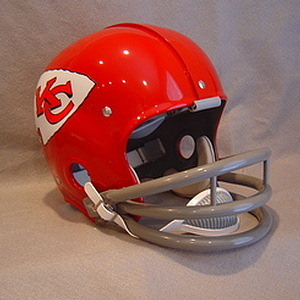
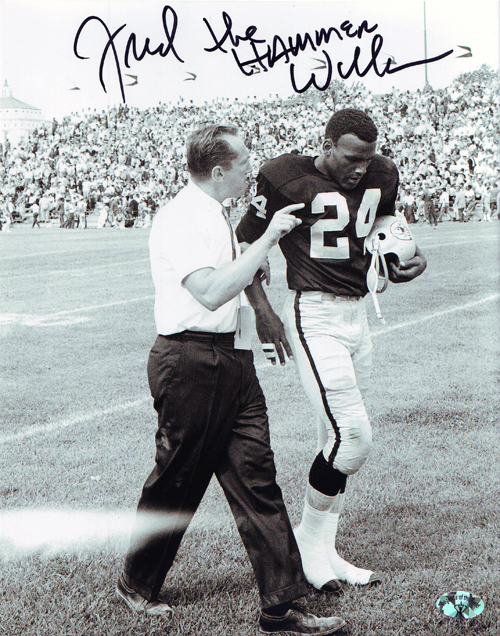


 Our CEO loved the thought of sudden death overtime. You had four full quarters to win a football game. The two point conversion was introduced in 1994 so that a team can win it in regulation yet NFL coaches are too soft and won’t roll the dice and win it in one play. If you don’t, you’re involved in a winner take all overtime where the game can be won on offense, defense, or special teams. Play was heightened with players realizing one mistake, a blown coverage, fumble, interception, or penalty could cost your team its season. It made for great theater.
 Another reason we mention the AFL was this was the last game ever to be played in Municipal Stadium. One of the AFL’s great stadiums through the 1960’s as the Kansas City Chiefs had been perennial winners there. It would be left behind as the Chiefs moved on to Arrowhead Stadium as the NFL moved on to future years of prosperity with new antiseptic ballparks.
 The Kansas City Chiefs were an older team and 1972 would be their last hurrah. They had finished as the AFL’s winningest team going 87-48-3, appearing in the first Super Bowl, then winning the fourth edition over Minnesota down in New Orleans. The team had just parted ways with All-time All AFL DE Jerry Mays and team leader C/LB E.J. Holub to retirement in 1970. Even RB Mike Garrett was gone to the San Diego Chargers by this time, replaced by Ed Podolak.


You must be logged in to post a comment.