Ken Stabler Belongs In The Hall of Fame – HOF Edition

Originally Published 12, July 2015 w/ Postscript 9, May 2019

When it comes to who should be in the Pro Football Hall of Fame, most inductees are in for the stellar performance over their careers entirety. Others are in based upon producing some of the greatest moments in football history. A third definition in the eyes of the The Chancellor is “Can we talk about the era in which a player performed without his name coming up?”  Ken Stabler of the Oakland Raiders fits the bill in all 3 of these categories.

KennyStablerHere in Taylor Blitz Times we have chronicled the long time bias against former Raiders when it comes to enshrinement. Head Coach John Madden’s field general has yet to be elected to Canton. Stabler was a throwback QB who called his own plays and routinely led the Raiders into the playoffs during the 1970’s. Along with Fan Tarkenton, Roger Staubach, and Terry Bradshaw, these four ruled the 1970’s and arguably Stabler had the most legendary moments.

On December 23,1972 in the AFC Divisional Playoff in Pittsburgh, Stabler, whom Madden had been grooming since 1968, was the wild card needed to change the tide of a game down 6-0. Desperate for some offense, John Madden inserted a young, mobile Kenny “The Snake” Stabler in for an anemic Daryle Lamonica which produced immediate results.

On a last second desperation drive, the Raiders came scrambling downfield with a young quarterback in his first significant action in an NFL playoff game. At the Steelers 30 with less than 1:30 to go, Stabler avoided the Steel Curtain, took off and scored on a 30 yard TD run to give the Raiders their first lead of the game 7-6. “The Snake” had done it!! A hero was born!! There was bedlam on the Oakland sideline and with 1:13 to go began to make reservations for they would host the AFC Championship Game against the undefeated Miami Dolphins.

However this was overshadowed by The Immaculate Reception that happened 4 plays later. Then later that day Roger Staubach had his 1st famous comeback in a 30-28 win in San Francisco. Yet Oakland knew they had their quarterback of the future and he could perform in pressure situations. Like a young George Blanda, who had a magical run during 1970, the Raiders could depend upon Stabler’s heroics for years to come.

Over the next 5 seasons as the starter, Stabler guided the Raiders to the AFC Championship Game. An NFL record. He was a daring quarterback who was a true river boat gambler. This led to some interceptions but even more daring touchdowns. He was old school yet enjoyed wine, women, and song out in the nightlife. He still came in and put in his work and teammates respected him and would follow him anywhere.

In 1973 Stabler completed an unheard of 62.7% of his passes, for 1,997 yards 14 TDs and 10 interceptions. The Raiders won the AFC West and got revenge on the Pittsburgh Steelers with a 33-14 win in the playoffs. The Miami Dolphins, on their way to back to back championships, beat them in the ’73 AFC Championship 27-10. Take a wild guess who was there to get revenge in the 1974 AFC Divisional Playoff?


Stabler ended the Dolphin dynasty with the touchdown to Clarence Davis in what became known as The Sea of Hands. One of the most famous games in NFL history.

Although the Raiders lost the AFC Championship the next two years to the rival Steelers, they came back in’76 with a vengeance. They recorded a 13-1 record and sought revenge on those Steelers yet needed another “Snake” come from behind miacle win in the AFC divisional round to get there.
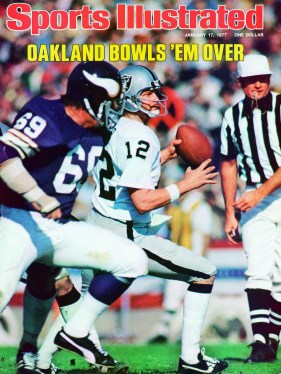
 

1977-01-17 CoverThe Raiders would go on to win the AFC Championship 24-7 over Pittsburgh, then Super Bowl XI over Minnesota 32-14. He had guided the Raiders to that elusive championship in an era when it seemed they would be destined to always be the bridesmaid. He had several great performances left but becoming a champion was the ultimate.

In defending that championship in 1977, Stabler guided Oakland to a record 5th straight AFC Title game in Denver. They fell short 20-17 in getting to Super Bowl XII. How much did that have to do with the fatigue from the 6 quarter epic, Ghost To the Post 37-31 victory over the Baltimore Colts 1 week before??


Stabler’s Raider career was filled with great highlights and one important Super Bowl championship. In 1976 he had one of the greatest season a QB could have. He went 194 of 291 for 2,737 yards 27 TDs and 17 ints and an astonishing completion rate of 67.7% and a 103.4 passer rating. Remember this is a guy who extolled the Raiders philosophy of pressure football while throwing the ball deep.

However Stabler’s career wasn’t a series of statistics. He was one of the NFL’s most visible and recognizable personalities. He did make four Pro Bowls, was voted NFL MVP in 1974, was All Pro twice, and led the league in touchdown passes on 2 occasions. Furthermore,”The Snake” also was voted to the 1970’s NFL All Decade Team and finished with 194 TDs and 222 interceptions. A trade to the Houston Oilers after the 1979 season ended his stint  in Oakland. However he did go out with a bang:


Before his retirement in 1984, he did play for the late Bum Phillips twice in Houston and with the New Orleans Saints. Yet it was the magic he deftly showed out in Oakland that should have him in Canton. You can’t even pick out the best quarterback/receiver combo from the 1970s. Was it Stabler to Cliff Branch who should be in the Hall of Fame?? Would it be Stabler to TE Dave Casper who is in “the hall”?? No…it has to be the obvious in Stabler to Hall of Famer Fred Biletnikoff…right?? If all of his receivers are in and being considered for the Pro Football Hall of Fame what does that make of the quarterback who helped get them there??

Unfortunately with his passing on Wednesday, we will have to lobby for Stabler to be enshrined posthumously.

For the Pro Football Hall of Fame, I present Kenny “The Snake” Stabler

RIP Ken Stabler (December 25, 1945 – July 8, 2015)

Epilogue: 9, May 2019 When going through the pics and remembering the 2016 enshrinement weekend at the Hall, it was an emotional weekend. During the Gold Jacket Ceremony, one of the “Grandsnakes” came on the stage to receive Stabler’s Hall of Fame crest. Not only did we give a standing ovation, there wasn’t a dry eye in the house. Not in the section I was in.
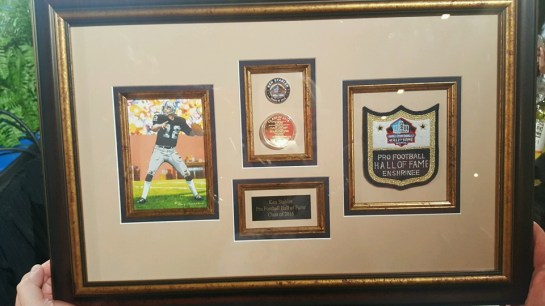
halloffamecrest.stablerIt was impossible to not think how great Kenny would have enjoyed that weekend. He would have shared it with his family and would have definitely included his grandsons to which he was most proud of in everything he did.

Having been to two of the last three ceremonies it’s the stories, the celebrating of a player and a family’s legacy to this great game, and the camaraderie reveling in the accomplishment. The Raider family was out in force and came far and wide to celebrate his enshrinement. Yet the elephant in the room is we all felt cheated out of hearing from the man himself.
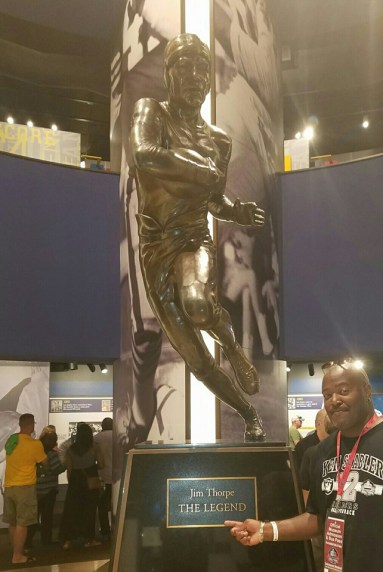
chancellor.hall

I wore a Jerry Kramer jersey into “The Hall” then removed it to reveal a Stabler shirt I picked up after the Gold Jacket ceremony.

For the record I do wish the PFHoF presented Stabler’s family with a ring and gold jacket.

It was bittersweet however its better that Ken Stabler’s Hall of Fame legacy is in Canton where it belongs and no longer being debated.

Thanks for reading and please share the article.

1990’s San Francisco 49ers v. Dallas Cowboys: Cowboys Perspective

Back on January 10, 1982, the San Francisco 49ers beat the Dallas Cowboys in the NFC Championship in what came to be known as “The Catch”. Emmitt Smith, Troy Aikman, and Michael Irvin were 12, 15, & 15 yrs of age respectively at the time. Over the next decade, a football generation came to know the 49ers as the dominant team in pro football. Yet here they were in January 1993, as men, having conquered the 49ers in the ’92 NFC Championship 30-20 in a true changing of the guard.

The passing of the torch

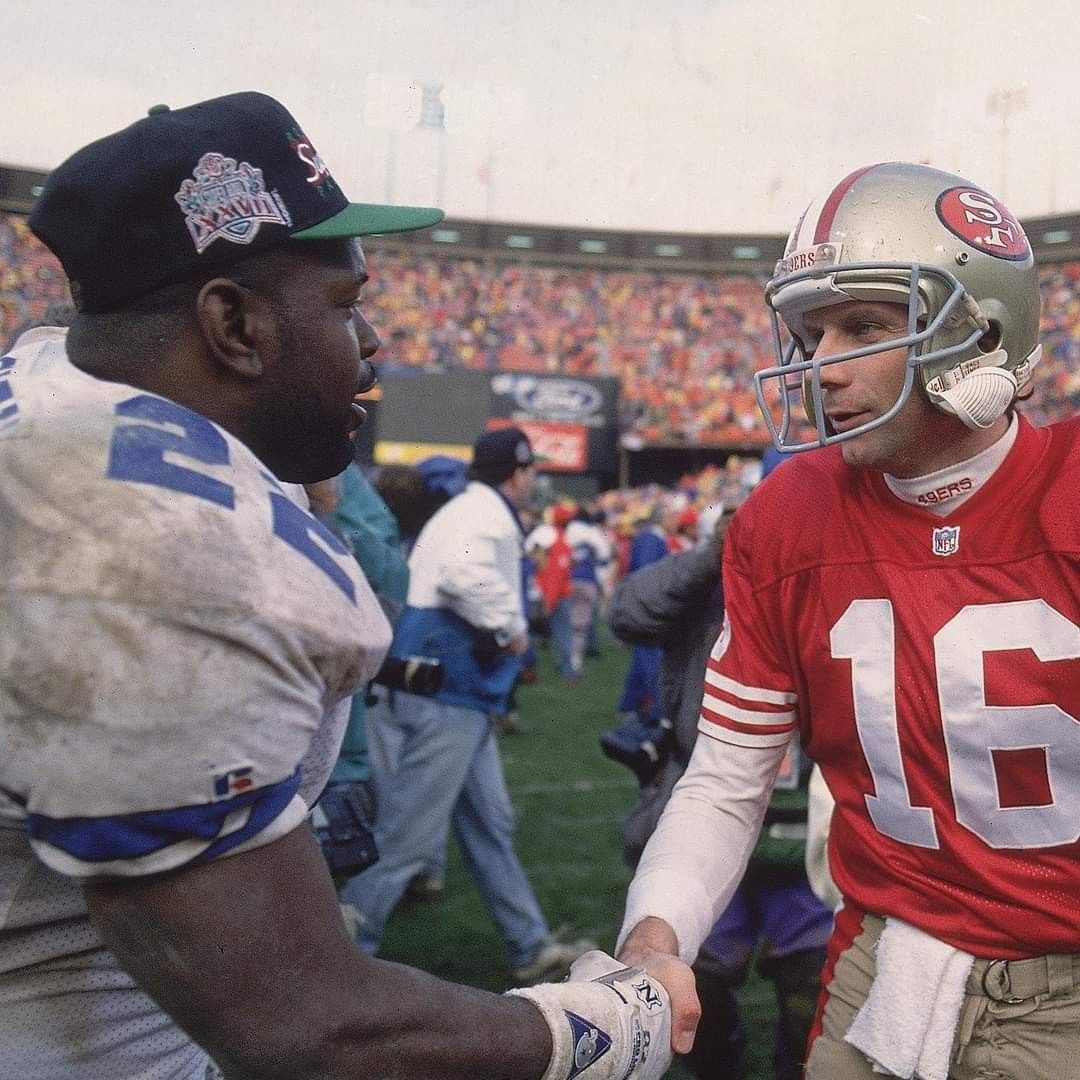
Joe Montana, an iconic symbol of the old guard, was shaking hands congratulating the young Cowboys. They had vanquished not only the team with the NFC’s best record, 14-2, they toppled the team that epitomized conference excellence over the last decade. Now they were navigating uncharted waters and off to Super Bowl XXVII to take on the Buffalo Bills. By the time they made it to Pasadena to take on the Bills, they’re confidence was at an all time high. However beating Buffalo was anticlimactic to what had taken place in soggy San Francisco 2 weeks before.
Troy Aikman came of age in the 1992 NFC Championship Game.

Troy Aikman fulfilled the promise of being a #1 overall pick with his 1992 NFC Championship Game performance.

They had come through the gauntlet which was the NFC at the time. A conference that had won the last 8 straight Super Bowls and would ultimately win 13 in a row. The physical nature of the conference was one thing, but they had to beat the mystique of the best organization in San Francisco. Once the 49ers unseated the Cowboys back in the ’81 NFC Championship Game, they became the gold standard of NFL franchises. Every veteran wanted to play for Eddie Debartolo’s organization. Once Jerry Jones purchased the team in 1989, he traveled to San Francisco to study how the league’s model front office operated. By the time Jimmy Johnson (the [[_]]) had rebuilt “America’s Team” in a few short years, they were ready to take on a 49er team that was prepared to rule the 1990’s just as they had the 80’s. They were built with a different breed of player. Fast, aggressive and an in your face bravado reminiscent of the Miami Hurricane teams Johnson coached in college. The most indelible image from that ’92 Championship was in the locker room when he boasted “How ’bout them Cowboys!??!” loud enough you could nearly hear it in the 49er locker room. Terry Bradshaw once said “Once you win a Super Bowl the regular season is boring. All you care about is getting back to the playoffs where it can be fun again.”
Jimmy Johnson on gameday.

Jimmy Johnson on gameday.

Well the boredom Dallas had to endure was losing Defensive Coordinator Dave Wannstedt, Emmitt Smith’s holdout, and the advent of free agency. In time free agency would prove to be the bigger foe, but when the Cowboys started 0-2 without Smith’s services, it was clear what priority one was. The reality set in these were the two best teams in football. Steve Young had won the last two passing titles but Aikman was thought of as the better quarterback. Troy entered ’93 as a Super Bowl winning QB, something Young had yet to do. Michael Irvin (78 rec. 1,396 yds 7 TDs) was beginning to challenge Jerry Rice (84 rec. 1,201 yds 10 TDs) as to who was the best receiver in the game. In every way these two team were eyeing each other for another postseason date but first had to get through a regular season affair that offered some answers.
The 26-17 win over the 49ers gave the Cowboys the inside track to Super Bowl XXVIII. In fact when they won homefield advantage for the ’93 playoffs, the only question was the status of Emmitt Smith’s separated shoulder suffered in the clinching finale against the New York Giants. Smith was one of 11 Pro Bowlers that included QB Troy Aikman, FB Darryl Johnston, WR Michael Irvin, linemen Mark Stepnoski, Nate Newton, and Eric Williams. By the time you include TE Jay Novacek, they were 3 starters away from sending every player to the Pro Bowl. The defense, which ranked 10th in the league sent LB Ken Norton Jr, DT Russell Maryland, and FS Thomas Everett to Honolulu. A far cry from the year before when they ranked #1 defensively and sent 0 players to the Pro Bowl. We’ll talk about the importance of Everett later but this team was riding high after the emotional win vs. New York. They kept their eye out west on the 49ers as they blew out the wildcard Giants 44-3 in the divisional round. Dallas beat Green Bay 27-17 to set up the NFC Championship rematch in Texas Stadium. As pundits lauded the 49ers lopsided win in Candlestick, it belied the fact they had actually struggled down the stretch losing 3 of their last 4. Sure their defense had put it together in taking down the 1 dimensional Giants, but that is after they had the huge battle in the season finale at Dallas and a hard fought wildcard against the Vikings. After listening to the experts all week, Jimmy Johnson had had enough and called in to a Dallas Radio show on Friday night and declared “We will win the game! You can put it in 3 inch headline!” There was no easing into it now….this was a street fight in the school yard. They called the laced up shirt and tie corporate 49ers out and how would they respond.
They beat down the 49ers 38-21 and were actually ahead 28-7 in the 2nd quarter. Texas Stadium for the first time ever was raucous. Even in the Tom Landry days crowds in Dallas responded like they were at a play or something. They cheered when it was time to but this felt different. It was boisterous and the tempo of the team and the audience fed off Jimmy Johnson’s bravado and echoed in kind. Who knew it was  going to be Johnson’s last game ever at Texas Stadium?? After beating The Chancellor of Football’s Buffalo Bills for the Super Bowl XXVIII championship, we had Johnson’s departure in the offseason. On March 29th was the press conference where there was a mutual parting of the ways. The shock wave could be felt through the NFL. The youngest team in the league that won back to back Super Bowls was going on without their vocal leader?? Jerry Jones erroneously stated there were 50 coaches who could coach the Dallas Cowboys and hired Barry Switzer to succeed him. The Cowboys were that talented and headed into 1994 as the best team in football on paper. Or so they thought… the 49ers had retooled and fashioned much of their team and personality based on the bravado that left them whipped in Dallas the preceding January. The Niners had signed away Ken Norton Jr. and 6 defenders to bolster their defense including future Hall of Famers Ricky Jackson, Richard Dent, and Deion Sanders. All off the NFC Pro Bowl roster. Back then the team that lost the conference championship coached the Pro Bowl and San Francisco used this as a recruiting trip. Free agency had robbed the Cowboys of Norton, DTs Tony Casillas & DT Jimmie Jones, and to the Chancellor the most valuable defender in FS Thomas Everett. Before Everett’s arrival in ’92, the 11-5 Cowboys struggled with Run & Shoot offenses especially, and at times was awful against the pass. Why do you think they drafted CBs Kevin Smith, Clayton Holmes, & S Darren Woodson, and traded for Everett to start 1992??
Not Charles Haley...it was Thomas Everett that pushed the Cowboys over the top back in the early 1990s.

Not just Charles Haley…it was also Thomas Everett that pushed the Cowboys over the top back in the early 1990s.

Dallas had been 1-3 against Run & Shoot teams in 1991. They went 5-0 against those teams including the Buffalo Bills in Super Bowl XXVII that finished as the #1 defense against the pass in ’92 that year with Everett. It was this end zone interception in Super Bowl XXVII that started the 1990’s reign of the Dallas Cowboys. Otherwise the Bills take a 17-14 lead and the Bills take control of the game. In big games he starred….in each NFC Championship Game against the 49ers he picked off Steve Young. You cannot underscore his importance in gluing a young secondary together and teaching them to be pros by example. Yet 1994 saw this team try to move on without this defensive firepower and they did go 12-4. DE Charles Haley was healthy and made the Pro Bowl with 12.5 sacks, S Darren Woodson, and Leon Lett came into their own making their first Pro Bowl trips. The offense was as potent as ever with Smith’s 1,461 yards and 21 TDs. Although he battled leg injuries the 2nd half of the season. Did they have enough in the gas tank to get to win a 3rd straight Super Bowl and make it into NFL lore?? All they had to do was take a trip out to beat the 49ers for the right to go to Super Bowl XXIX.
So Dallas had to watch the 49ers go on to win Super Bowl XXIX 49-26 over San Diego. They did return the following year to beat Pittsburgh 27-17 to win their 3rd Super Bowl in 4 years yet the rivalry came to an end for this era. Both teams kept raising the bar on each other and pushed themselves to a height no other team could reach. In each of these seasons they were the best teams in football and won all 4 Super Bowls… yet lingering questions are still being debated to this day…
  • How many Super Bowls would Dallas have won if Johnson coaches the whole decade??
  • Would they have won 3 in a row if Johnson coached them in ’94??
  • Would the 49ers have won in 1994 if they hadn’t built a defense from the ’93 Pro Bowl roster??
  • How would the 1990’s play out for Dallas if there had not been free agency??
  • Why isn’t Jimmy Johnson in the Pro Football Hall of Fame??
  • Would the Cowboys have won in 1994 if T Erik Williams doesn’t get in that car accident??
However one of the indelible moments from the 1994 NFC Championship Game was the near pass interference call in the 4th quarter between Deion Sanders and Michael Irvin. Instead of a 1st and goal where the 49er lead could have been trimmed to 3, an irate Barry Switzer bumps an official in protest incurring a 15 yard penalty. Dallas was forced to punt and never threatened again. In 1995, in a quiet Texas Stadium Courthouse the two Hall of Famers had a hearing to discuss this disputed play which altered the course of football history.d_sanders_950115_640
LMAO “Panicked state of mind!” Thanks for reading and please share the article. Epilogue: When it came to Jimmy Johnson’s success in Dallas, it was bitter sweet being a Buffalo Bill fan. We lost those two Super Bowls but I was a fan of his back to Herschel Walker and when he first coached the Cowboys. Nope not Dallas…we’re talking the Oklahoma St Cowboys. I first read about Jimmy Johnson during the ’82 season when his running back Earnest “Sparkplug” Anderson became the 5th back to run for 1,000 yards in just the 5th game of the season. Herschel walker won the Heisman but I kept screaming it was “Sparkplug” Anderson that led college football in rushing! Alas…no blog back in ’82. Yet remember following Johnson and as a tradition would watch the Bluebonnet Bowl played on New Year’s Eve and watched Oklahoma St win that game. When it was announced he was coming to my favorite college team at The [[_]] of Miami, talk about excited… I knew Schnellenberger’s replacement and the rest is history. I did get to meet Johnson and the Dallas Cowboy coaching staff at Houlihan’s on St Patrick’s Day in 1993 just after the first Super Bowl with Buffalo. I remember having him sign my Golden Nugget /Mirage jacket from Vegas and talked a little football. If only cell phones with cameras, Instagram & Facebook existed then… Dedicated to the memories of Mark Tuinei, Godfrey Myles, and Joe Avezzano Next Up: 1990’s San Francisco 49ers v. Dallas Cowboys: 49ers Perspective

Unsung Players: RIP Eddie LeBaron

Eddie LeBaronOn April 1st of this year, the football world lost Eddie LeBaron. To a prior generation he was remembered as a great quarterback that lacked the height to play the position at 5’7. However in a career that spanned 11 years he was voted to the Pro Bowl on 4 occasions. Three times he made it as a Washington Redskin and once with the Dallas Cowboys. In fact he was the first starting quarterback in the history of the Cowboys.

I first became aware of LeBaron reading the old Punt, Pass and Kick books covering players from the 1960’s. In some instances it seemed he was covered because of his oddity when it came to stature. Yet as I did more research it was discovered how good a player he was as this vignette barely saved from decades ago will attest…

It’s ironic the player who gives the strongest testimony to LeBaron’s playing prowess is “Concrete” Chuck Bednarik. Not only was he considered one of, if not the toughest player during the 1950’s, but we just lost him just two weeks prior. Like Bednarik, LeBaron had served our country as a Marine and fought in the Korean War prior to playing pro football.

Eddie LeBaron pictured with 1st Dallas Cowboy owner Clint Murchison.

Eddie LeBaron pictured with 1st Dallas Cowboy owner Clint Murchison.

In microcosm his story was an inspirational one to a generation of young men to fight on despite a lack of size. A father could drape his arm over his son’ s shoulder and tell them about Eddie LeBaron. Not only was he the first quarterback in the history of the Dallas Cowboys, he was a Pro Bowl quarterback for a large part of his career.

RIP Eddie LeBaron: January 7, 1930 – April 1, 2015

Epilogue: As we lose these players, it’s personal to me because reading their exploits in books as a kid back in the 1970’s is what lit my fire about football. I was never one into comic books and fictitious heroes, it was always about real people and their accomplishments.

Thanks for reading and please share the article.

Unsung Players: RIP Eddie LeBaron

Eddie LeBaronOn April 1st of this year, the football world lost Eddie LeBaron. To a prior generation he was remembered as a great quarterback that lacked the height to play the position at 5’7. However in a career that spanned 11 years he was voted to the Pro Bowl on 4 occasions. Three times he made it as a Washington Redskin and once with the Dallas Cowboys. In fact he was the first starting quarterback in the history of the Cowboys.

I first became aware of LeBaron reading the old Punt, Pass and Kick books covering players from the 1960’s. In some instances it seemed he was covered because of his oddity when it came to stature. Yet as I did more research it was discovered how good a player he was as this vignette barely saved from decades ago will attest…

It’s ironic the player who gives the strongest testimony to LeBaron’s playing prowess is “Concrete” Chuck Bednarik. Not only was he considered one of, if not the toughest player during the 1950’s, but we just lost him just two weeks prior. Like Bednarik, LeBaron had served our country as a Marine and fought in the Korean War prior to playing pro football.

Eddie LeBaron pictured with 1st Dallas Cowboy owner Clint Murchison.

Eddie LeBaron pictured with 1st Dallas Cowboy owner Clint Murchison.

In microcosm his story was an inspirational one to a generation of young men to fight on despite a lack of size. A father could drape his arm over his son’ s shoulder and tell them about Eddie LeBaron. Not only was he the first quarterback in the history of the Dallas Cowboys, he was a Pro Bowl quarterback for a large part of his career.

RIP Eddie LeBaron: January 7, 1930 – April 1, 2015

Epilogue: As we lose these players, it’s personal to me because reading their exploits in books as a kid back in the 1970’s is what lit my fire about football. I was never one into comic books and fictitious heroes, it was always about real people and their accomplishments.

Thanks for reading and please share the article.

Unsung Players: Joe Morris

From time to time there are players where we wonder how their careers could have tuned out if… Those ifs come in the form of injuries, had the player had a different coach who would have utilized him more, to if they had better talent around them. Then in some cases you can have a player that is a supernova burning bright for a brief period of time. Enter Joe Morris…

Morris stiff arms Alvin Walton in the 1986 NFC Championship Game

Morris stiff arms Alvin Walton in the 1986 NFC Championship Game

For those of us old enough to have enjoyed decades of pro football, we still remember the era of the super back. The power and speed of an Eric Dickerson, toughness and fury of a Walter Payton, or the electrifying burst of a Tony Dorsett. Several prototypes come to mind and Morris at 5’7 190 lbs and a straight line runner, just didn’t fit any.

He was the epitome of a ball carrier. One who could only get the yardage a given play was designed for. However as New York Giant Head Coach Bill Parcells was establishing his power running game in the early 1980s, he decided to move Rob Carpenter to Fullback which inserted Morris into the line-up. Morris had more of a burst and once he gelled with the offensive line, he may have given us the best 2 year stretch of any runner in the history of the NFC East. Morris evolved into a runner.

We’ll take a look at the numbers in a second but here is a glimpse at his play in 1985:

After powering the Giants to a wildcard finish in 1985, they had bigger aspirations for 1986. Could he have an encore performance to rival his breakout 1985??

In 1985, Morris rushed for 1.336 yards and a career high 21 touchdowns. He followed that up in ’86 with 1,516 yards and 14 more trips to the endzone. When you look at the best two year period v. other great NFC East backs of his era, the numbers will surprise you.

  • Joe Morris ’85 &’86: 635 car. 2,852 yds 35 TDs
  • Emmitt Smith ’94 & ’95: 745 car. 3,257 yds 46 TDs
  • Tony Dorsett ’80 & ’81: 620 car. 2,831 yds 15 TDs
  • John Riggins ’83 & ’84: 702 car. 2,586 yds 38 TDs
  • Wilbert Montgomery ’78 & ’79: 597 car. 2,732 yds 18 TDs
  • Ottis Anderson ’79 & ’80: 632 car. 2,957 yds 17 TDs

The only two that outscored him were Riggins in ’83 and Emmitt in ’95. Ironically those are the years that each set the NFL record for touchdowns in a season. Along with Smith and Riggins,  Morris powered his team to a Super Bowl win in his 2 year period. It’s also surprising he had a better two year total than OJ Anderson when he was with the Cardinals. In another ironic twist it was Anderson who replaced Morris in 1989 after Joe broke his foot. An injury that subsequently ended Joe’s career.

Morris didn’t finish with a Hall of Fame career (5,585 yds 50TDs) but he did power the ’86 Giants to their Super Bowl XXI championship. He developed into a power runner despite his size and was as good a running back the NFL had ever seen. Up until Tiki Barber, this was the New York Giants best running back and it’s worth taking a look back.

Thanks for reading and please share the article.

Ken Riley Belongs In The Pro Football Hall of Fame

There are several teams that have their best talents go unrecognized by the Pro Football Hall of Fame. The prevailing theme that has emerged are the lack of members from franchises that haven’t won a Super Bowl or an NFL championship in their existence. Even those that compiled impressive numbers during their careers. Enter Ken Riley of the Cincinnati Bengals.

Riley was drafted by the Cincinnati Bengals in the last year of the American Football League in 1969. He teamed with fellow CB Lemar Parrish and FS Tommy Casanova to form one of the best secondaries of the 1970’s. Over a 15 year career ending in 1983, Riley intercepted 65 enemy passes. Good enough for 4th all time at the time of his retirement, and still ranks 5th just behind Rod Woodson.

A quiet player drafted out of Florida A & M, his career was overshadowed by other teammates and playing in a small market in Cincinnati. There were only so many Pro Bowl votes to go around. Many of those went to teammate Parrish with 8 who was also one of the league’s best punt returners… we’ll get back to this.

From 1974-1978 the Bengal defense ranked 4th, 2nd, 3rd, 6th, and 3rd against the pass. The “Soul Patrol” Raider secondary of Jack Tatum and George Atkinson never yielded less yards than this group. The Steelers only outranked them once in ’74, when they were ranked #1. Keep in mind in ’75 & ’76 the Steel Curtain had two of our greatest ever defenses and Cincy was better against the pass.

As for Pro Bowl voting during this time, Parrish who deserves Hall of Fame consideration in his own right, was a mainstay. However Riley was the better pass thief. Riley pirated 22 enemy passes to Parrish’s 6 during the time ’74-77. In fact you’d have to combine all their years together dating back to 1970 to get Parrish in the race with 23 interceptions. However Riley’s number balloons to 36 when you do that.

The biggest Pro Bowl snub came in 1976 when teammate Parrish made it to LA and Riley stayed home. Riley was 2nd in the league with 9 ints which were returned for 141 yards and a touchdown. Parrish and fellow AFC Pro Bowl CB Emmitt Thomas only had 2 respectively. Are you serious?? How does this happen?? Let’s take a look back…first at Riley, then his exploits in one of the finest secondaries in NFL history.

They were the best secondary of the 1970’s. Maybe it was going against Bill Walsh and what would become the “west coast offense” everyday in practice that made them great? Walsh was Cincinnati’s Offensive Coordinator at the time and had Ken Anderson who won passing championships during this time in 1974 & ’75.

kenriley2

What The Chancellor of Football remembers most about Riley was his flawless backpedal. He was a tactician that used the sideline as his friend and was never out of position.

Once Parrish was dealt away to the Redskins and Tommy Casanova retired to attend medical school in 1978, Riley played on in the Bengal secondary. He played through 1983 when in his 15th and final season, was 2nd in the league with 8 interceptions. Most players would have dwindling stats that late in their careers. Riley had a combined 18 interceptions in his final 3 years alone and was 1st team All Pro in his last year.

Did you know Riley never made the Pro Bowl during his career?? However he was voted All Pro in 1975, 1976, 1981, and his final season in 1983. Something has to be said about that type of sustained excellence. Of the top ten interceptors in NFL history, only he and Hall of Famer Dick Lebeau did so for the same team throughout their career. He’s the only corner to have 7 seasons with 5 or more interceptions totaling 65 over 15 years.

Keep in mind it took Darrell Green 20 years to garner 53 interceptions. Hall of Famer Deion Sanders needed 14 years to net 53 picks and Lester Hayes needed 10 years to snatch 39. None of these guys came close to matching the 18 Riley had in his final 3 seasons during their careers.

To circle back, It was interesting the sporting press and coaches made sure Riley made those 4 All Pro teams when there wasn’t space on the Pro Bowl roster. Was Riley overshadowed by Parrish being one of the league’s best punt returners? Over the years corners who starred as return men seem to have a blurring of their special teams exploits and defensive play that collect in the memory. Which could have affected Pro Bowl voting. The NFL didn’t expand to include a special teams player until the 1986 season.

Thinking out loud here…

One item shared by Todd Christensen’s son Toby a few weeks back was this plauqe given to the players who made Pro Football Weekly’s All Pro Team for 1983.

When was the last time you saw an NFL cornerback finish his 15 year career as an All Pro? Check the top left… Riley and Lester Hayes.

Just like there is little footage of the Cincinnati Bengals of that era, there just isn’t a lot out there on Ken Riley. He was a great cornerback that played in a time before they expanded Pro Bowl voting to include more players. Yet you can’t take away his numbers. Aside from Hall of Famer Dick “Night Train” Lane no pure cornerback intercepted more passes.

For induction into the Pro Football Hall of Fame, I present Ken Riley.

Please write & nominate #13 Ken “The Rattler” Riley

Send letters to:
Pro Football Hall of Fame
Attention: Senior Selection Committee
2121 George Halas Dr NW, Canton,
OH 44708

Thanks for reading and please share the article.