Bring back The ProCap – Concussions In The NFL

As the NFL has to come to grips with paying true benefits and restitution to former players, they have to deal with the protection of the present day player. As the NFL has kept the contract for NFL helmets with Riddell, what ever happened to the ProCap that gave players additional helmet padding??

Mark Kelso was the first to sport a ProCap back in 1989.

Mark Kelso was the first to sport a ProCap back in 1989.

Who remembers the helmet of Buffalo Bill Mark Kelso and San Francisco 49ers T Steve Wallace?? Back in the 1980’s there were more players who wore helmets manufactured by Bike. A few NFL players were wearing them. Most notably Ronnie Lott in San Francisco, then Wilber Mashall and Otis Wilson in Chicago.

Yet the long standing relationship with Riddell effectively led to an exclusive contract which ended Bike helmets in the pros. Yet there were several manufacturers like Schutt who have come onto the scene touting advancements in helmet manufacturing in recent years.

Steve Wallace wore the ProCap while battling on the line of scrimmage.

Steve Wallace wore the ProCap while battling on the line of scrimmage.

Now we don’t have any statistics regarding concussions between both manufacturers. But when Mark Kelso donned a ProCap after his 4th career concussion in 1989, he only missed 2 games from 1990 -1993. Somewhere during that time Steve Wallace started to wear his. What happened to these during this time of heightened concussion awareness?? Why isn’t every player wearing one??

With all the talk on heightened awareness regarding CTE, concussion protocol, and rule changes: What about extended use of the ProCap??

Thanks for reading and please share the article.


Legends of The Fall: Wes Chandler & John Jefferson

During the glory years of Air Coryell, the receivers were John Jefferson, Charlie Joiner, and Tight End Kellen Winslow. Head Coach Don Coryell had taken full advantage of the rule changes in 1978 to produce the most prolific passing offense in league history. His San Diego Chargers were the evolutionary link between Sid Gillman’s high scoring AFL version of the Chargers and the offenses we know today.

Quarterback Dan Fouts was the trigger-man and was in the midst of building a Hall of Fame resume. In 1979 he broke Joe Namath’s single season passing record with 4,082 yards. Then shattered it with 4,715 yards the following year. So it was imperative that management keep top level receivers for Fouts to throw to. As a team they won the AFC West in ’79 and made it to the AFC Championship Game in 1980.

However going into 1981, several players desired new contracts and were holdouts. Upset with the inability to bring WR John Jefferson and DE Fred Dean to camp, each man was traded to teams thought to be NFC wastelands in San Francisco and Green Bay. Although they were the odds on favorite to make it to Super Bowl XVI before this, management pulled the trigger that could have brought down Air Coryell.

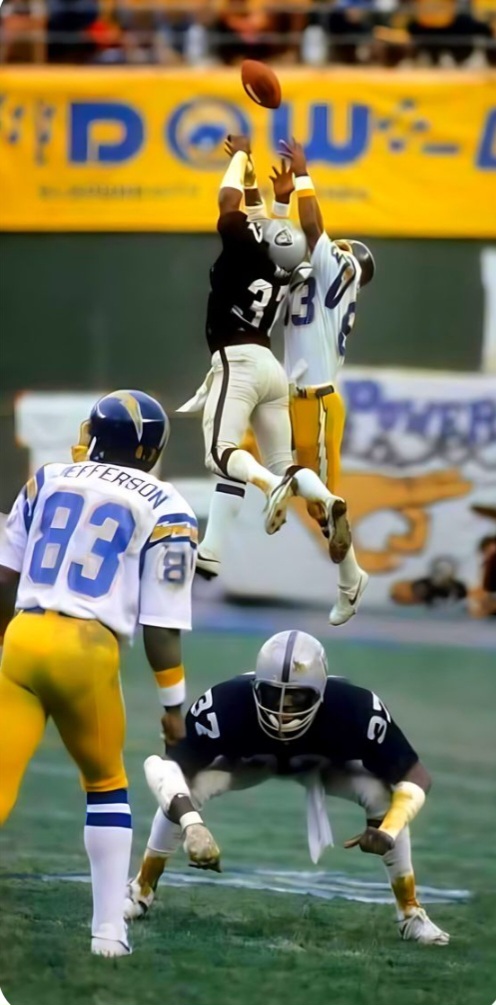
Yet they had an ace up their sleeve and traded for Wes Chandler a few weeks later. Whom they were sure could fill the shoes of former All Pro John Jefferson. You have to understand Jefferson was the most electrifying talent in the league. His circus catches and boundless enthusiasm was the lightning rod spirit of those Charger teams.

Asking Chandler to fill his shoes was not going to be easy. Yet week 6 of 1981, right before the trade deadline, the Chargers turned in their trade papers to Pete Rozelle’s office.

Yet first you need to understand the man he was going to replace. John Jefferson’s first 3 seasons with San Diego, they set the record and broke it for passing offense each season. His years from 1978-1980 were the most electric of any incoming receiver in NFL history. The acrobatic Jefferson produced highlight reel after highlight reel level catches. He amassed 199 rec. for 3,431 yards and 36 TDs as 1/3 of Air Coryell!! In this vignette about the ’80 Chargers you’ll get a better glimpse.


His battles with Lester Hayes that year were epic. Hayes was NFL Defensive Player of the year as he amassed 13 interceptions. Jefferson had 2-100 yard receiving games against him and 3TDs. Both were voted All Pro as he had a career best 1,340 yards on 82 receptions and 13 touchdowns.

In fact, the 1980 Chargers were the first team in history to have the standard set of receivers (2 wideouts and tight end) go over 1,000 yards in the same season. Against the Giants in week 7, they became the first standard set to all go over 100 receiving yards in the same game. Now they were going on without his services. How would the Chargers fare?

Well over in the NFC, another wideout from the 1978 draft was toiling away in New Orleans:


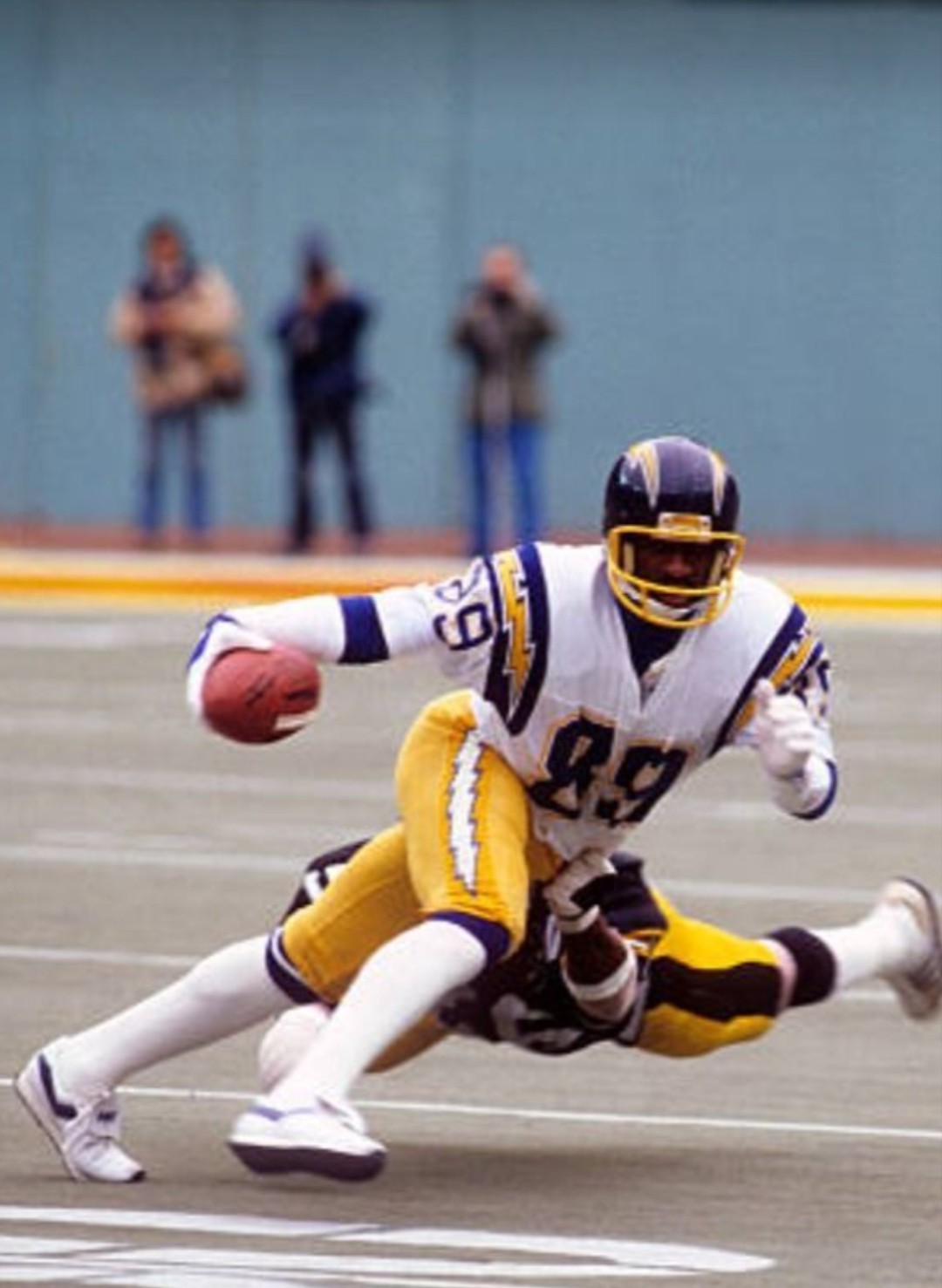
That 1982 season by Chandler ranks in The Chancellor of Football’s top five all time seasons by a receiver. He caught 49 passes for 1032 yards and 9 touchdowns in that strike shortened season. Just 8 games. Projected over a full season he would have had 98 receptions for 2064 yards and 18 TDs. At the time, 101 was the record for catches by Charley Hennigan back in the AFL in 1964. The TD record in a season was 17 held by Hall of Famer Elroy “Crazy Legs” Hirsch from 1951. He would have become the first and only 2,000 yard receiver and come close to or broken the other two records.

jefferson inspired figurine

jefferson inspired figurine

John Jefferson went on to team with James Lofton and made the Packers a formidable passing team for several years. In fact he made his fourth and final Pro Bowl in 1982 when he and Lofton went as teammates. However his best days were left in the team he should have helped to a Super Bowl in San Diego. Contract disputes kept that team from it’s greatest triumph.

For their careers

  • John Jefferson 351 rec. 5,714 yds 47TDs
  • Wes Chandler 559 rec. 8,966 yds 56TDs

When you picture Air Coryell in your mind, these two and their acrobatic catches are the first you envision. They were the spectacular performers of the group where Hall of Fame voting went with the numbers and impact of Charlie Joiner, Dan Fouts, and Kellen Winslow.

Amazingly Head Coach Don Coryell also sits outside the Hall of Fame. Too much is made of a coach not winning a Super Bowl yet Joe Gibbs left his staff and won 3 in Washington. He deserves to be in as well.

The high flying Chargers of the early 1980s. Just as we remembered them.

The high flying Chargers of the early 1980s. Just as we remembered them.

Although Chandler and Jefferson didn’t have Hall of Fame numbers, these two shouldn’t be forgotten for their contributions were just as great. Definitely legends of the fall.

Thanks for reading and please share the article.

Missing Rings: The 1986 Seattle Seahawks

Now that the ink is drying in the record book for the Super Bowl Champion Seattle Seahawks, it’s interesting to look at the team’s overall history. When we travel down the road to yesteryear, our remembrance of great teams that should have won the Super Bowl are normally teams that appeared in it. Yet if we returned to the last week of the season of 1986, you’d be surprised to learn the team that scared everyone going into the playoffs that year was the Seattle Seahawks.

The real Curt Warner was the first real super star in the history of the Seahawks.

The real Curt Warner was the first super star in the history of the Seahawks.

I know what you’re thinking. How could one of the best teams in Seahawk history be better than a team that appeared in the Super Bowl?? Well for starters the squad that made it to Super Bowl XL survived a fairly weak NFC playoff pool. Even the NFC Championship win had them best the Carolina Panthers who were starting a 4th string running back.

The team was born out of the expansion draft in 1976 along with the Tampa Bay Buccaneers. They struggled mightily early on until a couple drafts in the early 80s brought superstars to the Pacific Northwest. In 1981 they drafted 3 time All American Safety Kenny Easley to fortify the defense. Two years later they brought in RB Curt Warner to bring juice to the offense. Where the bulk of media attention was on the class of ’83 quarterbacks, the real Curt Warner had a great rookie season with 1,449 yards rushing and 13 TDs.

They made their first foray into the NFL playoffs where they ended John Elway’s rookie season with a 31-7 win under the artificial sky of the Kingdome. Where it was thought this was as far as they could go, they went on to a huge upset over Don Shula’s Dolphins on the road 27-20. The Seahawks found themselves just one game away from Super Bowl XVIII and a trip to Los Angeles beckoned. They had swept the 12-4 Raiders during the regular season and were playing in their first championship in team history. One more win and the cinderella Seahawks would play for it all down in Tampa.

Another big time defender Seattle had was Jacob Green

Another big time defender Seattle had was Jacob Green

In the AFC Championship, Marcus Allen came of age rushing for 154 yards while snagging passes for 62 more as the Raiders prevailed 34-14. It seemed the Seahawks had turned the corner, yet the team was unable to put together a championship run in 1984 when Warner was lost for the season. They were bound together by their defense but the lack of offensive firepower came back to haunt them in a 31-14 playoff loss to the Dolphins.

Hall of Fame receiver Steve Largeant was the steady star who was a perennial 1,000 yard receiver.

Hall of Fame receiver Steve Largeant was the steady star who was a perennial 1,000 yard receiver.

They followed that with an 8-8 record in 1985 as they eased Warner back after a knee reconstruction. He did make it past 1,000 yards but it was Dave Krieg who came of age. He made the Pro Bowl in ’84 after throwing a team record 32 touchdowns, yet tossed 24 interceptions. He reduced his picks to 20 in 1985 in his second full season as a starter.

After back to back campaigns with over 3,600 yards passing from Krieg, Warner’s knee gaining full strength, and returning with the NFL’s 11th ranked defense featuring the 1984 NFL Defensive Player of the year in Kenny Easley…1986 looked like it would be the Seahawk’s year.

From the outset of 1986, Seattle was on a mission. They opened with a rousing 30-0 win over Pittsburgh. They made it to 2-0 before having to take on the defending AFC Champion Patriots on the road. Down 31-21 with less than 8 minutes to go, the Seahawks turned it on scoring 17 points including a blocked kick to stun the Patriots 38-31. Despite the fact Tony Eason passed for 414 yards and 3 TDs, Seattle showed how strong they could turn it on offense, defense, and special teams to win against a quality opponent.

At no time was this more evident than when they took on the eventual Super Bowl champion New York Giants  in week 7. The Seahawk defense took over and sacked Phil Simms 7 times while intercepting 3 of his passes. Jacob Green had the best game of his career as he registered 4 sacks. He did this against T Brad Benson, who 8 weeks later, became the first offensive lineman ever named NFC Offensive Player of the week for his performance against Dexter Manley. On this day in the Kingdome however, they couldn’t slide the line or help Benson as the Seahaks won a slugfest 17-12.

At 5-2 the Seahawks had proven to win every type of game against the stiffest of competition. This is the mark of a champion. The only opponent they couldn’t overcome was themselves. Following the win in New York, they lost a marquee game against Denver for the AFC West divsion lead 20-13. What was painful is they had two touchdowns in that game called back. They lost their mojo and went on a four game tailspin and fell out of contention.

The one constant that kept the season from turning sour in 1986: Curt Warner

After a team meeting, the Seahawks went on a tear as they finished with a five game winning streak. Curt Warner was the lead horse as he ran for 556 yards on 110 carries with 6 touchdowns over that time. The assault started with 122 yards in a 31-14 win in Dallas on Thanksgiving. He scored twice as he tallied 116 yards in a 37-0 Monday Night massacre against the division rival LA Raiders. Which set up the final game of the season where he saved his best performance for last.

Before we go there we have to mention the defense raising their level of play. During the 4 game losing streak, the defense had broken allowing an average of 451 yards / 29.75 points per game and only logged 5 sacks. Over the last five weeks the defense improved dramatically. They only surrendered 272 yards and only 10 points per game. The #1 and #2 defense in Chicago  and New York gave up 258 and 297 yds per game respectively. In the Monday Night 37-0 win against the Raiders, they registered a team record 11 sacks.

This five game streak included a match-up with the eventual AFC Champion and Division Champion Denver Broncos, in the regular season finale.

That rousing 41-16 win was the culmination of the team finally firing on all cylinders. NFL playoff tie-breakers kept the 10-6 Seahawks out. Yet for the first time in the Super Bowl era, one team beat both Super Bowl participants during the season. The Giants last loss was a 17-12 defeat up in the Kingdome in week 7. Then the finale blowout of the Broncos.
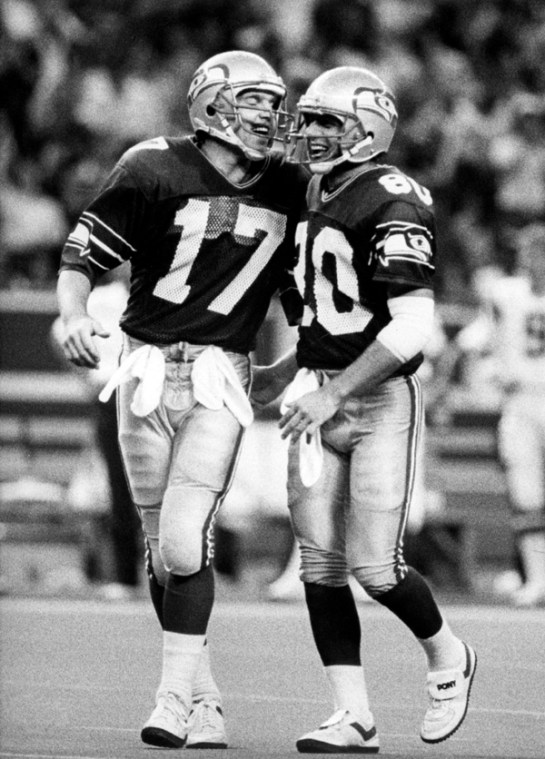
To this day, the Dave Krieg to Steve Largent connection remains the best in team history.

To this day, the Dave Krieg to Steve Largent connection remains the best in team history.

No one wanted to face this team as the ’86 playoffs were being set up. You had Curt Warner’s conference leading 1,481 yards and 13 touchdowns. Fellow Pro Bowler and future Hall of Famer Steve Largent’s 70 receptions for 1,070 yards and 9 TDs. The league’s  best kick returner in Bobby Joe Edmunds. Emerging star in Pro Bowl linebacker Fredd Young and a now healthy quarterback in Dave Krieg (60% completion rate/ 21TDs – 11 ints). They had to sit and watch a knock kneed New York Jet team become the first team in NFL history to make the playoffs after losing their last five games.

This is a cautionary tale as to why you have to win every game. During their 4 game losing streak they lost to those Jets 38-7. Cautionary?? This easily could have been your Super Bowl XXI champion. They finished 8th in offense and their defense was 8th in points allowed. They were jelling as the playoffs neared and in 1986 they played the league’s toughest schedule. They faced 3 of the 4 teams that made the conference title games that year.

In that regular season loss to the Jets, they may have left their ring on the table.

Thanks for reading and please share the article.

chancellor.krieg

Legends Of The Fall: Mike Quick

When you talk about the greatest receivers in NFL history, the name undoubtedly at the top of the list is Jerry Rice. Yet when you think of being able to catch passes from back to back Hall of Famers, it made it easier to accomplish what he did. With sporadic quarterbacking what would Rice’s career resemble most?? That of Mike Quick the player who most reminds our CEO of Rice.

Some may scoff but you have to remember in the early 1980’s, the big numbers coming from receivers were all in the AFC. The great quarterback class of ’83, the Air Coryell Charger receivers, Marino and the Marks Bros., and Steve Largent up in Seattle.

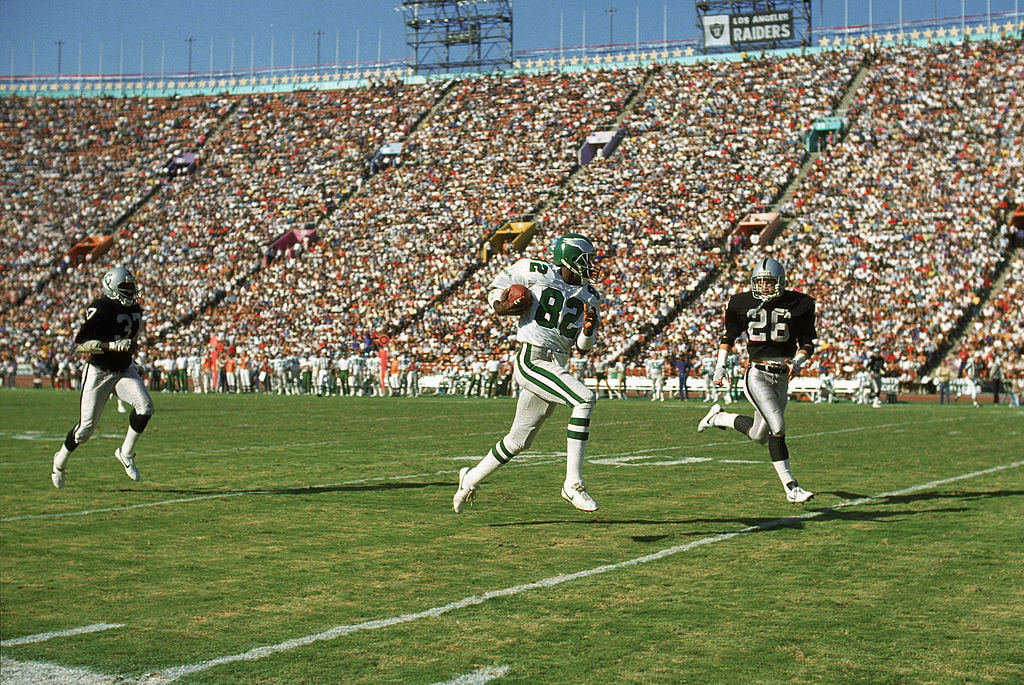
From 1983 through 1986, no one was better than Quick who caught 263 passes for 4,647 yards and 42 touchdowns. He was Jerry Rice before Jerry Rice yet was stuck between the aging Ron Jaworski and the emergence of Randall Cunningham which cost him in the end. Think about it… In 1986 Quick had the 4th of his 5 straight Pro Bowl appearances. He totaled 60 receptions for 939 yards and 9 touchdowns. Not great totals until you realize the Eagles set an NFL record allowing 104 sacks.

His 1983 total of 1,409 yards receiving was the most since Hall of Famer Don Maynard in 1967. That was the year Joe Namath became the first quarterback in history to throw for 4,000 yards. Quick played on the 27th (2nd to last) ranked offense in the NFL in contrast. He played for defensive minded head coach Marion Campbell. What would the late Bill Walsh been able to accomplish drawing plays up for Quick??

Quick making a big play against the Redskins.

Quick making a big play against the Redskins.

In the end you can understand the dilemma that affects certain careers. The cupboard was bare as he played his first 7 years without a single fellow Pro Bowler on offense. By the time Randall Cunningham made the Pro Bowl in ’88, the Eagles had drafted his heir apparent in Cris Carter.

After injuries robbed Quick of his once lethal speed, he retired after the 1990 season. His 363 catches for 6,464 yards and 61 TDs falls short of Hall of Fame consideration. Yet in his prime, he was an electrifying performer who could score from anywhere.

thanks for reading and please share the article.

Legends Of The Fall: Tony Dorsett

As the National Football League overtook baseball during the 1970’s, the Dallas Cowboys were arguably the most visible team. They appeared in Super Bowls and seemed like they were on Monday Night Football every other week. The star that shined on that Texas Stadium stage the brightest was easily Tony Dorsett.

dorsettFrom 1977-1988, Dorsett ran for 12,739 yards or 527 more than the legendary Jim Brown. At the time, Browns’s mark was the standard every good running back was judged by. However Dorsett was a different type of runner. No back in NFL history broke so many breath-taking big runs. He was quick to the hole and once he broke into the open, he was gone.

The mere mention of his name and everyone pictures his 99 yard record-breaking run against Minnesota. Yet The Chancellor of Football contends the 84 yard bomb he dropped on the Philadelphia Eagles his rookie year was his best. It’s the first touchdown of this clip where Herman Edwards described how difficult it was to catch him. How apropos since he was the Eagle #46 that trailed him on the play.

Amazingly, he never led the NFL in rushing or rushing touchdowns. Of his 8 -1,000 yard seasons, his best was 1,646 in 1981 when he led the Cowboys to their 2nd straight NFC championship appearance. In that season he only rushed for 4 touchdowns. A closer look career-wise,  he scored 72 during his 11 years with the Cowboys. Compare that to 58 by Emmitt Smith in the years 1994-1996. Smith was the battering ram for his team scoring many times from in close. Dorsett was the shot fired from the Cowboys long-range offensive rifle. You didn’t know when he’d explode into the secondary.

Never was this more evident than on Monday Night Football where TD had been the most prolific scorer in its first 20 years.

Ironically TD said in the first video that he was probably taken for granted during his career. Our CEO definitely doesn’t see it that way. He overshadowed the late Walter Payton up until he was about to become the NFL’s all time leading rusher. Playing for such a high-profile team in the Dallas Cowboys gave him great platforms from which to perform. All of those Cowboys playoff games and Super Bowls. Therefore raising his profile.

XII3

Dorsett scoring the opening TD in Super Bowl XII

From winning the Heisman Trophy at Pitt to becoming a member of the Pro Football Hall of Fame, Tony Dorsett was one of the best running backs in NFL history.

tdandthechancellor

Thanks for reading and please share the article.


Legends Of the Fall: James Brooks

From time to time you’ll find NFL teams trying to recreate what they once had and totally undervalue a current player on their roster. Never was this more evident than when the San Diego Chargers overreached for a big back to replace the aging Chuck Muncie. At first they signed late Ricky Bell who couldn’t stay healthy. Then they made one of the worst trades in NFL history, trading the multifaceted James Brooks to Cincinnati for FB Pete Johnson.

James Brooks burst onto the NFL scene in 1981 out of Auburn.

James Brooks burst onto the NFL scene in 1981 out of Auburn.

How lopsided was that trade in 1984?? Pete Johnson only played 3 games with the Chargers before being released. Brooks went on to play 8 seasons for Cincinnati gaining 9,459 combined yards and 64 touchdowns. During that time he ran for 1,000 yards on 3 occasions while compiling 5 seasons with over 1,200 yards from scrimmage. Not only did he make the Pro Bowl 4 times, he broke Johnson’s all time team rushing record and helped the Bengals to Super Bowl XXIII.

Although they brought in another Auburn tailback in Lionel James, this was the end of the Air Coryell reign. Age and injuries derailed their effectiveness where Brooks played on with the Bengals through the 1991 season. Why would you trade a proven commodity that led the league in all purpose yards in his first two years?? One could speculate how Chargers ownership under Gene Klein was dreading impending contract demands. Don’t forget this was only 3 years removed from trading away WR John Jefferson and DE Fred Dean for the same thing.

JamesBrooks2Brooks was one of the toughest and most durable runners at 180 lbs in NFL history. His game was a speed game but he broke tackles when he ran inside traps. He took on linebackers and safeties. His best run ever was a 56 yard TD run against the Patriots in 1986 in which he broke several tackles and drug SS Roland James into the endzone.

James Brooks was a great performer whose numbers will fall just short of Hall of Fame consideration. His trade stands as a cautionary tale to GMs everywhere. He was one of a long line of Auburn running backs that came into the NFL starting with Joe Cribbs, himself, Lionel James, and Bo Jackson during the 1980’s. Yet it was Brooks who out rushed them all.

Thanks for reading and please share the article.