Ken Riley Belongs In The Pro Football Hall of Fame

There are several teams that have their best talents go unrecognized by the Pro Football Hall of Fame. The prevailing theme that has emerged are the lack of members from franchises that haven’t won a Super Bowl or an NFL championship in their existence. Even those that compiled impressive numbers during their careers. Enter Ken Riley of the Cincinnati Bengals.
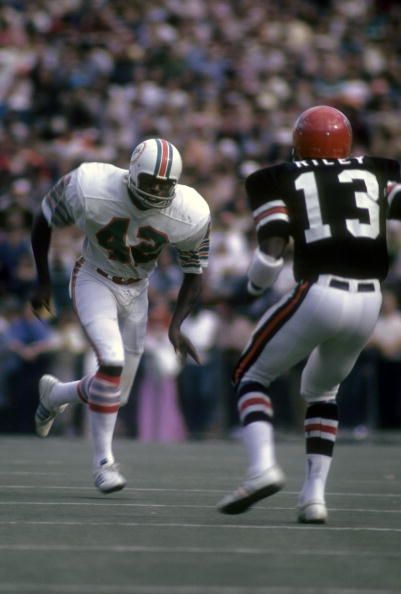
Riley was drafted by the Cincinnati Bengals in the last year of the American Football League in 1969. He teamed with fellow CB Lemar Parrish and FS Tommy Casanova to form one of the best secondaries of the 1970’s. Over a 15 year career ending in 1983, Riley intercepted 65 enemy passes. Good enough for 4th all time at the time of his retirement, and still ranks 5th just behind Rod Woodson.

A quiet player drafted out of Florida A & M, his career was overshadowed by other teammates and playing in a small market in Cincinnati. There were only so many Pro Bowl votes to go around. Many of those went to teammate Parrish with 8 who was also one of the league’s best punt returners… we’ll get back to this.

From 1974-1978 the Bengal defense ranked 4th, 2nd, 3rd, 6th, and 3rd against the pass. The “Soul Patrol” Raider secondary of Jack Tatum and George Atkinson never yielded less yards than this group. The Steelers only outranked them once in ’74, when they were ranked #1. Keep in mind in ’75 & ’76 the Steel Curtain had two of our greatest ever defenses and Cincy was better against the pass.

As for Pro Bowl voting during this time, Parrish who deserves Hall of Fame consideration in his own right, was a mainstay. However Riley was the better pass thief. Riley pirated 22 enemy passes to Parrish’s 6 during the time ’74-77. In fact you’d have to combine all their years together dating back to 1970 to get Parrish in the race with 23 interceptions. However Riley’s number balloons to 36 when you do that.

The biggest Pro Bowl snub came in 1976 when teammate Parrish made it to LA and Riley stayed home. Riley was 2nd in the league with 9 ints which were returned for 141 yards and a touchdown. Parrish and fellow AFC Pro Bowl CB Emmitt Thomas only had 2 respectively. Are you serious?? How does this happen?? Let’s take a look back…first at Riley, then his exploits in one of the finest secondaries in NFL history.

They were the best secondary of the 1970’s. Maybe it was going against Bill Walsh and what would become the “west coast offense” everyday in practice that made them great? Walsh was Cincinnati’s Offensive Coordinator at the time and had Ken Anderson who won passing championships during this time in 1974 & ’75.

kenriley2

What The Chancellor of Football remembers most about Riley was his flawless backpedal. He was a tactician that used the sideline as his friend and was never out of position.

Once Parrish was dealt away to the Redskins and Tommy Casanova retired to attend medical school in 1978, Riley played on in the Bengal secondary. He played through 1983 when in his 15th and final season, was 2nd in the league with 8 interceptions. Most players would have dwindling stats that late in their careers. Riley had a combined 18 interceptions in his final 3 years alone and was 1st team All Pro in his last year.

Did you know Riley never made the Pro Bowl during his career?? However he was voted All Pro in 1975, 1976, 1981, and his final season in 1983. Something has to be said about that type of sustained excellence. Of the top ten interceptors in NFL history, only he and Hall of Famer Dick Lebeau did so for the same team throughout their career. He’s the only corner to have 7 seasons with 5 or more interceptions totaling 65 over 15 years.

Keep in mind it took Darrell Green 20 years to garner 53 interceptions. Hall of Famer Deion Sanders needed 14 years to net 53 picks and Lester Hayes needed 10 years to snatch 39. None of these guys came close to matching the 18 Riley had in his final 3 seasons during their careers.

To circle back, It was interesting the sporting press and coaches made sure Riley made those 4 All Pro teams when there wasn’t space on the Pro Bowl roster. Was Riley overshadowed by Parrish being one of the league’s best punt returners? Over the years corners who starred as return men seem to have a blurring of their special teams exploits and defensive play that collect in the memory. Which could have affected Pro Bowl voting. The NFL didn’t expand to include a special teams player until the 1986 season.

Thinking out loud here…

One item shared by Todd Christensen’s son Toby a few weeks back was this plauqe given to the players who made Pro Football Weekly’s All Pro Team for 1983.
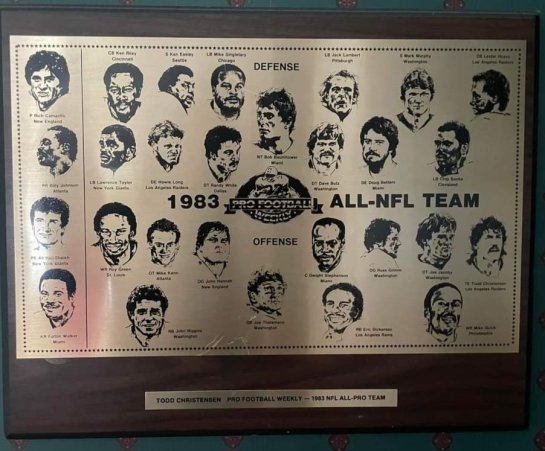
When was the last time you saw an NFL cornerback finish his 15 year career as an All Pro? Check the top left… Riley and Lester Hayes.

Just like there is little footage of the Cincinnati Bengals of that era, there just isn’t a lot out there on Ken Riley. He was a great cornerback that played in a time before they expanded Pro Bowl voting to include more players. Yet you can’t take away his numbers. Aside from Hall of Famer Dick “Night Train” Lane no pure cornerback intercepted more passes.

For induction into the Pro Football Hall of Fame, I present Ken Riley.

Please write & nominate #13 Ken “The Rattler” Riley

Send letters to:
Pro Football Hall of Fame
Attention: Senior Selection Committee
2121 George Halas Dr NW, Canton,
OH 44708

Thanks for reading and please share the article.

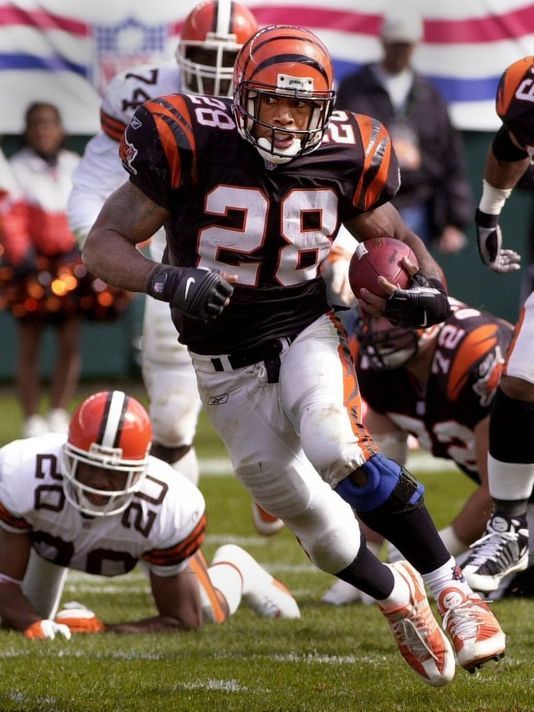
Corey Dillon Belongs In The Hall of Fame

There are many NFL fans who miss true talents around the league and just focus on their team. That narrow focus can keep one from seeing a Hall of Fame talent at work. That doesn’t mean an overlooked player should miss the call to the hall if he doesn’t garner great media attention. It’s about what they accomplished on the field and how well their peers respected their exploits.

Did you know that at one point Corey Dillon owned the greatest single game rushing performance and the #6 performance in NFL history?? Not Emmitt Smith, Barry Sanders, Eric Dickerson, LaDanian Tomlinson, nor Adrian Peterson or any great back you’ve ever watched accomplished that . Well, you have to be in your mid fifties at least to say you saw someone perform to that high a level. That was when OJ Simpson held sway in the NFL. You’d have to be in your fifties!!

Not only that, his 6th place (at the time) performance stood as the NFL’s rookie rushing record at 247 yards in a 1997 game against the Tennessee Oilers. That record Dillon broke had been Jim Brown’s. Each of these have since been broken but it was the manner in which they were set that sets them apart.

Unlike the shifty make ’em miss running style of most halfbacks, Dillon struck like the hammer of Thor. He was a passionate violent runner that thrived on contact. Once he positioned a defender to one side, he’d forearm, stiff-arm, or shoulder right through them. He made a joke of arm tackles and if you wanted to tackle him, your heart had better be in it.

For years media pundits painted him with the broad brush of that of a malcontent. Yet let me ask: If you were one of the best talents in the league, how frustrated would you be with a team that couldn’t get you any help?? In 1999 Inside The NFL broadcast their show from Cincinnati asking “Why can’t the Bengals tun it around?? Were they the JV of the NFL??” They interviewed player after player and the only one whose eyes burned fire with frustration were Dillon’s.

For an instant you could peer into his soul and you understood him completely. For all the hard work to make it to the NFL, then play for a franchise that couldn’t field a better team. He was toiling in anonymity loss after loss. All those childhood dreams of playing in a Super Bowl were dying an agonizing death.

It looked like 2000 would be no different as the Bengals started out 0-6. The optimism of having their 1st season in Paul Brown Stadium was fading fast. They had only scored 34 points while being shut out 3 times when the Denver Broncos, just two years removed from back to back championships, came to town. At the time the Broncos had the NFL’s 2nd ranked run defense.

The heavens opened up and the football god’s touched Dillon, allowing his fury to be unleashed in the greatest rushing display in NFL history.

Inside The NFL Perspective:

Did The Chancellor of Football say the greatest rushing display in the history of pro football?? Absolutely!! Listen, on a day when the Bengals completed just 4 passes, Dillon got off on a defense focused squarely on him. As for the record of 278 yards being broken twice by Jamal Lewis and Adrian Peterson, we will put them side by side in a minute. You have to remember the football world was still reeling from Walter Payton’s death. We were just 1 week short of the 1 year anniversary of his passing. As for the record comparison:

  • 2000 Corey Dillon 22 car. 278 yds 2TDs
  • 1977 Walter Payton 40 car. 275 yds 1 TD
  • 2003 Jamal Lewis 30 car. 295 yds 3TDs
  • 2007 Adrian Peterson 30 car. 296 yds 3TDs

However a closer look and Corey lost 6 yds on 6 of his carries. So in essence he ran for 284 yards in 16 carries or 17.75 yards per rush!!! Yikes!!! Best in history by a wide margin… It was Corey who wiped Jim Brown and Walter Payton from the record book, proving to a generation those records weren’t unbreakable. Payton’s record had stood for 23 years.

Dillon finished the 2000 season with a team record 1,435 yards rushing. Don’t forget he had two games against the  record setting Super Bowl champion Raven’s defense that ranked #2, and two more vs. Tennessee’s ranked at #1. What would he have done had he played in a less stout division defense-wise??

What would he have done behind a line like the Dallas wall with Larry Allen??

In 7 years he only played once with a Pro Bowl lineman.  That was T Willie Anderson in 2003. By then he was splitting time with Rudi Johnson. In that same year Chad Johnson (Ocho Cinco) made the Pro Bowl. Other than that he played with NO Pro Bowl players during his Cincinnati years. In those circumstances he ran for 1,000 yards in 6 of 7 seasons. In stark contrast Emmitt Smith’s line had 16 Pro Bowl Linemen and TEs between 1991-1995 alone. But alas he was traded to the New England Patriots for a second round pick when he failed to rush for 1,000 in 2003.

What did the Patriots get??

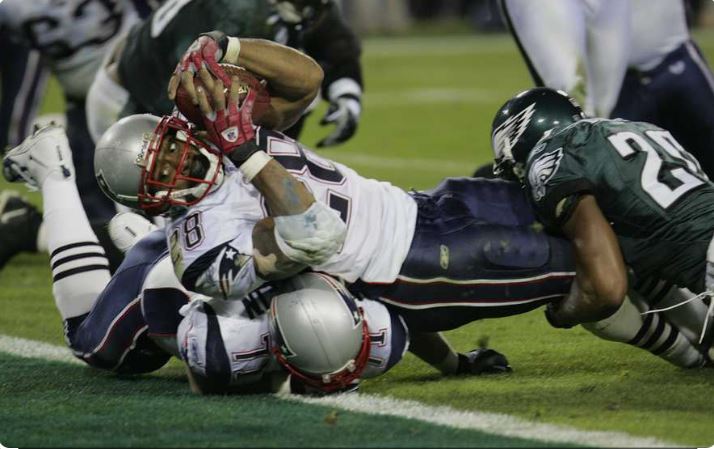
Try the driving force for their back to back championship season of 2004. He wasn’t just a member of that team. Dillon ran for a Patriots team record 1,635 yards and 13TDs & was the closer for the best of the three champions in their dynasty. He had 9 100 yard performances that year and the playoff clinching win came against Cincinnati. Where he received the game ball from Bill Belichick.

The Patriots went on to win Super Bowl XXXIX 24-21 which validated the career of Corey Dillon. Overall he rushed for 11,241 yards and 82 TDs. Dillon is one of a select few to set the franchise single season rushing record for two different teams.

As the argument heats up about the candidacy of other power runners like Eddie George and Jerome Bettis, neither showed the exhibition of power and speed Dillon displayed. Not to record breaking levels. He had 7 1,000 yard seasons and was a world champion. What could have become of Dillon’s career had he more talent around him??

Please lend your thoughts as well by writing in to the Pro Football Hall of Fame to the address below. Be respectful and positively lend your voice:

Please write & nominate Corey Dillon
Send letters to:
Pro Football Hall of Fame
Attention Hall of Fame Selection Committee
2121 George Halas Dr NW, Canton, 
OH 44708

There is also a fan vote here on the PFHOF website

For induction into the Pro Football Hall of Fame, I present to you Corey Dillon.


Roger Craig Should Be In Pro Football Hall of Fame

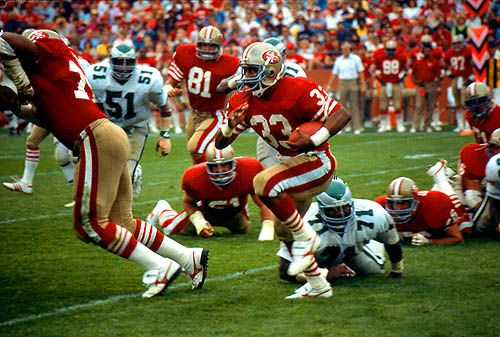
When you think back to Bill Walsh’s great 49er teams, who are the first players you think of?? Right there with the Joe Montanas, the Jerry Rices, and Ronnie Lotts it only takes a fraction of a second to think of Roger Craig. His high knee running style brought a physicality to the San Francisco offense that was seen as a finesse group up until his arrival. In fact he came to San Francisco as a fullback when they drafted him from Nebraska before the 1983 season.

In college he had been primarily a blocking back in the Cornhuskers wishbone offense. Normally he paved the way for Jarvis Redwine and then Mike Rozier. Yet when Bill Walsh decided to revamp San Francisco’s dismal backfield after a 3-6 season in 1982, he drafted Craig in the second round.

Although the 49ers had won it all in 1981, it had become apparent Bill Ring, Amos Lawrence, Walt Easley, and Earl Cooper just wasn’t cutting it in the backfield. To raise the stakes in the NFC for 1983, Craig and newly acquired Wendell Tyler would form a more potent backfield.

After posting the worst yards per carry average (3.4) and yardage (742) in 1982, the new backfield duo of Craig and Tyler turned that around completely. The much improved ground game of 1983 ranked 8th with 2,257 yards rushing and a gaudy 4.4 yard average. Ironically just ahead of the Los Angeles Rams, who had traded Tyler to San Francisco so they could draft Eric Dickerson.

You had to give the nod to Craig who ran for 783 yards a team leading 8 TDs, while catching 42 passes for 427 yards and another 4 scores. This more dynamic backfield, along with Joe Montana, powered San Francisco to the NFC Championship Game. A 24-21 loss to the Washington Redskins was shrouded in controversy, thanks to some questionable calls, yet Walsh had the backfield he envisioned. Craig had reinvented himself from a collegiate player who rarely touched the football to a dual threat pro.

The 1984 49ers were a juggernaut becoming the first team to go 15-1 during the regular season. Everyone of the 49 man roster played their role so no one had outstanding stats. However once the 49ers moved past the New York Giants and Chicago Bears during the playoffs, the stage was set for a coming out party in Super Bowl XIX. With all eyes on Joe Montana’s possible second Super Bowl trophy and the electrifying record setting Dan Marino, Craig’s name didn’t even make the marquee.


Roger Craig graces the cover of Sports Illustrated after his record breaking performance in Super Bowl XIX.

Roger Craig graces the cover of Sports Illustrated after his record breaking performance in Super Bowl XIX.

It was his 1985 that set Craig apart as he amassed his 1,000/ 1,000 yard seasons both rushing and receiving. The first player in league history to do so. Some 27 years later, only Hall of Famer Marshall Faulk shares that accomplishment when he did it in 1999. How dominating was his performance?? Well his 1,050 yards rushing doesn’t jump out at you until you realize he only ran 214 times for a whopping 4.9 yards per carry. The league average is always around 4.0.

Oh by the way, he led the NFL in receiving that year with 92, which set a record for running backs, that amassed 1,016 more yards. His 15 total touchdowns was second to Joe Morris and was 1 better than NFL MVP Marcus Allen. In fact many pundits, including our CEO believes Craig should have been the MVP in 1985 with that dominating performance.

Now buoy his 1985 record setting season not culminating with the league MVP, on the backdrop of a Super Bowl record 3 TDs yet not winning that MVP and you’ll see where we’re going in a minute. Don’t forget he did this on a 10-6 San Francisco team that was a defending champion with Jerry Rice being a rookie that didn’t have 1,000 yards receiving and only 3 touchdowns. Craig quite simply fueled that offense.

Once the 49ers won Super Bowl XIX, they were forced to retool and become a bigger physical team. In 1985, the Chicago Bears emerged with one of the most imposing defenses in NFL history. The Giants followed suit with an overwhelming defense that featured 4 linebackers in the 250 lbs category. When Bill Walsh and his 49ers were dominated 49-3 in the 1986 NFC Divisional Playoffs by the Giants something had to be done.

These were teams the 49ers had beaten on their way to the ’84 championship, now they had taken the game to a new level of brute force. In reinventing the offense from a size perspective, it was Craig who was switched from fullback to halfback to allow for the insertion of Tom Rathman at fullback. The entire offensive line was overhauled.

You have to keep in mind the average career for a runner in pro football is less than 4 years. Yet here Craig was making the switch in year 5 to a position that called for him to be quicker. This at a time where he should have been slowing down from a physical standpoint. Yet he, Jerry Rice and Joe Montana spearheaded one of history’s most accomplished runs. From 1987-1990 the 49ers went 51-12 in the regular season, winning back to back Super Bowls in ’88 & ’89 and were the prohibitive favorites to win it all in 1987 as well as 1990. They finished #1 in offense in ’87 and ’89 and #2 in ’88 and ’90. In each year they made it to at least the divisional round of the playoffs and 3 straight NFC Championship Games as they were trying to threepeat.

Playing in only 12 games due to the ’87 strike, Craig ran for 815 yards which projects out to 1,086 over a full season. The 13-2 Niners were poised to become the greatest team of the modern era yet were upset by the Vikings in the playoffs. They were #1 in both offense and defense yet proved fallible in the playoff loss. Craig went on to his greatest performance in the 1988 campaign. In rushing for a career high and club record 1,502 yards, he also caught 76 passes for an additional 534  yards for his second season with over 2,000 yards from scrimmage. More important, he powered San Francisco to another Super Bowl championship with a win over Cincinnati in the XXIII’d edition.

Roger Craig was a hard nosed runner.

Roger Craig was a hard nosed runner.

Yet go back to 1988 being his second season with more than 2,000 yards from scrimmage. Keep in mind this was no sleek, make ’em miss halfback. He brought a punishing style to his position where he bludgeoned the opposition. As you’re reading this you can picture his high knee running style like when he trampled through the Rams on his most famous run in 1988.

Yet did you know that Emmitt Smith, Thurman Thomas, and Barry Sanders only had 2 different seasons amassing 2,000 yards from scrimmage also?? Did you also know that Marcus Allen and Adrian Peterson have only had one?? Only Edgerrin James, Marshall Faulk, Ladainian Tomlinson, and Eric Dickerson had more. What do all of these runners have in common?? Peterson and Tomlinson will be in the Hall of Fame and all the others are in. Roger Craig is right there with them.

Now going into the Hall of Fame is based on impact on the game. By the time we bring up the 1989 team that won Super Bowl XXIV, Craig was a driving force behind the team of the decade. Again he was a 1,000 yard rusher as the team won their fourth Super Bowl and Roger had his 3rd ring. When he left the game in 1993, his 566 career receptions was #1 among running backs all time and still remains 7th.

He is in the linear line of great NFL running backs when it comes to catching the football and is a part of the game’s evolution. He took the mantle from Chuck Foreman and propelled it forward. Since then, only a handful of every down running backs have provided that type of versatility. Now everyone has a receiving running back who comes in on 3rd downs where Roger was in every play.

It was Craig’s play that allowed a young Jerry Rice to flourish as teams concentrated their efforts to stop him. If Craig’s move to halfback in 1987 hadn’t panned out, what would have been the legacy of Bill Walsh’s “West Coast Offense”?? It was the run from 1987-1990 that made the offense spread it’s wings throughout the National Football League. During this time is when it proved it could take on the big bad Chicago Bears defense (see 41-0 1987 Monday Night shutout) and 28-3 NFC Championship win in Soldier Field in ’88. Then you add the rivalry with the New York Giants.

From Mike Holmgren to Denny Green to Mike White to Jon Gruden ( who had just begun coaching on the 1990 SF coaching staff) and George Seifert succeeding Bill Walsh. They all could attribute their Head Coaching jobs to some extent to Craig’s performance along with Montana and Rice. Yet the foundation of that offense running and receiving along with goal line and short yardage was #33.

By the way, when did Roger Craig become the the first running back to have a 100 yard receiving game in a Super Bowl?? You guessed it… Super Bowl XXIII against Cincinnati and not his record setting performance against Miami. Now had he won the Super Bowl XIX MVP, or the 1985 NFL MVP, would that have propelled him to winning the NFL MVP in 1988?? Give it some thought.

For induction into the Pro Football Hall of Fame, I present to you…Roger Craig

Andre Reed Belongs In The Pro Football Hall of Fame

Andre Reed was a very dangerous receiver with the Buffalo Bills in the late 80s and early 90s.

Andre Reed was a very dangerous receiver with the Buffalo Bills in the late 80s and early 90s.

As many of the NFL’s best ever gather for the Pro Football Hall of Fame enshrinement ceremony, Andre Reed, who has been a finalist 7 times, remains on the outside looking in. Many forget how dangerous Andre Reed was with the football when the Buffalo Bills rose to prominence back in the late 80’s. He was a budding superstar before the Bills brought in James Lofton during the 1989 season.

Essentially and unselfishly he sacrificed personal glory as a slot receiver where he spent most of his time getting hit by linebackers and running away from safeties as he perfected the run after the catch. He could have been a prima donna and cried through the media for more passes, but he didn’t. He sacrificed for the good of the Buffalo Bills and it could be those lack of numbers now keeping him out of the Hall. So lets take a closer look.

During the early 1980’s, the Buffalo Bills were a downtrodden franchise with little direction. The Bills had stumbled in the standings from 1982-1984. going 14-27. The area was economically depressed and morale was low on a football team that was literally Siberia in NFL circles. However that changed in 1985 with the first overall draft selection of future Hall of Famer DE Bruce Smith and spent a fourth round pick on a little known receiver out of Kutztown St. Who?? Exactly. This was the draft where the pre-draft talk was on Jerry “World” Rice of Mississippi Valley State, and Al Toon out of Wisconsin. However there was talk brimming on a little known receiver shuffling off to Buffalo.

Reed as a rookie showed promise as he caught a modest 46 passes for 637 yards and 4 touchdowns. He and Smith were the first cogs in a rebuilding project that would include QB Jim Kelly in 1986, Shane Conlan, Cornelius Bennett in 1987, and Thurman Thomas in 1988. The Bills became a defensive minded team that ran the ball with a combination of Ronnie Harmon, Thomas, and Robb Riddick. It was the 1988 season, Reed’s fourth, where the team took off racing to an 11-1 record and became the first team to win their division by Thanksgiving. Reed made the Pro Bowl for the first time that season catching 71 passes for 968 yards and 7 touchdowns. Despite missing two games to injury. The Bills dropped the Houston Oilers 17-10 in the divisional round before falling to Cincinnati in the AFC Championship Game 21-10.

However it was the 1989 season where Andre Reed and the Bills offense hit full stride. For the record, he had become the NFL’s most dangerous receiver after the catch. In a year where the Bills found themselves in shootouts they opened up the offense with a no-huddle reminiscent of Kelly’s run & shoot USFL days. Reed burst into the nation’s consciousness when he had a 5 catch 135 yard 2 TD performance in a wild 47-41 overtime win against Houston. It was the game of the year and in spectacular fashion, Reed took a routine 5 yard pass and turned it into a winning 28 yard score. He juked the initial defender covering him, ran through an attempted arm tackle and took it down the sideline. Ballgame!! Reed finished with 88 receptions for a career best 1,312 yards and 9 touchdown (#2 in NFL /receptions) and became one of the league’s game breakers.

As the 9-7 Bills limped into the playoffs, they faced the aging Cleveland Browns in a divisional playoff.  With his team down 3-0, Kelly 0 for 5, and needing some offense, it was Reed who struck with a game breaking 72 yard touchdown to get the Bills into the game 7-3.

Reed went on to catch 6 for 115 yards and a touchdown as he was matched up against All Pro Cornerback Frank Minnifield all day. The 34-30 loss was one of the greatest games in NFL history and the nation’s first glimpse of what was to come. By 1990, with James Lofton now entrenched as a starter on the outside, the Bills ran their 3 receiver no huddle offense from the outset of the season and not as a 2 minute offense.  At the time, they made a then unheard of decision to have Reed play in the slot instead of the “Z” receiver. This isn’t like now where defenders aren’t allowed to really tee off on receivers running inside routes. He was never going to be the receiver running under picture perfect bombs again. He had to fight for yards the tough way….after the catch in the middle of defenses. As for the Bills offense??

Andre Reed tries to avoid Mark Collins in Super Bowl XXV.

Andre Reed tries to avoid Mark Collins in Super Bowl XXV.

Over the next five years, the Bills finished #1 in offense 3 times as the team went on to 4 Super Bowl appearances. During that time Reed amassed 288 receptions for 5,128 yards and 35 touchdowns on one of the offensive juggernauts in NFL history. While teammates Jim Kelly and Thurman Thomas won several offensive player of the year awards and an NFL MVP in 1991, it was Reed who was the only Pro Bowler in all five of those seasons. The attention defenses afforded Reed on the inside is why Lofton reemerged as one of the league’s deep threats. Thanks to 2, 1,000 yard seasons, Lofton retired after 1992 as the NFL’s yardage reception leader with 14,—- yards. The last few years of his career propelled him to Canton as a Hall of Famer thanks to Reed’s sacrifice within the team’s offensive structure.

One of the greatest aspects of Reed’s career was his performance in the postseason. We already alluded to the great game he had against the Browns in 1989. In ’90 the Bills had homefield throughout the playoffs yet Jim Kelly had missed the last three regular season games. Experts weren’t sure they could pick up where they had left off, until Reed caught a shallow crossing route, broke two tackles turning it into a 40 yard touchdown. 7-0 and the Dolphins were hanging on for dear life. In a 44-34 triumph, Reed scored the clinching touchdown on a similar play from 26 yards out. On the day he caught 4 passes for 122 yards and a pair of scores.

In 1992, Reed was the Bills only top shelf performer in the AFC Wild Card tilt with the Houston Oilers. After spotting the Oilers a 35-3 third quarter lead, Buffalo roared back to win 41-38 in the greatest comeback in NFL history. Both Hall of Fame quarterback Jim Kelly and Hall of Fame running back, Thurman Thomas didn’t play that day. All Reed did was team with Frank Reich, gather 8 receptions for 136 yards and 3 second half touchdowns including the one that tied it at 38 to force overtime. Although the Bills were beaten soundly in Super Bowl XXVII, Reed had another spectacular performance with 8 receptions for 152 yards, breaking two catches for over 35 yards in the second quarter to keep the game close. At halftime the Cowboys jumped his routes on their way to a blow out win. He was that much a factor early….but Dallas pulled away 52-17.

The ultimate reason Reed is a Hall of Famer is the way he played. Without being the size of a linebacker like Brandon Marshall, Terrell Owens, and this huge new breed of receiver, Reed only stood 6’2 and 190 lbs, yet he didn’t catch short passes and slide to the ground waiting to get touched down. He stiff armed defenders and ran through arm tackles for most of his touchdowns. He was the greatest ever receiver when it came to yardage after the catch. As you saw in the latest film, he caught passes over the middle and only when the Bills caught teams in a blitz did he sight adjust to a longer pattern. Otherwise he ran through defensive backs with ease. Over his 16 year career, he gathered in 951 receptions for 13,151 yards and 87 touchdowns. He ranks 10th all time in receptions and his 27 receptions in Super Bowl competition is 2nd only to Jerry Rice.

Had Andre Reed not sacrificed for the good of the Bills offense, would James Lofton have made the Pro Football Hall of Fame?? Would Jim Kelly and Thurman Thomas?? For a period, Kelly and Reed held the record for most touchdowns by a combination in NFL history. They wrested that mantle from Johnny Unitas and Raymond Berry, which has since been broken by Peyton Manning and Marvin Harrison. The closest duo in the 1990’s was Steve Young and Jerry Rice. All of these players are either in the Pro Football Hall of Fame or a shoo-in to get there as the count down for Manning will start this February. Only Marvin Harrison and Andre Reed are on the outside looking in. Reed deserves to be in the Hall of Fame for his fearless play.

For induction into the Pro Football Hall of Fame, I present Andre Reed

Thanks for reading and please share the article.
NEXT: 2013 Washington Redskins Preview

Warren Sapp Makes The Hall of Fame

Warren Sapp as a Miami [[_]] Hurricane!!

Warren Sapp as a Miami [[_]] Hurricane!!

When you think back to Tampa Bay’s Super Bow XXXVII win over the Oakland Raiders, you knew it was a win that was years in the making. It was born when Buccaneer coach Sam Wyche made two critical moves that solidified the franchise. The first thing he did was turn the organization into a defensive minded outfit, by signing free agent Middle Linebacker Hardy Nickerson as it’s  impenetrable core. This was the first year of NFL free agency in 1993 and this was where the Buccaneers re-invented themselves. Second was anointing Wyche’s assistant coach to Head Coach, Tony Dungy who selected Warren Sapp and Derrick Brooks in the draft of 1995. Brooks was a slightly undersized linebacker from Florida St.  But Warren Sapp??

Twin draft pics in 1995 turned the fortune of the Tampa Bay Buccaneers.

Twin draft pics in 1995 turned the fortune of the Tampa Bay Buccaneers.

After a sterling career at the University of Miami, Sapp was in line to make an impact on the NFL when before the draft, a report was leaked that Sapp had failed drug tests which affected his status. Even though he was the Big East Defensive Players of the Year, an All American, and winner of both the Nagurski and Lombardi Awards, 11 teams passed on him on draft day. He was projected to go number 1 and fell to the “Yucs” at #12. You could see the disappointment in his face. The picture above was once they were in Tampa for the press conference.

Why the “Yucs”?? This team had been laughingstocks for most of their history up to that point. For 12 years, from 1983-1994 the team had double-digit losses.

What didn’t bode well for Warren Sapp that day was the fuel to what burned as motivation for Sapp the rest of his career. He started slowly but by his 2nd season, he made his presence felt with 51 tackles, 9 sacks and 1 forced fumble. Since he was one with a big mouth and part of the “in your face generation” that hit the NFL in the mid to late 90’s it took time to gain acceptance. He should have made the Pro Bowl in ’96 but the Buccaneers were 6-10 and still a loser.

Sapp was a larger than life defensive tackle that Tony Dungy built his defense around. Pictured here celebrating in Super Bowl XXXVII.

Sapp was a larger than life defensive tackle that Tony Dungy built his defense around. Pictured here celebrating in Super Bowl XXXVII.

All that changed in 1997 as the team rolled out to a 5-0 start. In the opener against San Francisco, they knocked out both Steve Young and Jerry Rice in a 13-6 win. Sapp had relentlessly been involved in both plays. He began the season on everyone’s radar with a 2 1/2 sack performance.  In a frightening display of power and speed, Warren and the Bucs in their new uniforms showed a new day was dawning in Tampa.

They had throttled an offense that had been one of the NFL’s best for two decades and knocked Jerry Rice out for the season. Those two points alone had NFL shows talking about the 49ers, the Bucs, and especially Warren Sapp. No longer was he just one for on-field antics that made a few defensive plays, he was maturing into the best interior lineman in football. In ’97 he finished with 58 tackles, 10 1/2 sacks along with 3 forced fumbles and 1 recovery. They finished with a 10-6 record and a defensive ranking of #3.  Earning Tampa its first playoff berth in 14 years.

After defeating the Lions for their first playoff win since 1979, they made the pilgrimmage to Lambeau Field for a divisional playoff against the defending Super bowl Champion Packers.  Many weren’t taking the Bucs too serious. You have to understand the stigma they were trying to shed. Further evidence was the fact that 5 of their 6 losses had come from within the NFC Central. Sure they beat an inconsistent Detroit in the Wild Card 20-10. Many thought the Bucs would be happy just getting to the divisional round. Where Favre, White, Joyner and company were eyeing back to back championships and should plow through the neophyte Bucs. Besides, it would be 27* and Tampa hadn’t won a game where it was under 40* ever.

Sapp chases down Favre for one of his 3 sacks in the 1998 NFC Divisional Playoff in Lambeau.

Sapp chases down Favre for one of his 3 sacks in the 1998 NFC Divisional Playoff in Lambeau.

What took place on a dreary day in Green Bay was a young Lion standing toe to toe with an old warrior for 60 brutal minutes of football. In the signature game that defined his career, Sapp was all over Brett Favre and the Packer offense. He amassed 3 sacks and a fumble recovery. After each time he stopped a running play or harassed Favre, the two talked trash to each other and a national television audience witnessed the coming of the Bucs.

Inspired by Sapp’s lead by example, the Bucs, who had fallen behind 13-0, refused to be buried and began to believe they could win. Although they fell just 21-7, many saw a future champion in Tampa. On this day, he wrested the defensive leader mantle from Nickerson and placed it on himself. He was the face of the franchise and the entire off-season, his performance in that playoff loss to Green Bay seemed to be all people were talking about.

What we saw that day were two of the NFL’s best playing high stakes football as though it were being played in a backyard somewhere. The little brother Bucs led by Warren passionately jawing and playing with the favored big brother Packers led by Brett. Tony Dungy had tuned his team to the point they needed to catch and beat Green Bay in their growth as a club. So the playoff game was played like it was a Super Bowl.

In 1999, Sapp had the best season of his career. He was named NFL Defensive Player of the Year for his 41 tackle, 12 1/2 sacks, and 4 forced fumble performance. He led the Bucs back to the NFL playoffs, this time making it to the NFC Championship Game. Although an 11-6 loss to the Rams kept them from Super Bowl glory, Sapp led his team there at the conclusion of the 2002 season.

The calm before the storm before Super Bowl XXXVII.

The calm before the Super Bowl XXXVII storm. Tampa won 48-21. The Raiders never knew what hit them.

The victory in Super Bowl XXXVII validated many careers and vindicated one Warren Sapp. Eight years before he was embarrassed at the NFL draft amid rumors of drug use and having his character in question after his years in Miami. To some they still saw him as a big-mouthed player that was more show than substance. That Super Bowl victory made them have to acknowledge him as a champion. Critics had to give him his due as the best “three” technique defensive tackle of his time.

300_110727For his career he amassed 573 tackles, 96 1/2 sacks, 19 forced fumbles, 12 recoveries, and 4 interceptions, returning one for a touchdown.  Since the NFL is about sack totals for most pundits, he’s second only behind former Viking and Hall of Fame member John Randle. Whom he played with many times in Hawai’i where he made 7 trips to the Pro Bowl. Sapp wanted to be remembered like a Joe Greene. A true giant of the game.

Right after Super Bowl XXXVII, Sapp said we had to put his Bucs up there with the greatest defenses to play in the NFL. Can that point be argued??

  • ’85 Chicago Bears – #1 defense / allowed 258.4 yards per game /allowed 198 points for the season / 64 sacks / 34 ints / scored 6 TDs defensively
  • ’00 Baltimore Ravens -#2 defense / allowed 247.9 yards per game /allowed 165 points for the season / 43 sacks /23 ints/  1TD scored defensively
  • ’02 Tampa Buccaneers – #1 defense / allowed 252.8 yards per game / allowed 196 points for the season / 43 sacks/ 31 ints /scored 5TDs defensively
  • ’78 Pittsburgh Steelers – #3 defense / allowed 260.5 yards per game /allowed 198 points for the season/  / 27 ints /1 TD scored defensively

On second thought an argument can be made for the 2002 Tampa By defense as among the best of the Super Bowl era. One point that can’t be is the selection of Warren Sapp as a Hall of Famer.

For induction into the Pro Football Hall of Fame, from The [[_]], Warren Sapp aka QB Killa

Thanks for reading and share the article.

Taylor Blitz Times new logo!!

Taylor Blitz Times new logo!!

The 2013 Class of Hall of Fame Enshrinees: Bill Parcells & Cris Carter

300_110727The Pro Football Hall of Fame is the culmination of a career where a player, coach or owner stood as giants of the game. Once they’re enshrined here, they belong to every football fan for all eternity. Family members and fans can come to a place where they’ll be forever young and immortalized as one of the greats of all time.

This was the 50th anniversary class of those that went in. There will be another day for those that didn’t make it on this ballot but this is where we celebrate those that did make it.

Parcells

2013 Hall of Fame Enshrinee

Coach Bill Parcells – The only coach in NFL history to take 4 teams to the NFL’s post-season. Although many still think of him as the Head Coach of the New York Giants, don’t forget he took the 1998 New York Jets to a 12-4 record and the AFC Championship that season. This came on the heels of taking the New England Patriots to Super Bowl just two seasons before. His last good team was the 2007 Dallas Cowboys that finished 13-3 that should have played for it all. If not for a Patrick Crayton dropped pass in the 4th quarter, he may have had a third make the Super Bowl.

He finished 172-130-1 in the regular season and was 11-8 in the playoffs including 2 Super Bowls. Yet think about it?? He almost led four different teams to the Super Bowl, the latter three in an 11 year period. His famous departure from New England where he claimed “If you’re going to cook the meal you should be able to shop for the groceries.” He shopped for former Patriot in Hall of Fame back Curtis Martin and resurrected Vinny Testaverde’s career and pointed Bryan Cox in the right direction.  He’s now where he belongs, among the true giants of the game.

From THE Ohio State University: Cris Carter

From THE Ohio State University: Cris Carter

WR Cris Carter -What can’t be said that we hadn’t already said in our article about his Hall of Fame candidacy?? Has there been a better set of hands in the history of Pro Football?? How many ridiculous one handed catches did Cris Carter make during his great career with the Philadelphia Eagles and mainly with the Minnesota Vikings?? At first glance, the numbers stand out with 1,101 receptions for 13,899 yards and 130 touchdowns. Good for 2nd most in NFL history for receptions and receiving touchdowns at the time of his retirement.One of the greatest attributes is that he honed his skill amidst a myriad of pedestrian NFL quarterbacks.

The Vikings claimed Carter from the waiver wire for $100!! They nabbed a Hall of Fame wide receiver for half the price of a smartphone. Think about that for a second. With the humbling experience he rededicated himself and gave up his tempestuous ways and became a polished receiver with the Vikings. So polished that he thrived with moderate quarterbacking in Minnesota in the ensuing years. Do you realize that in just 12 years for the Norsemen he caught 1,004 receptions for 12,383 yards and 110 touchdowns?? Do you also realize he did most of this while catching passes from the likes of a moderately successful Sean Salisbury, a decade away from developing Rich Gannon, an eroding (with his fourth team) Jim McMahon, a developing Brad Johnson, and an on the downside late 30′s Warren Moon?? Now why didn’t we place an out of retirement Comeback Player of the Year Randall Cunningham with this group?? Because his three best years came before the famous 1998 Vikings everyone remembers with Cunningham & Randy Moss.

Carter, along with Jerry Rice became the first receivers not named Sterling Sharpe to have 100 receptions in back to back seasons for 1994 & 1995. Carter caught 122 in ’94 then 122 in ’95 as compared to Rice’s 112 and 122 respectively. It was 1994-1996 where Carter did his best work. In 1994 his stat-line was 122 rec. for 1,256 yards and 7 TDs. He followed that up with 122 receptions for 1,371 yards and a career high 17 touchdowns in 1995. Lets compare these numbers with Hall of Famer Jerry Rice and should be Hall of Famer Sterling Sharpe over their best 3 year periods. Where Sharpe’s numbers are 1992-1994, Rice and Carter’s are both from 1994-1996.

  • Cris Carter (1994-1996) 340 receptions, 3,790 yards & 34TDs
  • Jerry Rice (1994-1996) 342 receptions, 4,601 yards & 36TDs
  • Sterling Sharpe (1992-1994) 314 receptions, 3,854yards & 42 TDs

No longer does he have to be compared or concerned about not being enshrined. We will hear this come August: For induction into the Pro Football Hall of Fame, I present to you “From THE Ohio St University” Cris Carter!

Thanks for reading and please share the article.