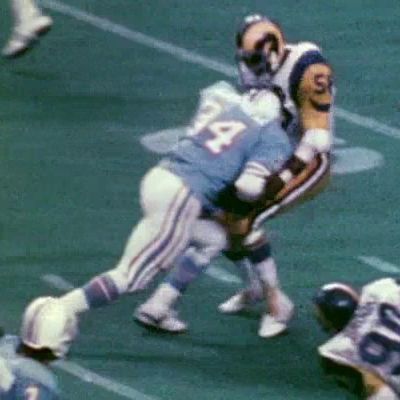
The Soul of The Game: Greg Lloyd

When you think of the Pittsburgh Steelers defenses of the last twenty years, one of the first players you think of is Greg Lloyd. After the original Steel Curtain defenses of the 1970s, there was a time Pittsburgh’s defense just didn’t scare anyone. Think back to the abysmal defenses from the mid 80s going into the early 90s. Aside from Mike Merriweather few of their defenders played with any distinction.

The most intimidating Steeler of them all.... Greg Lloyd

The most intimidating Steeler of them all…. Greg Lloyd

The one player that brought back the intimidation factor that had been a hallmark of Steeler defenses was Greg Lloyd. From his demeanor down to his disdain for the opposition. He flourished with the coming of Bill Cowher in 1992 and when Kevin Greene was signed a year later, Pittsburgh became Blitzburgh. They were the impetus for a ferocious defense and as for the embodiment of Steeler defensive football:

Unfortunately 1995 was the last year we saw Lloyd at full strength as a knee injury robbed him of his 1996 season and much of his explosiveness. However from 1991-1995 there wasn’t a more active linebacker as he averaged 97.5 tackles, 7.4 sacks, & 5.4 forced fumbles per season. Didn’t we give high consideration for TBT Defensive Player of the year to Navorro Bowman for his 6 forced fumbles??

greg-lloyd1Lloyd had played 8 seasons before that knee injury. He made the Pro Bowl 5 straight years and garnered All Pro distinction in the last three of those five. He played on through 1998 completing an 11 year career with the final played with the Carolina Panthers. It might be time to discuss his Hall of Fame candidacy. If you think about it… you can’t discuss NFL defensive excellence in the 1990’s without Lloyd’s inclusion.
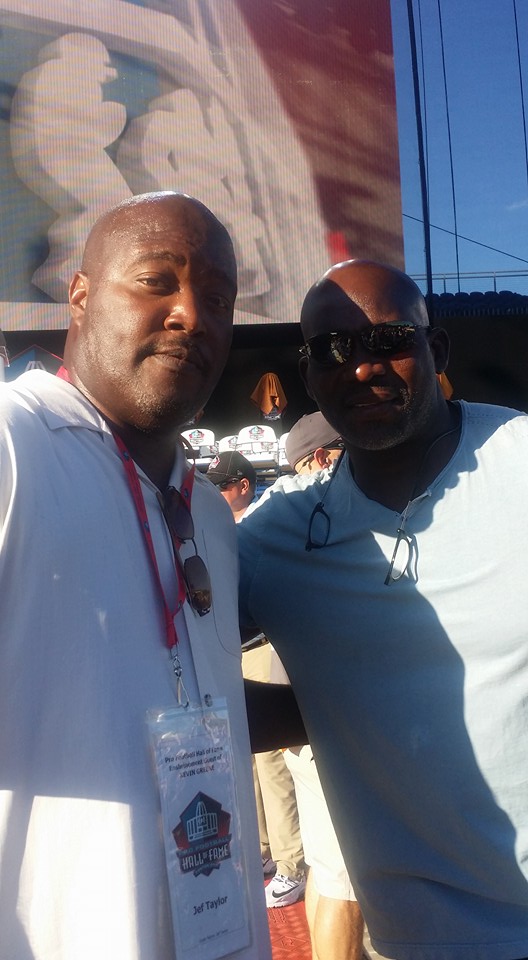
me-lloyd

Thanks for reading and please share the article.

The Soul Of The Game: Mike Singletary

Is it me or is it sacrilege to see the Chicago Bears dead last against the run with a #50 on the field?? Take that number off Anderson trying to play linebacker in Chicago!! Number 50 belongs to the heart and soul of the toughest defense in NFL history. When #50 comes to mind you think of some of the best play at Middle Linebacker in history also. That number should be retired and hanging on the wall of fame at Soldier Field.

When we go back to the early 1980’s, the majority of teams were moving to the 3-4 defense and away from the 4-3 that had been a staple for decades. A leader was being developed that revolutionized the play of Middle Linebacker. Before him, Jack Lambert was the first to play deep enough in his middle zone to cover receivers. However Singletary was actually assigned to guard receivers in Buddy Ryan’s 46 defense. When you watch the first series in Super Bowl XX, it was Singletary who wheeled around and knocked down the pass for Patriot wideout Stanley Morgan that kept them from scoring first. He was aiding CB Leslie Frazier on the play.

Yet make no bones about it, this was no third down pass defense specialist. He was the first MLB of the modern era who attacked backs yet had the athleticism to cover receivers crossing his area. Unlike Lambert, Samuari Mike left huge hits in all parts of the field. Collisions that made him a feared defender.  Singletary was a great form tackler. Hits that led to his induction into the Pro Football Hall of Fame.

The 1980’s brought 3rd down situation substitution to the NFL like the nickle defense. One where big thick MLBs were replaced by either a 3rd cornerback or a lanky skinnier linebacker who had pass first responsibility. Chicago Defensive Coordinator Buddy Ryan developed the 46 defense first as a nickle, then modified it to fit regular personnel that became the scourge of the league. Ironically he starred in a defense that was originally designed to replace his position.

In 1985 he was the signal caller to the most complex defense in NFL history. The 46 defense had nearly 70 blitzes and 20-30 fronts. While he was directing traffic on the #1 defense, he went on to become NFL Defensive Player of the Year as the 15-1 Bears won Super Bowl XX. This was Singletary at his zenith. Those of us old enough can remember the 4th and 1 attempt by the Rams with Eric Dickerson in the ’85 NFC Championshp. Not only did he stop him, he popped out several screws that held his facemask to his helmet the hit was so hard.

Out of a time capsule, here is what was thought of Mike Singletary’s 1985 season back then.

One of the fiercest hitters in NFL history who starred on one of the storied defenses in NFL history should have his number retired. The Chancellor of Football did get to meet Singletary during his rookie year in coaching in 2003. Was with the Rojas clan and we were guests of Brian Billick’s with sideline passes to enjoy the game as guests of the Ravens. I got the chance to talk some football with him for a few minutes and was glad to see him coaching. Right now he’s on Leslie Frazier’s coaching staff in Minnesota. Yup, that same Leslie Frazier he saved from giving up the first touchdown in Super Bowl XX. Yet today, we’re talking about an earlier incarnation of Mike, one of the best hitters in NFL history.

Hall of Fame linebacker Mike Singletary and The Chancellor of Football on the Ravens sideline in 2003.

Hall of Fame linebacker Mike Singletary and The Chancellor of Football on the Ravens sideline in 2003.

Thanks for reading and please share the article.

The Soul of The Game: Earl Campbell

When it comes to great hitting in the NFL, the first vision that comes to mind are those of defenders teeing off on offensive players. Yet some of the most frightening collisions were those that took place when Earl Campbell ran with the football.

earl.isiahHis aggressive style of play burst onto the NFL scene in 1978 and for the next four seasons was the most dynamic force the league had seen since Jim Brown’s retirement more than a decade before.

In the lineage of great power backs he was Larry Csonka’s successor in the 1970’s while raising the profile of the Houston Oilers. He was used as a bludgeoning weapon to hammer defenses into submission. The only defense he couldn’t beat down with regularity was the Steel Curtain in Pittsburgh. In back to back AFC Championship Games in 1978 and 1979, they kept Campbell short of a deserved Super Bowl visit. Yet against Atlanta’s Gritz Blitz, Denver’s Orange Crush, or even Dallas’ Doomsday Defense, he was the Oilers complete gameplan. Some of his best games came against the best defenses of his day.


In 1977 the Atlanta Falcons had set the record for fewest points given up in a 14 game NFL season with 129. They’re “Gritz Blitz” of Jerry Glanville had first shot at the former Heisman winner in game one of 1978. Campbell smashed off tackle for a 73 yard touchdown in the 1st quarter en route to 137 yards for the game. The fact they were behind for much of the game is why he only carried 15 times. He showed he belonged.

Against the Dallas Cowboys in 1979, a national televised audience tuned in on Thanksgiving to see Earl Campbell vs. Doomsday at Texas Stadium. Again he broke off tackle trampling Cowboys on the way to a 61 yard touchdown that set the tone for the day. His 195 yards rushing was the most ever given up (at that time) in the history of Texas Stadium. He was the star of the game.

Yet when you think of Earl Campbell, it was the collisions that come to mind. He was the most physical runner in NFL history. You’d have to give him the nod over Jim Brown because of the size of the fronts he faced. In the 1960s Brown faced defenses that averaged 250 lbs on the defensive line. He outweighed the linebackers of the time and the contemporary talent was fractured with so much defensive size being displayed over in the AFL. Campbell was facing defensive linemen in the 280 lbs range with middle linebackers outweighing his 225 lbs.

He was able to produce more force than both Brown and Larry Csonka because of the additional room taking the ball on pitches and handoffs back in the I formation and not from a fullback setting. Who was the most punishing runner in NFL history in your eyes?? The Chancellor’s vote is in.

The Soul Of The Game: Randy White

Randy White... easily a Hall of Fame player.

Randy White… easily a Hall of Fame player.

When it comes to great hitting in the NFL, much of it takes place on the line of scrimmage, away from the camera following the football. However there are players who deliver those hits on quarterbacks, running backs and those same offensive linemen. Randy White was one of those players. An intense desire burned in him if you ever watched him play.

In fact it was that desire which helped him turn in probably the NFL’s greatest defensive play in our CEO’s estimation. In the 1980 season finale, Dallas needed to beat the Eagles by 25 points to win the NFC East. The Eagles were near midfield when they completed a slant to wide receiver Scott Fitzkee, who took off for the goal line. White, who had seen the pass whiz by turned and chased down Fitzkee tackling him at the 5 yard line. Ask yourself when was the last time you saw a defensive lineman chase down a receiver after a 49 yard gain??

Of course that wasn’t a great hit but it showed unbelievable heart. When you thought of the Dallas Cowboys during the late 1970’s and thought of toughness, he was the one that came to mind. He wasn’t that big either and thrived on his quickness to get into the “A” gap of opposing offenses.

One aspect of his play that is unusual is his size for a defensive tackle. The Cowboys had him listed at 6’4″ 257 lbs but that was a smokescreen. He looks like he’s about 6’1 or 6’2 and played at a weight where most of his contemporaries were pushing 275-280 lbs. We have yet to see in any film where White was bigger than a player trying to block him.

Randy White was a flat out beast for the Dallas Cowboys.

Randy White was a flat out beast for the Dallas Cowboys.

Over his 14 year career he made the Pro Bowl 9 times and was voted All Pro in 8 of them.  He was the impetus to the Doomsday Defense II that followed the original unit Bob Lilly, Lee Roy Jordan, Dave Edwards, and Chuck Howley played on. In fact along with Howley, White shares the distinction of being named Super Bowl MVP while wearing #54 for the Cowboys. Howley did so as the only player from a losing team, to nab that distinction in Super Bowl V.

As for White, he was the co-winner along with the late Harvey Martin for chasing Craig Morton all over the Super Dome in game number XII. In that contest he and the defensive line hounded Denver quarterbacks into 4 interceptions on 8 of 25 passing for 61 yards. In a Super Bowl?? Yikes. For his career he finished with 9 Pro Bowls and 7 – 1st team All Pro selections. A sure Hall of Fame performer which raises an interesting question: Who was the Dallas Cowboys all time greatest defensive tackle?? Bob “Mr. Cowboy” Lilly or Randy “Manster” White??

Thanks for reading and please share the article.

NEXT: Andre Reed Belongs In The Pro Football Hall of Fame

The Soul Of The Game: Pat Fischer

In the long history of the NFL there have been players who defined their positions because of their physicality. Men like Dick Butkus, Dick “Night Train” Lane, and Lawrence Taylor were freaks at their position. They were bigger than what other teams were geared to deal with normally. Yet there are those that stand out as hitters first although their size would suggest something different. Enter Pat Fischer.

Standing only 5’9, and 170 lbs (that can’t be right) Smith played in an era where the NFL was a running league. Unlike today’s game where he could play out in space chasing an X, Z, or slot receiver, Fischer had to come up and tackle in an era where everyone was emulating Green Bay’s power sweep. He had to take on pulling guards,  some fullbacks along with his coverage responsibilities. Yet he only missed 10 games in his first 16 years.

Pat Fisher played cornerback for 17 NFL seasons.

Pat Fisher played cornerback for 17 NFL seasons.

His physical play belied his diminutive size as he played as a pint sized intimidator. Lionel “Train” James loves to say “It’s not the size of the dog in the fight, it’s the size of the fight in the dog.” Never was this more true than of Pat Fisher. Even in the Super Bowl VII highlight, NFL Films had John Facenda narrate how much a nemesis he was against the run and the pass. Let’s face it, a cornerback his size now is primarily a special team guy who is platooned only against multiple receiver sets. They rarely tackle players other than small slot receivers. Take a look at how Fisher played…

In the NFL of the 1960’s there was a concentration of talent that stayed with the same teams and systems for many years. Fischer was caught in this vice where Hall of Fame cornerbacks Dick “Night Train” Lane, Herb Adderley, Jimmy Johnson, and Lem Barney were playing. He was an overlooked player for awhile and some of it could have been other players not leaving behind on-field animosity when voting for fellow players.

There has to be some truth to it or Fischer wouldn’t have had one of his 3 Pro Bowl seasons in 1969 when he had just 2 interceptions. Now his first, in 1964, where he picked off 10 returning them for 164 yards and 2 touchdowns couldn’t be ignored. That was 1 TD short of the all time record. Yet other years he was overshadowed by these other players.

mel-gray-05893042

Pat Fischer played well into the 70’s and here he is going against Mel Gray in the mid ’70s.

One could also make the argument Fischer’s 1969 Pro Bowl and All Pro season came because of the higher visibility Vince Lombardi brought to the team in his only year coaching there.

Whatever the reason, Fischer played from 1961-1977 and retired having played in more games at cornerback in NFL history. If you think about that time frame, he came in 9 years before the AFL / NFL merger and played through the 12th Super Bowl. This is before the modern athlete could have arthroscopic surgery between seasons to prolong their careers. Does he belong in the Hall of Fame??

Thanks for reading and please share the article.

The Soul Of The Game: Bill Brown

Our choice for first special teams player to go to the Hall of Fame would be Bill Brown.

Our choice for first special teams player to go to the Hall of Fame would be Bill Brown.

When Steve Tasker was about to retire from the Buffalo Bills in 1997, many pundits talked about is candidacy for the Pro Football Hall of Fame. Aside from former Chiefs kicker Jan Stenerud, no player who played primarily on special teams has made it into the halls of Canton. Everyone thought Steve should be the first along with Pat Tillman and possibly Hank Bauer. However if you ask our CEO who should be the first person to make the Hall of Fame when it comes to special teams players, Bill Brown of the 1960s-1970s Minnesota Vikings would be the first.

Our The Soul of The Game series is about hitting and defense. Its still the essence of the sport. Although Bill Brown was a Full Back, he played special teams through his entire career. Most notably when the Vikings decided to get younger and drafted Full Back Chuck Foreman out of the University of Miami (The [[_]]) in 1973. In most instances an aging player goes to another team or sits the bench quietly. Out of the offensive limelight Brown still crashed on special teams as the Vikings became a Super Bowl team again in 1973 & 1974.


After the Vikings played in Super Bowl IX, a 16-6 loss to the Pittsburgh Steelers, Brown retired after a 14 year career. He had been a Pro Bowl Full Back 4 times back in the 1960s and finished his career with 5,838 yards rushing and 52 touchdowns. So his career did have real merit.

The only issue is the tackles weren’t being recorded on special teams to further showcase his contributions. However Brown’s career concluded well over a decade before the first Pro Bowl slot for a special teams player was introduced. He did go down and hit as the video will attest. What is sprinkled in the video as well are the many tackles he made after a fumble or an interception against the Vikings offense. Notice how many times he hits a linebacker wearing a 50s series number. Bill Brown was a complete football player and should be the first special teams player to go into the Pro Football Hall of Fame as a special teams ace.

Thanks again and please share the article.

Bill Brown (June 29, 1938- Nov. 4, 2018)

Taylor Blitz Times new logo!!

Taylor Blitz Times new logo!!