Baylor’s Robert Griffin III Takes Home the Heisman Trophy

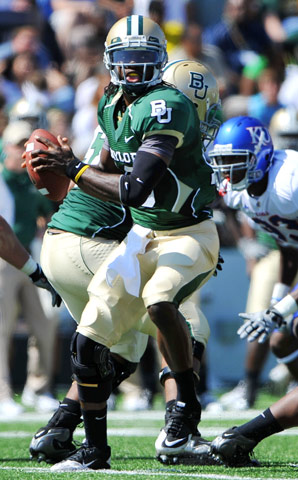
Robert Griffin III outruns Andrew Luck for the 2011 Heisman Trophy

Congratulations to the 77th Heisman Trophy winner in Baylor’s Robert Griffin III. He was easily the most electrifying player this year, a Cam Newton-lite if you will. It may have been a benefit Newton didn’t win it last year. Although he was swirled amidst off field allegations, had he won it last year the voters may have looked to give the award to another type of player this year or position. However if you look at Griffin III’s season in a vacuum, he deserved it hands down.

All he did was lead perennial doormat Baylor into the National spotlight completing 267 of 369, for 3,998 yards, 36TDs to only 6 interceptions. He was also a threat on the ground where he ran for 649 yards and another 9 touchdowns. He’s just 353 yards away from a 5,000 yard season against stellar competition and still has an Alamo Bowl showdown with Washington to pad his stats further.

Statistics don’t tell half the story. It was this electrifying talent that led his teammates to believe they could play with anyone. It started with his destruction of #14 TCU’s highly ranked defense, to the tune of 359 yards passing and 5 touchdowns in building a 47-21 lead. After the Bears offense grew cold, Griffin proved his mettle driving the Bears to the winning field goal 50-48 and a collegiate star was born. This was the first great early game of the season and talk of Griffin III’s exploits were showcased on national television.

Then really grew steam when he performed the coup de gras against Oklahoma. His Baylor Bears were ranked 22nd and were taking on media darling Bob Stoops and his #5 ranked Sooners. You have to understand the Bears were 3 weeks removed from losing badly to ranked #4 Oklahoma St. (59-24) and #23 Texas A & M (55-28). Their confidence was shaken as a team going into this game and it was do or die to find out if they were for real.  Griffin, who passed and ran his team to a 38-24 fourth quarter lead in one of the game’s of the year, dazzled early. Once their momentum crested, the high powered Sooners sprang to life and rallied to tie the score 38-38, with 2:38 to go.

With Oklahoma holding all three time outs, the Bears came out conservative and ran a dive showing they were content to go to overtime. Stoops called the first of his timeouts, which showed the Sooners wanted to force the Bears to punt the ball back and give the Sooners a chance to win it in regulation. Baylor’s body english looked defeated and Waco was completely silent. Armed with the knowledge of what Oklahoma intended to do, it was Griffin III who charged back to the huddle to breathe life in his team. He completed two strikes in the heart of the Sooner’s zone to put Baylor in field goal range reversing the momentum. Instead of waiting to kick the winning field goal, on first down he scrambled to his left and fired a 34 yard touchdown to Terrance Williams with :08 left. BALLGAME!!

By the time he engineered a 48-24 trouncing of the 22nd ranked Texas Longhorns, it was obvious this was the best player in all of college football. He led the Bears to a 4-2 record over top 25 teams. In the aforementioned games with Oklahoma and Texas how’d he do?? Against Oklahoma Griffin III ran for 98 yards while throwing for 479 yards and 4 touchdowns. Then you had him toast up the Longhorns rushing for 36 yards and 2 TDs, while throwing for 320 yards and 2 more scores.

Buoyed by these three signature games, it was impossible to hand the Heisman to another player. He carried his team into national prominence and backed up the press clippings with performance. The Baylor Bears went 9-3 with him at the helm and had their best record since 1986. Now further that distinction with bringing the school it’s first ever Heisman winner. So what does he do as an encore?? We suspect a 500 yard performance (rushing and passing) and a high draft status in April.  With the Colts eyeing a pure drop back passer in Andrew Luck, it looks like many teams would vie for his services. Right now, the Cleveland Browns are on the clock.

For if he’s Cam Newton-lite, he may be just as deadly in his rookie year. We’ll have time for that later. As for right now, congratulations Robert Griffin III. You deserved your Heisman with a performance for the ages.

Thanks for reading and share the article.


A Word From the Chancellor: College Football- Boise St Needs To Become The New Miami Hurricanes

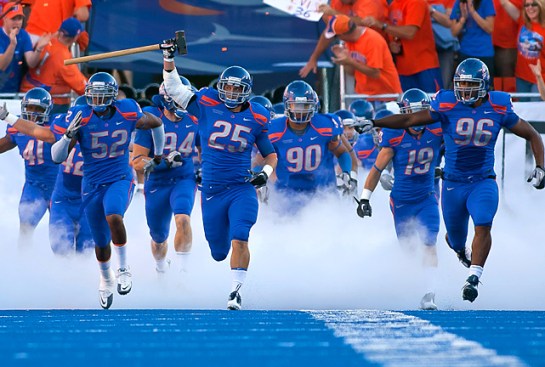
Boise St Broncos storming the field

After watching TCU and Boise St beat their heads against a brick wall just to play in BCS Bowl games, it finally hit our chancellor what needs to  be done.  The Mountain West Conference will never garner Boise St the respect it needs to crash the BCS Title Game no matter how well they play. The 4 undefeated seasons through the 2000s aren’t enough and neither were the 2 BCS Bowl wins in the eyes of jaded BCS conference lovers. With everyone joining these collegiate super conferences it’s time to reverse gears and go independent. Especially Boise St, at least TCU gets love since they hail from Texas.

Well, the blueprint has already been laid out for them. They are to copy the pattern that garnered the Miami Hurricanes prominence throughout the the 1980s and ’90s by being the independent foil that played 5 or 6 ranked opponents every year. This way they can play toward the mantra “it’s all about the money”, and take on teams that think they can beat them and will pay them for 3 to 4 game series. Think about it. Get a reported $800,000 from those three teams and supplement this with their bowl money. It will be a financial windfall. What happens if they take on a 3 game series with an LSU, and Ohio St., and an Alabama team that believes they can beat them?? Then they take on two to three single game  performances against a ranked West Virginia and USC, then schedule weaker opponents. If they come through a crucible such as that it forces the voters to rightfully vote them #1 if they can march through those 6. Gone is the conference argument being used against them. How well did this formula work for Miami??

Well the last time Miami was an independent and won the National Title outright was 1989, funny thing is they won a split title in 1991 as a Big East Conference member. You’ll note that they even lost to Florida St. yet ran the table against the rest of their ranked opponents. The teams that were not ranked by season’s end did hail from BCS conferences in Wisconsin, Cal, Pitt, defending champion Notre Dame (also an independent) and the pollsters couldn’t avoid voting them up. Look at this schedule for the 1989 Canes and fashion a 2012 schedule for Boise with some substitutes. If they could go 5-1 or 6-0 versus that tough of competition they could be #1 with ease. Think about it Coach Peterson!!

Date Result Miami Rank# (Rank#)Opponent Stadium · City
September 9, 1989 W 51-3 #3 Wisconsin Camp Randall Stadium – Madison, WI
September 16, 1989 W 31-3 #3 California Orange Bowl – Miami, FL
September 23, 1989 W 38-7 #2 Missouri Faurot Field – Columbia, MO
September 30, 1989 W 26-20 #2 Michigan State Spartan Stadium – East Lansing, MI
October 7, 1989 W 56-0 #2 Cincinnati Orange Bowl – Miami, FL
October 14, 1989 W 48-16 #2 San Jose State Orange Bowl – Miami, FL
October 28, 1989 L 10-24 #2 @ #9 Florida State Doak Campbell Stadium – Tallahassee, FL
November 4, 1989 W 40-10 #7 East Carolina Orange Bowl – Miami, FL
November 11, 1989 W 24-3 #7 @ #14 Pittsburgh Pitt Stadium – Pittsburgh, PA
November 18, 1989 W 42-6 #7 San Diego State Orange Bowl – Miami, FL
November 25, 1989 W 27-10 #7 #1 Notre Dame Orange Bowl – Miami, FL
January 1, 1990* W 33-25 #2 #7 Alabama Louisiana Superdome – New Orleans, LA
*Sugar Bowl #Rankings from AP Poll released prior to game.

The Boise St. Broncos need to copy this formula and wind up with a ranking that will elude them with their present conference situation. They have to take the voters stance and embrace the BCS and force their vote. Without this type of set-up it’s more of the same thing. A big win against a Georgia team earlier this year and SEC pundits and fans scoffed they were an SEC bottom feeder. Well if Boise St schedules two of these schools and march through them it would bode well for their shedding the “one tough opponent” label. Without this they may never get their due as the well coached team that they are.

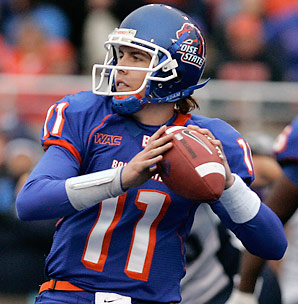
Kellen Moore, soon to become the all time winningest quarterback in Division I history.

The funny thing is most people equate the Broncos with BYU in past annals when they are not like BYU at all. This well oiled machine mines football talent from Northern and Southern California, and nabs some of the soon to develop talent who had issues with grades. They even allow players to send try-out tapes to the school and shop their wares instead of relying on big time scouting to be noticed. There are a lot of inner city kids on these Boise teams and these other “big schools” think they’re going to “punk” the Broncos. Then they wake up in the 4th quarter in a dog fight against a team where every player has a chip on his shoulder. There is a ruggedness to their teams yet they’re disciplined. It takes this type of attitude from the coaching staff and players to make this go. What do you say Coach Peterson?? The time is now or you may let one of history’s finest runs be regarded on the periphery of achievement when compared to other schools.

Just remember Boise St, the University of Miami was seriously thinking about dropping their football program from Division I altogether before Howard Schnellenberger came up with this bold plan. It turned a fledgling school in South Florida into a national power and may be just the tonic Bronco nation needs to finally crash the BCS Title Game. Well, that and a place kicker that can make a 4th quarter field goal.

Thanks for reading and share the article

Finally!! A College Football Playoff!!

National Championship Trophy

The NCAA needs to be tortured for the way they have handled their Division I football collegiate championship. No, we’re not going to speak in terms of subdivisions and that nonsense because it diverts the attention from the task at hand… How can we achieve a true national champion in college football?? For the most part the argument has come from teams, bowl sponsorships, and conferences not wanting to relinquish prestige or money. What was known as Division II and III have settled their championship on the field for years…so why can’t they in the top tier?? At Taylor Blitz Times, Chancellor Taylor decided to preside over a panel of experts and to decide how we can come up with a true national champion. Here is how it can be done in his estimation.

First off this move in college football to super conferences hurts the matter. The rumor that Florida St, Texas A&M joining the SEC would do what for the conference?? The argument by SEC loyalists would be that their 5th best team is better than other conferences 1st or 2nd. They would wind up with more than 6 teams not facing each other in a season. How could they determine a true champion?? This only detracts from the landscape of college football as well as a sentiment that is not true. The top level team in any conference can stay on the field with a top tier team from another conference. For a given playoff game?? Absolutely.

So the first thing we need to do is scrap the super conferences and adopt the NCAA basketball rules and dole out automatic qualifiers for each conference champion. Whether that conference has a championship game or not is up to them to decide who they’re conference champion is. So we would then have the Big Ten, ACC, Big 12, Big East, Pac 12, SEC, Conference USA, Sun Belt, WAC, and Mountain West would all have a qualifier. That gives us an 11 team field so far and we would need to have conferences move back their championship games to conclude in late November. Reversing the last 10 years where teams kept moving games later so they don’t get leapfrogged in the BCS. (see LSU leapfrogging USC in 2003) We need that to assist in the time necessary to get our playoff system to a condensed workable format. We need that December time to decide things.

Rose Bowl Trophy

Next up, the poll rankings and the BCS. Keep them! Otherwise Nebraska and Oklahoma would put Pugaswan St School for the Dyslexic, on their schedules again. Sure we say that in jest but the BCS has been good for one thing: It has brought to light the strength of schedule and condemened teams for not playing one. Great measuring tool so it and the AP and Coaches Poll stay. Why?? Its these mechanisms that will give us our 6 at large teams that will round out the 17 team tournament. Ranking and strength of schedule will determine who gets those spots.  If you are an Independent like Notre Dame, this is the only way to qualify for the National Championship playoff. So join a conference or schedule at least 7 heavies in your campaign. It’s their choice. You have to keep in mind that we have to have a tournament long enough to include the right amount of teams yet not so long that we interfere with college basketball. So the buck stops at seventeen.

So to assist with the strength of schedule format think of it like this: Had Auburn been upset in last year’s SEC Title Game, they still would have qualified for the playoff as an at large. Where a South Carolina had to win that game to qualify because of their record. So it’s paramount to win the most games and the strength of schedule will still aid your BCS standing for a late loss. Furthermore you can have 2 or more teams qualify for the playoff from the same conference. So if the Ohio St. Buckeyes win the Big Ten, yet a streaking Wisconsin Badger team almost catches them but falls a game short of qualifying for the conference championship game. They could make it to the playoffs by virtue of their poll and BCS standings.

While some conferences like the Mountain West, WAC, Sun Belt, or Conference USA won’t have that luxury, at least they would now be invited to the dance. However if you think about it, that’s not necessarily true. http://www.cbssports.com/collegefootball/rankings The Boise State Broncos would have qualified and followed Nevada into this mythical playoff system were it in place last year after losing to the Wolfpack. Otherwise win your conference and carry the torch and battleflag into the playoffs for the rest of your brethren.

Sugar Bowl Trophy

We would begin the playoffs with a playoff kickoff around Pearl Harbor Day (Dec 7th if you just came to the U.S.) with the BCS 16th and 17th teams playing on the home field of the 17th team.  No need for additional travel at this point, the first round of the playoffs would be at each team’s home facility anyway. This game would be played on a Thursday or Friday night. Could you imagine a playoff game at College Station between the Texas A&M Aggies hosting Nebraska on a chilly night??

Had this been in place last year this would have been our kickoff. Or the year before it would have been Oklahoma St. hosting Oregon St. So this game could be a revenge game with conference rivals or teams that don’t know each other. Perfect. Trust me fans and players would be fired up for more. The winner of this game slides into slot 16 for the final tournament bracket which would be seeded upon each team’s BCS finish. Think we could find a corporate sponsor for this game??

With an extra week off, around December 14th,  the 15 big boys join the party with the higher seeded teams at home hosting their lower seeded counterparts. So seeds #1 – #4 for example would have hosted #13 – #16.  Those games last year would have had BCS #1 Auburn hosting #16 Alabama, #2 Oregon hosting #15 Nevada, and #3 TCU hosting #14 Oklahoma St. and #4 Stanford hosting #13 Virginia Tech. Imagine that…didn’t Stanford play Virginia Tech in last year’s Orange Bowl?? Pay attention we are on to something.

Think about the marquee games being played on Thursday and Friday night as to not disrupt the NFL which plays Saturday games after college football is done.  Think about that for a second, Alabama getting a second crack at Cam Newton, Nick Fairley and Auburn after that come from behind win in the Iron Bowl?? Think Nick Saban wouldn’t have had ‘Bama up for a second go round?? Now you’re starting to see what we mean about a playoff system generating some battle lines. You’d call off sick from work or hit the sports bar early for that playoff game…think about it?? Would Auburn beat them a second time??

Orange Bowl Trophy

Step on the NFL’s Saturday toes?? On second thought, there would be a few of the middle seeds playing on Saturday though. We would then move into BCS #5-8 hosting #9-12 or: #5 Wisconsin hosting #12 Missouri in snowy Madison, #6 Ohio St. hosting #11 LSU, #7 Oklahoma hosting #10 Boise St, and #8 Arkansas hosting #9 Michigan St.  Goodness!! This slate would be better than the Thursday / Friday games. Columbus, Ohio hosting LSU to get revenge on the Tigers for that loss in the NCAA Title Game from 5 years ago??

Oklahoma being able to get revenge on Boise St for that Fiesta Bowl upset loss 5 years back?? Fans wouldn’t be up for these games with those battle lines now would they?? Could you imagine the barbecue, chips, and beer consumed watching these playoff games in one day?? How many folks would be at your house that day?? Bring pizza!!

Now we get a two week break for Christmas to set up the second round of the playoffs, and to allow other Bowl Games they’re rightful place to lead the marquee. Yet by January 1st we get right back to it with the present BCS bowls plus a few others so that we can move it around every year. So we would include the Outback Bowl, the Capitol One Bowl, and drop one of the BCS bowls as a playoff site for a given year to keep the pageantry of the bowls in place and make sure our championship keeps it’s variety from year to year.

With the winners of the Orange, Rose, Fiesta, and Sugar Bowls we’re now down to our final four schools.  So each Bowl has a sponsorship like the FedEx Orangebowl, etc. Do you think we could get a corporate sponsor for the semi final games to be played at a predetermined neutral site?? What about a semifinal being held in Ford Field in Detroit, an Ohio Stadium in Columbus, Ohio or a game in Rocky Top, or an Indianapolis. New places for a major college football playoff game. Everyone doesn’t live in the Sun Belt, so move it around to some new places. What about a National Championship Game in Notre Dame’s stadium with the College Football Hall of Fame right up the street??

Fiesta Bowl Trophy

With the bowl games decided we would take a week or two off to set up our neutral site semi final games. These would be prime time epics with one being played on a Friday night, the other being played on Monday Night. The NFL would be in their playoffs at this time so Monday would be open. This would be taking place around January 8th / 10th or the week of the 13th / 15th.  After a one week layoff and during the two week break between the NFL’s NFC and AFC Championship Games and the Super Bowl, we would have the NCAA National Championship Game on a Saturday night at a neutral field (highest bidder) all by itself around January 30th.

If you think we couldn’t find sponsors or site committees to step up to host that game you’re crazy.  Right now you’re salivating at just the shape of these playoffs and yet we did the one thing we set out to do.  Keep the governing bodies intact, not step on corporate sponsors toes and actually generate more money for college football with the additional television revenue.

The Bowls were kept intact and we included the BCS. We kept a manageable line when placing our games around the NFL games to be played and kept things tight from a logistics standpoint without too much additional travel. A national championship game in Seattle, Washington?? Raleigh, North Carolina?? Albequerque, New Mexico?? Why not?? These collegiate Super Bowls could pump financial blood into new areas and …. At long last we’ll have a real National Champion crowned in college football!!

Thanks for reading…share this article and give us your feedback

College Football’s Leveled Playing Fields

Marshall Faulk at San Diego State

The changing faces of college football over the last fifteen years has been a unique situation upon the sporting landscape. Gone are the days when the traditional schools would line up and pummel a school from a smaller conference. Don’t get us wrong, there are still some lopsided contests but the talent level is closer than in the 1970’s,80’s, or even the 90’s. This is the byproduct of several things.

The first thing was with up to 20 cable televisions showcasing football around the country. Schools could recruit outside their region for talent and deliver the promise that their families and friends could still watch them play. Alternative schools to the traditional powers also offered players the chance to remain at their position of choice. One glaring example of this was when Marshall Faulk was coming out of New Orleans as a high school star.

Tons of schools were recruiting him and one of the heaviest was Florida State. They would offer Faulk a full scholarship yet they wanted him to switch from running back  to cornerback. Faulk opted to go to San Diego State where he dazzled the nation as a freshman gaining 1,429 yards and 23TDs. Along the way he had a freshman record 386 yard, 7 touchdown performance against U of Pacific. Before you say something about the talent level, keep in mind he’s just 3 weeks away from giving his Pro Football Hall of Fame induction speech. So kill that noise.

The point being he didn’t have to play cornerback with Terrell Buckley and watch Amp Lee and Warrick Dunn as tailbacks at Florida St when he had other alternatives. Being on the west coast and playing in many night games, Faulk was watched all around the country and became the first freshman to get serious consideration as a Heisman Trophy candidate. There are other notable examples of this but an electrifying running back that made both Hall of Fames (college and pro) seemed like a logical example. Players know they can go anywhere and be seen all over the country.

Steve Slaton slashing up Marshall

The second was the scholarship limitations the NCAA  instituted in 1990. Now the top 20 schools, the Miami’s, Florida St’s, Oklahoma’s, Nebraska’s, Texas’, Michigan’s, Ohio St’s, the USC’s couldnt swallow the top 100 tailbacks coming out in a given year. Some of them were talents that never developed or later developed. Some players actually blossomed at non traditional schools that struggled to get the blue chip prospect.

When you get a Steve Slaton at West Virginia, a LaDainian Tomlinson who opted to stay near home at Texas Christian, or a Jamal Anderson at Utah, or even a Doug Martin right now at a Boise St. These players could have split time or may not have started early in their careers at traditional schools. In most cases we never hear of these players as they fade into obscurity and don’t make the pros.

Some play in Canada but many fall by the way side. Two players that did play later were Jeff Smith of the Nebraska Cornhuskers of ’83 and Priest Holmes of Texas in the late 90’s. Each played RB behind Heisman winners in Mike Rozier and Ricky Williams. Yet both developed their talent in the NFL, Smith had a serviceable career with Kansas City Chiefs, where Holmes went on to rewrite the Chiefs record book after winning a Super Bowl ring in Baltimore.

Yet all of a sudden we were seeing electrifying, record breaking runners at schools we didn’t expect those performances from. The aforementioned LaDainian Tomlinson, A Troy Davis at Iowa St running for back to back 2,000 yard seasons in the mid 90s. A Barry Sanders rushing for 2,629 yards and 37TDs in a 1988 Heisman Campaign, who followed an All American Thurman Thomas. Who followed another All American and ’82 NCAA rushing leader Earnest “Sparkplug” Anderson with over 1,800 yards rushing. Yes the year Herschel Walker won the Heisman he didn’t lead the nation in rushing. The latter three talents went to Oklahoma St and not Texas or Oklahoma.

The third key component in leveling the collegiate playing field were the different strategies employed by college coaches.  These evolving sets have been lifted from the antiquated wishbone offense to more pro style sets including the run and shoot, 3 receiver one back sets, to the variations of the spread offense. Teams that couldn’t field All American offensive linemen could opt for an attack that spread the defense and made it think. Why go toe to toe with an opponent when you can out think your opponent and outhit him when he is out of position? This has been the true equalizer in college football over this last ten years just ask Michigan how it feels about Appalchian St. Michigan became so confused that they thought “hell if you can’t understand it hire a coach who does” yet they didn’t have the type of talent needed to direct that offense under coach Rich Rodriguez.

With the run and shoot, different types of receivers were needed to make the offense go. You recruited your traditional large fast receiver(6’0-6’3 -215 lbs.) along with a new prototype that manned the slots.  This player was smaller in stature yet quicker than the large fast receiver and stood (5’7-5’9 -175-185lbs.) which were the high school receivers that traditional schools didn’t recruit unless they were going to be switched to cornerback.

Yet these players found homes in offenses that spread the field and played their game in space throwing the football. Most teams realized that the third and fourth best WR were normally better than third and fourth corners on a given team. You had the University of Houston in the 80s and early 90s as the vanguard of the run and shoot teams and most recently June Jones University of Hawaii teams. Even the Miami Hurricanes employed these techniques winning two National Championships in1989 and 1991.

Then along came Rich Rodriguez and his West Virginia Mountaineers. He took the spread offense to a complete zenith with what you could do with a 53 1/3 yard wide field and implemented a power rushing attack from a spread formation. First he recruited Pat White from Alabama.  At 6’0 (being generous) and 185 lbs. he was short for a quarterback and had a decent arm, yet it was his 4.28 40 yard dash that made it nearly impossible for interior linebackers to read blocking patterns, than get to the flank to defend against his options or pitch to Steve Slaton.

Slaton was brought down from Pennsylvania. One of the nation’s fastest running backs coming out of high school in 2005.  He had committed to Maryland who had offered him a scholarship then retracted their offer.  He took his 4.3 speed to West Virginia to team with Pat White, Owen Schmitt, recievers Darius Reynaud #82 and Brandon Miles#7 and a powerhouse was born. They spread from a traditional set and some 3 receivers yet ran what they call a speed option that most MLBs didnt have the lateral quickness to stay with.  The result?? First we have to set the table for you.

The Miami Hurricanes and Boston College had just fled the Big East to join the ACC. Many felt that the Big East was no longer a top flight conference with two of their heavyweight schools having departed. Yet the Mountaineers started a redshirt freshman in Pat White, and a freshman tailback in Steve Slaton and a new offense took the country by storm.  They improved as the season went on and Slaton finished the season with 1,128 yards and 17 TDs, while White finished with 952 yds rushing and 7 TDs to go along with moderate passing to keep defenses honest.

Once they ran out to a 10-1 record, their Big East championship gave them an automatic bid to the BCS Sugar Bowl where they would take on Georgia. The Bulldogs that year were 12-1 and only a close loss in SEC play had kept them from appearing in the National Championship Game. Experts scoffed that West Virginia’s offense couldn’t perform that well against a superior defense from a superior conference. Yes experts were treating the Big East as a second tier conference with the remaining teams.  So the battle lines were drawn and since the Sugar Bowl had to be moved from New Orleans to Atlanta’s Georgia Dome, because of Hurricane Katrina, this would be a home crowd for the Bulldogs too. No way the Mountaineers could stay on the field with an SEC team……………….right??

Naturally underdogs play with a chip on their shoulder and Bulldogs were chasing Mountaineers all night. In a humiliating 38-35 defeat, SEC Champion Georgia never led in the ball game. http://scores.espn.go.com/ncf/boxscore?gameId=260020061 No one on the set picked West Virginia to win and the nation watched in stunned amazement as the Mountaineers burst onto the field and  was up 28-0 before Georgia knew what hit them. Freshman Steve Slaton set the Sugar Bowl rushing record with 26 carries for 204 yards, 3 Tds with twin 52 yard touchdowns that were electrifying. Passing the exploits of Tony Dorsett, Herschel Walker, Major Ogilvie, Vegas Ferguson, and keep filling in blanks here…Slaton outrushed them all just being 7 months removed from high school. Yikes!!

This watershed game got more coaches on the bandwagon of the spread to be used as a rushing offense.  By the time the point was hammered home that this was an offense to stay, was when Appalachian State upset Michigan in “The Big House” in 2007. Now even skeptics were using some variation of the offense in their playbooks. Though the SEC was embarrassed that night in the Sugar Bowl, we come to see that 5 years later Auburn wins the National Championship over Oregon and both were run first, spread option teams. In came the Cam Newtons and Terrelle Pryors to lead this new wave…

So the landscape has changed, first through the proliferation of cable television stations allowing players to play in far away places and still be seen back home.  This changed the way colleges could approach players when they weren’t the clear cut favorite to land a particular recruit. Players weren’t forced to switch positions to go to a particular name school when there were other alternatives.

This happened simultaneously with the NCAA limiting the amount of scholarships teams which spread talent all over the collegiate landscape. Then in an effort to find the great equalizer, coaching innovations leveled the playing field even more with better tactics while landing a better athlete on their campus than ever before.  Couple these factors with the natural chip on the shoulder that most underdogs play with and college football has turned into “On any given Saturday…” Making college football an even greater game than before.  We’ll be back to help solve the National Championship Game and BCS problem later.

Thanks for reading and share this with everyone

2011 Heisman Campaign: Doug Martin of Boise St.

Boise St’s talented Doug Martin

Heisman Trophy

One of the nation’s best running backs wasn’t even a guaranteed starter at his position just two years ago, let alone last year. Would you believe he was a complimentary back and special team standout who switched to and from safety several times at Boise State?? At 5’9 201lbs, he runs with a Mark Ingram-like low center of gravity, yet unlike the past Heisman Trophy winner, Martin has an explosive burst. He began the 2010 season as a complimentary option to incumbent starter Jeremy Avery and just flat unseated him. He wound up rushing for 1,260 yds on just 201 carries, had a whopping 6.2 yards per carry average and 12 TDs. Yikes! What would he have done if he had been the undisputed starter at the beginning of the season??

He exploded at the end of the season when he dazzled the nation with one of the best performances in college football against Nevada.  Boise St was ranked #3 with a 10-0 record and traveled to play Nevada, who was on a 10 game winning streak, and were 10-1 with a #19 ranking. This was the last hurdle for the Broncos to push to play in that elusive National Championship Game. In a nationally televised game, the Broncos sprinted out to a 24-7 lead thanks to 2TDs by Martin. The last of which was a 51 yd sweep to the left that left Wolfpack defenders gasping for air as he sprinted into the endzone for what appeared to be a clinching touchdown. Yet the Wolfpack furiously fought to get back into the game tying the score at 24 with 5:10 left in the regulation.

The Boise offense had been stifled for the better part of two quarters when they turned to their dynamic junior running back. In what should have been a last possession time consuming drive, Martin accidentally showcased his flare for the dramatic. On 1st and 10, he took a routine screen pass, set up blocks with a few electrifying moves and powered through an attempted tackle and exploded for a 79 yard touchdown. The play was stunning by itself yet when his team was playing pensive and they needed it most he came through. Alas the finish to the game robbed the Broncos of their shot at playing for it all falling 34-31 in overtime. However that Saturday night in front of an ESPN audience Martin amassed 152 yds on 24 carries for 2TDs while gaining 78 yards on 3 receptions and another touchdown. Two of his scoring plays were from 51 and 79 yards out.  For the season he had 11 plays of over 25 yds or more and 3 that were over 50.

After receiving a slight from the Bowl Committee and having to play December 22 in the Maaco Las Vegas Bowl, the Broncos again had a national television audience tune in. After both teams started off sluggish, Martin moved the crowd with an 84 yard touchdown run in which he outran the entire secondary the last 50 yards to the endzone. He had another breathtaking cutback run of 32 yards and finished the day with 17 carries for 147 yards and 1 touchdown in a 26-3 win. When the lights came on and it was time to perform, he played his absolute best.

So why the high expectations on Doug Martin? He finished with 6, 100 yard games and if he carries the football to the tune of 250-275 times this season he could rush for 1,700 yards and over 20TDs in the Mountain West Conference. He rushed for 15TDs in a complimentary role in 2009 so those numbers aren’t far-fetched.  His stock is clearly on the rise and this is an NFL ready running back. As we debated the merits of a Boise St’s legitimacy to play for the National Championship last year, we expect some flack because of the Broncos schedule and conference. Until you realize

  • LaDainian Tomlinson -TCU Hornedfrogs WAC- 13,404 NFL Career Yards, 144 rushing TDs & NFL record 31TDs in one season
  • Walter Payton – Jackson St – SWAC- Former NFL All Time Rushing leader with 16,726 yards rushing
  • Jamal Anderson-Utah WAC- Ran for Atlanta Falcon record 1,750 yards on NFL record 410 carries in 1998
  • Mike Anderson-Utah WAC – Ran for NFL rookie game rushing record 250 yards against New Orleans Saints 2000

2011 Boise State Bronco Stadium Banner of Doug Martin

Just to name a few of the merits of those coming from smaller schools and their ability to compete with their BCS Conference School counterparts at the next level. Take a look at Reggie Bush for example….yet I digress. Ahem it’s at the collegiate level we’re talking about. As the video illustrates Martin can avoid the big hit with his quick feet yet when contact is imminent, he explodes into tacklers with the mentality of a defensive player. If you approach Boise St’s Stadium, you’ll see these huge banners of Kellen Moore and a few other players, yet its the one to the left of this column that will catch your eye. Keep your eye out for him this season and in next April’s draft. You haven’t heard the last of this talent and with an injury free season could be the best in the country and worthy of the Heisman Trophy.

2011 New Orleans Saints Preview

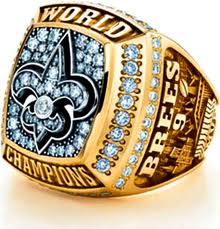
Its amazing what happens in pro football when a team becomes Super Bowl champion.  Every little nuance is studied and every small flaw gets worked on until it becomes a crack, then transformed into a team’s Achille’s heel.  However when you think about it, the same problems the Saints had in 2009 were there in 2010.

In ’09 the ball just seemed to keep bouncing their way, from the Robert Meachem stealing the ball from a Redskin who intercepted Brees then ran it in for a TD, to the tipped pass to Darren Sharper who returned it for a clinching TD in a struggle with the Dolphins. What goes up must come down and all those you climb over to get that ring are all of those who will give you their best shot on your way down.  Does it wear on a team? Week after week everyone takes their best shot and the war of attrition sets in…yes  By the end of the 2010 season the New Orleans Saints were running on empty.  We at the Taylor Blitz Times are still waiting for the Saints to tackle Seattle’s Marshawn Lynch.  With the additions and target on someone else’s back, can they liberate the NFC South mantle from the Atlanta Falcons??
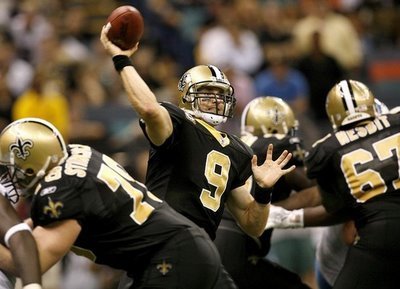
Quarterback: Aside from Green Bay and New England, no team is in better shape at the quarterback position.  You could argue that Drew Brees is still the NFC ‘s best quarterback over Aaron Rodgers.  Hell the NFL for that matter. Without his steady play this team would have slid into the abyss with a running game that wasn’t as formidable as the title run the year before.

Although Brees passer rating dropped to 12th, (90.9) he threw a whopping 658 times completing 448 for 4,620 yards, 33TDs yet had 20 interceptions. Having to overcompensate for the anemic running game and being forced to throw, contributed to the high turnover totals.  Sounds like a down year coming off of his 5,ooo yard masterpiece two years before but get this… He was still 3rd in yards passing, 2nd in touchdowns thrown while leading the league in completion percentage at 68.1%.  Even in the 41-36 playoff upset loss to the Seattle Seahawks he was forced to hoist 60 passes. Far too many.  He completed 33 for 404 yards and he was masterful in that game throwing no interceptions.  He now ranks 1st in every Saints  career passing category: yards, completions, attempts and touchdown passes.

What hasn’t been showcased is how to get the best of Drew Brees as a defense.  Even last season he threw several interceptions late in games when he was forced to take chances.  Sean Payton has constructed a passing game that gets the ball out of Brees hands the instant his back foot hits the turf.  They make great use of 3 and 5 step drops and bubble screens to get the jump on opposing defenses.

Teams may be better suited to come up and press his receivers and send overload blitzes at him because the way the rules are now, he’s going to go up the field throwing 5 to 6 yard throws.  Send a series of zone blitzes and overload blitzes to rough him up seems like the only way. Otherwise its basketball on grass and you won’t stop him.  He is in his prime and barring catastrophy should have another 5 years left in him.  Without question quarterback is Super Bowl quality in New Orleans.
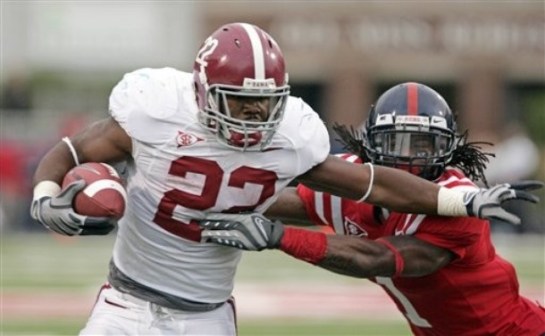
Offensive Backfield: After being derailed by backfield injuries, the Saints pulled the second biggest coup of the 2011 draft landing Heisman winner Mark Ingram from Alabama.  They stole a lot of thunder being made on draft day by their NFC South rivals, the Atlanta Falcons, for trading up for Julio Jones, Ingram’s teammate from the 2009 National Championship team.  This solves a tremendous problem the Saints have had for several years now: running consistently tough between the tackles.

Many think Ingram is a “can’t miss” running back and an Emmitt Smith clone.  A patient runner with short choppy steps who runs with a low pad level to prevent him from fumbling while powering forward for the tough yards.  He had a few injuries in his senior season where he rushed for 875 yards, yet dazzled in his Heisman season where he ran for 1,658 yards and 17 TDs.  The running back position in the NFL is not a position where a player grows into it. All great running backs have their best years in the first three.  Running the football, Ingram will prove to be a fit immediately.

Speaking of a fit, time to talk about a running back who doesn’t. This should spell the end for Reggie Bush who couldn’t make it work in the pros unless he was in space. A bust with a few splash plays per year doesn’t merit the $11 million he is scheduled to make this season.  He has had some impact on special teams but face it, his 36 carries for 150 yards rushing and 34 rec. for 208 yards for a combined 2 TDs is nowhere close to enough. After Mike Bell departed for Cleveland, the rushing game was turned over to Chris Ivory, who led the Saints with 716 yards, and Pierre Thomas who gained 269 more.

Yet each proved unable to handle the pounding and the Saints had to bring in former Dallas Cowboy Julius Jones off the streets to man the backfield in the playoff loss to the Seahawks.  These backs just couldn’t stay on the field and when they were, the offense couldn’t sustain drives which caused team wide problems. Having to pass so much led to being unable to control the clock which put an undersized defense on the field too much. (See early 90’s Buffalo Bills) Its a systemic solution that one solid running back, in Mark Ingram, should  solve.  At running back the Saints leaped back to very good. He can also power the ball from in tight and the Saints should improve on 9 rushing TDs.
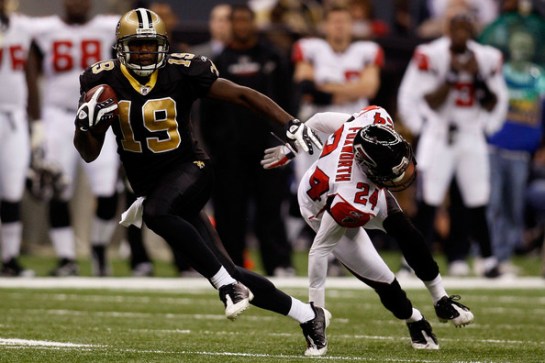
Receivers: The beneficiaries to all this passing is a receiving corp devoid of stars yet are solid intermediate receivers.  Marques Colston led the way with 84 rec. for 1,023 yards and 7 TDs followed by Lance Moore’s 66 receptions for 763 yards with a team leading 8 touchdowns.  What is unique is Colston, Devery Henderson, and Robert Meachem are the same type of receiver, tall, rangy and they play relatively slow.  Its Brees throwing the ball on time that makes this receiving corp look better than it is.

Yet Moore is quick and darts in and out of small cracks to gain 40 first downs out of his 66 catches. He and Colston  each made 1st downs on their receptions 60% and 67% of the time respectively.  This team runs the bubble screen as affective as any team in football.  This was an extension of their running game in 2010.

Yet this group is slow and defenses should press this group more. Teams are playing so fearful of Brees that they immediately drop into zones when this team has no burners on it.  Defense this receiving corps with combo coverages on their slot players and get physical with your corners on slower receivers and make Brees throw out of rhythm. This pressure on the receivers would make Brees pump fake and pull the ball down allowing your pass rush extra time to sack him.

Looks like the Saints will be moving on at tight end going with Jimmy Graham as Jeremy Shockey’s successor. Their numbers were nearly identical yet Graham reached the endzone 5 times to Shockey’s 3 yet this is a salary cap issue. They get to maintain that production while paying less and thats the NFL we follow now.  Receiver is serviceable to good in the Crescent City.

Offensive Line: In the words of Vince Lombardi, football is always going to be a game of blocking and tackling.  Well this offensive line had some issues with the blocking side of that equation. This team only rushed for 1,519 yards (28th) yet averaged 4.0 yards per attempt yet had problems pushing into the endzone when the team drove down close.  The 9 rushing touchdowns (28th) this team scored is evidence of that. What is unique is between the 20s this team ran off right tackle and gained first downs 67 times which ranked 9th.  You would think that would translate down at the goal line. Puzzling.

The Saints passing statistics from a line standpoint are mixed.  One of the aspects of Sean Payton’s playbook is for Brees to get the ball out quickly with 3 and 5 step drops.  The Saints were 5th lowest in sacks allowing 26th and were ranked 11th in allowing Brees to be hit 67 times.  They need to improve on their pass protection with the Buccaneers building a strong defensive front as a division opponent and the Panthers will be building a defense under former defensive co-ordinator and current Head Coach Ron Rivera.

Teams will be coming after Brees and if he is injured the Saints would be in trouble.  The New Orleans front did have a pro bowl performer in LG Carl Nicks out of Nebraska. This line is average to below average…just doesn’t get the push when close to the goal line and those passing numbers are high for a team that throws from short quarterback drop backs.

Defensive Line: This line had a fair year yet needs some help. Of the 33 sacks the Saints collected, 21.5 came from a committee of 7 linemen with none totalling more than DT Sedrick Ellis’ 6.  Will Smith needs to stop acting and rapping and get after the damn quarterback.  His sack total of 5.5 doesn’t cut it for a former first round draft pick and is down from 13.5 from the year before. In defensive co-ordinator Greg Williams scheme, DEs are to get after the quarterback and check on the run on their way there.

This is the system Jevon Kearse broke in with. So come on Smith, get after it. The Saints spent their1st round draft pick for the services of Cal DE Cameron Jordan to help bolster the pass rush. At 6’4, 287lbs he has the size and wingspan to rush in the pros.  His father Steve Jordan was a pro bowl tight end with the Minnesota Vikings in the 80s and 90s so the athletic pedigree is there.  They also drafted Greg Romeus out of Pitt to help get after the passer. Veteran DE Alex Brown may be the odd man out.

If the Saints want to regain the NFC South crown one thing they need to do is play a little more stout up front against the run.  This team was 16th against the rush and gave up a mediocre 4.3 yards per attempt. At times this line was shoved into the linebacker and the safeties faces. With big running backs to face in the division with Atlanta’s Michael Turner, Tampa Bay’s Blount, and Carolina’s Jonathon Stewart / DeAngelo Williams combo, this has to be a priority. Surprisingly they didn’t draft a DT, yet right before the lockout they picked up Shaun Rogers, former Cleveland Brown, to help hold the middle.  At 6’3 350 lbs he should eat up blockers and allow Vilma, and Shanle to make plays. Defensive front is slightly below average and they should get another DT when free agency opens up.
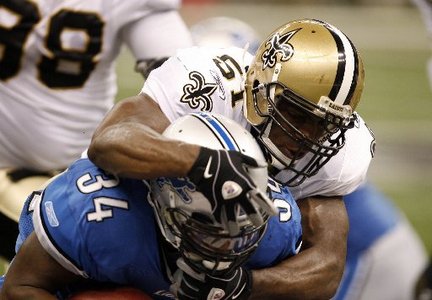
Linebackers: The anchor of this defense is Pro Bowl MLB Jonathon Vilma out of the University of Miami.  He led the team with 107 tackles, had 4 sacks and forced 3 fumbles. He’s instinctive and quick yet at 230 lbs can be engulfed by blockers so its imperative the DT play improves.  Scott Shanle (76 tackles) and Danny Clark (59 tackles) are the starters on the outside. They’re solid tacklers yet rarely make big hits or splash plays.

Between the two of them there wasn’t a sack or interception turned in all year…and they still haven’t tackled Marshawn Lynch.  Saint’s brass must be in agreeance with us since they spent two draft picks here on Illinois linebackers Martez Wilson and Nate Bussey in the 3rd and 7th rounds respectively.

Linebacker is below average thanks to the outside ‘backer play.  This group needs to force more turnovers and its puzzling that they don’t since they play pretty fast.

Secondary: When a pass rush can’t get to the quarterback, the play that is most affected will be that of the secondary. The starting quartet only pulled in 5 interceptions among them.  Former Buckeyes Malcolm Jenkins and Jabari Greer each had two interceptions.  The secondary missed the veteran play of Darren Sharper at free safety, however Jenkins is a converted corner and should grow with the position.  Its a good thing SS Roman Harper likes to tackle, he gets many shots at it. Not only did he make the pro bowl in 2010, he was second on the team with 94 tackles, had 3 sacks, and forced 6 fumbles. Thats a tremendous performance.

Tracy Porter only had 1 interception in 2010 while defending 6 passes.  This is as solid a secondary as the NFC South offers.  It rates better than what is shown statistically.  Once the pass rush resumes, this team will pick off more passes.  Porter in particular since Will Smith is on the same side.

It sounds like we’re piling on Smith but one of the recipes for interceptions is for quarterbacks too throw over a disruptive, tall pass rusher. If you can’t get to the quarterback, at least get your hands up.  This is how Lester Hayes once picked off 13 passes in a season behind a 6’8 Ted Hendricks, and an Everson Walls snatched 11 the next year behind a 6’9 “Too Tall” Jones.  Smith did deflect 5 passes last year so keep watching.

Overall: This is going  to be an interesting year for the Saints.  Drew Brees enjoys being one of the faces of the league, will he turn around and hand the ball off to Mark Ingram as much as he should??  Brees like any other good athlete has an ego.  This will be a good watch to see what he audibles to and how he responds if his rhythm is thrown off with a more balanced attack.  Will Ingram fit into the passing game well enough so they can have him as an every down back? If he is platooned, the Saints could suffer from the syndrome that affected the Dallas Cowboys last year.

They telegraphed what they were going to run based on which running back was in there.  Defenses would get the jump on them. We’re still unsure at Taylor Blitz Times if they did enough on the defensive front to solidify themselves against the run.  We see a mixed year coming up with a record of 9-7 to 10-6 and another wild card berth.

Pathp
Word count: 1256 Last edited by jeftaylor on May 20, 2011 at 12:00 pm

Writing Helper

  • Copy a Post

    Copy a Post

    Use an existing post as a template.

  • Request Feedback

    Request Feedback

    Get feedback on this draft before publishing.

Revisions

Likes and Shares

 Show likes on this post.

 Show sharing buttons on this post.