Legendary Days: The Freezer Bowl- 1981 AFC Championship Game (Chargers Edition)

For all the romanticized hyperbole when The Ice Bowl is brought up, The Freezer Bowl is largely forgotten about. The 1981 AFC Championship between the Cincinnati Bengals and the San Diego Chargers was colder from a wind chill factor perspective at -59*.  Do you realize that is 90* below freezing?? This was where Air Coryell unceremoniously crash landed for good and became the ultimate lesson on why achieving home field advantage is so important.

It was a hard earned lesson and we covered this in the championship rings for Cincinnati… so this one is being told from the Chargers’ perspective
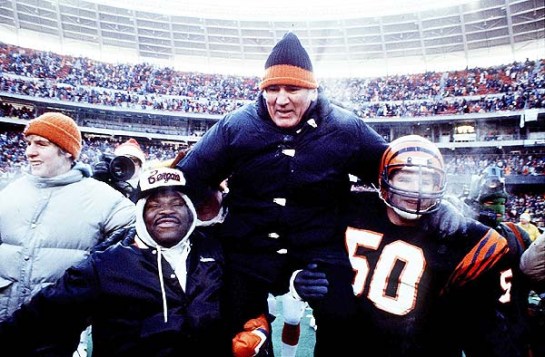
Head Coach Forrest Gregg carried off by his Cincinnati Bengals players.

One man happened to be involved in both games.  Hall of Fame Tackle Forrest Gregg started for the Green Bay Packers in the ’67 NFL Championship. Then he went into coaching where he was the Bengals head man when they advanced to the ’81 AFC Championship Game. The winner would make the trek to Super Bowl XVI in frozen Pontiac Michigan, they first had to endure the coldest game in NFL history.
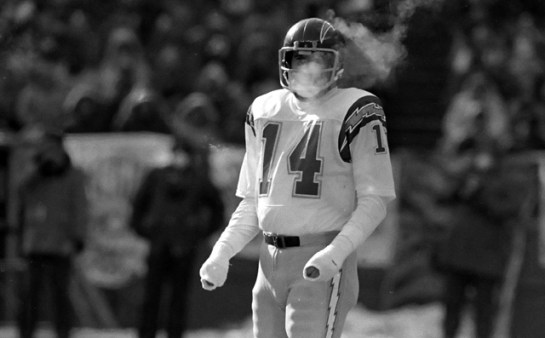
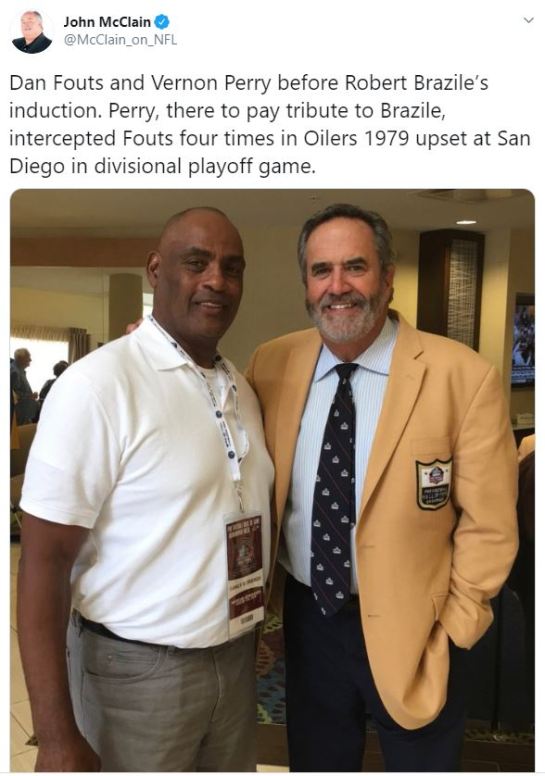
A frozen Dan Fouts.

Coming into 1981 the San Diego Chargers had been the vanguard of the new passing offenses that dominated with the rules of 1978, which liberalized the passing game. Head coach Don Coryell had revived the passing attack with many of Sid Gillman’s principles from the old AFL Chargers and forged a passing game that became the scourge of the league.

Now the head slap was outlawed on the line of scrimmage. Offensive linemen were allowed to extend their arms in pass protection, and receivers weren’t allowed to be hit after 5 yards. Offenses had been liberated from the thunderclap of defense which had dominated both the AFL & NFL since the mid 60’s.

Dan Fouts became the 1st QB to challenge and break Joe Namath’s all time record 4,007 yards passing when he broke it with 4,082 in 1979. Then he pushed it to new heights throwing for 4,715 yds in 1980, and finally 4,802 in 1981. However his Charger teams fell short of greatness by short circuiting in the playoffs. First they stumbled in a mind numbing 17-14 upset loss at home to the Houston Oilers in ’79, then again to the arch rival Oakland Raiders in the 1980 AFC Championship Game.

Also a loss at home in sunny San Diego. In all reality this team was losing it’s prime and not capitalizing on the championship window that was before them.

Armed with 3, 1,000 yard receivers in TE Kellen Winslow, WR Charlie Joiner, and now WR Wes Chandler, it was interesting to watch individual battles. Fouts led the league with 33 TDs, the late Chuck Muncie led the league with 19 rushing TDs to go with his 1,144 yards and James Brooks had nearly 900 yds from scrimmage and 6 more scores. Nevertheless they fell to 10-6 and had to go on the road in the ’81 playoffs.

One reason this game wasn’t remembered with the reverence of The Ice Bowl is it didn’t produce a champion. Another reason is it was buffered against 2 other memorable playoff games in January 1982. One was the Epic In Miami where the Dolphins and the Chargers played in 76* weather for 6 quarters in a 41-38 divisional thriller. The other was The Catch in the NFC Championship between San Francisco and Dallas the following week. Yet earlier on January 10, 1982 San Diego’s 2nd straight road affair took them to Cincinnati for the AFC Championship Game.

If you’re keeping score at home, yes the San Diego Chargers had to play in 140 degree temperature difference in one week’s time.  There were heated buses outside Riverfront Stadium in case fans needed to get warm. A Sports Illustrated article the following week reported 43 fans suffered heart attacks at the game.

Temperature difference withstanding, the divisional game against Miami went into 6 quarters in high humidity, so the Chargers were exhausted.
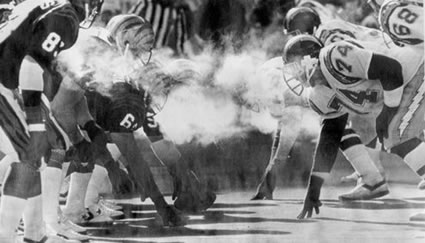
It was the end of an era for Charger power. Sure they made the playoffs in 1982 but so did everyone else in the strike shortened year where 16 teams were in a single elimination tournament. Proof?? They beat a Pittsburgh team in the 1st round that had been shut out twice by non playoff teams. In one of them they lost to Buffalo 13-0 and finished the day with -2 yards passing. Yes that is with Terry Bradshaw….yet I digress

Age and injuries caught up to the Chargers as well as AFC West opponents to their air attack. John Elway and Marcus Allen came in and the balance of power shifted toward the Broncos and Raiders. In 3 of the next 5 years, Fouts watched those teams play on the Super Bowl stage he so desperately wanted to lead the Chargers to. He retired after the 1987 season and when you look back to the 2 AFC Championship Games lost it was this one that produces the most what ifs.

Thanks for reading and please share the article.

The Freezer Bowl – 1981 AFC Championship Game

For all the romanticized hyperbole when The Ice Bowl is brought up, The Freezer Bowl is largely forgotten about. The 1981 AFC Championship between the Cincinnati Bengals and the San Diego Chargers was colder from a wind chill factor at -59*. This was where  Air Coryell unceremoniously crash landed.

One man that happened to be in both games was Hall of Famer Forrest Gregg. He was the starting Tackle for the Green Bay Packers in the ’67 NFL Championship. Then he was the Head Coach of the Bengals in 1981 when they advanced to the AFC Championship Game. In a game where the winner would make the trek to Super Bowl XVI, they first had to endure the coldest game in NFL history.

Error
This video doesn’t exist

From the perspective of the ’81 San Diego Chargers

Error
This video doesn’t exist

One reason this game wasn’t remembered with the reverence of The Ice Bowl is it didn’t produce a champion. Another reason is it was buffered against 2 other memorable playoff games in January 1982. One was the Epic In Miami where the Dolphins and the Chargers played in 81* weather for 6 quarters in a 41-38 thriller. The other was The Catch or the NFC Championship between San Francisco and Dallas later that same day.

If you’re keeping score at home, yes the San Diego Chargers had to play in 140 degree temperature difference in one week’s time. Cincinnati won the game and went on to Pontiac, Michigan to face the 49ers in Super Bowl XVI. Yet it’s hard to forget -59* below zero.

Thanks for reading and please share the article.

Legends of The Fall: Wes Chandler & John Jefferson

During the glory years of Air Coryell, the receivers were John Jefferson, Charlie Joiner, and Tight End Kellen Winslow. Head Coach Don Coryell had taken full advantage of the rule changes in 1978 to produce the most prolific passing offense in league history. His San Diego Chargers were the evolutionary link between Sid Gillman’s high scoring AFL version of the Chargers and the offenses we know today.

Quarterback Dan Fouts was the trigger-man and was in the midst of building a Hall of Fame resume. In 1979 he broke Joe Namath’s single season passing record with 4,082 yards. Then shattered it with 4,715 yards the following year. So it was imperative that management keep top level receivers for Fouts to throw to. As a team they won the AFC West in ’79 and made it to the AFC Championship Game in 1980.

However going into 1981, several players desired new contracts and were holdouts. Upset with the inability to bring WR John Jefferson and DE Fred Dean to camp, each man was traded to teams thought to be NFC wastelands in San Francisco and Green Bay. Although they were the odds on favorite to make it to Super Bowl XVI before this, management pulled the trigger that could have brought down Air Coryell.

Yet they had an ace up their sleeve and traded for Wes Chandler a few weeks later. Whom they were sure could fill the shoes of former All Pro John Jefferson. You have to understand Jefferson was the most electrifying talent in the league. His circus catches and boundless enthusiasm was the lightning rod spirit of those Charger teams.

Asking Chandler to fill his shoes was not going to be easy. Yet week 6 of 1981, right before the trade deadline, the Chargers turned in their trade papers to Pete Rozelle’s office.

Yet first you need to understand the man he was going to replace. John Jefferson’s first 3 seasons with San Diego, they set the record and broke it for passing offense each season. His years from 1978-1980 were the most electric of any incoming receiver in NFL history. The acrobatic Jefferson produced highlight reel after highlight reel level catches. He amassed 199 rec. for 3,431 yards and 36 TDs as 1/3 of Air Coryell!! In this vignette about the ’80 Chargers you’ll get a better glimpse.


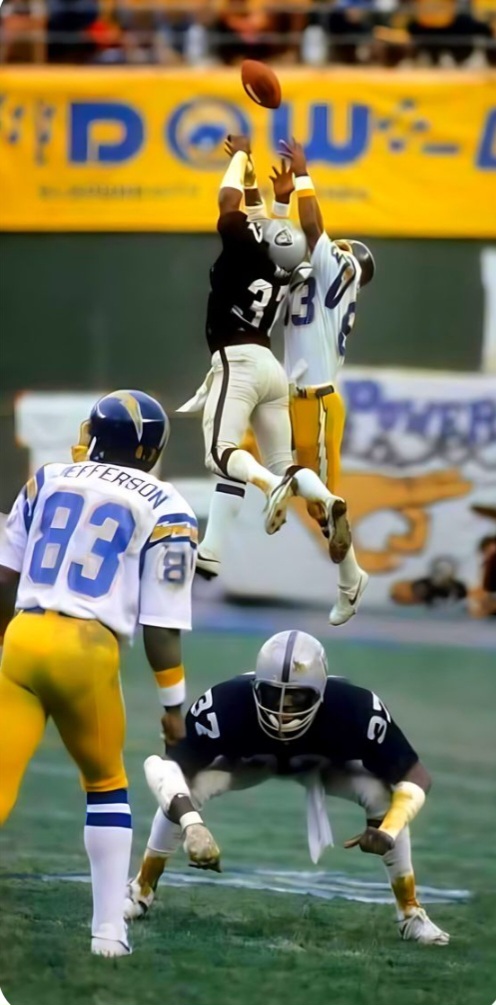
His battles with Lester Hayes that year were epic. Hayes was NFL Defensive Player of the year as he amassed 13 interceptions. Jefferson had 2-100 yard receiving games against him and 3TDs. Both were voted All Pro as he had a career best 1,340 yards on 82 receptions and 13 touchdowns.

In fact, the 1980 Chargers were the first team in history to have the standard set of receivers (2 wideouts and tight end) go over 1,000 yards in the same season. Against the Giants in week 7, they became the first standard set to all go over 100 receiving yards in the same game. Now they were going on without his services. How would the Chargers fare?

Well over in the NFC, another wideout from the 1978 draft was toiling away in New Orleans:


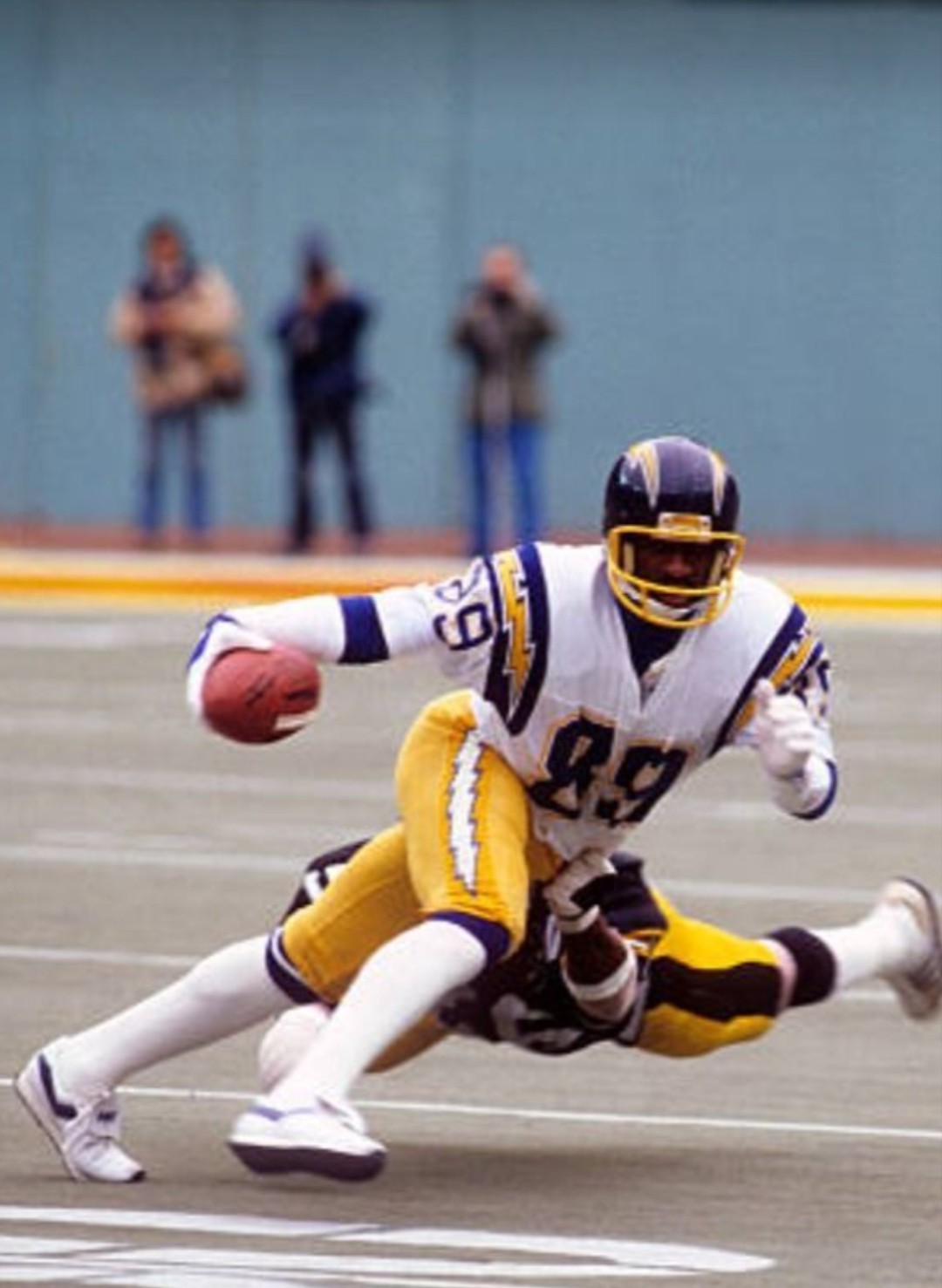
That 1982 season by Chandler ranks in The Chancellor of Football’s top five all time seasons by a receiver. He caught 49 passes for 1032 yards and 9 touchdowns in that strike shortened season. Just 8 games. Projected over a full season he would have had 98 receptions for 2064 yards and 18 TDs. At the time, 101 was the record for catches by Charley Hennigan back in the AFL in 1964. The TD record in a season was 17 held by Hall of Famer Elroy “Crazy Legs” Hirsch from 1951. He would have become the first and only 2,000 yard receiver and come close to or broken the other two records.

jefferson inspired figurine

jefferson inspired figurine

John Jefferson went on to team with James Lofton and made the Packers a formidable passing team for several years. In fact he made his fourth and final Pro Bowl in 1982 when he and Lofton went as teammates. However his best days were left in the team he should have helped to a Super Bowl in San Diego. Contract disputes kept that team from it’s greatest triumph.

For their careers

  • John Jefferson 351 rec. 5,714 yds 47TDs
  • Wes Chandler 559 rec. 8,966 yds 56TDs

When you picture Air Coryell in your mind, these two and their acrobatic catches are the first you envision. They were the spectacular performers of the group where Hall of Fame voting went with the numbers and impact of Charlie Joiner, Dan Fouts, and Kellen Winslow.

Amazingly Head Coach Don Coryell also sits outside the Hall of Fame. Too much is made of a coach not winning a Super Bowl yet Joe Gibbs left his staff and won 3 in Washington. He deserves to be in as well.

The high flying Chargers of the early 1980s. Just as we remembered them.

The high flying Chargers of the early 1980s. Just as we remembered them.

Although Chandler and Jefferson didn’t have Hall of Fame numbers, these two shouldn’t be forgotten for their contributions were just as great. Definitely legends of the fall.

Thanks for reading and please share the article.
Greatest Defensive Performance in an NFL Game – Vernon Perry

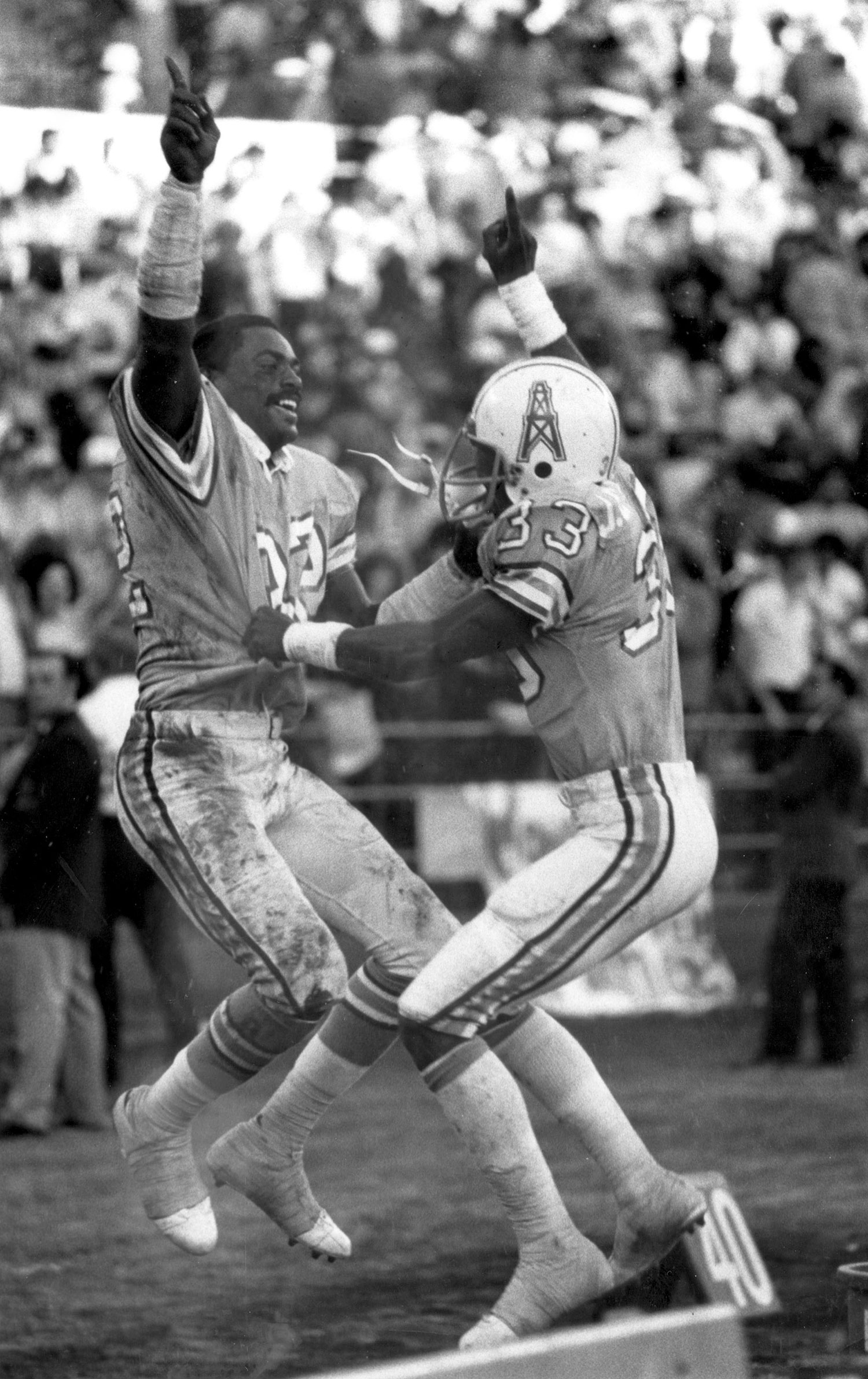
Celebrating after a performance for the ages.

When it comes to great performances in the NFL we tend to think of superstars having spectacular days. However there are times when a player finds himself totally in tune with a situation and turns in the game of a lifetime.

Such was the case with SS Vernon Perry of the late 70’s Houston Oilers. He was the college teammate of the late Walter Payton and Oiler teammate Robert Brazile at Jackson State. After a stint in Canada, Perry only played five seasons in the NFL (1979-1983) and the only distinction he gained was being named 2nd team All Pro in 1980.

In 1979, the Oilers were chasing perennial champion and division rival Pittsburgh, to whom they lost the 1978 AFC Championship Game to. Perry’s rookie year helped solidify a secondary that picked off 34 passes for the season. They were built as a run heavy team behind legendary Hall of Fame running back Earl Campbell. In week 15 the Oilers beat the Steelers 20-17 to give them both identical 11-4 records. A loss to the Philadelphia Eagles in the final week relegated the Oilers to the wild card role and the Steelers the division championship.

The wild card game was one of the most physical games in NFL history. The Denver Broncos “Orange Crush” defense battled tooth and nail in the 13-7 loss to the Oilers. They knocked out Earl Campbell, leading receiver Ken Burrough, and starting quarterback Dan Pastorini.

So a team that had serious aspirations of reaching Super Bowl XIV, or at least a rematch with the Steelers, would have to do so without Campbell’s 1,697 yards in the divisional round. Since the game would be on Saturday and not Sunday, they would be without Pastorini and Burrough as well.

Air Coryell - Dan Fouts, Charlie Joiner, John Jefferson, and Kellen Winslow

Air Coryell – Dan Fouts, Charlie Joiner, John Jefferson, and Kellen Winslow

Picture the 1990’s Dallas Cowboys going into a playoff game without Troy Aikman, Emmitt Smith, and Michael Irvin all not being in the game. This was that equivalent.

Their opponent was the AFC West Champion San Diego Chargers who also had Super Bowl aspirations. In 1979 they became the first team since the merger to make the playoffs passing more then they ran. Dan Fouts had thrown for 4,082 yards which was an NFL record at the time. They too finished with a 12-4 record to tie Pittsburgh for best record in the conference, and had their confidence boosted in week 12 with a 35-7 blowout of those Steelers. They had Pro Bowlers in John Jefferson (61 rec. 1,090 yds 10TDs), Charlie Joiner (72 rec. 1,008 yds 4TDs) along with Hall of Fame DE Fred Dean and DT Gary “Big Hands” Johnson.

The Chargers finished winning 6 of their last 7 and had held 4 of their last 5 opponents to 7 points or less. For the year, finished 5th in the NFL in defense and were healthy and home for the divisional round. This was a Super Bowl ready group… All they had to do was get past an Oiler team without it’s starting quarterback, running back, and leading receiver.

Naturally the Chargers scored on their first possession to take a 7-0 lead and were driving to take a two score lead when Vernon Perry struck…

The Chargers were undaunted but found the Oiler defense was tougher than anticipated. Once they drove inside the red-zone on the next drive, they stalled at the 7 yard line. They were up 7-3 when they lined up for a 26 yard field goal in the second quarter when:

A pensive crowd started to sit on their hands as their high-flying Chargers were clinging to that same 7-3 lead and couldn’t increase it. The Oilers were also struggling to finish drives. The Chargers were coming out with 3:24 to go and they were sure they’d score on the last drive of the half when Vernon Perry decided to undercut Charlie Joiner crossing the middle.

Thanks to the field position caused by Perry’s 2nd theft, the Oilers scored to take a 10-7 halftime lead. With a team that scored 411 points, 2nd most in the NFL in 1979, it was only going to be a matter of time before the Charger juggernaut got rolling.

Or so San Diego fans thought.

Truth be told they had moved the football early and it was becoming clear the Oilers weren’t going away. The team traded 3rd quarter touchdowns and the Oilers were on top 17-14 after Mike Renfro’s 47 yard touchdown. From that point on an upset seemed imminent and the Chargers started pressing. With just over 3:00 to go in the game, Fouts led his team into field goal range when:

Complete disappointment had set in when the San Diego offense took the field with 1:00 to go. Even though they were only behind by 3 and needed a field goal, their body english was that of a defeated team. Yet with under 10 seconds to go, Dan Fouts could get them into field goal range or hope for a pass interference when he heaved his last pass…

After the game Oiler Head Coach Bum Phillips addressed his team “We were short on man power but we were long on guts” was an understatement. Not once can our CEO remember where a team had to go into a playoff game missing 80% of their season’s offensive production due to injury.

Behind Vernon Perry’s NFL playoff record 4 interceptions, 8 tackles, 2 passes defensed, and a blocked field goal he returned 57 yards, the Oilers pulled off the biggest upset since Super Bowl III. Not only did it come when the Oilers desperately needed it in a playoff game, he set up the Oilers’ first 10 points which gave the team confidence believing they could win.  It was the best defensive performance in NFL history by an individual in The Chancellor of Football’s estimation.

It set up an AFC Championship rematch with the champion Pittsburgh Steelers. Armed with their hot rookie safety they made it to the gunlap in the race for Super Bowl XIV. Once there Perry got the Oilers off to a great start early in the game.

Yet alas the Oilers fell 27-13 in a game made famous by the Mike Renfro no touchdown call that sparked the instant replay debate. At the time the score would have been tied 17-17 late in the third quarter and the Oilers would have had the momentum in a quiet Three Rivers Stadium. However that is another story for another day. For it was the week before when Vernon Perry made NFL history that was the story of the 1979 playoffs and a game for the ages.


Thanks for reading and please share the article.
Taylor Blitz Times new logo!!

Taylor Blitz Times new logo!!

The Greatest NFL Game Never Talked About

Welcome to another episode of theater from the past. The most famous games in NFL history have always been playoff games.

Football is a game of emotion and it’s the finality of knowing your season could be over that can elevate the play of both teams. Yet some playoff games are talked about and held with esteem while others are rarely written about, rehashed, re-shown, or ever discussed among the greats.
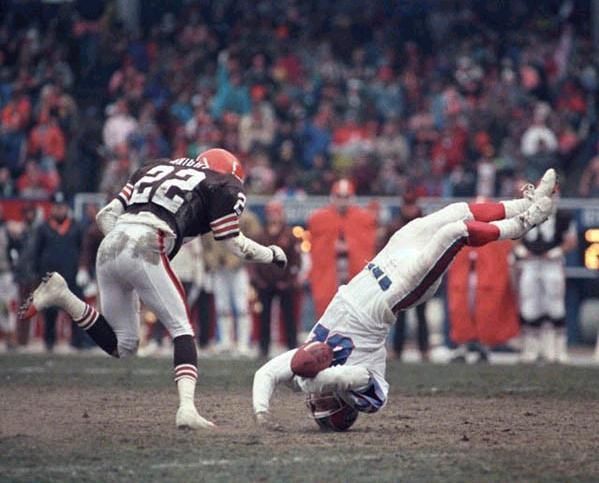
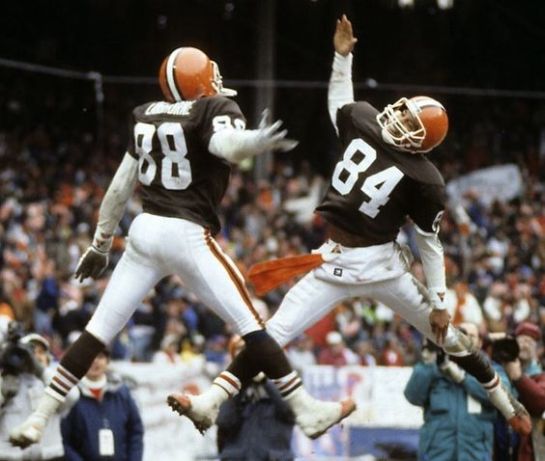
To us, there is a heavy bias toward the glamour franchises or darlings that the media aid in anointing their games great while others are passed over. One such game was the 1989 AFC Divisional playoff tilt between the Cleveland Browns and the Buffalo Bills. Not only was it great, it was as great as “The Epic in Miami”, or in my estimation better.

This was a magnificent football game. You have to realize that particular weekend you had John Elway and the Denver Broncos hosting the cinderella Pittsburgh Steelers in one playoff game. Jim Everett’s underdog Los Angeles Rams in New York facing Lawrence Taylor’s Giants, and the defending Super Bowl champion 49ers of Joe Montana hosting the Minnesota Vikings for a third straight post season. Yet it was the Browns v. the Bills that caught the imagination of NFL Commissioner Paul Tagliabue, who was in attendance, and Donald Trump who was in the box with Browns owner Art Modell. Why??

Well the Browns, famous for their “Dawg Defense”, had been stung 3 years before by John Elway’s Denver Broncos in the ’86 AFC Championship, and the following season with Earnest Byner’s fumble in the 1987 AFC Championship. Although the Cleveland Browns had been the NFL’s Team of the decade in the 1950’s, they had been a down franchise for many years. However each time the Browns thought they had a team capable of winning it all, they lost in heart breaking fashion on 3 occasions. The stellar teams they had from 1985-1989 were aging and many pundits thought this was the last chance for this team to get a Super Bowl win for owner Art Modell.
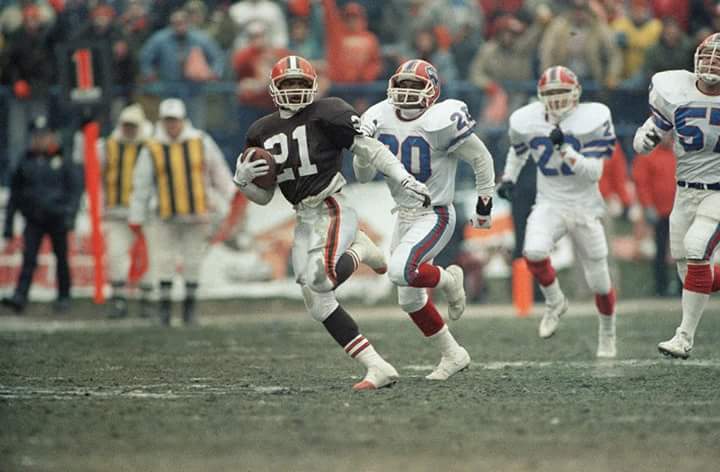
The other side had an up and coming Buffalo Bills team that rose to prominence as a defensive giant in 1988, after nearly a decade of futility. High draft picks,which included future Hall of Famer Bruce Smith, Cornelius Bennett, and Shane Conlan carried this team to the 1988 AFC Championship Game. After losing that game to the Cincinnati Bengals, the Bills were looked upon as a team of the future. However the team almost imploded in 1989 from infighting and finger pointing, which earned them the nickname ” the Bickering Bills”. The offense of Jim Kelly, Andre Reed, and Thurman Thomas was starting to show signs of life as the defense slumped slightly from the year before.

Better than “The Epic In Miami“?? Yes! This game featured big play after big play and came down to the wire with the Browns prevailing 34-30. To compare it to the great ’81 AFC Divisional playoff: Want to talk excitement?? With touchdowns of 33, 44, 52, 73, and 90 yards out, this game in ’89 had 5 touchdowns from 33 yards or more compared to 2 in that one. The only other playoff game in the Super Bowl era to equal 5 TDs of that distance was Super Bowl XXXVII between the Bucs and the Raiders. This game had 4 lead changes as compared to 3 in the earlier game.

Each had the record holder for receptions in a playoff game with 13 in both Thurman Thomas and Kellen Winslow. (both Hall of Famers) Each had a Hall of Fame Coach, Marv Levy of Buffalo and Don Shula as well as quarterbacks in Jim Kelly and Dan Fouts. Where the earlier game went to double overtime and ended on a boring field goal, this one had a sense of de ja vu. The Bills made a last second march toward their goal line with time running out, just like John Elway and “The Drive.” Although this time Clay Matthews intercepted Jim Kelly at the 1 yard line with :03 left. Now that is a finish!!

The game was also one of the best ever broadcast with Charlie Jones and the late Merlin Olson making the call. Here are the sights and sounds of the biggest plays from the game…

One outstanding aspect of this game was how great the commentary was. Notice how Charlie Jones and Merlin Olsen allowed the viewer to take in the sights and sounds of 80,000 fans going crazy. This is the antithesis to Joe Buck, who our CEO thinks is the worst play by play man ever. One aspect of announcing a football game versus a baseball game: Allow the visuals to stimulate the viewer more so than the commentary and know when to acquiesce to such.

Metcalf’s 90 yard return was the backbreaker in a game that had every thing.

Epilogue: Why is this game not revered like “The Epic In Miami”? This game had more Hall of Famers and neither game produced a Super Bowl winner. We feel that it might have something to do with the media’s growing disdain for the University of Miami football team, from which both Jim Kelly and Bernie Kosar hailed. Then NFL Films, who rarely slights a team due to media prejudice, chose NOT to put this game in the Cleveland Browns 1989 Yearbook. Seriously?? That was embarrassing.

Yet alas it came down to one play and Clay Matthews made it. So when you saw the 4th quarter fumble caused by his son Clay Matthews III in last year’s Super Bowl, and Casey Matthews forcing a 4th quarter fumble in last year’s National Championship Game for Oregon, you now know it’s in the genes.

The Browns would go on to lose their 3rd AFC Championship Game in 4 years to the Denver Broncos that brought an end to their playoff run. However the Buffalo Bills went on to a record 4 straight Super Bowls which began the following season.

From 1986-1993, one of these teams was in every single AFC Championship game for an 8 year period. It was this game that was the birth of the Buffalo “K-Gun” offense and the crossing point where Cleveland conceded to Buffalo as an AFC elite team. For one game, and four hours of sheer escapism magnificence, they played to the highest level worthy of being one of the greatest NFL playoff games ever played and is due more in it’s remembrance.

I dedicate this article to the late Charlie Jones and the late Merlin Olsen for their broadcasting excellence in elevating this game to one of  magnificent lore. Your call on this afternoon in January 1990 was simply the best ever. Gentlemen, thank you for a job well done.

R.I.P. Charlie Jones and Merlin Olsen

Thanks for reading this article, share this with those that love Pro Football