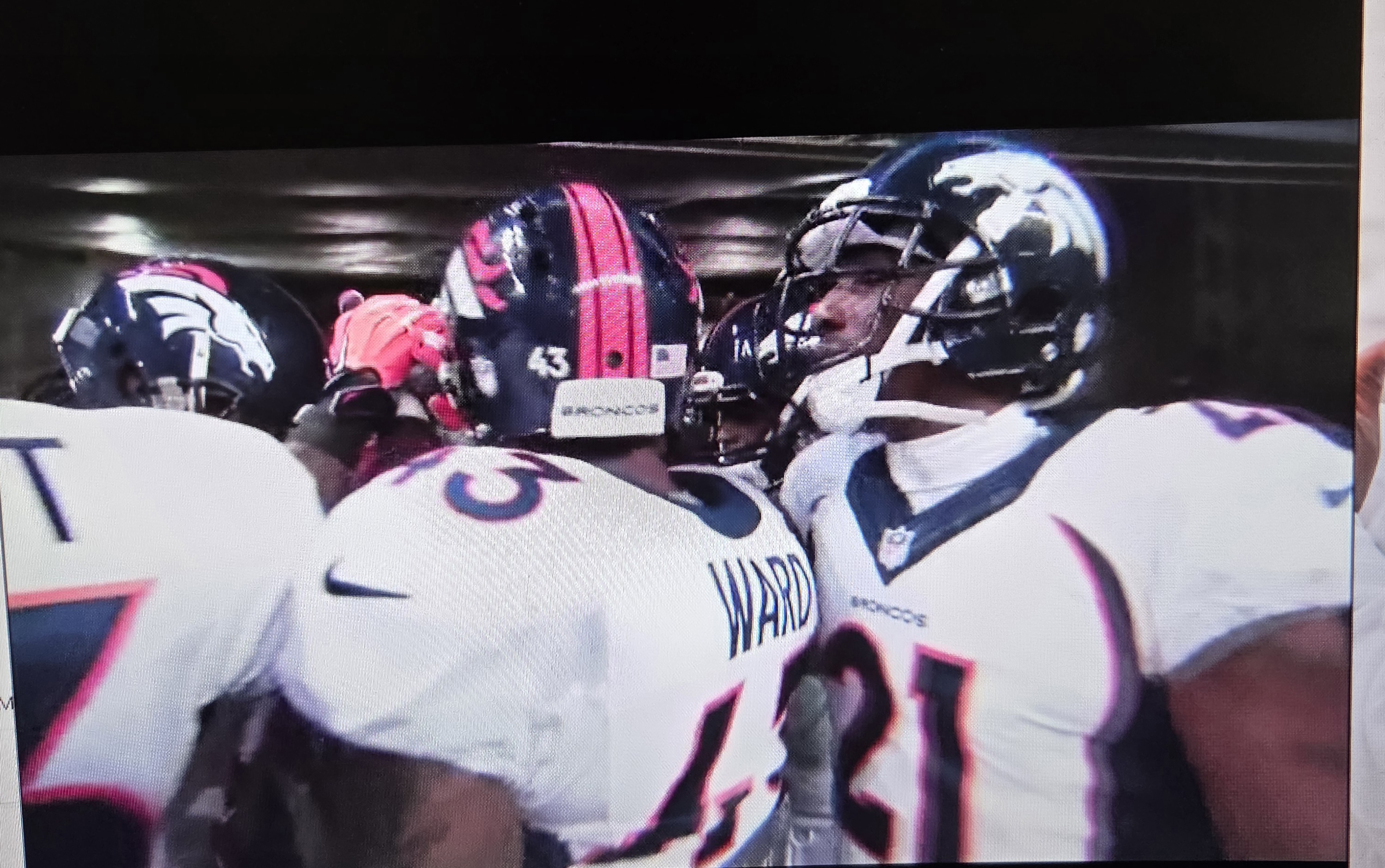
Greatest Single Season Defenses: 2013 Seahawks “Legion of Boom” v 2015 Broncos “No Fly Zone”

A decade or so back I had completed a journey to find the greatest single season defense in NFL history and had a childhood friend Gerald “Honeybun”Johnson claim “Hey you have to redo that study and include the 2015 Broncos.” To which I said they were a great defense but they weren’t good enough. Now everyone has their criteria but I know my method had been pretty fool proof. Take every Super Bowl champion, every #1 defense, every record setting defense, every trend setting defense. Now lets see how they fared against Pro Bowl QBs and Top Ten offenses and held opponents to 10 points or less in their season of dominance to knock out all biases.

In recent years you’ve had people inventing their own unofficial stats to make a team seem better than they were. Official defensive rankings have always gone by yardage per game, not points allowed. Now looking at points allowed after yardage, then add in yardage rankings passing, rushing, sacks, and interceptions, then you have methodology to begin a study. My study had over 200 defenses and included all 48 and now 60 Super Bowl champion defenses. So no one can flippantly say “They won the Super Bowl” when every one of them are here.

My online arguments with “Honeybun” (childhoood nickname sincehe always ate ’em lol) had long since ended and then former Bronco Aqib Talib revived it on The Arena Gridiron’s Podcast. Both argued the ’15 Broncos were better than the Legion of Boom from 2013:

Time for The chancellor of Football to break this down and the Seahawks wound up #3 all time on my list

2013 Seahawks – Super Bowl XLVIII champions /2015 Broncos – Super Bowl 50 champions

  • ’13 Seahawks -#1 overall/273.6yds allowed /231 pts given up/44 sacks/ 28 ints.
  • ’15 Broncos -#1 overall/283.1 ypg allowed / 296 pts given up/52 sacks/ 14 ints.

Keep in mind in ’15 it was the 2nd ranked Seahawks (291.5 ypg) who actually led the league in fewest points allowed with 277 in the Broncos dominant season. The Broncos were ranked #1 by giving up 138 yds less for the season than #2 ranked Seattle (4,668 to 4,530) but in Seattle’s 2013 season?? *sucks teeth* A much wider chasm between #1 Seattle and #2 Carolina Panthers (4,378 yds to 4,820 yds)

This group was #1 overall (273.6 ypg. v #2 301.25 ypg) while finishing #1 against the pass allowing 172 yards per game. Those stats were 28 and 22 ypg. better than the Panthers ranked 2nd.

Now that the games are big for everyone, Seattle can apply pressure to opponents.

The Legion of Boom held 7 regular season opponents to 10 points or fewer where The No Fly Zone had 3. The Broncos were 3-1 v top ten offenses which includes the Panthers in the Super Bowl where Seattle only beat 2.

The ’13 Seahawks were 4-1 v Pro Bowl QBs where DC Wade Phillip’s Broncos were 3-2. In those 2 losses they allowed Andrew Luck’s Colts 27 points and Big Ben’s Steelers 34 points and these weren’t top ten offenses in 2015. Yet the Broncos were stronger against the run in ’15 ranking 3rd where Seattle was only 8th in their season. Sooooo Seattle wins this but…

What makes the Broncos so memerable is their front 7 had more flash and substance with Super Bowl 50 MVP LB Von Miller (11 sacks) and PFHof DeMarcus Ware (7.5 sacks) crashing the pocket. We see his sacks on Cam Newton all the time but folks forget his 3 sacks and an interception of Tom Bardy in the AFC Championship to get them there:

Miller, Aqib Talib, Chris Harris Jr, TJ Ward and DeMarcus Ware all made the Pro Bowl back when it meant something. Teh No Fly Zone was #1 against the pass and # 3 against the run with DEs Malik Jackson (45 tack/5.5 sacks) Derek Wolfe (49 tack/ 5.5 sacks) & NT Sylvester Williams bearing the brunt up front. Then think about this…. Shaq Barrett who would be Taylor Blitz Times Defensive Player of the Year in 2019 (in Tampa Bay) was a backup linebacker on this squad where he had 5.5 sacks in relief of Ware. Yes the same Barrett that chased Patrick Mahomes out of the stadium in Super Bowl LV. he tied Miller in ’15 for the team lead with 4 forced fumbles.
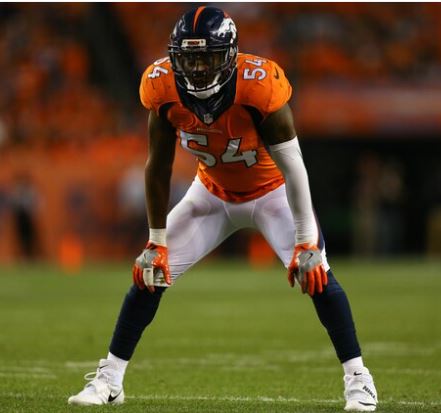
Danny Trevathan (109 tackles/ 6 pbu / 2 ints 1TD) & Brandon Marshall (102 tackles/4 pbu/ 2ff) were rangier than most Inside Linebackers and cleaned up everything between the hashmarks under 15 yards.

The strength of The No Fly Zone was blanket coverage where as a unit they had 83 pass break ups over the season. Talib led the unit with 3 Ints returning 2 for touchdowns and Harris and Stewart finished with 1 each. Against other statistical defenses the lack of interceptions (14) hurt in comparison. Even against The Legion of Boom with 28 in their 2013 year. Yet they were in man to man knocking down passes rather than being in a zone and breaking on throws.

Like many in this group the Broncos incredible defensive run in ’15 came while dragging an anemic offense to a title. Did you know the Broncos had the lowest ranked offense in the Super Bowl era to win it all?? They were ranked 19th beating out the 2000 Ravens where Trent Dilfer led the 16th best offense. Yet you had the feeling had they played Super Bowl 50 another 10 quarters the Panthers weren’t going to score.

Seriously in this day and age Peyton Manning (9TDs/ 17 ints) & Brock Osweiler (10TDs/6 ints) threw for less than 4,000 yards and completed just 60.7% of their passes. This ranks as low as the ’71 Colts with 2 aging QBs and the ’91 Eagles who had 5 QBs on the season. Their 6.55 yards per attempt might be the worst of any champion as well.

Are they a best ever defense?? They’re the 2nd best of the decade and 3rd best defense dating back to 2000. The short answer for The Chancellor of Football is yes, they were phenomenal. They would definitely be in the honorable mention category of this list. Remember every Super Bowl champion and every #1 ranked defense for over 60 years is included. See for yourself. Don’t just look at the names…the total arguments are in each article. Ohhh… and by the way “It was a different era” is an agument that doesn’t fly here. I love Talib’s takes on The Arena and I wouldnt watch it without him on there but here is where I brought conjecture and complete historical data to support.

  1. 1985 Chicago Bears
  2. 2000 Baltimore Ravens
  3. 2013 Seattle Seahawks
  4. 1976 Pittsburgh Steelers
  5. 1991 Philadelphia Eagles
  6. 1971 Baltimore Colts
  7. 1977 Dallas Cowboys
  8. 1975 Minnesota Vikings
  9. 1975 Pittsburgh Steelers
  10. 1986 Chicago Bears
  11. Honorable Mention Units

Share, then hit the like and subscribe!!

Top Ten Single Season Defenses in NFL History : #4 1976 Pittsburgh Steelers

Now how could we have a category on the best defenses and defenders in NFL history and not include the Pittsburgh Steelers?? As we moved into the 1970′s following the merger, we saw the hashmarks narrowed in 1974 and the goal posts moved to the end line to provide offenses more room to operate. Scoring had been down for much of the first half of the decade and it was thought this additional field to cover would hamper defenses. Especially those with burly MLB types that had limited range tracking sideline to sideline, or defending the pass.

No one could run on the '76 Steelers

No one could run on the ’76 Steelers

Enter Jack Lambert. A converted outside linebacker who stood 6’4 and stayed at a playing weight of 220 lbs. the majority of his career. What he brought to the table was the speed to get further back than the Willie Lanier’s and the Dick Butkus’, a prior generation’s middle linebackers who were mainly there to stuff the run. His ability to get past twenty yards in pass defense was the impetus for the Steelers to run what is NOW misnamed the “Tampa 2″.

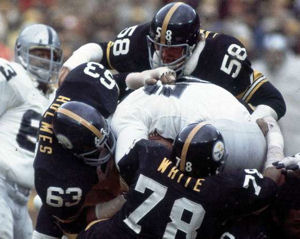
It started in Pittsburgh because against the run and rushing the passer, Ernie Holmes, Joe Greene, Dwight White, and LC Greenwood were the finest front four of their era….possibly football history. Lambert, along with outside linebackers Andy Russell, and Jack Ham, only needed to clean up against the run and were already a step back ready to clog the middle and flat areas against the slower tight ends of that era. The result??

A defense put together from astute drafting grew into one of menace that powered the Steelers to victories in both Super Bowls IX and X. In Super Bowl IX the Steelers held the Vikings to just 17 yards rushing for the game. A record that stood until Super Bowl XX. They stood tall and defended against a frantic last second effort in Super Bowl X. So strong was the Steeler defense, Coach Chuck Noll ran the ball on 4th and 9 and let the Cowboys have the ball at their own 40 yard line leaving it up to the defense to win the game. While winning a second straight world title they set the Super Bowl record for sacks with 7.

A young team with an unprecedented chance to win a third straight Super Bowl went into the 1976 season with their front four in their prime.With Terry Bradshaw growing up as a quarterback and growing receivers John Stallworth and Lynn Swann with one of history’s finest defense….What would they do for an encore?? Could they threepeat??


However there were a couple issues as this defemse was 2-2 against Pro Bowl QBs. They lost to Fran Tarkenton and Minnesota 17-6, and Ken Stabler’s Raiders 31-28 in a wild come back out by the East Bay. Another notch against the Steelers was their performance against 1976’s Top Ten offenses where they went 1-3 in the regular season.  They allowed the 2nd ranked Raiders 31 in a loss. The Vikings were 6th in offense and lost 17-6 and New England’s 8th ranked offense dropped 30 in a loss at Three Rivers no less.

The only win was against the Kansas City Chiefs who had the league’s 7th best offense. The one thing they did do was blow out the #1 offense Baltimore Colts 40-14 but they didn’t hold any Top Ten offense to 10 points or less. Another best ever defense hallmark. 

These blemishes against top ten offenses dropped this unit out of the Top 3. This is for statistical dominance over a season not just a particular streak that happened during a one. How did you fare against Pro Bowl QBs and Top Ten offenses is a staple to this study to eliminate biases. 

This team was primarily responsible for the upcoming rule changes of 1978 and this was their best season. For the year they were #1 overall (237.4 y/pg) gave up just 138 points and held 7 of 8 straight opponents to 10 points or less. Five of those came by shutout and the first modern team to record 3 in a row. In fact they only allowed 2 touchdowns in the last 10 games and those came in the same game. A 32-16 win over the Oilers.

They had a string of 22 quarters where they didn’t allow a touchdown. They were so good they had to be legislated out of business.

Starting in 1978 they instituted the “Mel Blount Rule” where receivers could only be jammed / hit within the first five yards of the scrimmage line. Blount was bludgeoning receives all down the field until the pass was thrown. Pass protectors were allowed to extend their arms to better protect against the Steel Curtain. The head slap was another tactic taken away from Pittsburgh’s charging front four in 1978. All of these rule changes can be traced back to this group.

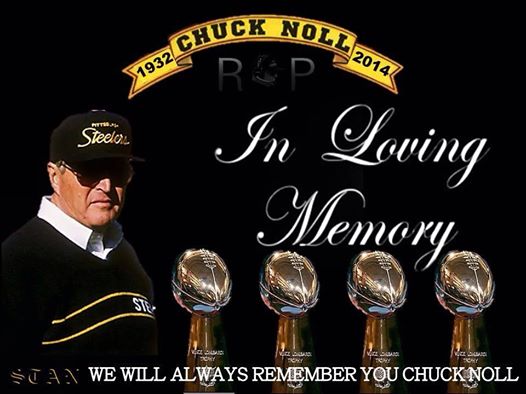
RIP Coach Noll

RIP Coach Noll

One of the best in history and number 4 on The Chancellor of Football’s list.

Dedicated to the memories of Art Rooney, Chuck Noll, Ernie Holmes, LC Greenwood, & Dwight White.

Top Ten Single Season Defenses in NFL History: #5 1991 Philadelphia Eagles

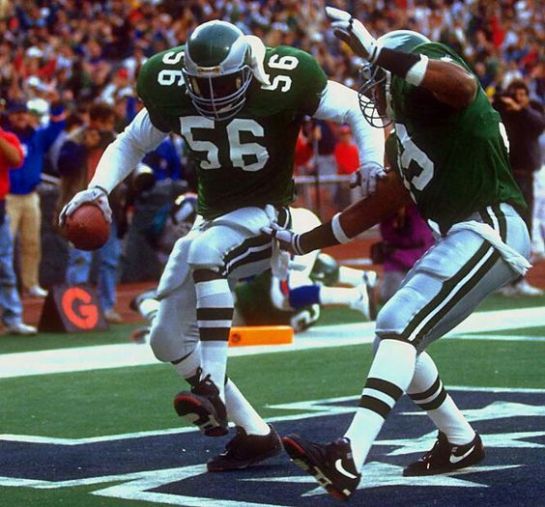
A recurring theme that seems to be running through these greatest defenses were they had to carry anemic, inefficient offenses through the season. One such incident took place when the Philadelphia Eagles lost the 1990 NFL MVP Runner Up Randall Cunningham in the first week 1991. All appeared to be lost as they attempted to go on without their #1 weapon. This defense turned in one of the last truly great performances finishing #1 against the run, #1 against the pass, and obviously #1 overall.

When you carry a team that played five quarterbacks during the season, you’ve done something. We’re sure you remember that renowned NFL quarterback Brad Goebel or Pat Ryan, right?? Who?? Brad Goebel not Stan Gable…that’s a fictitious character from Revenge Of the Nerds.
As for real quarterbacks they had two games against the Redskins Mark Rypien, that year’s Super Bowl MVP. Two more against Hall of Famer Troy Aikman then one against Steve Young and Warren Moon. Also Hall of Fame members. All but Young made the Pro Bowl in 1991. They went 3-3 against them and held Young’s 49ers (#3 offensively) and Aikman’s Cowboys (#9 offensively) to less than 100 yards passing in two complete games that year.

Remember, Aikman and Young went on to face each other in 3 consecutive NFC Championships starting the following year and won the next four Super Bowls.

They faced 6 top 10 offenses going 3-3 against them. Defensively they held 6 opponents to 10 points or fewer. Two of those games were against top ten offenses as we mentioned earlier. Counting match-ups with divisional foes as individual games, 8 times they held their opposition to their lowest offensive output for the season.

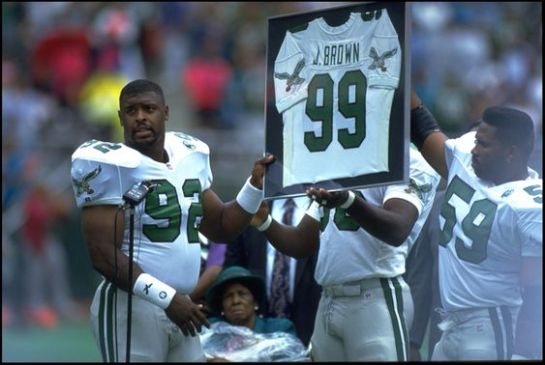
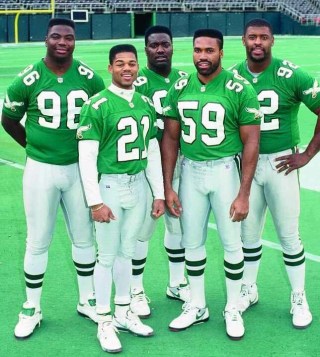
1991 Pro Bowl members of the Eagles defense.

1991 Pro Bowl members of the Eagles defense.

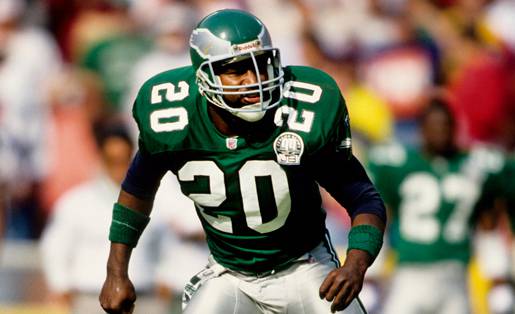
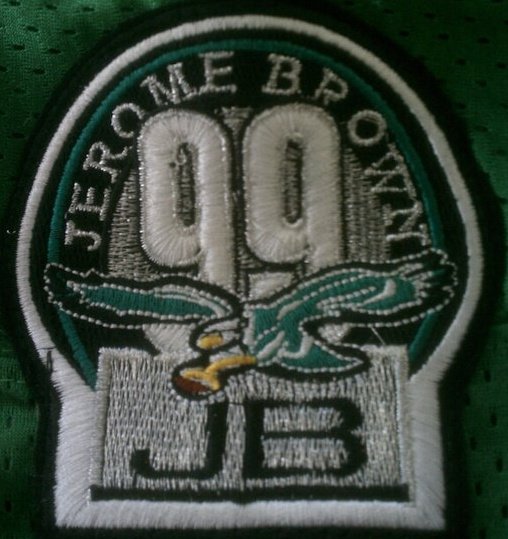
Half the defense made the Pro Bowl starting with the late Reggie White, the late Jerome Brown, and Clyde Simmons from the defensive line. These three accounted for 37 of the Eagle’s 55 sacks. Those 3 alone had just 7 sacks fewer than the 2013 NFL champion Seahawks had as a team. OLB Seth Joyner (110 tck / 6.5 sacks / 6 ff /3 ints) and CB Eric Allen who picked off 5.

The only reason SS Andre Waters didn't make the Pro Bowl was his reputation.

The only reason SS Andre Waters didn’t make the Pro Bowl was his reputation.

Amazingly the late SS Andre Waters didn’t make the Pro Bowl even though he had 156 tackles. It was he and FS Wes Hopkins that sent the early message in their signature game against the Oilers. Did you know starting the very next week, when others used their 13-6 destruction against Houston as a blueprint, stats diminished for the Run & Shoot?? This historic performance was the impetus for the abolition of the Run & Shoot as a complete offensive approach in the NFL.

In winning 7 of their last 8 attempting to make the playoffs, the quarterback rating allowed was around 40.0. For the season, 206 of 467 (44.1%) for 2,807 yards 16 TDs and 26 interceptions would get a quarterback cut and ripped by NFL Network or ESPN shows. Well this was the passing given up by the 91′ Eagles all year.

Or think of it like this: Look at the ’91 Eagles performance against 6 top 10 offenses and 4 HOF QBs. Compare those stats to Geno Smith who was the worst rated starting QB last year. Yes 32nd!!:

  • ’13 Geno Smith – 247 of 443 (55.8%) 3,046 yds 12tds 21 ints
  • ’91 Eagles – 206 of 467 (44.1%) for 2,807 yards 16 TDs and 26 interceptions

One of the best in history and #5 on The Chancellor of Football’s list.apicofme3.

Dedicated to the memories of: Reggie White, Jerome Brown, Andre Waters, Wes Hopkins, Mike Pitts, Buddy Ryan, and Bud Carson.

Thanks for reading and please share the article.

Top Ten Single Season Defenses in NFL History: Honorable Mention

When Malcolm Smith crossed the goal line to put Seattle up 22-0 in last February’s Super Bowl, pundits were already arguing where they ranked among the NFL’s greatest defenses. Here at Taylor Blitz Times we wanted to let some time pass before we waxed too philosophical about their exploits. As the keeper of the flame, it’s up to The Chancellor of Football to accurately place each great defense. We will do this in 3 parts.

Smith's 69 yard interception in Super Bowl XLVIII ended the competitive phase of the game.

Smith’s 69 yard interception in Super Bowl XLVIII ended the competitive phase of the game and trumpeted the question: Where would you rank Seattle’s defense with  the all-time greats??

One of the criteria for greatest ever defenses you have to ask is: How dominant were they at their peak? They had to bring the lumber over an entire season. These defenses had to be stout with a performance that stands the test of time in remembrance. Without further adieu we have to get on with the Honorable Mention. Those right outside the top ten.

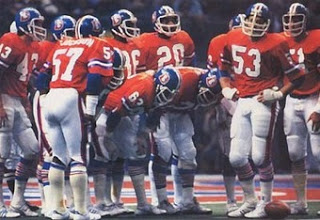
1977 Denver Broncos – The original Orange Crush defense that led the Broncos to Super Bowl XII and Denver’s first ever winning season. This was the first great full time 3-4 defense that yielded only 148 points (10.6 pts / game) and just 18 touchdowns for the season. Holding 7 of their opponents to 10 points or less.

Even with an offense that turned it over 8 times, the still held Dallas to 27 points in Super Bowl XII.

Even with an offense that turned it over 8 times, the still held Dallas to 27 points in Super Bowl XII.

Led by Randy Gradishar, ESPN’s Tom Jackson, and the late Lyle Alzado this defense had an unheard of 4 All Pros concentrated on this defense and 5 Pro Bowlers. This not ready for primetime group came out of nowhere and swallowed the Steelers and Raiders in the playoffs before falling to Dallas in New Orleans in Super Bowl XII. This group swarmed like bees and ushered in the era where 3-4 defenses took over the NFL.

1978 Pittsburgh Steelers – In the first year in which the NFL moved to a 16 game schedule, this group set the new record with fewest points allowed in a season with 195. Powered by the Steel Curtain, they held 8 of 16 opponents to 10 or fewer points. This group did more blitzing than in years past to get to the quarterback. They did have 5 Pro Bowl defenders and 1 All Pro in Jack Ham, but there were stronger incarnations of the Steeler defense.

A fact that gets lost is going into Super Bowl XIII, the consensus was Pittsburgh force vs the finesse Cowboys. Yet it was Dallas whose defense was ranked #2 and Pittsburgh’s #3, For the season they yielded 260.5 yards per game, unofficially had 52 sacks and 27 interceptions which ranked 7th. They peaked in the playoffs holding both Denver and Houston to 10 points and 5 points respectively. Yet gave up some serious candy to the Dallas offense (320 yards & 31 points)

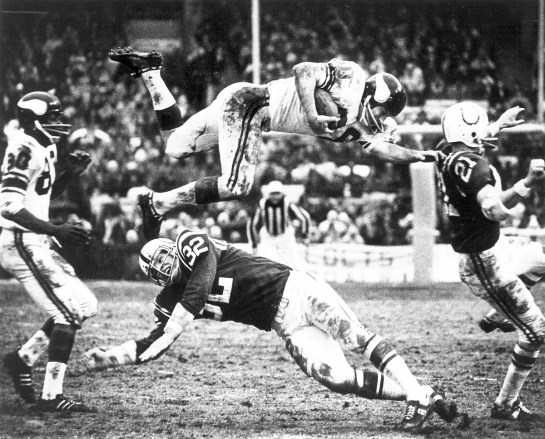
1968 Baltimore Colts – The team that is best known for coming up short in Super Bowl III against the AFL’s New York Jets. In The Chancellor of Football’s estimation, this was the best team that Don Shula ever coached and one of his defensive assistants was the late Chuck Noll. This defense held 10 of 14 regular season opponents to 10 or fewer points. At one point late in the season, they gave up 1 touchdown over 25 quarters including a string of 16 straight quarters w/out a touchdown allowed.

md-darkroom-hutchins-curtisThe Colts of ’68 shut out 3 regular season opponents and the fourth was against the Browns who gave the 13-1 team their only loss. That drubbing was avenged 34-0 in the NFL Championship Game. They even set the record with only 144 points allowed. Between 1967 & 1968 their record was 24-2-2. If only this team had won on January 12th 1969…..but….

2000 Tennessee Titans – Lost in the delirium over the great 2000 Ravens defense, is the fact they finished #2 to the Titans that year in rankings. Jeff Fisher’s bunch only allowed 238.9 yards per game and held 6 opponents to 10 points or less over the campaign.

Second year DE Jevon Kearse led the team with 11.5 sacks and 4 forced fumbles. Samri Rolle had 7 interceptions he returned for 140 yards and a touchdown. SS Blaine Bishop had 84 tackles to go with 2.5 sacks but 0 interceptions. All three were Pro Bowlers but only Samari was an All Pro Player. One issue is they didn’t force enough turnovers (29) and they finished just +1 in turnover ratio. These are poor marks considering they only saw 1 Pro Bowl quarterback the entire season. Yet they were #1 against the pass (151 yds /gm) and #3 against the run (86 yds /gm).

1987 San Francisco 49ers – One of the last teams to finish with the NFL’s #1 offense and defense happened with this group in 1987. They were gaining momentum allowing only 1 touchdown in the final 16 quarters of the season and none in the final 12 as the playoffs beckoned. They held 5 opponents to 10 or fewer points including two shutouts in their final three games. One of which was a 41-0 hammering of the NFC Central Champion Chicago Bears on Monday Night Football. 

Led by All Pro and Pro Bowler Ronnie Lott (5 ints) this group was #1 against the pass (165 yds /gm) while only yielding 273 yards for the game. What makes this more remarkable are 3 games were played with replacement players due to the strike. Had the season been 16 games instead of 15 and no strike, these numbers could have been even better. They were also #5 against the run (107.4 yds / gm) thanks to All Pro and Pro Bowl Nose Tackle Michael Carter.

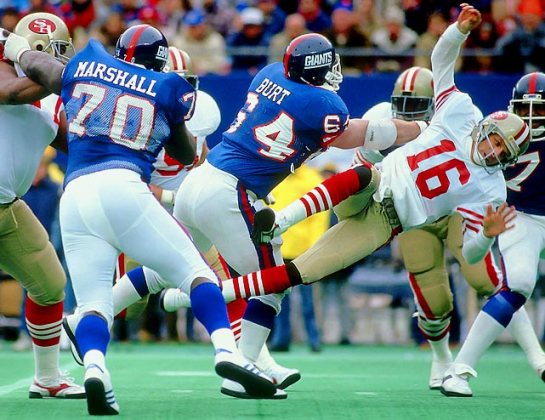
Jim Burt knocking Joe Montana out with a concussion in their 49-3 rout in the '86 playoffs.

Jim Burt knocking Joe Montana out with a concussion in their 49-3 rout in the ’86 playoffs.

1986 New York Giants – A romanticized defense that knocked 5 quarterbacks out on their way to the Super Bowl XXI championship. Yet they were #2 in 1986 and allowed 39 more yards per game than the #1 Chicago Bears with 297.3 yards per game. Second biggest discrepancy between #1 and #2 since 1970.

Led by League MVP and Defensive Player of the Year Lawrence Taylor’s 20 sacks, New York held 5 teams to 10 points or fewer during the regular season. They held their 2 NFC playoff opponents to 3 & 0 points respectively. There were 4 Pro Bowl defenders on this defense in LB Harry Carson, NT Jim Burt, DE Leonard Marshall, and the aforementioned LT.

2008 Pittsburgh Steelers – Close but no cigar. This team finished with the #1 ranking allowing just 237.2 yards per game. They held 8 opponents to 10 or fewer points yet gave up 223 for the season. One mark against them is they only faced 2 Pro Bowl QBs and lost both games. Losing 24-20 to Peyton’s Colts and 21-14 against Eli’s Giants. This was also the year they beat the Patriots 33-10 with Matt Cassel at QB not an injured Tom Brady. Big difference. This group had 51 sacks but only 20 interceptions. The last time we saw them, Kurt Warner passed for 377 yards, 2nd highest in Super Bowl history, and needed Big Ben to bail them out with a game winning pass with :32 left.

This group did have NFL Defensive Player of the Year James Harrison and Pro Bowl SS Troy Palamalu who would win the award 2 years later. Harrison had 16 sacks with 7 forced fumbles. James Farrior (122 tackles) was the 3rd and final Pro Bowler on a talented roster which included LaMarr Woodley (11 sacks).  They were a world champion but this group didn’t perform high enough against the best competition. The top ten is a Sugar Ray Leonard’s list, the honorable mention is where Thomas Hearns resides.

Dwight Smith capped off Super Bowl XXXVII with 2 defensive touchdowns. Should have been the MVP.

Dwight Smith capped off Super Bowl XXXVII with 2 defensive touchdowns. Should have been the MVP.

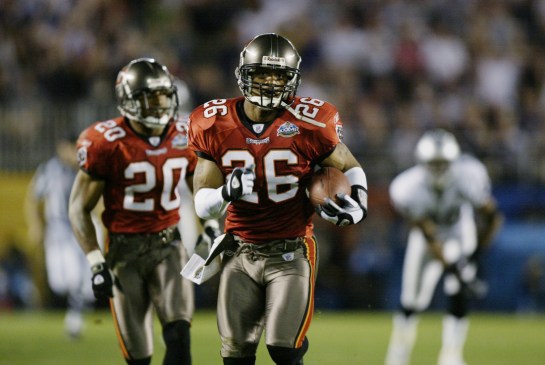
2002 Tampa Bay Buccaneers – The final team to miss the call to the top ten was the 2002 Buccaneers. The undisputed #1 defense that year. However playing in the new NFC South they feasted on patsies. On 3 occasions they took on top 10 offenses and they lost two of those games to Philadelphia (10th) and Pittsburgh (5th).

This team yielded 252.8 yards per game had 43 sacks and 31 interceptions which ranked 6th and 1st respectively. This team only gave up 196 points while holding 9 regular season opponents to 10 or fewer points. However a closer look reveals they came against offenses ranked 26th, 18th, 14th, 23rd, 31st, 31st, 12th, 14th, and 29th. Chris Redman (who??) quarterbacked the Ravens who was the first in this group. While NFL journeyman Jim Miller led the Bears in the last game.

This team fielded 5 Pro Bowl players in NFL Defensive Player of the Year Derrick Brooks, Shelton Quarles, Hall of Famer Warren Sapp, Simeon Rice (15.5 sacks), and S John Lynch. This group scored on defense. Brooks tied the NFL record with 4 defensive touchdowns and CB Dwight Smith set a Super Bowl record with 2 interception returns for touchdowns. Their numbers and performance should get them in until you look at the competition. Someone reading this is going to describe how they throttled the #1 Raider offense in the Super Bowl. Yet how much do you attribute to Monte Kiffin’s defense or Jon Gruden knowing the Raider offense and personnel??

Thanks for reading and now its time for the top 10.