Roger Craig Should Be In Pro Football Hall of Fame

When you think back to Bill Walsh’s great 49er teams, who are the first players you think of?? Right there with the Joe Montanas, the Jerry Rices, and Ronnie Lotts it only takes a fraction of a second to think of Roger Craig. His high knee running style brought a physicality to the San Francisco offense that was seen as a finesse group up until his arrival. In fact he came to San Francisco as a fullback when they drafted him from Nebraska before the 1983 season.

In college he had been primarily a blocking back in the Cornhuskers wishbone offense. Normally he paved the way for Jarvis Redwine and then Mike Rozier. Yet when Bill Walsh decided to revamp San Francisco’s dismal backfield after a 3-6 season in 1982, he drafted Craig in the second round.

Although the 49ers had won it all in 1981, it had become apparent Bill Ring, Amos Lawrence, Walt Easley, and Earl Cooper just wasn’t cutting it in the backfield. To raise the stakes in the NFC for 1983, Craig and newly acquired Wendell Tyler would form a more potent backfield.

After posting the worst yards per carry average (3.4) and yardage (742) in 1982, the new backfield duo of Craig and Tyler turned that around completely. The much improved ground game of 1983 ranked 8th with 2,257 yards rushing and a gaudy 4.4 yard average. Ironically just ahead of the Los Angeles Rams, who had traded Tyler to San Francisco so they could draft Eric Dickerson.

You had to give the nod to Craig who ran for 783 yards a team leading 8 TDs, while catching 42 passes for 427 yards and another 4 scores. This more dynamic backfield, along with Joe Montana, powered San Francisco to the NFC Championship Game. A 24-21 loss to the Washington Redskins was shrouded in controversy, thanks to some questionable calls, yet Walsh had the backfield he envisioned. Craig had reinvented himself from a collegiate player who rarely touched the football to a dual threat pro.
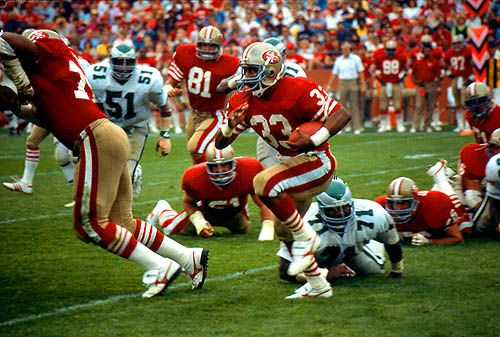
The 1984 49ers were a juggernaut becoming the first team to go 15-1 during the regular season. Everyone of the 49 man roster played their role so no one had outstanding stats. However once the 49ers moved past the New York Giants and Chicago Bears during the playoffs, the stage was set for a coming out party in Super Bowl XIX. With all eyes on Joe Montana’s possible second Super Bowl trophy and the electrifying record setting Dan Marino, Craig’s name didn’t even make the marquee.


Roger Craig graces the cover of Sports Illustrated after his record breaking performance in Super Bowl XIX.

Roger Craig graces the cover of Sports Illustrated after his record breaking performance in Super Bowl XIX.

It was his 1985 that set Craig apart as he amassed his 1,000/ 1,000 yard seasons both rushing and receiving. The first player in league history to do so. Some 27 years later, only Hall of Famer Marshall Faulk shares that accomplishment when he did it in 1999. How dominating was his performance?? Well his 1,050 yards rushing doesn’t jump out at you until you realize he only ran 214 times for a whopping 4.9 yards per carry. The league average is always around 4.0.

Oh by the way, he led the NFL in receiving that year with 92, which set a record for running backs, that amassed 1,016 more yards. His 15 total touchdowns was second to Joe Morris and was 1 better than NFL MVP Marcus Allen. In fact many pundits, including our CEO believes Craig should have been the MVP in 1985 with that dominating performance.

Now buoy his 1985 record setting season not culminating with the league MVP, on the backdrop of a Super Bowl record 3 TDs yet not winning that MVP and you’ll see where we’re going in a minute. Don’t forget he did this on a 10-6 San Francisco team that was a defending champion with Jerry Rice being a rookie that didn’t have 1,000 yards receiving and only 3 touchdowns. Craig quite simply fueled that offense.

Once the 49ers won Super Bowl XIX, they were forced to retool and become a bigger physical team. In 1985, the Chicago Bears emerged with one of the most imposing defenses in NFL history. The Giants followed suit with an overwhelming defense that featured 4 linebackers in the 250 lbs category. When Bill Walsh and his 49ers were dominated 49-3 in the 1986 NFC Divisional Playoffs by the Giants something had to be done.

These were teams the 49ers had beaten on their way to the ’84 championship, now they had taken the game to a new level of brute force. In reinventing the offense from a size perspective, it was Craig who was switched from fullback to halfback to allow for the insertion of Tom Rathman at fullback. The entire offensive line was overhauled.

You have to keep in mind the average career for a runner in pro football is less than 4 years. Yet here Craig was making the switch in year 5 to a position that called for him to be quicker. This at a time where he should have been slowing down from a physical standpoint. Yet he, Jerry Rice and Joe Montana spearheaded one of history’s most accomplished runs. From 1987-1990 the 49ers went 51-12 in the regular season, winning back to back Super Bowls in ’88 & ’89 and were the prohibitive favorites to win it all in 1987 as well as 1990. They finished #1 in offense in ’87 and ’89 and #2 in ’88 and ’90. In each year they made it to at least the divisional round of the playoffs and 3 straight NFC Championship Games as they were trying to threepeat.

Playing in only 12 games due to the ’87 strike, Craig ran for 815 yards which projects out to 1,086 over a full season. The 13-2 Niners were poised to become the greatest team of the modern era yet were upset by the Vikings in the playoffs. They were #1 in both offense and defense yet proved fallible in the playoff loss. Craig went on to his greatest performance in the 1988 campaign. In rushing for a career high and club record 1,502 yards, he also caught 76 passes for an additional 534  yards for his second season with over 2,000 yards from scrimmage. More important, he powered San Francisco to another Super Bowl championship with a win over Cincinnati in the XXIII’d edition.

Roger Craig was a hard nosed runner.

Roger Craig was a hard nosed runner.

Yet go back to 1988 being his second season with more than 2,000 yards from scrimmage. Keep in mind this was no sleek, make ’em miss halfback. He brought a punishing style to his position where he bludgeoned the opposition. As you’re reading this you can picture his high knee running style like when he trampled through the Rams on his most famous run in 1988.

Yet did you know that Emmitt Smith, Thurman Thomas, and Barry Sanders only had 2 different seasons amassing 2,000 yards from scrimmage also?? Did you also know that Marcus Allen and Adrian Peterson have only had one?? Only Edgerrin James, Marshall Faulk, Ladainian Tomlinson, and Eric Dickerson had more. What do all of these runners have in common?? Peterson and Tomlinson will be in the Hall of Fame and all the others are in. Roger Craig is right there with them.

Now going into the Hall of Fame is based on impact on the game. By the time we bring up the 1989 team that won Super Bowl XXIV, Craig was a driving force behind the team of the decade. Again he was a 1,000 yard rusher as the team won their fourth Super Bowl and Roger had his 3rd ring. When he left the game in 1993, his 566 career receptions was #1 among running backs all time and still remains 7th.

He is in the linear line of great NFL running backs when it comes to catching the football and is a part of the game’s evolution. He took the mantle from Chuck Foreman and propelled it forward. Since then, only a handful of every down running backs have provided that type of versatility. Now everyone has a receiving running back who comes in on 3rd downs where Roger was in every play.

It was Craig’s play that allowed a young Jerry Rice to flourish as teams concentrated their efforts to stop him. If Craig’s move to halfback in 1987 hadn’t panned out, what would have been the legacy of Bill Walsh’s “West Coast Offense”?? It was the run from 1987-1990 that made the offense spread it’s wings throughout the National Football League. During this time is when it proved it could take on the big bad Chicago Bears defense (see 41-0 1987 Monday Night shutout) and 28-3 NFC Championship win in Soldier Field in ’88. Then you add the rivalry with the New York Giants.

From Mike Holmgren to Denny Green to Mike White to Jon Gruden ( who had just begun coaching on the 1990 SF coaching staff) and George Seifert succeeding Bill Walsh. They all could attribute their Head Coaching jobs to some extent to Craig’s performance along with Montana and Rice. Yet the foundation of that offense running and receiving along with goal line and short yardage was #33.

By the way, when did Roger Craig become the the first running back to have a 100 yard receiving game in a Super Bowl?? You guessed it… Super Bowl XXIII against Cincinnati and not his record setting performance against Miami. Now had he won the Super Bowl XIX MVP, or the 1985 NFL MVP, would that have propelled him to winning the NFL MVP in 1988?? Give it some thought.

For induction into the Pro Football Hall of Fame, I present to you…Roger Craig

Falcons Clear Cap Space – Release Michael Turner, John Abraham, & Dunta Robinson

Abraham is now free to shop his wares on the open market as a free agent.

Abraham is now free to shop his wares on the open market as a free agent.

Some teams have to manipulate the salary cap by restructuring contracts of their top paid players. We’ve seen this with the restructuring of Tom Brady’s contract in New England & Ben Roethlisberger’s in Pittsburgh. However some teams have to part ways with players where a succession is in place or their production can be replaced for a lot less money. Such is the case in the Falcons releasing Turner, Abraham, and Robinson.

In the case of John Abraham he has been a good player with flashes of greatness yet disappeared in games for the Falcons. He’s been injured or nicked here and there and has missed 5 games in the last three years. Soon to be 35 his best years are definitely behind him. They should be able to replace the 10 sacks he had last year for a lot less money. Don’t forget he was drafted by the New York Jets in 2000, so he has some mileage. There are other pass rushers available in free agency that have more tread on their tires. Osi Yumeniora or Dwight Freeney as a situational pass rusher could do the trick.

As for Michael Turner he has slowed down tremendously over the last year. He hasn’t shown the burst that he had when he originally hit the scene down in Atlanta. Nevermind the fact he only rushed for 800 yards last year, look how far is average per rush has dropped. He only had a 3.6 yard average last year after 4.9 in 2009, to 4.1 in 2010, to 4.5 in 2011. While it’s true that all the Falcons runners had down years in terms of average yardage per rush, Turner was their battering ram coming off back to back 1,300 yard seasons. Now that he’s turning 31 they should be able to find a runner or two to fill that void. They’re saving $6.4 million with his release so they can even go into free agency or draft a young back if they need to.

Samuels came in as advertised.

Samuels came in as advertised.

With Dunta Robinson you need to look no further than the signing of Asante Samuel last year. When Brent Grimes went down Samuel stepped in and picked off 5 passes to lead all  Falcon cornerbacks and was second on the team to Thomas DeCoud with 6. With a healthy Brent Grimes returning from injury, Robinson who only defensed 8 passes and had 1 interception was expendable.

Sure they have to re-sign Grimes but these three roster cuts freed up over $16 million to put the Falcons more than $20 million under the cap. This was a healthy move for a team with serious designs on returning to the 2013 NFC Championship Game and beyond. They need to get more of an impact rusher and a serviceable back to do so, but now they have the money to acquire what they need. Abraham and Turner were diminishing returns if we’re talking late next season. There are no assurances in the NFL but these are good moves for the Falcons.

Thanks for reading and please share the article.

Taylor Blitz Times new logo!!

Taylor Blitz Times new logo!!

Warren Sapp Makes The Hall of Fame

Warren Sapp as a Miami [[_]] Hurricane!!

Warren Sapp as a Miami [[_]] Hurricane!!

When you think back to Tampa Bay’s Super Bow XXXVII win over the Oakland Raiders, you knew it was a win that was years in the making. It was born when Buccaneer coach Sam Wyche made two critical moves that solidified the franchise. The first thing he did was turn the organization into a defensive minded outfit, by signing free agent Middle Linebacker Hardy Nickerson as it’s  impenetrable core. This was the first year of NFL free agency in 1993 and this was where the Buccaneers re-invented themselves. Second was anointing Wyche’s assistant coach to Head Coach, Tony Dungy who selected Warren Sapp and Derrick Brooks in the draft of 1995. Brooks was a slightly undersized linebacker from Florida St.  But Warren Sapp??

Twin draft pics in 1995 turned the fortune of the Tampa Bay Buccaneers.

Twin draft pics in 1995 turned the fortune of the Tampa Bay Buccaneers.

After a sterling career at the University of Miami, Sapp was in line to make an impact on the NFL when before the draft, a report was leaked that Sapp had failed drug tests which affected his status. Even though he was the Big East Defensive Players of the Year, an All American, and winner of both the Nagurski and Lombardi Awards, 11 teams passed on him on draft day. He was projected to go number 1 and fell to the “Yucs” at #12. You could see the disappointment in his face. The picture above was once they were in Tampa for the press conference.

Why the “Yucs”?? This team had been laughingstocks for most of their history up to that point. For 12 years, from 1983-1994 the team had double-digit losses.

What didn’t bode well for Warren Sapp that day was the fuel to what burned as motivation for Sapp the rest of his career. He started slowly but by his 2nd season, he made his presence felt with 51 tackles, 9 sacks and 1 forced fumble. Since he was one with a big mouth and part of the “in your face generation” that hit the NFL in the mid to late 90’s it took time to gain acceptance. He should have made the Pro Bowl in ’96 but the Buccaneers were 6-10 and still a loser.

Sapp was a larger than life defensive tackle that Tony Dungy built his defense around. Pictured here celebrating in Super Bowl XXXVII.

Sapp was a larger than life defensive tackle that Tony Dungy built his defense around. Pictured here celebrating in Super Bowl XXXVII.

All that changed in 1997 as the team rolled out to a 5-0 start. In the opener against San Francisco, they knocked out both Steve Young and Jerry Rice in a 13-6 win. Sapp had relentlessly been involved in both plays. He began the season on everyone’s radar with a 2 1/2 sack performance.  In a frightening display of power and speed, Warren and the Bucs in their new uniforms showed a new day was dawning in Tampa.

They had throttled an offense that had been one of the NFL’s best for two decades and knocked Jerry Rice out for the season. Those two points alone had NFL shows talking about the 49ers, the Bucs, and especially Warren Sapp. No longer was he just one for on-field antics that made a few defensive plays, he was maturing into the best interior lineman in football. In ’97 he finished with 58 tackles, 10 1/2 sacks along with 3 forced fumbles and 1 recovery. They finished with a 10-6 record and a defensive ranking of #3.  Earning Tampa its first playoff berth in 14 years.

After defeating the Lions for their first playoff win since 1979, they made the pilgrimmage to Lambeau Field for a divisional playoff against the defending Super bowl Champion Packers.  Many weren’t taking the Bucs too serious. You have to understand the stigma they were trying to shed. Further evidence was the fact that 5 of their 6 losses had come from within the NFC Central. Sure they beat an inconsistent Detroit in the Wild Card 20-10. Many thought the Bucs would be happy just getting to the divisional round. Where Favre, White, Joyner and company were eyeing back to back championships and should plow through the neophyte Bucs. Besides, it would be 27* and Tampa hadn’t won a game where it was under 40* ever.

Sapp chases down Favre for one of his 3 sacks in the 1998 NFC Divisional Playoff in Lambeau.

Sapp chases down Favre for one of his 3 sacks in the 1998 NFC Divisional Playoff in Lambeau.

What took place on a dreary day in Green Bay was a young Lion standing toe to toe with an old warrior for 60 brutal minutes of football. In the signature game that defined his career, Sapp was all over Brett Favre and the Packer offense. He amassed 3 sacks and a fumble recovery. After each time he stopped a running play or harassed Favre, the two talked trash to each other and a national television audience witnessed the coming of the Bucs.

Inspired by Sapp’s lead by example, the Bucs, who had fallen behind 13-0, refused to be buried and began to believe they could win. Although they fell just 21-7, many saw a future champion in Tampa. On this day, he wrested the defensive leader mantle from Nickerson and placed it on himself. He was the face of the franchise and the entire off-season, his performance in that playoff loss to Green Bay seemed to be all people were talking about.

What we saw that day were two of the NFL’s best playing high stakes football as though it were being played in a backyard somewhere. The little brother Bucs led by Warren passionately jawing and playing with the favored big brother Packers led by Brett. Tony Dungy had tuned his team to the point they needed to catch and beat Green Bay in their growth as a club. So the playoff game was played like it was a Super Bowl.

In 1999, Sapp had the best season of his career. He was named NFL Defensive Player of the Year for his 41 tackle, 12 1/2 sacks, and 4 forced fumble performance. He led the Bucs back to the NFL playoffs, this time making it to the NFC Championship Game. Although an 11-6 loss to the Rams kept them from Super Bowl glory, Sapp led his team there at the conclusion of the 2002 season.

The calm before the storm before Super Bowl XXXVII.

The calm before the Super Bowl XXXVII storm. Tampa won 48-21. The Raiders never knew what hit them.

The victory in Super Bowl XXXVII validated many careers and vindicated one Warren Sapp. Eight years before he was embarrassed at the NFL draft amid rumors of drug use and having his character in question after his years in Miami. To some they still saw him as a big-mouthed player that was more show than substance. That Super Bowl victory made them have to acknowledge him as a champion. Critics had to give him his due as the best “three” technique defensive tackle of his time.

300_110727For his career he amassed 573 tackles, 96 1/2 sacks, 19 forced fumbles, 12 recoveries, and 4 interceptions, returning one for a touchdown.  Since the NFL is about sack totals for most pundits, he’s second only behind former Viking and Hall of Fame member John Randle. Whom he played with many times in Hawai’i where he made 7 trips to the Pro Bowl. Sapp wanted to be remembered like a Joe Greene. A true giant of the game.

Right after Super Bowl XXXVII, Sapp said we had to put his Bucs up there with the greatest defenses to play in the NFL. Can that point be argued??

  • ’85 Chicago Bears – #1 defense / allowed 258.4 yards per game /allowed 198 points for the season / 64 sacks / 34 ints / scored 6 TDs defensively
  • ’00 Baltimore Ravens -#2 defense / allowed 247.9 yards per game /allowed 165 points for the season / 43 sacks /23 ints/  1TD scored defensively
  • ’02 Tampa Buccaneers – #1 defense / allowed 252.8 yards per game / allowed 196 points for the season / 43 sacks/ 31 ints /scored 5TDs defensively
  • ’78 Pittsburgh Steelers – #3 defense / allowed 260.5 yards per game /allowed 198 points for the season/  / 27 ints /1 TD scored defensively

On second thought an argument can be made for the 2002 Tampa By defense as among the best of the Super Bowl era. One point that can’t be is the selection of Warren Sapp as a Hall of Famer.

For induction into the Pro Football Hall of Fame, from The [[_]], Warren Sapp aka QB Killa

Thanks for reading and share the article.

Taylor Blitz Times new logo!!

Taylor Blitz Times new logo!!

Super Bowl XLVII Preview: Ray Lewis and His NFL Legacy

Ray at a Baltimore practice session.

Ray at a Baltimore practice session.

The mere mention of his name conjures up images of frighteningly intense play from his great 2000 season. We have seen and heard his pregame speeches and he has spawned an entire generation of Middle Linebackers to imitate his play. One such player will line up for the San Francisco 49ers in Patrick Willis. Do you think it’s a coincidence that he wears number 52?? With this being his last NFL game how do we see him going out??

While it’s true that Lewis has lost a step, he’s been very effective as of late. In the AFC Championship he was in on 14 tackles. Against Peyton Manning and the Denver Broncos in the divisional round, he had 17 tackles and 1 fumble recovery. What you don’t see are the flash plays that he was able to achieve in the early 2000’s. However you do see a veteran linebacker take the minimum amount of steps necessary to make plays from his position.

The 2012 Ray Lewis in Lando Calrissian facemask. Are we sure he won't intimidate Colin Kaepernick on gameday??

The 2012 Ray Lewis in Lando Calrissian facemask. Are we sure he won’t intimidate Colin Kaepernick on gameday??

This is a veteran linebacker that needs to key with the zone option read Colin Kaepernick will run at them on Sunday. In the Ravens defense, when they see this play, Lewis needs to stay on Frank Gore and the outside guys in Dannell Ellerbe, Paul Kruger, and Bernard Pollard have to be there to hit Kaepernick early to get his attention. Lewis out in space would definitely be a liability at this time. He, Haloti Ngata, and Terrence Cody have to take care of Frank Gore at the point of this play.

If the Ravens can prove to use the front 3 to eat up the blockers and limit Gore’s effectiveness on the read option, Lewis will be able to scrape from inside out if Ellerbe and Kruger can keep containment. This will have to be later in the game once the read option has been neutralized up front. This game may be won or lost on this premise. Lewis needs to flow from his Inside Linebacker position to the cut back point of this play with containment. If the 49ers can stretch the outside, Lewis will not be able to make it to that point to stop Kaepernick.

Ironically, he was the last player introduced in Super Bowl XXXV when players were introduced individually.

Ironically, he was the last player introduced in Super Bowl XXXV when players were introduced individually.

Don’t underestimate the value of leadership and what it means to motivate men. It’s a lot like going to war with Genghis Khan to those fellow players in the huddle with him. Warriors bring out the best in fellow warriors. The Ravens had lost 4 of 5 at the end of the season without him. During that time they had allowed 27.7 points per game in those 4 losses and only 4 turnovers forced. Take out the 2 special teams touchdowns against Denver, Baltimore is only giving up 16 points per game and forced 8 turnovers upon his return.

His place in history is secure. Simply put, he is the greatest Middle Linebacker of the last 50 years. Dick Butkus ruled the first 50 and the eras are different and here, we pay homage to each era. More players have used his example how they need to be when it comes to being a leader on his or her team. You have some that lead by words before or during a contest, or you have those who lead by deed. When you have both you catch lightning in a jug. When you have a player that players from other teams look to for leadership and counsel off the field, what does that tell you??

He has a chance to walk off into the sunset with another Super Bowl triumph. The first team achieved greatness because of his will. We’re hard pressed to think this second incarnation of the Ravens won’t do the same thing.

Epilogue: You know..everyone is entitled to their opinion of Ray Lewis. Rather than go on your page and say something, I’ll say it here. I hear others saying he is no role model from his obstruction of justice charge following his trial. What is disturbing is anyone who still vents how he is a murderer and such never seem to keep it to themselves…including a Mrs. Wes Welker. Now, I’m sure those of the opinion went over every nook and cranny of that trial’s evidence to find him guilty…right??

Brian Billick on the sidelines of Super Bowl XXXV.

Brian Billick on the sidelines of Super Bowl XXXV.

Maybe not, but there are many that preach forgiveness and all these virtues yet have none for the man. Let’s ask the question… Why?? I’m sure you donated money to funds set up for the the two deceased men who were killed in that fight. Correct?? By the way do you know their names?? Have your opinions, but I find it ironic we’re headed to Super Bowl XLVII some 12 years later and I can hear Brian Billick’s voice the second they arrived in Tampa for XXXV.

He stepped to the podium and sternly said ‘We’re not going to re-try Ray Lewis and go over that trial. Number one it’s inappropriate and two you’re not qualified.’ No matter his repentance those still feel compelled to say or express venomous comments at the mention of his name as though you’re pure of sin or misdoing. Seriously?? So no matter what he’s done, you have decided to be judge, jury, and executioner on his character forever. Nevermind charitable works, turning his life over to Christ and the lives he has touched. What would you say about him if his behavior was that of an athlete with run-ins after the fact?? Out in the nightlife with questionable behavior?? We’d be listening to how unrepentant his behavior is or had been.

What really is upsetting is how so much of this smack of racism. For African Americans it’s an unspoken but understood issue that once you fall from grace you won’t be forgiven. In Lewis’ case in many instances on the web, OJ is always brought up and it seems to be the same people with the racist leanings in their commentary. How many of these have written the Atlanta District Attorney or the Atlanta police department looking for follow-up investigation information?? Yet do we hear murder yelled out every time we saw or speak of actor Robert Wagner, whose wife Natalie Wood, drowned mysteriously with just a few people on the boat?? Aside from one outburst a few years before he died how often was “Chappaquiddick” yelled at Ted Kennedy after the drowning incident that involved Mary Jo Kopechne in 1969?? I don’t remember that slur following Kennedy around every where he went.

In those latter two incidents the person was there but the venom was never delivered anywhere near the frequency of bombs hurled at Lewis. This upsets me to no end because we don’t hear of the Robert Blake incident with this frequency either now do we?? Everyone needs to come off of their high horse and those that hide behind the “concerned citizen” cloak have nothing to fear. Unless you’re going to meet up with and have a fight with a younger Lewis outside of a bar with each of you banked by sets of friends you have nothing to worry about. He’s turned his life over to Christ and has led an exemplary life after that in the name of redemption. At what point do you forgive?? Just a thought…

Thanks for reading and please share the article. New logo of the Taylor Blitz Times

Taylor Blitz Times new logo!!

Taylor Blitz Times new logo!!

George S Halas – A Word on Papa Bear & 1963 NFL Championship Highlight

"Papa Bear" George Halas

“Papa Bear” George Halas (Feb. 5, 1895 – Oct. 31, 1983)

In the last few years, we get to the NFL playoffs, it’s interesting to hear short sighted fans ask why the NFC Championship trophy is named after George S. Halas and the Super Bowl trophy is named after Vince Lombardi. Several times our CEO has heard on multiple occasions that one of the trophies should be named after Tom Landry. Those Cowboy fans couldn’t be more delusional.

First off, Tom Landry never had a back to back champion that would qualify any of his Cowboy teams as a best ever unit. What would be the basis for this?? Because he won 2 championships as coach of the Dallas Cowboys and coached for 29 years?? That is nowhere near close enough to unseat George Halas who coached for 40 years, and his six championships are the most ever. Not only is he the Phil Jackson of the National Football League when it comes to coaching championships, he’s also the  founding father of the NFL and the Chicago Bears. No George Halas, no NFL, its that simple.

Don Shula has overtaken him as the coach with the most wins 347-324, but you have to realize he was there pushing the pro game from it’s infancy to the modern age. Yet if you want to base it on just coaching feats try these on…

Ring for the 1933 Chicago Bears championship rings

Ring for the 1933 Chicago Bears championship.

Earlier we mentioned Landry not having coached back to back champions, well Halas did it twice. First in the 1932 & 1933 seasons, then in 1940 & 1941. The latter dynasty featured the 73-0 defeat of the Washington Redskins in the 1940 NFL Championship Game that introduced a new backfield alignment, the T-Formation. For a seven year period, his Chicago Bears won 4 championships which nearly equals what the Steelers (4 in 6 yrs) did in the 1970’s. His greatest team were none of these.

In 1934 with his chance to three-peat, he had an undefeated team in the NFL Championship Game when the Giants “outsmarted” them switching to basketball shoes on in icy field. That 30-13 loss brought an end to his first dynasty. So it wasn’t Don Shula with the first team to finish the regular season undefeated and Bill Belichick suffered the same fate in 2007, but he was going for 3 in a row at the time.

As for his last championship in 1963:

George Halas Bust

The George Halas Trophy that is awarded to the NFC Champion.

The George Halas Trophy that is awarded to the NFC Champion.

George Stanley Halas led an incredible football life. Without his efforts of over 60 years the National Football League and the subsequent All America Football Conference and the American Football League wouldn’t have had the wings to take flight. Each of those rival leagues had to have the NFL to aspire to be greater than. So when you see his name on the side of the NFC Championship Trophy, understand his importance to pro football.

The list of his Champion Chicago Bears championship teams:

Dedicated to the memory of George Stanley Halas (Feb. 5, 1895- Oct. 31, 1983)

The ring for George Halas' last champion Bear team from 1963.

The ring for George Halas’ last champion Bear team from 1963.

Lester Hayes Belongs In The Hall of Fame

As the NFL changed the rules in 1978 to liberate the passing game, many thought the big physical cornerback would give way to smaller quicker men. Those who could turn and run with receivers after the 5 yard “chuck” zone (The Mel Blount Rule) would be highly sought after. Yet one team held steadfast to the belief of not allowing that receiver a free ride off the line of scrimmage.

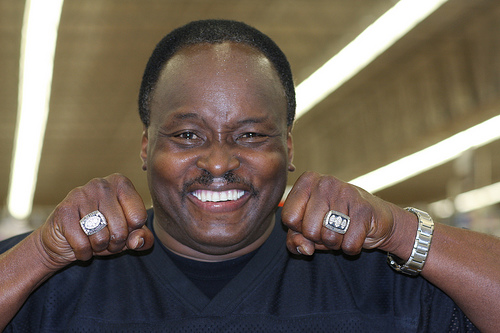
The Oakland Raiders who in 1977, just one year removed from winning Super Bowl XI, selected Lester Hayes out of Texas A&M. Where the league saw smaller cornerbacks at 175-180 lbs enter the league at that time. Hayes was a converted college safety who stood 6’0 and weighed 200 lbs.

Does he have on enough stickum??

His inclusion into the Raiders organization was at the right time as Hall of Fame cornerback Willie Brown retired and took over as secondary coach. Under his tutelage Hayes became a master of bump and run coverage and with his size, manhandled receivers at the line of scrimmage. Sure a receiver could run free after 5 yards but he had to get there first.

Another retiring Hall of Fame Raider was WR Fred Biletnikoff who went against Hayes in practice. Fred ran crisp routes and was a slower version of Steve Largent or a Charlie Joiner. Going up against he and Cliff Branch, who was the one of the league’s perennial deep threats, honed his skills to that of one of the greatest cornerbacks the game had ever seen. He also borrowed Biletnikoff’s use of stickum and took it to obscene levels. Take a look at the pic on the right if you think we’re joking.

Stickum talk aside, his true coming out party was the 1979 season where he led the team with 7 interceptions, returning 2 for touchdowns in the only losing season for the Raider organization during the 1970’s. John Madden had retired and Tom Flores had taken over as Head Coach and the Raiders were a team in transition.

Most teams make a transition in personnel with a defensive leader being a linebacker or a star defensive lineman being a marquee player yet here was a cornerback just starting to make a name for himself at the helm. However he couldn’t unseat Louis Wright of Denver, Mel Blount of Pittsburgh, or Mike Haynes of New England on the 1979 AFC Pro Bowl roster. Naturally you’ll conclude they had better seasons yet Blount and Haynes made it on reputation with only 3 interceptions each and Wright only had 2. A gross injustice just because Hayes team had slipped that year.

Enter the greatest single season for a cornerback in NFL history and the greatest coaching job in NFL history…the 1980 Oakland Raiders. In the second season for Tom Flores, the Raiders became the first team to win the Super Bowl from a wildcard position. The team had replaced nine defensive starters from a Super Bowl team just four years before.

Lester Hayes intimidating style at cornerback belied his agility to cover the fastest and best route runners in the NFL.For the season, he picked off 13 passes, just one short of the NFL record by “Night Train” Lane in 1951.  Not only was that the highest total in 29 years, no cornerback has come within 2 of that performance since then (Everson Walls in 1981). He returned those passes for 273 yards and one touchdown and went on to be the Associated Press NFL Defensive Player of the Year.

He was the first player to receive the award while playing for a team that didn’t finish as a top 10 defense with the Raiders finishing 11th. He did this while facing Hall of Fame WRs Steve Largent in Seattle, Charlie Joiner and Kellen Winslow in San Diego, and the electrifying John Jefferson also of the Chargers with whom he had epic battles with.

During the 1980 season teams kept testing him and coming up snake eyes. If you added his 4 interceptions during the playoffs he finished with 17 interceptions in one season. If you look at that against the year Hall of Famer Deion Sanders won his NFL MVP (1994 with San Francisco) from the same position, 6 interceptions for 303 yards and 3 TDs with 2 more ints. in the postseason, it dwarfs it tremendously. Sanders needed another NINE interceptions just to tie him!!!  You would have to add Deion’s next FOUR seasons with Dallas just to tie him with 17!! Tremendous

Oakland went on to win Super Bowl XV and the 80 playoffs began with a wildcard battle against Houston and former quarterback Ken Stabler. The Raiders prevailed 27-7 with the final points scored on Hayes intercepting Stabler and returning it 20 yards hand held high to send the Raiders to Cleveland and the divisional round.

He intercepted Stabler twice then intercepted 1980 NFL MVP Brian Sipe twice in the 14-12 upset of the Browns. In the AFC Championship against the Chargers and the Super Bowl with the Eagles, Dan Fouts and Ron Jaworski just didn’t throw into his area. How do we know this?? In Super Bowl XV Hayes was the left cornerback. Jaworski threw exclusively to his left and Right OLB Rod Martin picked off a Super Bowl record 3 interceptions in a 27-10 win.

The NFL outlawed stickum after that 1980 season in anther decision that Raider loyalist felt was the offspring from the court battle between Raiders’ owner Al Davis and commissioner Pete Rozelle. Some thought that Hayes inability to use stickum had a lot to do with his interception total dropping, when in fact quarterbacks just flat didn’t throw into his area. He never intercepted more than 3 passes in a season from that point forward.

Lester Hayes showing off both rings from Super Bowl XV and XVIII

After being overshadowed by Mike Haynes for that 1979 Pro Bowl slot, he was joined by his former counterpart in 1983 to form one of the greatest CB tandem in NFL history. In that year the Washington Redskins became the highest scoring team in NFL history scoring 541 points on their way to Super Bowl XVIII. Washington’s quarterback Joe Theismann was the NFL’s MVP and the Redskins were being hailed as the greatest team in NFL history…yet they had to defend their title against Los Angeles.

The Raiders started their charge in the 83 playoffs with a 37-10 devastation of the Pittsburgh Steelers which ironically began with Hayes getting the team started with an 18 yard TD interception return. After a 30-14 win against the Seahawks in the AFC Championship experts had the Redskins winning a high scoring game.

What took place in Super Bowl XVIII was a dismantling of epic proportions. Charlie Brown, who had caught 78 for 1,225 and 8 TDs during the regular season, was smothered along with Art Monk and held to a combined 4 receptions by Hayes and Haynes. The coverage was so superb the Raiders blitzed their linebackers and recorded 6 sacks as Joe Theismann had his worst game of the year. His stat-line?? Theismann was held to 16 of 35 for 243 yards and 2 ints. Only one pass was completed in Lester Hayes area the entire day. He won his second championship ring as the Raiders won in dominating fashion 38-9.

Hayes at this point was the best cornerback in all of football. He played in 5 straight Pro Bowls from 1980-1984 and was the player most future NFL’ers modeled their game after. Most notably Hanford Dixon of the Cleveland Browns. Everything from the three foot long towel hanging from his waist to his aggressive play against a receiver at the line. Dixon and Frank Minnifield are the tandem that Lester Hayes and Mike Haynes are most often compared to. As a combo… Dixon and Minnifield were the best tandem in NFL history. Yet the man who coined the Brown’s “Dawg Defense”, was a 3 time Pro Bowler who modeled himself to be like Lester, what would you call Hayes?? In The Chancellor’s book, he’s a Hall of Famer.

Please lend your thoughts as well by writing in to the Pro Football Hall of Fame to the address below. Please be respectful and positively lend your voice:

Please write & nominate #37 Lester Hayes
Send letters to:
Pro Football Hall of Fame
Attention Senior Selection Committee
2121 George Halas Dr NW, Canton, 
OH 44708

For induction into the Pro Football Hall of Fame, I present to you Lester Hayes

lester