The Chancellor of Football covers NFL football like no one else. The history of the game and how it relates to today's game all under one roof!
Category Archives: Historic Writings
Articles on various games, players, and coaches from the past that had an impact on how the game is played today. Will highlight known and faded legends of the past to shed light on these forgotten contributors to the game.
When football fans and historians talk about big physical cornerbacks who dominated wide receivers in yesteryear, several names come up. Dick “Night Train” Lane, Mel Blount, Lester Hayes and Herb Adderley come to mind. Yet history has always been slanted toward players before the AFL-NFL merger.
Over in the AFL there were some great players history has overlooked.We’ve already taken a look back at Fred “The Hammer” Williamson and now need to do so with Butch Byrd.
He starred on the 2 time defending AFL champion Buffalo Bills at right cornerback. The Bills were the most dominant defense in the history of the AFL. Byrd only played 6 of his 8 seasons in the old league yet was an all star on 5 occasions. He was nudged out by David Grayson and Hall of Famer Willie Brown for cornerback on the All Time AFL Team.
Byrd could cover and could hit. He finished his career with 40 interceptions, returning 5 for touchdowns. An excellent defender whose hitting and coverage makes Byrd a “Soul of The Game defender.
Long live the AFL! Thanks for reading and please share the article..
One true friend to Taylor Blitz Times is AFL historian Ange Coniglio. His website RememberThe AFL is a permanent link on Taylor Blitz and the best reference point for everything about the American Football League.
When you look back at seasons past, many of the NFL champions had a feeling of inevitability to them. You can remember the greatest of champions putting their stamp on the season as they started to separate from other contenders. The inadequacies that kept them from winning it all before, had seemingly been swept away.
Yet when that team runs into a brick wall on the way to what was supposed to be their championship. It becomes the expiration date on their being a legitimate contender and you’re left with…what if??? Enter the 2004 Philadelphia Eagles.
Head Coach Andy Reid was hired in ’99 from the Green Bay Packers and the Mike Holmgren coaching tree. As Quarterback Coach he oversaw Brett Favre as he accumulated 3 straight NFL MVP trophies, 2 Super Bowl visits, and 1 championship in their final 3 seasons together. By drafting McNabb in year 1 for Reid to develop, the future looked bright.
As the 2000’s began, your Philadelphia Eagles were developing a young Donovan McNabb at quarterback. He was the shining member of the quarterback class of 1999, and he had become a dynamic play maker in Head Coach Andy Reid’s “West Coast Offense”. Although he was developing as a passer, he would take off on serpentine runs when plays broke down. They ran the ball by committee at RB and relied on a gambling blitzing defense run by the late Jim Johnson.
McNabb eludes Michael Strahan in the 2000 divisional playoff.
Philadelphia became a wildcard entrant in 2000, where they gained confidence with a 21-3 hammering of the Tampa Bay Buccaneers. The following week they lost a 20-10 slugfest in the divisional round v the Giants. New York went on to play in Super Bowl XXXV and did so based on 3 wins over Philly. So the die was cast, a little improvement and the Eagles could play in the Super Bowl.
No one knew beginning with the 2001 NFC Championship a new odyssey would begin. Three consecutive losses in the championship game left the Eagles and the city of Philadelphia mired in despair. They lost a tough game in ’01 to The Greatest Show on Turf St Louis Rams 29-24, although they were underdogs on the road. This was nothing compared to what happened next.
The 2002 NFC Championship had the Eagles hosting in the last game ever in Veterans Stadium. A title starved city was raucous in anticipation as the Buccaneers were making the trip to The City of Brotherly Love for a 3rd consecutive postseason. The ’00 Wildcard win established the Eagles as the up and coming team in the NFC and not the Bucs. The ’01 Wildcard solidified the notion and Tampa fired Head Coach Tony Dungy.
Ronde Barber sails 95 yards with the game clinching touchdown.
The Eagles were planning an NFC Championship coronation with an outdoor trophy presentation. The field was surrounded by police mounted on horseback. One small problem…the Bucs won the game 27-10 thanks to new Coach Jon Gruden’s offense. Tampa was motivated by those previous playoff losses. They went on to win Super Bowl XXXVII 48-21 over Oakland.
After another NFC Championship flame-out against Carolina in ’03, and it appeared the Eagles had let their championship window close.
Speculation rained down over the organization. Had the Eagles put enough offensive talent around McNabb to become a champion?? Rush Limbaugh was fired by ESPN over comments “the NFL was desirous of a black quarterback doing well.” Donovan McNabb had thrown for 1 TD & 5 interceptions in the 3 NFC Title losses. Was McNabb given a pass for his poor performances?? Everyone had an opinion…until
Jevon Kearse was one of the league’s best quarterback trackers.
The front office struck a blow in Free agency when they signed DE Jevon Kearse then traded for WR Terrell Owens. These were the two big fish available in the 2004 off-season and Philly nabbed them both. Gone was the attitude the Eagles didn’t need to sign blue chip talent to make it to the Super Bowl. It was all or nothing for 2004.
A perennial top 10 defense returned to form after sliding to 20th in the 2003 season. With Kearse (7.5 sacks) the Eagles returned to form as they garnered 45 sacks and 17 ints in 2014. Up from 35 sacks and 13 picks the season before. Defensive Coordinator Jim Johnson didn’t blitz as often with a dominant presence like Kearse in the lineup.
McNabb, now with the league’s best receiver in T.O., had the best season of his career. In his previous 3 complete seasons he averaged 57% completion rate, 3,272 yards, 22 TDs and 11 interceptions. In ’04 he completed 64% of his passes for 3,758 yards, 31 touchdowns to just 8 picks. He set several club records and Owens was on his way to when he suffered a fractured ankle in week 15 after a dirty horse collar tackle by Roy Williams in a 12-7 win over Dallas.
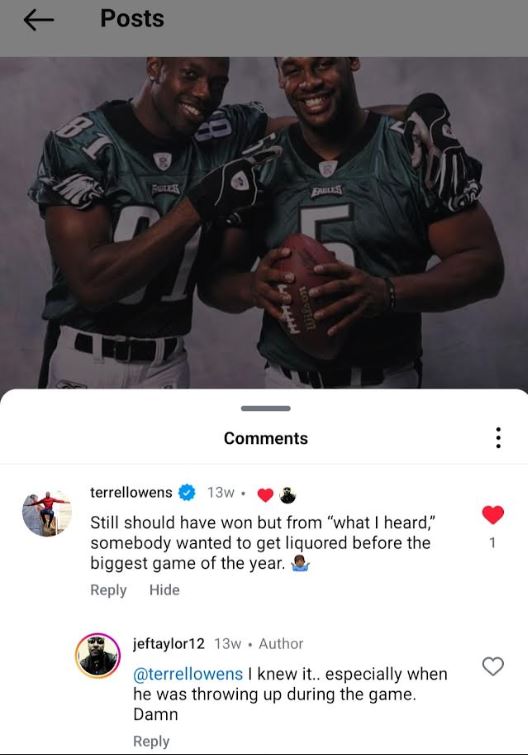
Before that Owens, and his endzone antics, had shredded the league with 77 receptions for 1,200 yards and 14 scores. He had made a pact with Coach Reid to score 15 TDs and if he did so Reid would have to don a pair of tights. Damn he came close but the real story became what would the 13-3 Eagles do in the upcoming playoffs without their #1 playmaker??
They would have to rely on the receivers from previous years who weren’t thought of as making enough plays to get the Eagles over the top. Freddie Mitchell, Todd Pinkston, and Greg Lewis. It was Mitchell who scored twice in the 24-14 NFC Divisional playoff win over the Minnesota Vikings. Running back Brian Westbrook (1,515 yards from scrimmage) would be relied upon heavily. Although there was speculation T.O. might make it back if the team made it to the Super Bowl. To do so they would have to make it past their albatross… the NFC Championship Game.
Leading up to Super Bowl XXXIX, the lead story had been would Terrell Owens play in the title games. With several surgical screws in his ankle, and after signing an injury waiver, he was available on center stage.
The Eagles 24-21 loss was a valiant effort. Just 6 weeks after fracturing his ankle, Terrell Owens 9 rec for 122 yards was a sight to behold. They were beaten by the defending champion New England Patriots who were just a step better. McNabb had thrown for over 300 yards but had 3 costly interceptions that were the difference in a close, close Super Bowl. The Eagles were primed to make it back to the big dance in ’05.
McNabb to Owens made the 2004 Eagles.
However the expiration date had come and gone on the Eagles as a personality conflict between T.O. and Donovan McNabb tore at the fabric of the team. Owens would eventually be released for conduct detrimental to the team. After a 3-1 start, the ’05 Eagles fell to a 6-10 record which included a 42-0 road loss to the eventual NFC Champion Seahawks. . The run was over.
Andy Reid coached on through the 2012 campaign with several playoff seasons but none where the Eagles were considered elite. McNabb played on through 2009 before leaving for Washington. He was replaced by Michael Vick, the quarterback he beat for the 2004 NFC Championship.
Donovan McNabb, Terrell Owens and their … “irreconcilable differences” derailed a promising team and the City of Brotherly Love had to wait another 13 years before capturing a title.
Did Donovan McNabb lose his chance at the Pro Football Hall of Fame because of this rift?? Something to ponder…
Thanks for reading and please share the article.
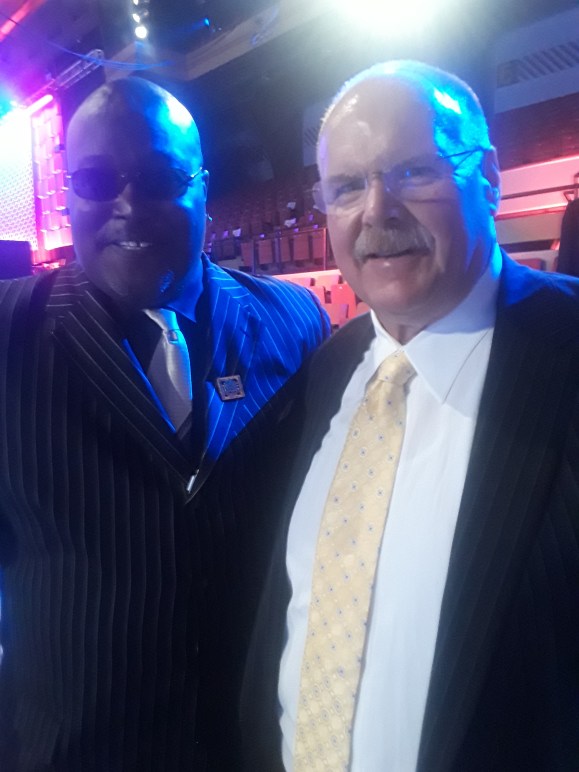
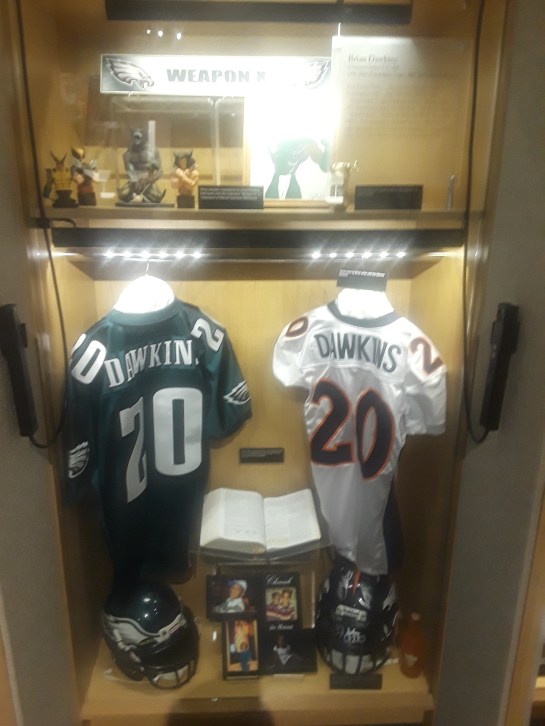
Met Reid at the Gold Jacket Dinner in Canton 2018. Eagles Safety Brian Dawkins had received his Gold Jacket earlier.
Former San Francisco 49er Head Coach Bill Walsh referred to the early years of the organization’s coming of age as “Camelot”. After the 1981 Super Bowl championship they would go on to become “Team of the Decade” winning another 3 titles. San Francisco became the NFL’s gold standard in on field achievement and the corporate way they conducted themselves.
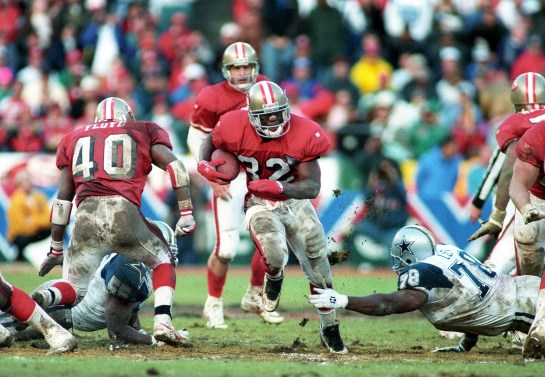
Their players were revered as Joe Montana, Jerry Rice, and Ronnie Lott took their place among the league’s greatest ever players. They had been the toast of Presidents as the 80’s drew to a close. In 1989 new Dallas Cowboy owner Jerry Jones traveled to San Francisco to learn from Eddie Debartolo how the league’s model franchise did business. This was nothing new as even former Head Coach Bill Walsh had become a favorite on the corporate motivational speaking circuit.
As the 90’s beckoned, the team was transitioning on the field as Steve Young, Ricky Watters and a new wave of 49ers emerged. It started with a team loss in the 90 NFC Championship to the New York Giants 15-13 ending their chance at a 3-peat. Gone were 80’s holdovers Montana, Roger Craig, and Lott as the new generation took shape in 1991. Montana from a vicious hit that kept him out of football for two years. The others were released as the team looked to get younger to stay competitive.
They finished 10-6 as Steve Young finished his first season as a passing champion. It took awhile for San Fran to find their footing yet they finished on a 6 game winning streak. By 1992 the Niners hit their stride finishing 14-2 and retooled with Ricky Watters rushing for 1,013 yards to join Young, and Rice in the Pro Bowl. Another passing title moved Young into the elite of the sport yet it came crashing down with a loss to the upstart Dallas Cowboys in the NFC Championship 30-20.
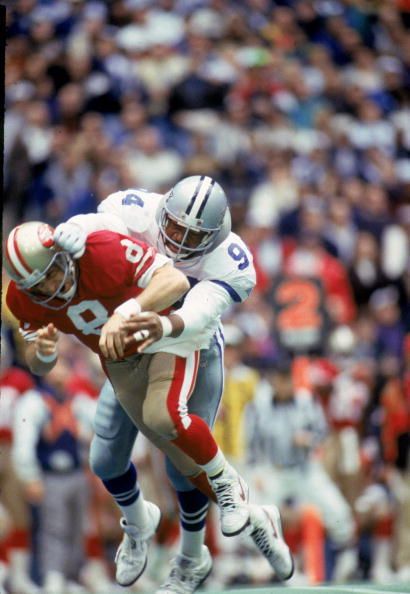
Steve Young being sacked during the 1992 NFC Championship Game.
Yes, those same Dallas Cowboys who had studied the 49er organization some 4 years before. The same Jimmy Johnson and Jerry Jones who had traded for former 49er Charles Haley to help lead the upstart Cowboys and shift the balance of power. Haley had grown up a 49er and battled T Steve Wallace, G Guy McIntyre, and G Harris Barton for 6 years in practice. His experience and spirit settled the nervous young Cowboys in their ’92 NFC Championship triumph.
Going into the game it was a 50/50 split as to who had the upper hand. What really hurt Steve Young is a now healthy Joe Montana watched from the sideline. As San Fran fell behind in the second half, a growing feeling in the stadium loomed. Would George Seifert put Montana in if the game got away from Young. Even though Young was the NFL’s MVP, he still had the legend looking over his shoulder. As the event drew near it felt like a defining NFC Championship was taking shape. The excitement leading into the game reached a crescendo when…
What if Guy McIntyre doesn’t get called for holding on the game’s 3rd play negating Jerry Rice’s 63 yard TD from Young?? It would have changed the complexion of the game. However Troy Aikman had gone 24 of 34 for 322 yards and 2TDs. Troy Aikman outplayed him and made several signature throws to Alvin Harper while Young threw 2 4th quarter interceptions.Emmitt Smith controlled the clock with 114 yds rushing and 59 yds receiving. They took the measure of San Fran and became the league’s signature team with their Super Bowl XXVII championship.
Going into 1993 the 49ers had traded away Joe Montana making it Young’s team. This added pressure from the fans but their real battle was catching Dallas who was now an established champion. They were brash and played with an in your face bravado that took the 49ers aback. In the locker room following the ’92 Championship, Jimmy Johnson’s boast “How ’bout them Cowboys!?!” reverberated in the CBS cameras & throughout Candlestick Park. It haunted the organization as they set their sights on dethroning the loud, brash Cowboys.
Once they qualified for the NFC Championship rematch in Dallas, it was time to right the ship. Dallas had beat them 26-17 in the regular season to add to their confidence. Then Cowboy coach Jimmy Johnson dropped a bombshell. He called a Dallas radio station and declared “We will win the game and you can put it in 3 inch headline!” Now they were calling San Fran out and how would they respond??
Called out and humiliated like an after school fight in 6th grade, the 38-21 loss in the ’93 NFC Championship was worse than it looked. Dallas was up 28-7 in the 2nd quarter and was sitting on the ball with 3:27 to go. The defense, which had struggled all year, was completely exposed. The gap was widening and the team needed to make drastic changes if they were going to compete with the younger Cowboys.
Michael Irvin had emerged as one of the best wide outs in the NFL. Emmitt Smith had the last 2 rushing titles and had his 3rd straight 100 yard rushing game against the 49ers. Troy Aikman had yet to throw an interception in 2 NFC Championship games. Alvin Harper was becoming a serious 49er killer as he emerged with the highest yard per catch average in postseason history. Most of it due to huge plays against San Fran.
Carmen Policy and the 49ers brass moved into swift action. Back then the team that lost the conference championship coached the Pro Bowl squad. Free agency had come to the NFL the year before and they used this as a recruiting trip. They signed future Hall of Famers Rickey Jackson, Richard Dent, Deion Sanders off the NFC Pro Bowl squad. Then stole Ken Norton Jr from the Cowboys and DE Charles Mann all fom the ’93 Pro Bowl.
Floyd and Watters celebrate touchdown during their 44-15 demolition of Chicago in the ’94 playoffs.
“If you can come in and give us the defense, we have an offense that can dethrone the Cowboys and get to the Super Bowl.” They also knew they needed a new approach psychologically and embraced a more brash, in your face swaggering persona. Spearheaded by the outgoing personalities of Ricky Watters, Deion Sanders, and rookie FB William Floyd.
Gone was the laced up corporate attitude of the team on the field. This group showed its emotions on the field, celebrated with end zone dancing and Deion highstepping downfield after interceptions. The only thing that made the 49ers recognizable were their helmets. Thanks to the NFL commemorating their 75th season, the Niners elected to play most of the season in their “throwback” uniforms of the 1950s. The 49ers were reborn in 1994.
It worked as the 49ers blew through the regular season 13-3 and scored a team record 505 points. Steve Young was league MVP and Sanders was the NFL’s Defensive Player of the Year. They retooled and had specific match ups ready as they eyed the defending champion Cowboys. They beat them during the season 21-14 to earn the right to homefield advantage for the ’94 NFC Championship. If the Cowboys were going to 3peat, they had to go through the last team that had that same chance just 4 years before.
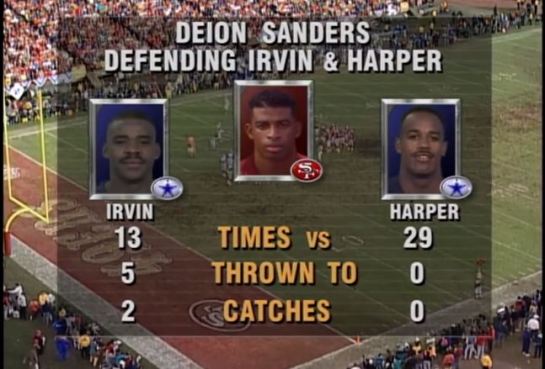
Sanders impact on the Conference Championship Game was immense. While he intercepted Aikman at a critical juncture of the 3rd quarter, it was the strategy to put him on 49er killer Alvin Harper at the start of the game that proved fatal. The first two scores were set up by turnovers as the Cowboys threw away from Sanders on Harper. By the third drive Harper was removed from the game so the Cowboys coaches could get a grasp of how they would deploy Deion in his absence. Harper returned to the game a series later but so decisive was Deion’s coverage you could trace the decline of Harper’s career to this point.
The vanquished became the victors with their 38-28 defeat of the Dallas Cowboys in the ’94 NFC Championship Game. Super Bowl XXIX was an anticlimactic 49-26 win over the San Diego Chargers. Steve Young liberated himself from the ghost of Joe Montana. For 3 straight years these two teams pushed each other to heights they would not have achieved without each other. However the final shot was fired by the 49ers.
Young and Rice celebrate in Super Bowl XXIX.
Jerry Jones had become obsessed with overtaking the 49ers who themselves made practical business decisions. They didn’t match Ricky Watters free agent contract with Philadelphia, which was a mistake, and they had to enter a bidding war for Deion Sanders. In ’94 they signed him to $1.1 million for one year where other teams were offering 4 years $17 million. Coming off a Super Bowl triumph and his 1994 NFL Defensive Player of the Year it was time to cash in. San Francisco baited jones and he took it and overspent for Deion at a cost of $35 million.
This crippled Dallas who wouldn’t be a player in free agency the rest of the decade. The Cowboys had all their money tied to Aikman, Smith, Irvin, and Sanders. The 49ers had freed themselves of the Dallas stranglehold and would go on to be an elite team the rest of the decade. They just didn’t see a new foe emerging in Mike Holmgren’s Green Bay Packers.
However there was the 1995 season where the 49ers were more in the spirit of the pre ’94 group. At midseason they took on the revenge minded Cowboys in Texas Stadium. The Cowboys were 8-1, healthy and ready to show with Deion Sanders in tow, they had overtaken San Fran. Going into the game they were missing QB Steve Young, FB William Floyd and staggered into the game with a 5-4 record. Perfect timing for the Cowboys to provide the knock out blow. Nobody believed the 49ers had a chance…
After being upset by the Packers in the 1995 NFC Divisional Playoffs 21-17, they began a new rivalry chapter with them. As for Dallas, they did win Super Bowl XXX to make it 4 wins in 4 years between these two organizations. New teams would emerge before the decade concluded. Most notable was Mike Shanahan’s Denver Broncos. Shanahan was San Francisco’s Offensive Coordinator during the heat of the 49er v Cowboys rivalry.
Back on January 10, 1982, the San Francisco 49ers beat the Dallas Cowboys in the NFC Championship in what came to be known as “The Catch”. Emmitt Smith, Troy Aikman, and Michael Irvin were 12, 15, & 15 yrs of age respectively at the time. Over the next decade, a football generation came to know the 49ers as the dominant team in pro football. Yet here they were in January 1993, as men, having conquered the 49ers in the ’92 NFC Championship 30-20 in a true changing of the guard.
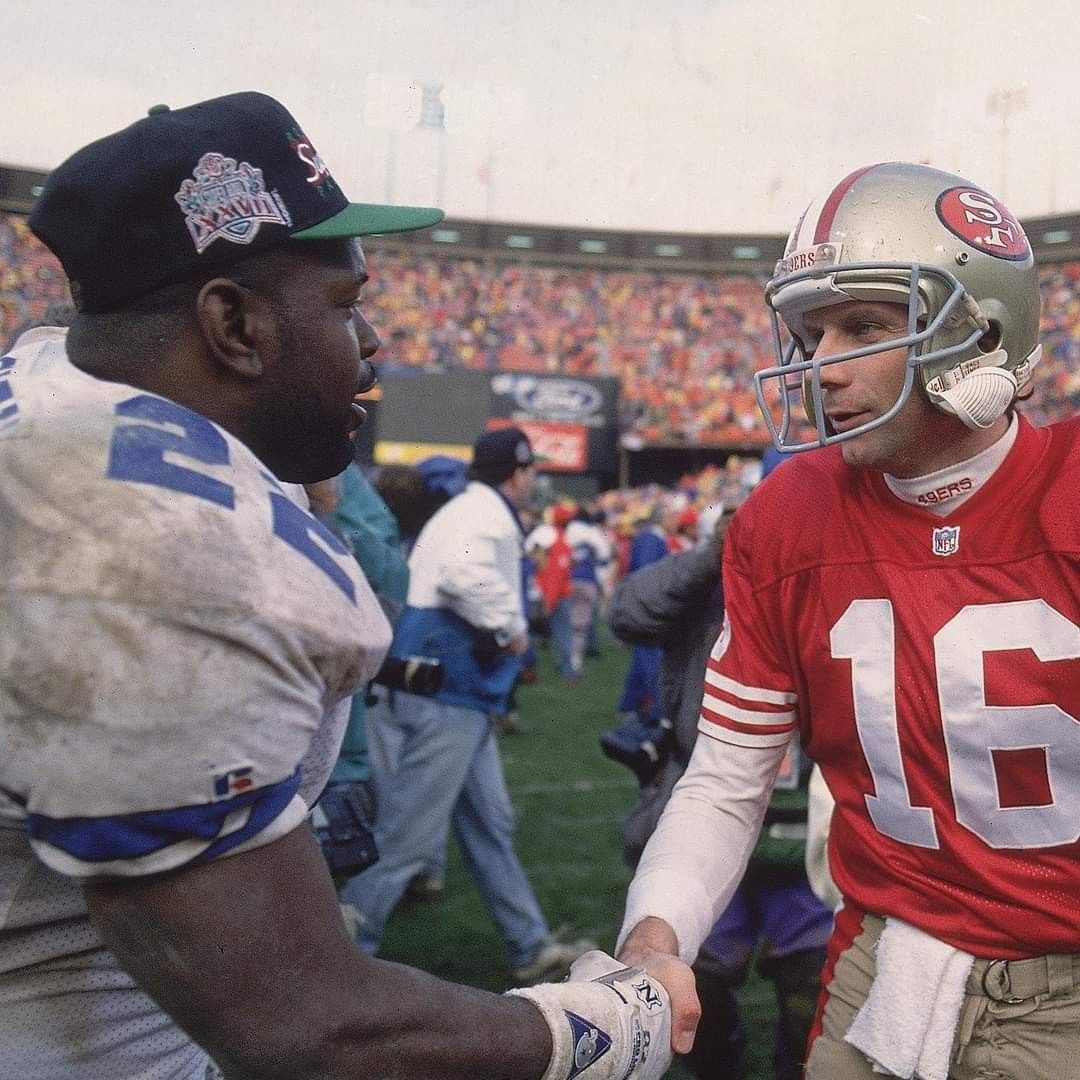
The passing of the torch
Joe Montana, an iconic symbol of the old guard, was shaking hands congratulating the young Cowboys. They had vanquished not only the team with the NFC’s best record, 14-2, they toppled the team that epitomized conference excellence over the last decade. Now they were navigating uncharted waters and off to Super Bowl XXVII to take on the Buffalo Bills.
By the time they made it to Pasadena to take on the Bills, they’re confidence was at an all time high. However beating Buffalo was anticlimactic to what had taken place in soggy San Francisco 2 weeks before.
Troy Aikman fulfilled the promise of being a #1 overall pick with his 1992 NFC Championship Game performance.
They had come through the gauntlet which was the NFC at the time. A conference that had won the last 8 straight Super Bowls and would ultimately win 13 in a row. The physical nature of the conference was one thing, but they had to beat the mystique of the best organization in San Francisco.
Once the 49ers unseated the Cowboys back in the ’81 NFC Championship Game, they became the gold standard of NFL franchises. Every veteran wanted to play for Eddie Debartolo’s organization. Once Jerry Jones purchased the team in 1989, he traveled to San Francisco to study how the league’s model front office operated.
By the time Jimmy Johnson (the [[_]]) had rebuilt “America’s Team” in a few short years, they were ready to take on a 49er team that was prepared to rule the 1990’s just as they had the 80’s. They were built with a different breed of player. Fast, aggressive and an in your face bravado reminiscent of the Miami Hurricane teams Johnson coached in college. The most indelible image from that ’92 Championship was in the locker room when he boasted “How ’bout them Cowboys!??!” loud enough you could nearly hear it in the 49er locker room.
Terry Bradshaw once said “Once you win a Super Bowl the regular season is boring. All you care about is getting back to the playoffs where it can be fun again.”
Jimmy Johnson on gameday.
Well the boredom Dallas had to endure was losing Defensive Coordinator Dave Wannstedt, Emmitt Smith’s holdout, and the advent of free agency. In time free agency would prove to be the bigger foe, but when the Cowboys started 0-2 without Smith’s services, it was clear what priority one was.
The reality set in these were the two best teams in football. Steve Young had won the last two passing titles but Aikman was thought of as the better quarterback. Troy entered ’93 as a Super Bowl winning QB, something Young had yet to do. Michael Irvin (78 rec. 1,396 yds 7 TDs) was beginning to challenge Jerry Rice (84 rec. 1,201 yds 10 TDs) as to who was the best receiver in the game.
In every way these two team were eyeing each other for another postseason date but first had to get through a regular season affair that offered some answers.
The 26-17 win over the 49ers gave the Cowboys the inside track to Super Bowl XXVIII. In fact when they won homefield advantage for the ’93 playoffs, the only question was the status of Emmitt Smith’s separated shoulder suffered in the clinching finale against the New York Giants. Smith was one of 11 Pro Bowlers that included QB Troy Aikman, FB Darryl Johnston, WR Michael Irvin, linemen Mark Stepnoski, Nate Newton, and Eric Williams. By the time you include TE Jay Novacek, they were 3 starters away from sending every player to the Pro Bowl.
The defense, which ranked 10th in the league sent LB Ken Norton Jr, DT Russell Maryland, and FS Thomas Everett to Honolulu. A far cry from the year before when they ranked #1 defensively and sent 0 players to the Pro Bowl. We’ll talk about the importance of Everett later but this team was riding high after the emotional win vs. New York. They kept their eye out west on the 49ers as they blew out the wildcard Giants 44-3 in the divisional round. Dallas beat Green Bay 27-17 to set up the NFC Championship rematch in Texas Stadium.
As pundits lauded the 49ers lopsided win in Candlestick, it belied the fact they had actually struggled down the stretch losing 3 of their last 4. Sure their defense had put it together in taking down the 1 dimensional Giants, but that is after they had the huge battle in the season finale at Dallas and a hard fought wildcard against the Vikings.
After listening to the experts all week, Jimmy Johnson had had enough and called in to a Dallas Radio show on Friday night and declared “We will win the game! You can put it in 3 inch headline!” There was no easing into it now….this was a street fight in the school yard. They called the laced up shirt and tie corporate 49ers out and how would they respond.
They beat down the 49ers 38-21 and were actually ahead 28-7 in the 2nd quarter. Texas Stadium for the first time ever was raucous. Even in the Tom Landry days crowds in Dallas responded like they were at a play or something. They cheered when it was time to but this felt different. It was boisterous and the tempo of the team and the audience fed off Jimmy Johnson’s bravado and echoed in kind. Who knew it was going to be Johnson’s last game ever at Texas Stadium??
After beating The Chancellor of Football’s Buffalo Bills for the Super Bowl XXVIII championship, we had Johnson’s departure in the offseason. On March 29th was the press conference where there was a mutual parting of the ways. The shock wave could be felt through the NFL. The youngest team in the league that won back to back Super Bowls was going on without their vocal leader?? Jerry Jones erroneously stated there were 50 coaches who could coach the Dallas Cowboys and hired Barry Switzer to succeed him.
The Cowboys were that talented and headed into 1994 as the best team in football on paper. Or so they thought… the 49ers had retooled and fashioned much of their team and personality based on the bravado that left them whipped in Dallas the preceding January. The Niners had signed away Ken Norton Jr. and 6 defenders to bolster their defense including future Hall of Famers Ricky Jackson, Richard Dent, and Deion Sanders. All off the NFC Pro Bowl roster. Back then the team that lost the conference championship coached the Pro Bowl and San Francisco used this as a recruiting trip.
Free agency had robbed the Cowboys of Norton, DTs Tony Casillas & DT Jimmie Jones, and to the Chancellor the most valuable defender in FS Thomas Everett. Before Everett’s arrival in ’92, the 11-5 Cowboys struggled with Run & Shoot offenses especially, and at times was awful against the pass. Why do you think they drafted CBs Kevin Smith, Clayton Holmes, & S Darren Woodson, and traded for Everett to start 1992??
Not just Charles Haley…it was also Thomas Everett that pushed the Cowboys over the top back in the early 1990s.
Dallas had been 1-3 against Run & Shoot teams in 1991. They went 5-0 against those teams including the Buffalo Bills in Super Bowl XXVII that finished as the #1 defense against the pass in ’92 that year with Everett. It was this end zone interception in Super Bowl XXVII that started the 1990’s reign of the Dallas Cowboys. Otherwise the Bills take a 17-14 lead and the Bills take control of the game. In big games he starred….in each NFC Championship Game against the 49ers he picked off Steve Young. You cannot underscore his importance in gluing a young secondary together and teaching them to be pros by example.
Yet 1994 saw this team try to move on without this defensive firepower and they did go 12-4. DE Charles Haley was healthy and made the Pro Bowl with 12.5 sacks, S Darren Woodson, and Leon Lett came into their own making their first Pro Bowl trips. The offense was as potent as ever with Smith’s 1,461 yards and 21 TDs. Although he battled leg injuries the 2nd half of the season. Did they have enough in the gas tank to get to win a 3rd straight Super Bowl and make it into NFL lore?? All they had to do was take a trip out to beat the 49ers for the right to go to Super Bowl XXIX.
So Dallas had to watch the 49ers go on to win Super Bowl XXIX 49-26 over San Diego. They did return the following year to beat Pittsburgh 27-17 to win their 3rd Super Bowl in 4 years yet the rivalry came to an end for this era. Both teams kept raising the bar on each other and pushed themselves to a height no other team could reach. In each of these seasons they were the best teams in football and won all 4 Super Bowls… yet lingering questions are still being debated to this day…
How many Super Bowls would Dallas have won if Johnson coaches the whole decade??
Would they have won 3 in a row if Johnson coached them in ’94??
Would the 49ers have won in 1994 if they hadn’t built a defense from the ’93 Pro Bowl roster??
How would the 1990’s play out for Dallas if there had not been free agency??
Why isn’t Jimmy Johnson in the Pro Football Hall of Fame??
Would the Cowboys have won in 1994 if T Erik Williams doesn’t get in that car accident??
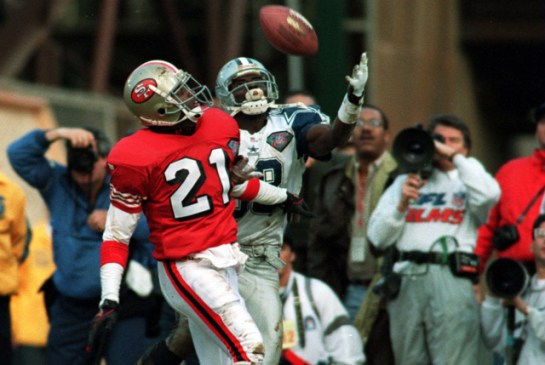
However one of the indelible moments from the 1994 NFC Championship Game was the near pass interference call in the 4th quarter between Deion Sanders and Michael Irvin. Instead of a 1st and goal where the 49er lead could have been trimmed to 3, an irate Barry Switzer bumps an official in protest incurring a 15 yard penalty. Dallas was forced to punt and never threatened again. In 1995, in a quiet Texas Stadium Courthouse the two Hall of Famers had a hearing to discuss this disputed play which altered the course of football history.
LMAO “Panicked state of mind!” Thanks for reading and please share the article.
Epilogue: When it came to Jimmy Johnson’s success in Dallas, it was bitter sweet being a Buffalo Bill fan. We lost those two Super Bowls but I was a fan of his back to Herschel Walker and when he first coached the Cowboys. Nope not Dallas…we’re talking the Oklahoma St Cowboys. I first read about Jimmy Johnson during the ’82 season when his running back Earnest “Sparkplug” Anderson became the 5th back to run for 1,000 yards in just the 5th game of the season.
Herschel walker won the Heisman but I kept screaming it was “Sparkplug” Anderson that led college football in rushing! Alas…no blog back in ’82. Yet remember following Johnson and as a tradition would watch the Bluebonnet Bowl played on New Year’s Eve and watched Oklahoma St win that game. When it was announced he was coming to my favorite college team at The [[_]] of Miami, talk about excited… I knew Schnellenberger’s replacement and the rest is history.
I did get to meet Johnson and the Dallas Cowboy coaching staff at Houlihan’s on St Patrick’s Day in 1993 just after the first Super Bowl with Buffalo. I remember having him sign my Golden Nugget /Mirage jacket from Vegas and talked a little football. If only cell phones with cameras, Instagram & Facebook existed then…
Dedicated to the memories of Mark Tuinei, Godfrey Myles, and Joe Avezzano
Next Up: 1990’s San Francisco 49ers v. Dallas Cowboys: 49ers Perspective
On April 1st of this year, the football world lost Eddie LeBaron. To a prior generation he was remembered as a great quarterback that lacked the height to play the position at 5’7. However in a career that spanned 11 years he was voted to the Pro Bowl on 4 occasions. Three times he made it as a Washington Redskin and once with the Dallas Cowboys. In fact he was the first starting quarterback in the history of the Cowboys.
I first became aware of LeBaron reading the old Punt, Pass and Kick books covering players from the 1960’s. In some instances it seemed he was covered because of his oddity when it came to stature. Yet as I did more research it was discovered how good a player he was as this vignette barely saved from decades ago will attest…
It’s ironic the player who gives the strongest testimony to LeBaron’s playing prowess is “Concrete” Chuck Bednarik. Not only was he considered one of, if not the toughest player during the 1950’s, but we just lost him just two weeks prior. Like Bednarik, LeBaron had served our country as a Marine and fought in the Korean War prior to playing pro football.
Eddie LeBaron pictured with 1st Dallas Cowboy owner Clint Murchison.
In microcosm his story was an inspirational one to a generation of young men to fight on despite a lack of size. A father could drape his arm over his son’ s shoulder and tell them about Eddie LeBaron. Not only was he the first quarterback in the history of the Dallas Cowboys, he was a Pro Bowl quarterback for a large part of his career.
RIP Eddie LeBaron: January 7, 1930 – April 1, 2015
Epilogue: As we lose these players, it’s personal to me because reading their exploits in books as a kid back in the 1970’s is what lit my fire about football. I was never one into comic books and fictitious heroes, it was always about real people and their accomplishments.
On April 1st of this year, the football world lost Eddie LeBaron. To a prior generation he was remembered as a great quarterback that lacked the height to play the position at 5’7. However in a career that spanned 11 years he was voted to the Pro Bowl on 4 occasions. Three times he made it as a Washington Redskin and once with the Dallas Cowboys. In fact he was the first starting quarterback in the history of the Cowboys.
I first became aware of LeBaron reading the old Punt, Pass and Kick books covering players from the 1960’s. In some instances it seemed he was covered because of his oddity when it came to stature. Yet as I did more research it was discovered how good a player he was as this vignette barely saved from decades ago will attest…
It’s ironic the player who gives the strongest testimony to LeBaron’s playing prowess is “Concrete” Chuck Bednarik. Not only was he considered one of, if not the toughest player during the 1950’s, but we just lost him just two weeks prior. Like Bednarik, LeBaron had served our country as a Marine and fought in the Korean War prior to playing pro football.
Eddie LeBaron pictured with 1st Dallas Cowboy owner Clint Murchison.
In microcosm his story was an inspirational one to a generation of young men to fight on despite a lack of size. A father could drape his arm over his son’ s shoulder and tell them about Eddie LeBaron. Not only was he the first quarterback in the history of the Dallas Cowboys, he was a Pro Bowl quarterback for a large part of his career.
RIP Eddie LeBaron: January 7, 1930 – April 1, 2015
Epilogue: As we lose these players, it’s personal to me because reading their exploits in books as a kid back in the 1970’s is what lit my fire about football. I was never one into comic books and fictitious heroes, it was always about real people and their accomplishments.

 Over in the AFL there were some great players history has overlooked.We’ve already taken a look back at Fred “The Hammer” Williamson and now need to do so with Butch Byrd.



 Their players were revered as





 After beating The Chancellor of Football’s Buffalo Bills for the Super Bowl XXVIII championship, we had Johnson’s departure in the offseason. On March 29th was the press conference where there was a mutual parting of the ways. The shock wave could be felt through the NFL. The youngest team in the league that won back to back Super Bowls was going on without their vocal leader?? Jerry Jones erroneously stated there were 50 coaches who could coach the Dallas Cowboys and hired Barry Switzer to succeed him.
The Cowboys were that talented and headed into 1994 as the best team in football on paper. Or so they thought… the 49ers had retooled and fashioned much of their team and personality based on the bravado that left them whipped in Dallas the preceding January. The Niners had signed away Ken Norton Jr. and 6 defenders to bolster their defense including future Hall of Famers Ricky Jackson, Richard Dent, and Deion Sanders. All off the NFC Pro Bowl roster. Back then the team that lost the conference championship coached the Pro Bowl and San Francisco used this as a recruiting trip.
Free agency had robbed the Cowboys of Norton, DTs Tony Casillas & DT Jimmie Jones, and to the Chancellor the most valuable defender in FS Thomas Everett. Before Everett’s arrival in ’92, the 11-5 Cowboys struggled with Run & Shoot offenses especially, and at times was awful against the pass. Why do you think they drafted CBs Kevin Smith, Clayton Holmes, & S Darren Woodson, and traded for Everett to start 1992??
After beating The Chancellor of Football’s Buffalo Bills for the Super Bowl XXVIII championship, we had Johnson’s departure in the offseason. On March 29th was the press conference where there was a mutual parting of the ways. The shock wave could be felt through the NFL. The youngest team in the league that won back to back Super Bowls was going on without their vocal leader?? Jerry Jones erroneously stated there were 50 coaches who could coach the Dallas Cowboys and hired Barry Switzer to succeed him.
The Cowboys were that talented and headed into 1994 as the best team in football on paper. Or so they thought… the 49ers had retooled and fashioned much of their team and personality based on the bravado that left them whipped in Dallas the preceding January. The Niners had signed away Ken Norton Jr. and 6 defenders to bolster their defense including future Hall of Famers Ricky Jackson, Richard Dent, and Deion Sanders. All off the NFC Pro Bowl roster. Back then the team that lost the conference championship coached the Pro Bowl and San Francisco used this as a recruiting trip.
Free agency had robbed the Cowboys of Norton, DTs Tony Casillas & DT Jimmie Jones, and to the Chancellor the most valuable defender in FS Thomas Everett. Before Everett’s arrival in ’92, the 11-5 Cowboys struggled with Run & Shoot offenses especially, and at times was awful against the pass. Why do you think they drafted CBs Kevin Smith, Clayton Holmes, & S Darren Woodson, and traded for Everett to start 1992??



You must be logged in to post a comment.