Top Ten Single Season Defenses in NFL History : #9 1975 Pittsburgh Steelers

The Pittsburgh Steelers of the 1970s were definitely known as a defensive football team. They came of age during their run leading up to Super Bowl IX, but it was in the following two seasons they were at their zenith. The late Chuck Noll had a roster that entered its prime on the defensive side first after drafting DT “Mean” Joe Greene in 1969.

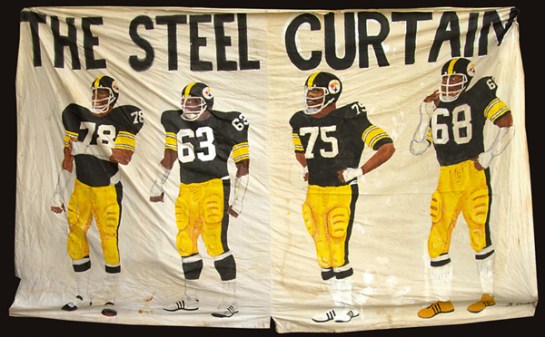
The banner that hung in Three Rivers Stadium honoring the Front Four.

The banner that hung in Three Rivers Stadium honoring the Front Four.

As defending Super Bowl champion, everyone gave them their best shot. For all the talk of the ’76 version, this team was equally stout. They only allowed 162 points while holding 8 of 14 opponents to 10 or fewer points. This didn’t include the Cincinnati Bengals, who under Paul Brown and Bill Walsh fashioned the league’s #2 ranked offense. The Steelers did hold them to 24 and 14 points to sweep them as they finished 12-2 to Cincy’s 11-3.

In fact the ’75 AFC Central was the first time in history 3 teams finished with at least 10 wins thanks to the 10-4 Oilers. Take away the games with the Steelers and the Bengals finished 11-1 and Houston 10-2 v the rest of the NFL. Pretty significant to go 4-0 against these two then wouldn’t you say??

When it comes to quality opponents, two of the Steeler’s 8 games of 10 or less allowed  came against top 10 offenses that year. Now add in both the AFC Divisional playoff and the AFC Championship where they gave up 10 points in both wins over Baltimore (12th offense) and Oakland (4th in offense). Then they made it to Super Bowl X and beat the 3rd best offense in the Dallas Cowboys while only yielding 17.

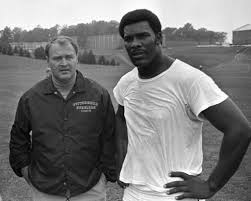
Joe Greene was the 1st Steeler drafted in the Chuck Noll era.

Joe Greene was the 1st Steeler drafted in the Chuck Noll era.

Now this is a heavyweight champ that left little standing in their wake defensively. The lone blemish?? OJ Simpson and Buffalo’s #1 ranked offense got off on them in a 30-21 win. “The Juice” broke for over 200 yards in Three Rivers Stadium. Buffalo ran for 308 yards in that game.

All that withstanding, the Steelers sent 3/4ths of their secondary to the Pro Bowl. Cornerback Mel Blount, who led the league with 11 interceptions, joined FS Mike Wagner and SS Glen Edwards. These guys were behind a good group of Linebackers that included fellow Pro Bowlers Jack Lambert, Andy Russell, and Jack Ham. Yes all three made the Pro Bowl. Once you follow that up with DT “Mean” Joe Greene and DE LC Greenwood, you have 8 of the starting 11 in the Pro Bowl….. Eight!! Come on…that is beyond the college try. Now you know why the ’78 Steelers didn’t make the top ten.

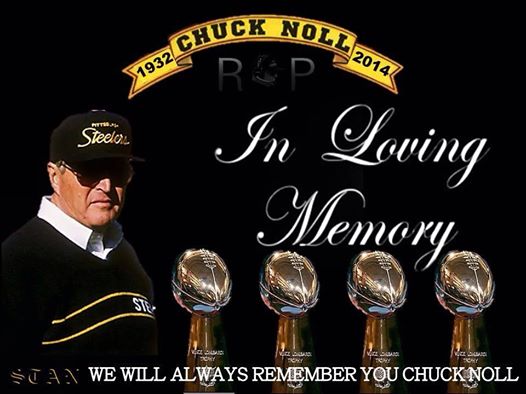
RIP Coach Noll

RIP Coach Noll

This article is dedicated in the memory of DT Ernie Holmes, DE LC Greenwood, DE Dwight White, and former Head Coach Chuck Noll who passed last week.

Thanks for reading and lease share the article.


Top Ten Single Season Defenses in NFL History : #10 1986 Chicago Bears

Welcome to the second installment on the 10 greatest defenses in NFL history. We are off to a rousing start as folks are putting in their reasons for their teams and why the honorable mention units should have made the top ten list. Truth of the matter is all bias has to be removed and the great equalizers lie in the season statistics, play against strongest offenses during their year, and what precedents they set.  If one team is sitting in front of another for having set a precedent, a team with less stature or ranking cannot sit above them on the list.

So now we have to countdown to the single season defenses in NFL history starting with #10.

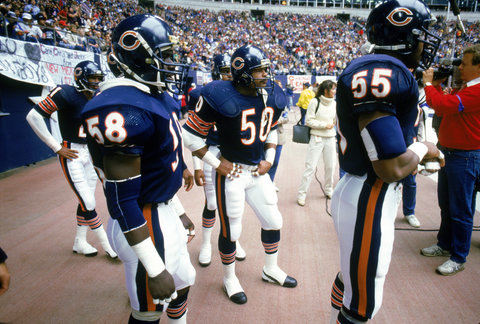
The best trio of linebackers in the game in Mike Singletary, Wilber Marshall, and Otis Wilson.

The best trio of linebackers in the game in Mike Singletary, Wilber Marshall, and Otis Wilson.

10. 1986 Chicago Bears –  A season after bludgeoning their way to the NFL title, this group was poised to repeat. If Mike Ditka would have stayed the course and not played Doug Flutie at quarterback who was on the team for four weeks, they would have. Having done so he robbed NFL fans of the greatest 2 year dynasty the NFL had ever seen. They were 15-1 in 1985 then went 14-2 which tied for the best record in the league that year. 29-3 over two seasons?? So why is this group in and the ’86 Giants and ’02 Bucs left off??

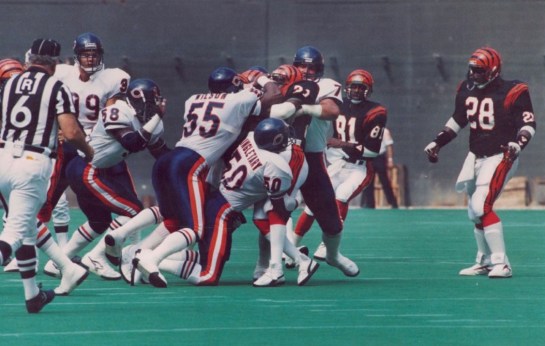
  • ’86 Bears – 187 pts allowed *NFL record / 10 of 16 opponents held to 10 or fewer points / 258.1 yds per game (1st) / 62 sacks (2nd) / 31 int. (2nd)
  • ’86 Giants- 236 pts allowed / 5 of 16 opponents held to 10 or fewer points *2 more in playoffs* / 297.3 yds per game (2nd) / 59 sacks (4th / 24 int. (tied 7th)
  • ’02 Bucs – 196 pts allowed / 9 of 16 opponents held to 10 or fewer points / 252.8 yds per game (1st) / 43 sacks (6th) / 31 int. (1st)

Furthermore in compiling these statistics the yardage difference between #1 & #2 in 1986 (258.1 to 297.3) is the second biggest difference since 1970. No way in hell you could say the Giants defense in 1986 was better than Chicago’s…no way.

In a year where two future Hall of Famers Dan Hampton (10 sacks) and Richard Dent (11.5 sacks) didn’t make the Pro Bowl, LB Wilber Marshall, DT Steve McMichael, late SS Dave Duerson, and MLB Mike Singletary did. All this before we bring up FS Gary Fencik. They were 2-1 against Pro Bowl quarterbacks. They split with the Vikings and Tommy Kramer beating him once 23-0.

Then they pasted Boomer Esiason and the NFL’s #1 offense 44-7 on the road. By the way the Bengals were 10-6 that year and the Browns were 12-4 and played for the AFC Championship. The Bears beat them also. In fact they were 4-1 on the year vs top ten offenses.

This group had to drag a Bears offense that had been handicapped by the loss of Jim McMahon through several qbs that couldn’t complete 50% of their passes. The true reason the ’86 Bears didn’t win Super Bowl XXI and the ’86 Giants did was this incident right here.

The defense drug a team with no offensive continuity to the best record in the NFL at 14-2. However since the 2 losses came within the NFC and only 1 of the Giants had, New York got homefield advantage. The Bears fell to the Redskins in the divisional round 27-13 behind 3 turnovers on their own side of the 50 in the 2nd half. Even the 10th best defense in NFL history could save them from that. As for would the ’86 Bears have beaten the ’86 Giants had they played?? The first game of 1987 had both teams healthy and the Bears, without McMahon again, won 34-19. Two of New York’s touchdowns were on defense and special teams. Couple this with the fact the Bears shut out New York in the ’85 playoffs 21-0. The Bears would have taken them as New York couldn’t score on this defense.

The Bears season in microcosm was this game against the Lions:

This defense really should be higher but we’re starting the top ten off with a bang. Thanks for reading and please share the article.

Top Ten Single Season Defenses in NFL History: Honorable Mention

When Malcolm Smith crossed the goal line to put Seattle up 22-0 in last February’s Super Bowl, pundits were already arguing where they ranked among the NFL’s greatest defenses. Here at Taylor Blitz Times we wanted to let some time pass before we waxed too philosophical about their exploits. As the keeper of the flame, it’s up to The Chancellor of Football to accurately place each great defense. We will do this in 3 parts.
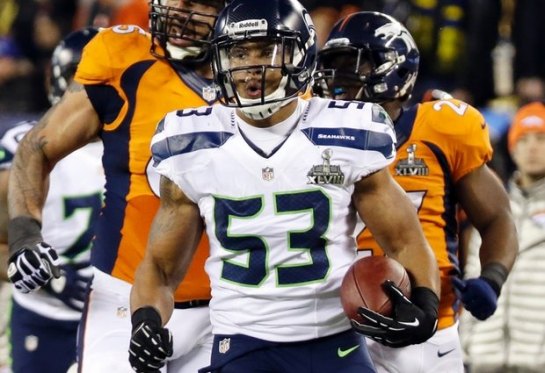
Smith's 69 yard interception in Super Bowl XLVIII ended the competitive phase of the game.

Smith’s 69 yard interception in Super Bowl XLVIII ended the competitive phase of the game and trumpeted the question: Where would you rank Seattle’s defense with  the all-time greats??

One of the criteria for greatest ever defenses you have to ask is: How dominant were they at their peak? They had to bring the lumber over an entire season. These defenses had to be stout with a performance that stands the test of time in remembrance. Without further adieu we have to get on with the Honorable Mention. Those right outside the top ten.

1977 Denver Broncos – The original Orange Crush defense that led the Broncos to Super Bowl XII and Denver’s first ever winning season. This was the first great full time 3-4 defense that yielded only 148 points (10.6 pts / game) and just 18 touchdowns for the season. Holding 7 of their opponents to 10 points or less.
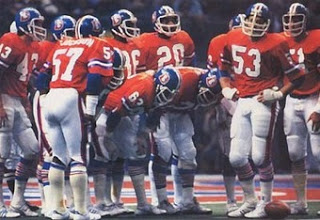
Even with an offense that turned it over 8 times, the still held Dallas to 27 points in Super Bowl XII.

Even with an offense that turned it over 8 times, the still held Dallas to 27 points in Super Bowl XII.

Led by Randy Gradishar, ESPN’s Tom Jackson, and the late Lyle Alzado this defense had an unheard of 4 All Pros concentrated on this defense and 5 Pro Bowlers. This not ready for primetime group came out of nowhere and swallowed the Steelers and Raiders in the playoffs before falling to Dallas in New Orleans in Super Bowl XII. This group swarmed like bees and ushered in the era where 3-4 defenses took over the NFL.

1978 Pittsburgh Steelers – In the first year in which the NFL moved to a 16 game schedule, this group set the new record with fewest points allowed in a season with 195. Powered by the Steel Curtain, they held 8 of 16 opponents to 10 or fewer points. This group did more blitzing than in years past to get to the quarterback. They did have 5 Pro Bowl defenders and 1 All Pro in Jack Ham, but there were stronger incarnations of the Steeler defense.

A fact that gets lost is going into Super Bowl XIII, the consensus was Pittsburgh force vs the finesse Cowboys. Yet it was Dallas whose defense was ranked #2 and Pittsburgh’s #3, For the season they yielded 260.5 yards per game, unofficially had 52 sacks and 27 interceptions which ranked 7th. They peaked in the playoffs holding both Denver and Houston to 10 points and 5 points respectively. Yet gave up some serious candy to the Dallas offense (320 yards & 31 points)

1968 Baltimore Colts – The team that is best known for coming up short in Super Bowl III against the AFL’s New York Jets. In The Chancellor of Football’s estimation, this was the best team that Don Shula ever coached and one of his defensive assistants was the late Chuck Noll. This defense held 10 of 14 regular season opponents to 10 or fewer points. At one point late in the season, they gave up 1 touchdown over 25 quarters including a string of 16 straight quarters w/out a touchdown allowed.
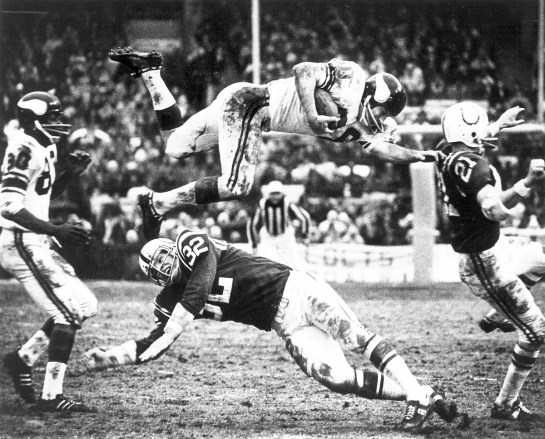
md-darkroom-hutchins-curtisThe Colts of ’68 shut out 3 regular season opponents and the fourth was against the Browns who gave the 13-1 team their only loss. That drubbing was avenged 34-0 in the NFL Championship Game. They even set the record with only 144 points allowed. Between 1967 & 1968 their record was 24-2-2. If only this team had won on January 12th 1969…..but….

2000 Tennessee Titans – Lost in the delirium over the great 2000 Ravens defense, is the fact they finished #2 to the Titans that year in rankings. Jeff Fisher’s bunch only allowed 238.9 yards per game and held 6 opponents to 10 points or less over the campaign.

Second year DE Jevon Kearse led the team with 11.5 sacks and 4 forced fumbles. Samri Rolle had 7 interceptions he returned for 140 yards and a touchdown. SS Blaine Bishop had 84 tackles to go with 2.5 sacks but 0 interceptions. All three were Pro Bowlers but only Samari was an All Pro Player. One issue is they didn’t force enough turnovers (29) and they finished just +1 in turnover ratio. These are poor marks considering they only saw 1 Pro Bowl quarterback the entire season. Yet they were #1 against the pass (151 yds /gm) and #3 against the run (86 yds /gm).

1987 San Francisco 49ers – One of the last teams to finish with the NFL’s #1 offense and defense happened with this group in 1987. They were gaining momentum allowing only 1 touchdown in the final 16 quarters of the season and none in the final 12 as the playoffs beckoned. They held 5 opponents to 10 or fewer points including two shutouts in their final three games. One of which was a 41-0 hammering of the NFC Central Champion Chicago Bears on Monday Night Football. 

Led by All Pro and Pro Bowler Ronnie Lott (5 ints) this group was #1 against the pass (165 yds /gm) while only yielding 273 yards for the game. What makes this more remarkable are 3 games were played with replacement players due to the strike. Had the season been 16 games instead of 15 and no strike, these numbers could have been even better. They were also #5 against the run (107.4 yds / gm) thanks to All Pro and Pro Bowl Nose Tackle Michael Carter.
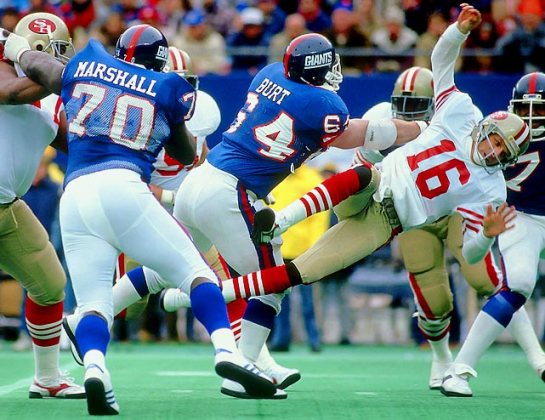
Jim Burt knocking Joe Montana out with a concussion in their 49-3 rout in the '86 playoffs.

Jim Burt knocking Joe Montana out with a concussion in their 49-3 rout in the ’86 playoffs.

1986 New York Giants – A romanticized defense that knocked 5 quarterbacks out on their way to the Super Bowl XXI championship. Yet they were #2 in 1986 and allowed 39 more yards per game than the #1 Chicago Bears with 297.3 yards per game. Second biggest discrepancy between #1 and #2 since 1970.

Led by League MVP and Defensive Player of the Year Lawrence Taylor’s 20 sacks, New York held 5 teams to 10 points or fewer during the regular season. They held their 2 NFC playoff opponents to 3 & 0 points respectively. There were 4 Pro Bowl defenders on this defense in LB Harry Carson, NT Jim Burt, DE Leonard Marshall, and the aforementioned LT.

2008 Pittsburgh Steelers – Close but no cigar. This team finished with the #1 ranking allowing just 237.2 yards per game. They held 8 opponents to 10 or fewer points yet gave up 223 for the season. One mark against them is they only faced 2 Pro Bowl QBs and lost both games. Losing 24-20 to Peyton’s Colts and 21-14 against Eli’s Giants. This was also the year they beat the Patriots 33-10 with Matt Cassel at QB not an injured Tom Brady. Big difference. This group had 51 sacks but only 20 interceptions. The last time we saw them, Kurt Warner passed for 377 yards, 2nd highest in Super Bowl history, and needed Big Ben to bail them out with a game winning pass with :32 left.

This group did have NFL Defensive Player of the Year James Harrison and Pro Bowl SS Troy Palamalu who would win the award 2 years later. Harrison had 16 sacks with 7 forced fumbles. James Farrior (122 tackles) was the 3rd and final Pro Bowler on a talented roster which included LaMarr Woodley (11 sacks).  They were a world champion but this group didn’t perform high enough against the best competition. The top ten is a Sugar Ray Leonard’s list, the honorable mention is where Thomas Hearns resides.
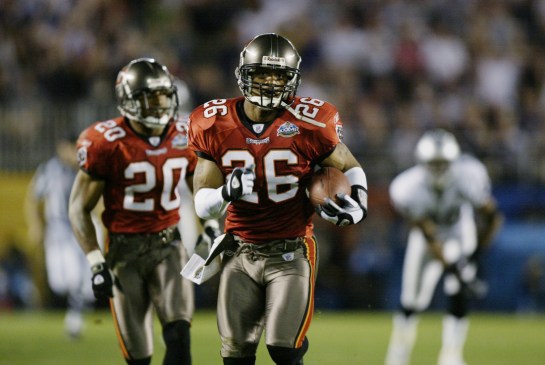
Dwight Smith capped off Super Bowl XXXVII with 2 defensive touchdowns. Should have been the MVP.

Dwight Smith capped off Super Bowl XXXVII with 2 defensive touchdowns. Should have been the MVP.

2002 Tampa Bay Buccaneers – The final team to miss the call to the top ten was the 2002 Buccaneers. The undisputed #1 defense that year. However playing in the new NFC South they feasted on patsies. On 3 occasions they took on top 10 offenses and they lost two of those games to Philadelphia (10th) and Pittsburgh (5th).

This team yielded 252.8 yards per game had 43 sacks and 31 interceptions which ranked 6th and 1st respectively. This team only gave up 196 points while holding 9 regular season opponents to 10 or fewer points. However a closer look reveals they came against offenses ranked 26th, 18th, 14th, 23rd, 31st, 31st, 12th, 14th, and 29th. Chris Redman (who??) quarterbacked the Ravens who was the first in this group. While NFL journeyman Jim Miller led the Bears in the last game.

This team fielded 5 Pro Bowl players in NFL Defensive Player of the Year Derrick Brooks, Shelton Quarles, Hall of Famer Warren Sapp, Simeon Rice (15.5 sacks), and S John Lynch. This group scored on defense. Brooks tied the NFL record with 4 defensive touchdowns and CB Dwight Smith set a Super Bowl record with 2 interception returns for touchdowns. Their numbers and performance should get them in until you look at the competition. Someone reading this is going to describe how they throttled the #1 Raider offense in the Super Bowl. Yet how much do you attribute to Monte Kiffin’s defense or Jon Gruden knowing the Raider offense and personnel??

Thanks for reading and now its time for the top 10.

The Immaculate Reception Encore: 1972 AFC Championship Game

The No Name Defense stopping Franco Harris in the '72 AFC Championship Game.

The No Name Defense stopping Franco Harris in the ’72 AFC Championship Game.

One of the unique themes in NFL history is whenever a team has a famous miracle playoff win, those teams rarely win the Super Bowl. Well even the NFL championship for that matter when you think back to Detroit’s 31-27 win over San Francisco in the 1957 playoffs. In that game the 49ers were up 24-7 in the 3rd quarter only to lose to a series of backups for the Lions. It was the only instance where a miracle playoff win would culminate with a league championship. Fast forward to The Immaculate Reception and the Pittsburgh Steelers in the 1972 playoffs.

After winning their first ever playoff game over the Oakland Raiders, most people forget they ran smack into the undefeated Miami Dolphins. As far as the AFC Championship Game, the Steelers were playing with house money. They were one game away from the Super Bowl and were able to host the championship game since it was rotated by division back then.

Pete Rozelle didn’t institute home field advantage until 1978. He did it as a means to reward not only the team with the best record. He wanted to insure teams would play all the way through their schedule and not take the final weeks off. Yet in ’72, the 14-0 Miami Dolphins traveled to the 11-3 steel city to take on Franco’s Italian Army for the right to go to Super Bowl VII.

It was the first of only three times Don Shula and Miami would meet Chuck Noll’s Steelers in the playoffs during their coaching careers. Noll had served on Shula’s staff in Baltimore and had ties dating back to the Cleveland Browns of the 1950’s where they were both players.

Ironically the case remains. Why is it when a team should be riding an emotional lift like a miracle finish in the playoffs, they don’t win it all?? It’s easy to say they let down but would it be more that they’re an incomplete team that gets exposed as competition gets better?? The ’72 Steelers (Immaculate Reception) the ’72 Cowboys (Roger’s 1st comeback) the ’75 Cowboys (Hail Mary) ’80 Cowboys (Duel In Dixie) ’86 Denver Broncos (The Drive) ’99 Tennessee Titans (Homerun Throwback) all fell short of winning it all….. The lone exception would be the 1981 San Francisco 49ers with The Catch. 

RIP Coach Noll

RIP Coach Noll

Chuck Noll would obviously make his mark, embarking on one of the greatest runs in history. Over the next 7 seasons, his team made the playoffs every year with their winning a Super Bowl in 4 of those seasons. We lost another legend with Noll’s passing Friday night. This article is dedicated to the Hall of Fame coach…

Former Oakland Raider Mike Davis Ready To Part With “Red Right 88” Football

It could have been borne from the comment about The Immaculate Reception football being worth a million dollars from the Football Life series. Or was it simply a scenario where a player has gained enough from a momento from his past?? Whatever the reason, in casual conversation former Oakland / LA Raider Mike Davis has decided to sell the football he has held since the Red Right 88 interception against the Cleveland Browns in the 1980 playoffs.

Mike Davis clutch interception in the 1980 AFC Playoffs saved the Raiders season.

Mike Davis clutch interception in the 1980 AFC Playoffs saved the Raiders season.

To understand the value of the ball you have to understand where it came from. It is from the single play that saved the Raiders season and propelled them to become the first wild card team to win the Super Bowl 3 weeks later. The entire story of Jim Plunkett wouldn’t have been complete without this play.

Head coach Tom Flores, whom we believe should be in the Hall of Fame, wouldn’t have been able to leave the shadow cast by John Madden without it. The 11-5 Cinderella Raiders were riding high after a wildcard win over the Houston Oilers 27-7. They had vanquished former Raider Kenny Stabler, whom they traded before the season. Now they were off to play the AFC Central champion Browns.

What is forgotten is how great the Cleveland Browns of that era were. In 1980 they were great throwing the football. In fact they were ranked 2nd only to the San Diego Chargers of Air Coryell fame. Quarterback Brian Sipe was the NFL MVP in 1980 and Head Coach Sam Rutigliano had just won his second straight Coach of the Year honor. Sipe threw for 4,132 yards 30 touchdowns with just 14 interceptions. Over the 1979 and ’80 seasons they had come from behind to win 14 times in the last 2 minutes. In contrast, Roger Staubach had 23 over his entire career to earn the nickname Captain Comeback.

So the football world was gearing up for an aerial AFC Championship between the Cleveland Browns and the San Diego Chargers. It was to be the changing of the guard from the grind it out Pittsburgh Steelers to the first conquerors of the new passing NFL set up by the rules in 1978 favoring such. The Chargers had vanquished the best defense in football in the Buffalo Bills in one AFC playoff 20-14 on Saturday. Now they awaited the Browns who would play an Oakland Raider team full of unknowns, with a journeyman quarterback and unknown coach on Sunday…

The Raiders escaped the confines of Cleveland Municipal Stadium and rode the wave of momentum into San Diego. They won the AFC Championship 34-27 for the right to play the Philadelphia Eagles in Super Bowl XV. All the while Mike Davis clutched the football that propelled his Raiders into NFL history.

He would eventually win two Super Bowls with the team when they came back and dethroned the Washington Redskins in XVIII. There he made another iconic play when from his Strong Safety position blitzed sacking Joe Theismann. It was the final turnover and the famous visual of Theismann slowly walking off. His jersey, half pulled off exposing his shoulder pads and stained by field paint.

Yet it was this famous play in the 1980 playoffs that altered the course of NFL history. NFL pundits were ready to crown Air Coryell as the sucessors to the ground oriented teams that dominated the 1970s. Accolades that were thrown around a year later when San Francisco and their passing offense made it to the top of pro football.

So what would this football be worth? To Oakland Raider fans?? To Cleveland Brown fans?? To a collector?? To the Pro Football Hall of Fame?? Mike’s question hit me like a ton of bricks and it took me a day to realize that football’s value. You can see a part of the conversation on social media to know that it’s true. You’re hearing about this for the first time.

The first thing Mike, we have to get your ball appraised and possibly auctioned by one of the memorabilia auction houses. Here at Taylor Blitz Times, we would like to hear from Raider fans what it would be like to own a big piece of Oakland Raider history like this. The Chancellor of Football has an idea what the football would be worth. But lets hear from the professionals who appraise such things first.

Thanks for reading and please share the article.

Follow up comment from Mike Davis:   MikeDavis&I

Epilogue: What is intriguing is following the principles of a seminal moment. In this instance what did the future hold for the vanquished Browns, Brian Sipe, Sam Rutigliano, and owner Art Modell?? At the time, if you were in Ohio as I was, you heard “The Browns’ 12 Days of Christmas” for the last two months as the Browns appeared headed to a Super Bowl. After “Red Right 88” I can’t remember hearing it once living there the next 17 years.

You’ll have to ask Brian Sipe and Sam Rutigliano… as for fellow Arizonan Mike Davis… he received this from Art Modell:m.davis.letter.art.modell

Time may heal all wounds. Yet a letter from years gone by about a moment of great reflection is the closure The Chancellor can add between Art Modell, who owned the Browns in 1980 and Mike Davis of the Raiders, who ended their best ever season. If Modell can find forgiveness…??

Remember….these men lived it…

Thanks for reading and please share the article.

The Chancellor with Mike Davis

The Chancellor with Mike Davis at at his 2015 Raiders draft party.

With your passing we lost a great player and I lost a good friend. Your teammates and Raider family shared many great stories at your Celebration of Life service. May this article be here to educate new Raider generations of “Red Right 88” and learn of this great moment in team history and you in general. We will definitely see each other again and this article is dedicated to your memory.

Mike Davis: April 15, 1956 – April 25, 2021


Unsung Players: James Jones

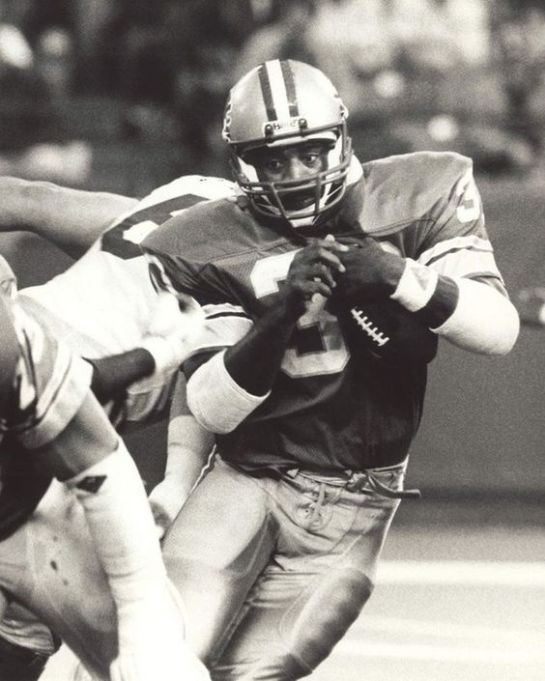
When pictures of the abandoned Silverdome surfaced on aol.com this week, it struck a nerve with everyone The Chancellor interacts with. Of course all of us pictured so many Thanksgiving Day games, Barry Sanders breaking ankles, and the incomparable Billy Sims flying high into the end zone. However sandwiched between these two was a fullback who was a #1 draft pick in James Jones.

The Silverdome as it exists today. Almost a scene from the shoow "Life after People"

The Silverdome as it exists today. Almost a scene from the show “Life after People”

In the vignette to follow, you’ll see Jones was forced into a bigger role with the Lions although the team was lacking in talent to fully showcase him. Had QB Chuck Long developed fully or Eric Hipple able to avoid injuries, the offense could have gotten on track.

They just didn’t have the talent at receiver to stretch the field and provide more running room. Not a single Pro Bowl performer on offense between 1983-1988 slowed what could have been an even more productive career.

As twilight is descending on the Silverdome with all of it’s assets being auctioned off, why not take a look back at James Jones career. His name should be thought of with the best Detroit Lions who played in this building. Yes Super Bowl XVI was played here but these men toiled on the floor of this stadium trying to bring Detroit a winner.

Jones had the talent to be one of the best fullbacks in league history. When you play for a team that is always behind it’s hard to get rushing totals to be considered among the elite. Players like Jones are overlooked when playing for incomplete teams that lose most of the time. That has to be frustrating. Its worth taking a look back and think what might have been as the Silverdome fades from memory.

Although he played 10 seasons the bulk of his career yardage came as the link between Billy Sims and Barry Sanders.

James Jones Lion Career 1983-1988:

  • 960 carries 3,452 yards 23TDs
  • 285 receptions 2,318 yards 10TDs

These are nowhere near what the more celebrated #20s accumulated but when you look at his play among the pantheon of fullbacks, you have to tip your cap to the career he had.

Thanks again and please share the article.