The Chancellor’s Take on Peyton Manning

The old NFL logo

The old NFL logo

When it comes to NFL football no one has watched more games and studied the game more than The Chancellor of Football. It has always been the great escape for me to study the players, analyze games, dissect teams and playing styles of different eras. I can think back to the early 80’s when someone was watching “The Cosby Show” in the other room, I had a ton of paper out drawing up the “46 defense” and studying Bears games I recorded over in mine.

If I didn’t have a football video game going, I was outside playing it with friends. All  the while my mind was studying the nuances of the game. Then the study migrated to understanding the dynamics of coaches, the sociological aspects of football, the psyche of players, and the psychological make up of a team. What made the player tick…and why certain players received the coverage they did.

One of the real reasons I have been such a harsh Peyton Manning critic is the Alpha or Beta quarterback argument. He’s proven to be an alpha quarterback obviously but I wasn’t going to give him a pass because he was Archie’s son the way the mainstream media did.  I have never been a media darling type. I abhor it. The reason I gravitated to sports and football in general from the beginning was the exploits the athletes made were earned on the field of endeavor. Not what someone made up for them like a Hollywood movie or covered favorably when others are tortured by media types for the same short comings. Take a look at this comment from Facebook earlier when I described Matt Schaub in yesterday’s article. The Beta Quarterback.

“To come off this list you have to start winning the big games. I knew Schaub would regress for one simple reason. He NEVER beat the bully on his block. The Indianapolis Colts own him and even retooled on the run. He NEVER bested the Colts in significant games while Peyton Manning was there and now a whole new regime is in place and he still hasn’t grown. Pundits started to pick the Texans as a possible Super Bowl team because of other talent on the squad. Truth is…he’s a beta qb until he proves it beating good teams like Joe Flacco did last year. Only one way past the bully…you have to kick his ass…. If you don’t, you remain in this twilight.”

Peyton Manning with his college coach Phil Fulmer.

Peyton Manning with his college coach Phil Fulmer.

Think back to Peyton Manning’s inability to beat Florida when he was at Tennessee. The Chancellor of Football watched “the next big thing” all throughout his college career. I still have the highlights recorded when he and Jay Graham powered past Eddie George, Terry Glenn and the 4th ranked Buckeyes in the Outback Bowl in 1996…yet I digress

The fundamental flaw to NEVER take down your bully on your block goes with you psychologically for a lifetime. That bully is just substituted later by other people. i.e. Tom Brady and the New England Patriots. Yet in his coverage the mainstream media wanted to “make” him a champion before he became one.

What got his career launched is he played with 3 Hall of Fame talents that didn’t get the credit for it. Marshall Faulk, Edgerrin James, and Marvin Harrison. Faulk, who in 1998 nearly had the same stats as he did when the St Louis Rams won it all in 1999. He had 1319 yards to go with 86 receptions and 908 more yards and 10 TDs. Sure a baby faced rookie Manning showed promise, but he threw a rookie record 28 interceptions. Yet you didn’t hear of that through the mainstream media. However Kurt Warner in 1999, who had never started in the NFL won the Super Bowl the following season with Faulk.

Marshll had been relieved of duty when the Colts traded him to the Rams to so they could draft Edgerrin James. In 1999, James became the first rookie to lead the NFL in  rushing in nearly 20 years. In fact he joined Jim Brown, Earl Campell, and Eric Dickerson as the only runners to lead the league in rushing in their first two seasons. That is dating back to 1957. Yet all the coverage went to Manning as though Edgerrin wasn’t even there. James is one of only 3 running backs (Barry Sanders & Eric Dickerson) to have 4 seasons of over 1,500 yards rushing yet when we suggest he’s a Hall of Fame player, some scoff at the notion. Why?? All the coverage was on Peyton Manning and the mainstream media NEVER fed this information to the football masses. Never. He also went on to a Super Bowl without Manning with Kurt Warner ironically in Arizona 2008.

Then you have the quiet Marvin Harrison. Although the end of his career was somewhat shrouded with the backdrop of a gang related shooting death. This performer is the current record holder for receptions in an NFL season with 143 in 2002, and caught 1,102 passes for 14,580 yards and 128 touchdowns during his career. Just about the same as new Hall of Fame enshrinee Cris Carter, and finally we’re hearing about his Pro Football Hall of Fame candidacy. This was a #1 draft pick and All America talent at Syracuse catching passes from Donovan McNabb. Yet here is another that rarely received coverage because Manning was the national media’s end all be all when it came to covering the Indianapolis Colts.

The biggest issue is how the media chose to cover him as they thought he would be and not cover him fairly for how he performed. His first forays into the playoffs were underwhelming to say the least. In ’99 when they were the 2nd seed, they only managed 13 at home in a loss to the Titans. Three years later came the worst playoff loss of this millenia in a 41-0 loss to the New York Jets in the Meadowlands. Ironically the site of this year’s Super Bowl. They only gained 167 yards total in that game which was nearly a record low performance. Yet you never heard of these performances or the fact he has a record 11 playoff losses. Why?? Too much jock sniffing by the national media. Guys who wished they were Peyton Manning instead of just covering him.

One of the reasons you're seeing a record breaking season for Manning started here. The 2003 AFC Championship Game.

One of the reasons you’re seeing a record breaking season for Manning started here. The 2003 AFC Championship Game.

Keep in mind he was favored in Super Bowl XLIV and fell behind the New Orleans Saints. Marching for the tying touchdown in the fourth quarter he threw the pick six to Tracy Porter to seal the Colts fate. What would the media have said had that been Eli Manning?? Tony Romo?? Jay Cutler?? They would have buried him like he was Rex Grossman. You have to keep in mind the NFL offices pay attention to media coverage. We saw how much sway media had when the Colts lost the 2003 AFC Championship 24-14 to Brady’s Patriots.

The immediate coverage was on how the Patriots held their receivers and stretched the 5 yard “chuck zone” further downfield. Complaints from the Colts were all over ESPN and dominated the airwaves leading into Super Bowl XXXVIII between the Patriots and Panthers. Ironically they set a Super Bowl record with both quarterbacks throwing for more than 300 yards for the first time in history.

That off-season the NFL stated they were going to reinforce that rule just because of the complaints from Manning and the Colts. No one was able to touch his receivers without a flag and ironically this was the season he broke Marino’s touchdown record of 48. Funny, he couldn’t come within 16 touchdowns of it in his 6 previous seasons.
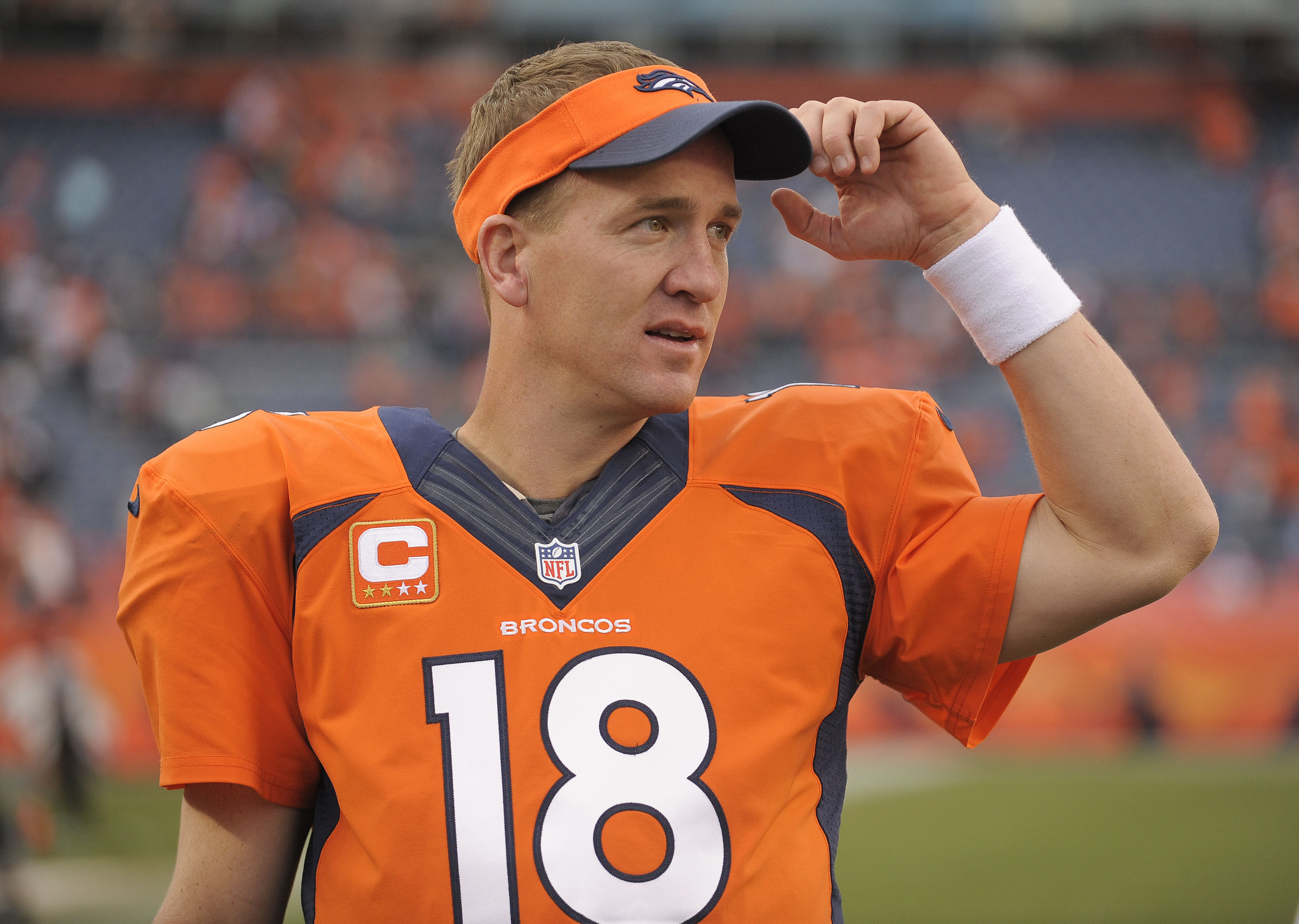
Is Manning a Hall of Fame??? Absolutely

Is Manning a Hall of Famer??? Absolutely

The coddling of Manning and the favorable officiating is why the Broncos receivers are able to run pass interference routes at their leisure. Whenever you hear these announcers say “pick” its a form of offensive pass interference. Ironically the league hasn’t had a knee jerk reaction to reinforce those rules. So the record book has shattered from this.

The real problem here is it cheapens the record book and cheapens the league as a whole. Just like rules for Michael Jordan ruined the NBA for purists, the same thing is happening in the NFL. What you’re doing is turning the sport into a television show. One where his games are officiated differently than other teams to manufacture a successful environment. Don’t tell me it’s a quarterback driven league when there are just as many who tune in for a stout defense or a record breaking runner. Then you hear the corporate types, who are wholly responsible for this, talk about ratings. Listen, in 1986 the Chicago Bears won Super Bowl XX in front of 120 million viewers. At the time on American television, the top 20 watched shows were 18 Super Bowls, the MASH finale, and Roots. The ratings have always been there, so come off that excuse.

Where Peyton Manning was / is concerned he’s given a pass for his flaws and celebrated for what he has done right as though it’s never been done before. Is he really better than Joe Montana when it comes to pre-snap reads?? He’s a better gun slinger than Dan Fouts?? A better deep ball than Terry Bradshaw or Johnny Unitas?? Is he better than Joe Montana at any aspect of quarterbacking?? I know he wasn’t better than Dan Marino in his prime. Yet you hear these pundits wax philosophical as though there is no footage of the 77 years of the NFL before his arrival.

Well here at Taylor Blitz Times, we do have tons of footage of all the greats. No, Manning isn’t the first who handled pre-snap adjustments. Audibles have been a part of the league for greater than 50 years.  The one description I love is how he plays with what scouts call “nervous feet”, which was to a quarterbacks detriment. All of a sudden pundits helped change that to a positive attribute.  Go figure.  He is a Hall of Fame player but keep it in perspective from a historical sense. Everything happening today isn’t the greatest ever seen and make sure you cover players fairly for what they do. After all it is a sport, right??

Thanks for reading and please share the article.

The Chancellor Weighs In: LaDainian Tomlinson Retires

Tomlinson set to retire as a Charger on Monday.

We’re hours away from the retirement of a future Hall of Famer when Tomlinson takes the podium. In the history of the NFL, Tomlinson is an evolutionary link to great runners of the past.  Ernie Nevers, Steve Van Buren, Jim Brown, OJ Simpson Continue reading

Marshall Faulk Makes The Hall of Fame

You can still hear Chris Berman saying “Marshall! Marshall! Marshall!” on NFL Primetime. Can’t you? When we think of great players we tend to think of them at their zenith. For Marshall Faulk it was definitely the years of “The Greatest Show on Turf” where he played his way into the Hall of Fame in just three years. The earlier years were just a harbinger of things to come.

Yet when I think of Marshall Faulk, I think of a faster version of Thurman Thomas. Better yet, if we spliced Thurman Thomas with Barry Sanders, this is the hybrid that would have been created. In fact it was Sanders departure that swung the door wide open for this talent to finally get his acclaim on a world wide basis. When Barry retired, the NFL lost it’s instant highlight reel. We were spoiled as fans because week after week we saw something spectacular and weren’t sure if we’d see that again. Enter Marshall Faulk.

The NFL world was mourning the loss of John Elway and Barry Sanders to retirement. Then we were thrown for another loop when the Indianapolis Colts selected Edgerrin James ahead of Heisman Trophy winner Ricky Williams. Almost as an afterthought Marshall Faulk was traded by the Colts to the Rams to make way for James. Instantly, I remember saying this is the Football Gods reversing the Eric Dickerson trade. Referring to the Rams trading Dickerson, the greatest runner of his era, to the Colts in 1987.

No one was really paying attention to Marshall Faulk going to St Louis yet being in Anaheim at the time, I was still in the Rams television market. My response was a flippant comment and not a premonition but it turned out to be. History would judge this trade on what happened with both teams. I thought the Colts had made a mistake letting Faulk go. So who won the Marshall Faulk / Edgerrin James trade??

Marshall Faulk in Super Bowl XXXIV

Super Bowl XXXIV Ring

The St Louis Rams became “The Greatest Show on Turf” thanks to a forgotten running back who could play receiver, had moves and an effortless running style with a burst. In three seasons (1999-2001) he rushed for 4,122 yards averaging 5.4 yards per carry while scoring 59 touchdowns!! Won 2 NFL Offensive Player of the Year awards and an NFL Most Valuable Player Award while taking the Rams to 2 Super Bowls. They won Super Bowl XXXIV beating the Tennessee Titans 23-16. Before Faulk the Rams had not been league champion since 1951.

In the 1999 championship season alone, he joined Roger Craig as the only other back to gain 1,000 yards rushing and receiving in the same season. When Craig did it he had 1,050 yards rushing, 1,016 receiving. Faulk burst by that with 1,381 yards rushing and 1,048 yards receiving while sitting out most of the last 3 quarters of the finale against Philadelphia.

That game the Rams lost 38-31 and Faulk would have stretched his numbers further had he played that game and the 4th quarter of 4 other blowouts at home. Not factoring that in, Faulk still broke Barry Sanders record for total yards from scrimmage with 2,429 yards. Greatness. He was the impetus for one of the NFL’s greatest champions.

How do you follow up a season like that? How about narrowly missing another 1,000/1,000 season with 1,359 yards rushing and 830 receiving while setting a new record by breaking Emmitt Smith’s TD record with 26 TDs. In 2001 he led the league with yards from scrimmage for the 4th straight year tying the record of Thurman Thomas. Yet all four of Faulk’s seasons were over 2,000 combined yards where Thomas only had 3. Now when you look back and see that in 1998, in his last season with the Colts, he ran for 1,319 yards and caught passes for 908 yards. He had four consecutive seasons  where he flirted with 1,000/1,000.

He broke records and tied another of Hall of Fame running backs, how could he not be enshrined with them with numbers like that?? All this to lead the Rams in becoming the first team to score over 500 points in multiple seasons with 3 (1999-2001). The Rams also averaged 32.6 points per game for those 3 seasons which was the best in history narrowly beating their 1951 predecessors with just under 31 points.

Marshall Faulk on Saturday’s Hall of Fame Induction Ceremony

Marshall went on to finish his career with 12,279 yards rushing with another 6,875 receiving and 136 overall touchdowns. Yet it was this amazing 3 year run that catapulted him to the halls of Canton. Now its interesting to note that while Faulk was doing all this, Edgerrin James (The U) twice led the league in rushing.

Yet the Rams were participating in Super Bowls and became one of the most memorable teams in league history. Another irony is they each went to the Super Bowl while teaming with Kurt Warner when….wait for it…..the Colts let James go via free agency. *In all due respect, the Colts gave Edgerrin a Super Bowl XLI ring for all that he had done for them up to that point.*  Jim Irsay don’t let any more running backs go because the one you let out of town in 1998 was one of the best in history. The Rams won that trade plain and simple. His induction speech was eloquent and he’s been the best analyst on the NFL Network. Congratulations Marshall Faulk…Hall of Famer

Thanks for reading and please share the article.

College Football’s Leveled Playing Fields

Marshall Faulk at San Diego State

The changing faces of college football over the last fifteen years has been a unique situation upon the sporting landscape. Gone are the days when the traditional schools would line up and pummel a school from a smaller conference. Don’t get us wrong, there are still some lopsided contests but the talent level is closer than in the 1970’s,80’s, or even the 90’s. This is the byproduct of several things.

The first thing was with up to 20 cable televisions showcasing football around the country. Schools could recruit outside their region for talent and deliver the promise that their families and friends could still watch them play. Alternative schools to the traditional powers also offered players the chance to remain at their position of choice. One glaring example of this was when Marshall Faulk was coming out of New Orleans as a high school star.

Tons of schools were recruiting him and one of the heaviest was Florida State. They would offer Faulk a full scholarship yet they wanted him to switch from running back  to cornerback. Faulk opted to go to San Diego State where he dazzled the nation as a freshman gaining 1,429 yards and 23TDs. Along the way he had a freshman record 386 yard, 7 touchdown performance against U of Pacific. Before you say something about the talent level, keep in mind he’s just 3 weeks away from giving his Pro Football Hall of Fame induction speech. So kill that noise.

The point being he didn’t have to play cornerback with Terrell Buckley and watch Amp Lee and Warrick Dunn as tailbacks at Florida St when he had other alternatives. Being on the west coast and playing in many night games, Faulk was watched all around the country and became the first freshman to get serious consideration as a Heisman Trophy candidate. There are other notable examples of this but an electrifying running back that made both Hall of Fames (college and pro) seemed like a logical example. Players know they can go anywhere and be seen all over the country.

Steve Slaton slashing up Marshall

The second was the scholarship limitations the NCAA  instituted in 1990. Now the top 20 schools, the Miami’s, Florida St’s, Oklahoma’s, Nebraska’s, Texas’, Michigan’s, Ohio St’s, the USC’s couldnt swallow the top 100 tailbacks coming out in a given year. Some of them were talents that never developed or later developed. Some players actually blossomed at non traditional schools that struggled to get the blue chip prospect.

When you get a Steve Slaton at West Virginia, a LaDainian Tomlinson who opted to stay near home at Texas Christian, or a Jamal Anderson at Utah, or even a Doug Martin right now at a Boise St. These players could have split time or may not have started early in their careers at traditional schools. In most cases we never hear of these players as they fade into obscurity and don’t make the pros.

Some play in Canada but many fall by the way side. Two players that did play later were Jeff Smith of the Nebraska Cornhuskers of ’83 and Priest Holmes of Texas in the late 90’s. Each played RB behind Heisman winners in Mike Rozier and Ricky Williams. Yet both developed their talent in the NFL, Smith had a serviceable career with Kansas City Chiefs, where Holmes went on to rewrite the Chiefs record book after winning a Super Bowl ring in Baltimore.

Yet all of a sudden we were seeing electrifying, record breaking runners at schools we didn’t expect those performances from. The aforementioned LaDainian Tomlinson, A Troy Davis at Iowa St running for back to back 2,000 yard seasons in the mid 90s. A Barry Sanders rushing for 2,629 yards and 37TDs in a 1988 Heisman Campaign, who followed an All American Thurman Thomas. Who followed another All American and ’82 NCAA rushing leader Earnest “Sparkplug” Anderson with over 1,800 yards rushing. Yes the year Herschel Walker won the Heisman he didn’t lead the nation in rushing. The latter three talents went to Oklahoma St and not Texas or Oklahoma.

The third key component in leveling the collegiate playing field were the different strategies employed by college coaches.  These evolving sets have been lifted from the antiquated wishbone offense to more pro style sets including the run and shoot, 3 receiver one back sets, to the variations of the spread offense. Teams that couldn’t field All American offensive linemen could opt for an attack that spread the defense and made it think. Why go toe to toe with an opponent when you can out think your opponent and outhit him when he is out of position? This has been the true equalizer in college football over this last ten years just ask Michigan how it feels about Appalchian St. Michigan became so confused that they thought “hell if you can’t understand it hire a coach who does” yet they didn’t have the type of talent needed to direct that offense under coach Rich Rodriguez.

With the run and shoot, different types of receivers were needed to make the offense go. You recruited your traditional large fast receiver(6’0-6’3 -215 lbs.) along with a new prototype that manned the slots.  This player was smaller in stature yet quicker than the large fast receiver and stood (5’7-5’9 -175-185lbs.) which were the high school receivers that traditional schools didn’t recruit unless they were going to be switched to cornerback.

Yet these players found homes in offenses that spread the field and played their game in space throwing the football. Most teams realized that the third and fourth best WR were normally better than third and fourth corners on a given team. You had the University of Houston in the 80s and early 90s as the vanguard of the run and shoot teams and most recently June Jones University of Hawaii teams. Even the Miami Hurricanes employed these techniques winning two National Championships in1989 and 1991.

Then along came Rich Rodriguez and his West Virginia Mountaineers. He took the spread offense to a complete zenith with what you could do with a 53 1/3 yard wide field and implemented a power rushing attack from a spread formation. First he recruited Pat White from Alabama.  At 6’0 (being generous) and 185 lbs. he was short for a quarterback and had a decent arm, yet it was his 4.28 40 yard dash that made it nearly impossible for interior linebackers to read blocking patterns, than get to the flank to defend against his options or pitch to Steve Slaton.

Slaton was brought down from Pennsylvania. One of the nation’s fastest running backs coming out of high school in 2005.  He had committed to Maryland who had offered him a scholarship then retracted their offer.  He took his 4.3 speed to West Virginia to team with Pat White, Owen Schmitt, recievers Darius Reynaud #82 and Brandon Miles#7 and a powerhouse was born. They spread from a traditional set and some 3 receivers yet ran what they call a speed option that most MLBs didnt have the lateral quickness to stay with.  The result?? First we have to set the table for you.

The Miami Hurricanes and Boston College had just fled the Big East to join the ACC. Many felt that the Big East was no longer a top flight conference with two of their heavyweight schools having departed. Yet the Mountaineers started a redshirt freshman in Pat White, and a freshman tailback in Steve Slaton and a new offense took the country by storm.  They improved as the season went on and Slaton finished the season with 1,128 yards and 17 TDs, while White finished with 952 yds rushing and 7 TDs to go along with moderate passing to keep defenses honest.

Once they ran out to a 10-1 record, their Big East championship gave them an automatic bid to the BCS Sugar Bowl where they would take on Georgia. The Bulldogs that year were 12-1 and only a close loss in SEC play had kept them from appearing in the National Championship Game. Experts scoffed that West Virginia’s offense couldn’t perform that well against a superior defense from a superior conference. Yes experts were treating the Big East as a second tier conference with the remaining teams.  So the battle lines were drawn and since the Sugar Bowl had to be moved from New Orleans to Atlanta’s Georgia Dome, because of Hurricane Katrina, this would be a home crowd for the Bulldogs too. No way the Mountaineers could stay on the field with an SEC team……………….right??

Naturally underdogs play with a chip on their shoulder and Bulldogs were chasing Mountaineers all night. In a humiliating 38-35 defeat, SEC Champion Georgia never led in the ball game. http://scores.espn.go.com/ncf/boxscore?gameId=260020061 No one on the set picked West Virginia to win and the nation watched in stunned amazement as the Mountaineers burst onto the field and  was up 28-0 before Georgia knew what hit them. Freshman Steve Slaton set the Sugar Bowl rushing record with 26 carries for 204 yards, 3 Tds with twin 52 yard touchdowns that were electrifying. Passing the exploits of Tony Dorsett, Herschel Walker, Major Ogilvie, Vegas Ferguson, and keep filling in blanks here…Slaton outrushed them all just being 7 months removed from high school. Yikes!!

This watershed game got more coaches on the bandwagon of the spread to be used as a rushing offense.  By the time the point was hammered home that this was an offense to stay, was when Appalachian State upset Michigan in “The Big House” in 2007. Now even skeptics were using some variation of the offense in their playbooks. Though the SEC was embarrassed that night in the Sugar Bowl, we come to see that 5 years later Auburn wins the National Championship over Oregon and both were run first, spread option teams. In came the Cam Newtons and Terrelle Pryors to lead this new wave…

So the landscape has changed, first through the proliferation of cable television stations allowing players to play in far away places and still be seen back home.  This changed the way colleges could approach players when they weren’t the clear cut favorite to land a particular recruit. Players weren’t forced to switch positions to go to a particular name school when there were other alternatives.

This happened simultaneously with the NCAA limiting the amount of scholarships teams which spread talent all over the collegiate landscape. Then in an effort to find the great equalizer, coaching innovations leveled the playing field even more with better tactics while landing a better athlete on their campus than ever before.  Couple these factors with the natural chip on the shoulder that most underdogs play with and college football has turned into “On any given Saturday…” Making college football an even greater game than before.  We’ll be back to help solve the National Championship Game and BCS problem later.

Thanks for reading and share this with everyone