The Greatest NFL Game Never Talked About

Welcome to another episode of theater from the past. The most famous games in NFL history have always been playoff games.
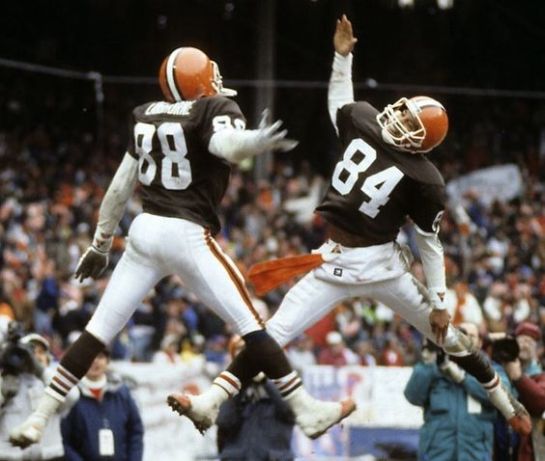
Football is a game of emotion and it’s the finality of knowing your season could be over that can elevate the play of both teams. Yet some playoff games are talked about and held with esteem while others are rarely written about, rehashed, re-shown, or ever discussed among the greats.

To us, there is a heavy bias toward the glamour franchises or darlings that the media aid in anointing their games great while others are passed over. One such game was the 1989 AFC Divisional playoff tilt between the Cleveland Browns and the Buffalo Bills. Not only was it great, it was as great as “The Epic in Miami”, or in my estimation better.

This was a magnificent football game. You have to realize that particular weekend you had John Elway and the Denver Broncos hosting the cinderella Pittsburgh Steelers in one playoff game. Jim Everett’s underdog Los Angeles Rams in New York facing Lawrence Taylor’s Giants, and the defending Super Bowl champion 49ers of Joe Montana hosting the Minnesota Vikings for a third straight post season. Yet it was the Browns v. the Bills that caught the imagination of NFL Commissioner Paul Tagliabue, who was in attendance, and Donald Trump who was in the box with Browns owner Art Modell. Why??
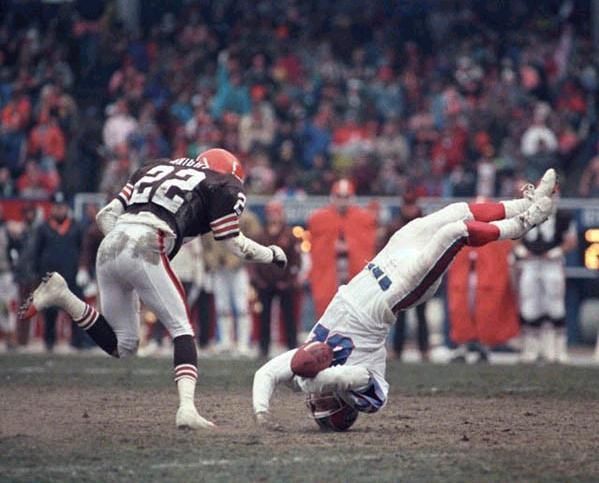
Well the Browns, famous for their “Dawg Defense”, had been stung 3 years before by John Elway’s Denver Broncos in the ’86 AFC Championship, and the following season with Earnest Byner’s fumble in the 1987 AFC Championship. Although the Cleveland Browns had been the NFL’s Team of the decade in the 1950’s, they had been a down franchise for many years. However each time the Browns thought they had a team capable of winning it all, they lost in heart breaking fashion on 3 occasions. The stellar teams they had from 1985-1989 were aging and many pundits thought this was the last chance for this team to get a Super Bowl win for owner Art Modell.

The other side had an up and coming Buffalo Bills team that rose to prominence as a defensive giant in 1988, after nearly a decade of futility. High draft picks,which included future Hall of Famer Bruce Smith, Cornelius Bennett, and Shane Conlan carried this team to the 1988 AFC Championship Game. After losing that game to the Cincinnati Bengals, the Bills were looked upon as a team of the future. However the team almost imploded in 1989 from infighting and finger pointing, which earned them the nickname ” the Bickering Bills”. The offense of Jim Kelly, Andre Reed, and Thurman Thomas was starting to show signs of life as the defense slumped slightly from the year before.

Better than “The Epic In Miami“?? Yes! This game featured big play after big play and came down to the wire with the Browns prevailing 34-30. To compare it to the great ’81 AFC Divisional playoff: Want to talk excitement?? With touchdowns of 33, 44, 52, 73, and 90 yards out, this game in ’89 had 5 touchdowns from 33 yards or more compared to 2 in that one. The only other playoff game in the Super Bowl era to equal 5 TDs of that distance was Super Bowl XXXVII between the Bucs and the Raiders. This game had 4 lead changes as compared to 3 in the earlier game.

Each had the record holder for receptions in a playoff game with 13 in both Thurman Thomas and Kellen Winslow. (both Hall of Famers) Each had a Hall of Fame Coach, Marv Levy of Buffalo and Don Shula as well as quarterbacks in Jim Kelly and Dan Fouts. Where the earlier game went to double overtime and ended on a boring field goal, this one had a sense of de ja vu. The Bills made a last second march toward their goal line with time running out, just like John Elway and “The Drive.” Although this time Clay Matthews intercepted Jim Kelly at the 1 yard line with :03 left. Now that is a finish!!

The game was also one of the best ever broadcast with Charlie Jones and the late Merlin Olson making the call. Here are the sights and sounds of the biggest plays from the game…

One outstanding aspect of this game was how great the commentary was. Notice how Charlie Jones and Merlin Olsen allowed the viewer to take in the sights and sounds of 80,000 fans going crazy. This is the antithesis to Joe Buck, who our CEO thinks is the worst play by play man ever. One aspect of announcing a football game versus a baseball game: Allow the visuals to stimulate the viewer more so than the commentary and know when to acquiesce to such.
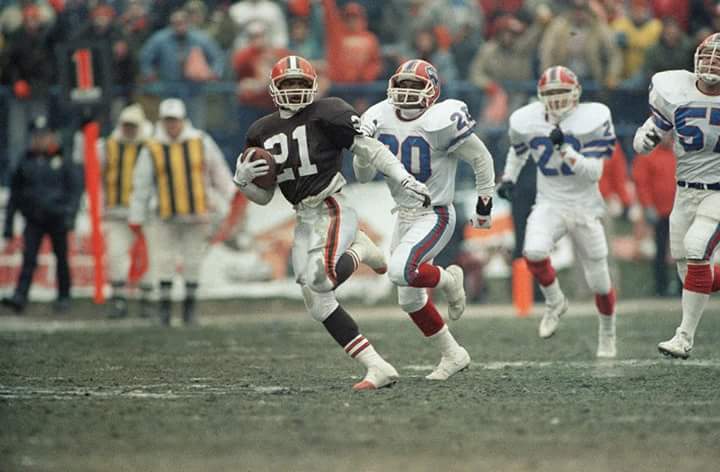
Metcalf’s 90 yard return was the backbreaker in a game that had every thing.

Epilogue: Why is this game not revered like “The Epic In Miami”? This game had more Hall of Famers and neither game produced a Super Bowl winner. We feel that it might have something to do with the media’s growing disdain for the University of Miami football team, from which both Jim Kelly and Bernie Kosar hailed. Then NFL Films, who rarely slights a team due to media prejudice, chose NOT to put this game in the Cleveland Browns 1989 Yearbook. Seriously?? That was embarrassing.

Yet alas it came down to one play and Clay Matthews made it. So when you saw the 4th quarter fumble caused by his son Clay Matthews III in last year’s Super Bowl, and Casey Matthews forcing a 4th quarter fumble in last year’s National Championship Game for Oregon, you now know it’s in the genes.

The Browns would go on to lose their 3rd AFC Championship Game in 4 years to the Denver Broncos that brought an end to their playoff run. However the Buffalo Bills went on to a record 4 straight Super Bowls which began the following season.

From 1986-1993, one of these teams was in every single AFC Championship game for an 8 year period. It was this game that was the birth of the Buffalo “K-Gun” offense and the crossing point where Cleveland conceded to Buffalo as an AFC elite team. For one game, and four hours of sheer escapism magnificence, they played to the highest level worthy of being one of the greatest NFL playoff games ever played and is due more in it’s remembrance.

I dedicate this article to the late Charlie Jones and the late Merlin Olsen for their broadcasting excellence in elevating this game to one of  magnificent lore. Your call on this afternoon in January 1990 was simply the best ever. Gentlemen, thank you for a job well done.

R.I.P. Charlie Jones and Merlin Olsen

Thanks for reading this article, share this with those that love Pro Football

A Word From the Chancellor: College Football- Boise St Needs To Become The New Miami Hurricanes

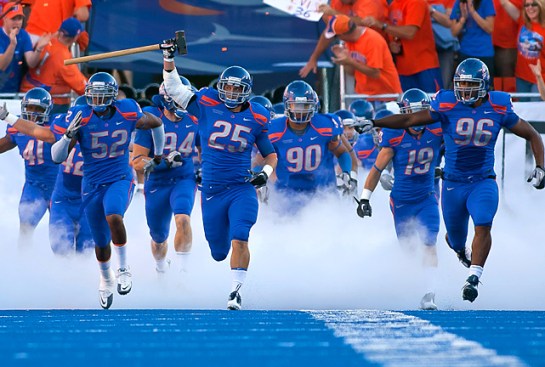
Boise St Broncos storming the field

After watching TCU and Boise St beat their heads against a brick wall just to play in BCS Bowl games, it finally hit our chancellor what needs to  be done.  The Mountain West Conference will never garner Boise St the respect it needs to crash the BCS Title Game no matter how well they play. The 4 undefeated seasons through the 2000s aren’t enough and neither were the 2 BCS Bowl wins in the eyes of jaded BCS conference lovers. With everyone joining these collegiate super conferences it’s time to reverse gears and go independent. Especially Boise St, at least TCU gets love since they hail from Texas.

Well, the blueprint has already been laid out for them. They are to copy the pattern that garnered the Miami Hurricanes prominence throughout the the 1980s and ’90s by being the independent foil that played 5 or 6 ranked opponents every year. This way they can play toward the mantra “it’s all about the money”, and take on teams that think they can beat them and will pay them for 3 to 4 game series. Think about it. Get a reported $800,000 from those three teams and supplement this with their bowl money. It will be a financial windfall. What happens if they take on a 3 game series with an LSU, and Ohio St., and an Alabama team that believes they can beat them?? Then they take on two to three single game  performances against a ranked West Virginia and USC, then schedule weaker opponents. If they come through a crucible such as that it forces the voters to rightfully vote them #1 if they can march through those 6. Gone is the conference argument being used against them. How well did this formula work for Miami??

Well the last time Miami was an independent and won the National Title outright was 1989, funny thing is they won a split title in 1991 as a Big East Conference member. You’ll note that they even lost to Florida St. yet ran the table against the rest of their ranked opponents. The teams that were not ranked by season’s end did hail from BCS conferences in Wisconsin, Cal, Pitt, defending champion Notre Dame (also an independent) and the pollsters couldn’t avoid voting them up. Look at this schedule for the 1989 Canes and fashion a 2012 schedule for Boise with some substitutes. If they could go 5-1 or 6-0 versus that tough of competition they could be #1 with ease. Think about it Coach Peterson!!

Date Result Miami Rank# (Rank#)Opponent Stadium · City
September 9, 1989 W 51-3 #3 Wisconsin Camp Randall Stadium – Madison, WI
September 16, 1989 W 31-3 #3 California Orange Bowl – Miami, FL
September 23, 1989 W 38-7 #2 Missouri Faurot Field – Columbia, MO
September 30, 1989 W 26-20 #2 Michigan State Spartan Stadium – East Lansing, MI
October 7, 1989 W 56-0 #2 Cincinnati Orange Bowl – Miami, FL
October 14, 1989 W 48-16 #2 San Jose State Orange Bowl – Miami, FL
October 28, 1989 L 10-24 #2 @ #9 Florida State Doak Campbell Stadium – Tallahassee, FL
November 4, 1989 W 40-10 #7 East Carolina Orange Bowl – Miami, FL
November 11, 1989 W 24-3 #7 @ #14 Pittsburgh Pitt Stadium – Pittsburgh, PA
November 18, 1989 W 42-6 #7 San Diego State Orange Bowl – Miami, FL
November 25, 1989 W 27-10 #7 #1 Notre Dame Orange Bowl – Miami, FL
January 1, 1990* W 33-25 #2 #7 Alabama Louisiana Superdome – New Orleans, LA
*Sugar Bowl #Rankings from AP Poll released prior to game.

The Boise St. Broncos need to copy this formula and wind up with a ranking that will elude them with their present conference situation. They have to take the voters stance and embrace the BCS and force their vote. Without this type of set-up it’s more of the same thing. A big win against a Georgia team earlier this year and SEC pundits and fans scoffed they were an SEC bottom feeder. Well if Boise St schedules two of these schools and march through them it would bode well for their shedding the “one tough opponent” label. Without this they may never get their due as the well coached team that they are.

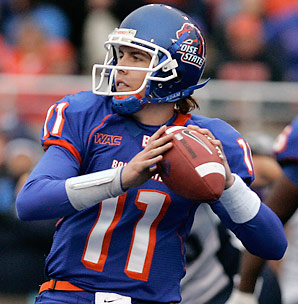
Kellen Moore, soon to become the all time winningest quarterback in Division I history.

The funny thing is most people equate the Broncos with BYU in past annals when they are not like BYU at all. This well oiled machine mines football talent from Northern and Southern California, and nabs some of the soon to develop talent who had issues with grades. They even allow players to send try-out tapes to the school and shop their wares instead of relying on big time scouting to be noticed. There are a lot of inner city kids on these Boise teams and these other “big schools” think they’re going to “punk” the Broncos. Then they wake up in the 4th quarter in a dog fight against a team where every player has a chip on his shoulder. There is a ruggedness to their teams yet they’re disciplined. It takes this type of attitude from the coaching staff and players to make this go. What do you say Coach Peterson?? The time is now or you may let one of history’s finest runs be regarded on the periphery of achievement when compared to other schools.

Just remember Boise St, the University of Miami was seriously thinking about dropping their football program from Division I altogether before Howard Schnellenberger came up with this bold plan. It turned a fledgling school in South Florida into a national power and may be just the tonic Bronco nation needs to finally crash the BCS Title Game. Well, that and a place kicker that can make a 4th quarter field goal.

Thanks for reading and share the article

College Football’s Leveled Playing Fields

Marshall Faulk at San Diego State

The changing faces of college football over the last fifteen years has been a unique situation upon the sporting landscape. Gone are the days when the traditional schools would line up and pummel a school from a smaller conference. Don’t get us wrong, there are still some lopsided contests but the talent level is closer than in the 1970’s,80’s, or even the 90’s. This is the byproduct of several things.

The first thing was with up to 20 cable televisions showcasing football around the country. Schools could recruit outside their region for talent and deliver the promise that their families and friends could still watch them play. Alternative schools to the traditional powers also offered players the chance to remain at their position of choice. One glaring example of this was when Marshall Faulk was coming out of New Orleans as a high school star.

Tons of schools were recruiting him and one of the heaviest was Florida State. They would offer Faulk a full scholarship yet they wanted him to switch from running back  to cornerback. Faulk opted to go to San Diego State where he dazzled the nation as a freshman gaining 1,429 yards and 23TDs. Along the way he had a freshman record 386 yard, 7 touchdown performance against U of Pacific. Before you say something about the talent level, keep in mind he’s just 3 weeks away from giving his Pro Football Hall of Fame induction speech. So kill that noise.

The point being he didn’t have to play cornerback with Terrell Buckley and watch Amp Lee and Warrick Dunn as tailbacks at Florida St when he had other alternatives. Being on the west coast and playing in many night games, Faulk was watched all around the country and became the first freshman to get serious consideration as a Heisman Trophy candidate. There are other notable examples of this but an electrifying running back that made both Hall of Fames (college and pro) seemed like a logical example. Players know they can go anywhere and be seen all over the country.

Steve Slaton slashing up Marshall

The second was the scholarship limitations the NCAA  instituted in 1990. Now the top 20 schools, the Miami’s, Florida St’s, Oklahoma’s, Nebraska’s, Texas’, Michigan’s, Ohio St’s, the USC’s couldnt swallow the top 100 tailbacks coming out in a given year. Some of them were talents that never developed or later developed. Some players actually blossomed at non traditional schools that struggled to get the blue chip prospect.

When you get a Steve Slaton at West Virginia, a LaDainian Tomlinson who opted to stay near home at Texas Christian, or a Jamal Anderson at Utah, or even a Doug Martin right now at a Boise St. These players could have split time or may not have started early in their careers at traditional schools. In most cases we never hear of these players as they fade into obscurity and don’t make the pros.

Some play in Canada but many fall by the way side. Two players that did play later were Jeff Smith of the Nebraska Cornhuskers of ’83 and Priest Holmes of Texas in the late 90’s. Each played RB behind Heisman winners in Mike Rozier and Ricky Williams. Yet both developed their talent in the NFL, Smith had a serviceable career with Kansas City Chiefs, where Holmes went on to rewrite the Chiefs record book after winning a Super Bowl ring in Baltimore.

Yet all of a sudden we were seeing electrifying, record breaking runners at schools we didn’t expect those performances from. The aforementioned LaDainian Tomlinson, A Troy Davis at Iowa St running for back to back 2,000 yard seasons in the mid 90s. A Barry Sanders rushing for 2,629 yards and 37TDs in a 1988 Heisman Campaign, who followed an All American Thurman Thomas. Who followed another All American and ’82 NCAA rushing leader Earnest “Sparkplug” Anderson with over 1,800 yards rushing. Yes the year Herschel Walker won the Heisman he didn’t lead the nation in rushing. The latter three talents went to Oklahoma St and not Texas or Oklahoma.

The third key component in leveling the collegiate playing field were the different strategies employed by college coaches.  These evolving sets have been lifted from the antiquated wishbone offense to more pro style sets including the run and shoot, 3 receiver one back sets, to the variations of the spread offense. Teams that couldn’t field All American offensive linemen could opt for an attack that spread the defense and made it think. Why go toe to toe with an opponent when you can out think your opponent and outhit him when he is out of position? This has been the true equalizer in college football over this last ten years just ask Michigan how it feels about Appalchian St. Michigan became so confused that they thought “hell if you can’t understand it hire a coach who does” yet they didn’t have the type of talent needed to direct that offense under coach Rich Rodriguez.

With the run and shoot, different types of receivers were needed to make the offense go. You recruited your traditional large fast receiver(6’0-6’3 -215 lbs.) along with a new prototype that manned the slots.  This player was smaller in stature yet quicker than the large fast receiver and stood (5’7-5’9 -175-185lbs.) which were the high school receivers that traditional schools didn’t recruit unless they were going to be switched to cornerback.

Yet these players found homes in offenses that spread the field and played their game in space throwing the football. Most teams realized that the third and fourth best WR were normally better than third and fourth corners on a given team. You had the University of Houston in the 80s and early 90s as the vanguard of the run and shoot teams and most recently June Jones University of Hawaii teams. Even the Miami Hurricanes employed these techniques winning two National Championships in1989 and 1991.

Then along came Rich Rodriguez and his West Virginia Mountaineers. He took the spread offense to a complete zenith with what you could do with a 53 1/3 yard wide field and implemented a power rushing attack from a spread formation. First he recruited Pat White from Alabama.  At 6’0 (being generous) and 185 lbs. he was short for a quarterback and had a decent arm, yet it was his 4.28 40 yard dash that made it nearly impossible for interior linebackers to read blocking patterns, than get to the flank to defend against his options or pitch to Steve Slaton.

Slaton was brought down from Pennsylvania. One of the nation’s fastest running backs coming out of high school in 2005.  He had committed to Maryland who had offered him a scholarship then retracted their offer.  He took his 4.3 speed to West Virginia to team with Pat White, Owen Schmitt, recievers Darius Reynaud #82 and Brandon Miles#7 and a powerhouse was born. They spread from a traditional set and some 3 receivers yet ran what they call a speed option that most MLBs didnt have the lateral quickness to stay with.  The result?? First we have to set the table for you.

The Miami Hurricanes and Boston College had just fled the Big East to join the ACC. Many felt that the Big East was no longer a top flight conference with two of their heavyweight schools having departed. Yet the Mountaineers started a redshirt freshman in Pat White, and a freshman tailback in Steve Slaton and a new offense took the country by storm.  They improved as the season went on and Slaton finished the season with 1,128 yards and 17 TDs, while White finished with 952 yds rushing and 7 TDs to go along with moderate passing to keep defenses honest.

Once they ran out to a 10-1 record, their Big East championship gave them an automatic bid to the BCS Sugar Bowl where they would take on Georgia. The Bulldogs that year were 12-1 and only a close loss in SEC play had kept them from appearing in the National Championship Game. Experts scoffed that West Virginia’s offense couldn’t perform that well against a superior defense from a superior conference. Yes experts were treating the Big East as a second tier conference with the remaining teams.  So the battle lines were drawn and since the Sugar Bowl had to be moved from New Orleans to Atlanta’s Georgia Dome, because of Hurricane Katrina, this would be a home crowd for the Bulldogs too. No way the Mountaineers could stay on the field with an SEC team……………….right??

Naturally underdogs play with a chip on their shoulder and Bulldogs were chasing Mountaineers all night. In a humiliating 38-35 defeat, SEC Champion Georgia never led in the ball game. http://scores.espn.go.com/ncf/boxscore?gameId=260020061 No one on the set picked West Virginia to win and the nation watched in stunned amazement as the Mountaineers burst onto the field and  was up 28-0 before Georgia knew what hit them. Freshman Steve Slaton set the Sugar Bowl rushing record with 26 carries for 204 yards, 3 Tds with twin 52 yard touchdowns that were electrifying. Passing the exploits of Tony Dorsett, Herschel Walker, Major Ogilvie, Vegas Ferguson, and keep filling in blanks here…Slaton outrushed them all just being 7 months removed from high school. Yikes!!

This watershed game got more coaches on the bandwagon of the spread to be used as a rushing offense.  By the time the point was hammered home that this was an offense to stay, was when Appalachian State upset Michigan in “The Big House” in 2007. Now even skeptics were using some variation of the offense in their playbooks. Though the SEC was embarrassed that night in the Sugar Bowl, we come to see that 5 years later Auburn wins the National Championship over Oregon and both were run first, spread option teams. In came the Cam Newtons and Terrelle Pryors to lead this new wave…

So the landscape has changed, first through the proliferation of cable television stations allowing players to play in far away places and still be seen back home.  This changed the way colleges could approach players when they weren’t the clear cut favorite to land a particular recruit. Players weren’t forced to switch positions to go to a particular name school when there were other alternatives.

This happened simultaneously with the NCAA limiting the amount of scholarships teams which spread talent all over the collegiate landscape. Then in an effort to find the great equalizer, coaching innovations leveled the playing field even more with better tactics while landing a better athlete on their campus than ever before.  Couple these factors with the natural chip on the shoulder that most underdogs play with and college football has turned into “On any given Saturday…” Making college football an even greater game than before.  We’ll be back to help solve the National Championship Game and BCS problem later.

Thanks for reading and share this with everyone