Top Ten Single Season Defenses in NFL History : #7 1977 Dallas Cowboys

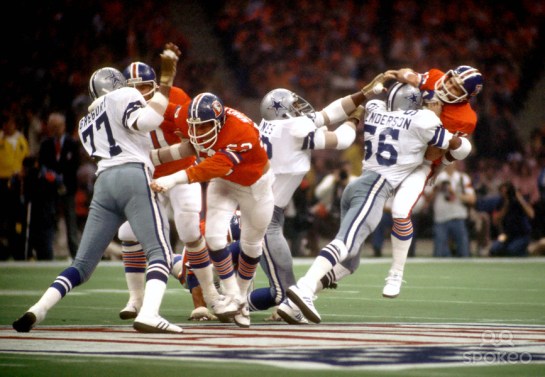
For all the talk of the Gritz Blitz and the Orange Crush Defense in 1977, it was the year of The Doomsday Defense II. They faced off with the Denver Broncos down in New Orleans in Super Bowl XII and the better defense won. They carried their season statistical domination into that game and forced a then Super Bowl record 8 turnovers. This was the last NFL champion to finish #1 on defense and #1 on offense. In giving up just 229.5 yards per game, most don’t realize that was better than the 1978 champion Pittsburgh Steelers (260.5) or even the great ’76 version (237.5).

After Craig Morton was benched, Hollywood Henderson and Doomsday treated Norris Weese to a rough outing. Super Bowl XII

After Craig Morton was benched, Hollywood Henderson and Doomsday treated Norris Weese to a rough outing. In Super Bowl XII

Unofficially that year was the little known fact that DE Harvey Martin recorded 26 sacks. The league didn’t start keeping that statistic until 1981 or that would still be a record. It was arguably his best season as he was named All Pro and made the Pro Bowl. Surprisingly he was only joined by SS Charlie Waters, OLB Hollywood Henderson, FS Cliff Harris, and DT Randy White.

Yet this group does have some knocks against it. They only faced 3 top ten offenses that year and gave up  212 points  for the season. The highest of our top ten. However they were 2-1 in those games and were the first Super Bowl champion to face their eventual Super Bowl opponent during the season. Winning the finale 14-6.

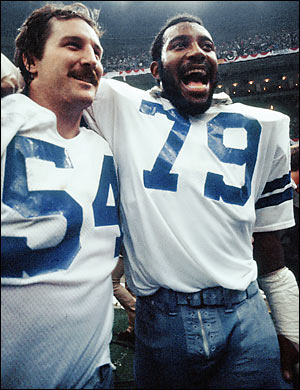
Supe Bowl XII Co-MVPs Randy White and the late Harvey Martin.

Supe Bowl XII Co-MVPs Randy White and the late Harvey Martin.

So why are they in the top ten??

The number one reason this group is here is this was the height of The Flex Defense. Their dominance was felt in a season long display. They held 7 of their 14 opponents to 10 points or less then became the first team since the merger to hold their 3 postseason opponents to 10 points or less. One of those was the #3 ranked offense of the  Chicago Bears and NFL rushing champion Walter Payton. He was held to 60 yards on 19 carries in a 37-7 win in the divisional round.

The havoc they raised in Super Bowl XII with 4 sacks, countless hurries that led to 4 interceptions on the biggest stage didn’t hurt. When half your line, DT Randy White and DE the late Harvey Martin, become the first defensive linemen to win Super Bowl MVP, that puts on an exclamation point on the season.

Other talents such as Ed “Too Tall” Jones, Thomas “Hollywood” Henderson who made his 1st Pro Bowl, made names for themselves as well. They would defend their championship in the following Super Bowl with the Pittsburgh Steelers where they ranked #2 in defense to the Steelers ranked third. That’s another story for a different time.

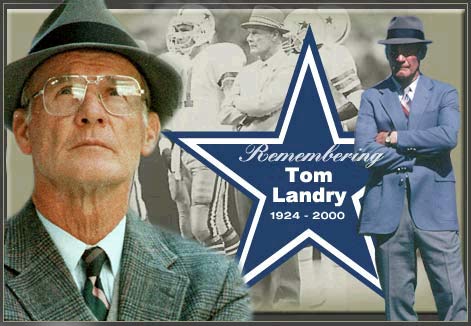
landry.2Epilogue: This was the crowning jewel in the late Tom Landry’s coaching career. Where he engineered a majority of the tactics to bring the 4-3 to be the modern staple of defense in the NFL. It was his ability to innovate that defense and come up with the Flex Defense to read and react as well as keep the Middle Linebacker (Bob Breunig) free of potential blockers.

Dedicated in the memory of both Tom Landry and Harvey Martin.

Thanks for reading and please share the article.

My man Hollywood’s parting shot:

Hollywood Strikes Back!

Hollywood Strikes Back!


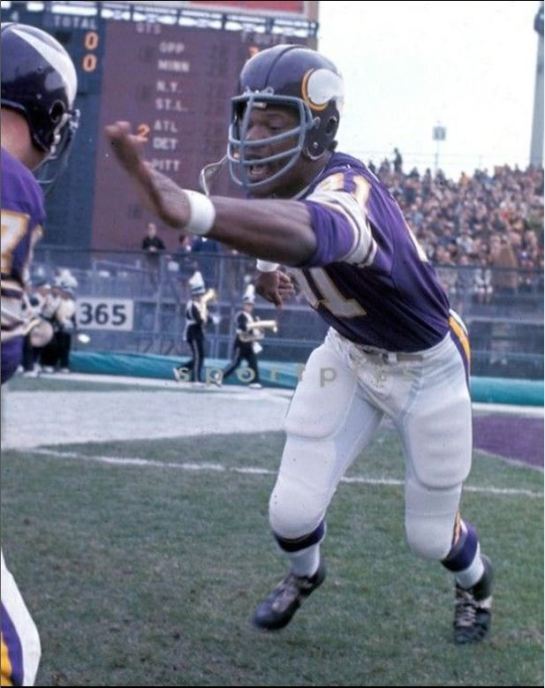
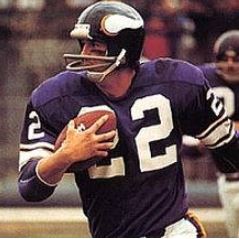
Top Ten Single Season Defenses in NFL History : #8 1975 Minnesota Vikings

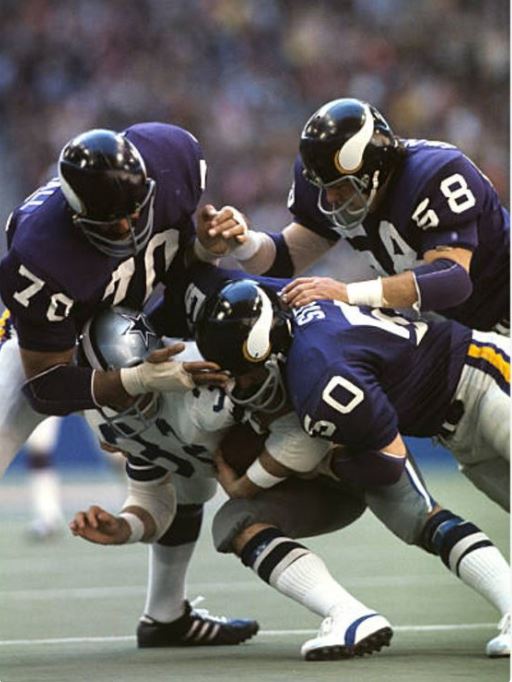
Jim Marshall, Jeff Siemon, & Wally Hilgenberg corrall Walt Garrison.

Much like the “dead ball” era in major league baseball when pitchers dominated the 1960’s, NFL defenses in the ’70’s were the equivalent in football. Up in Minnesota, the Vikings used a dominant front four to limit opponents to 225.2 yards per game. Far and away the best in the league that year. In fact the ’75 Steelers, #9 on this list, was ranked 4th allowing 261.5 yards for the season. They only gave up 180 points or 12.3 pts per game in the ’75 campaign.

Interestingly this team didn’t use it’s cold weather advantage to compile these statistics. They played 3 of their final 4 games on the road. One of those came in the temperature controlled Silverdome against the Lions. Within their statistics you can definitely see their dominance. They held 6 teams to 10 points or less while ranking #1 against the pass (115.8 yds / gm) and #1 against the run (109.4 yds/ gm) finshing #1 overall.  This team threatened to go undefeated bolting out to a 10-0 start.

Hall of Fame DE Carl Eller warming up pregame.

Led by All Pro and Pro Bowl DT Alan Page, this group put significant pressure on the quarterback. Free Safety Paul Krause, the NFL’s all time leading interceptor had 10 on the season. He made the Pro Bowl in ’75 along with MLB Jeff Siemon who picked off 3 more passes and CB Bobby Bryant who snatched 6. They were 3rd in interceptions with 28.

The only knock on this group is they played just 2 top 10 offenses the entire year. However they did face the #1 ranked offense in the Buffalo Bills in the season finale. OJ was threatening for 2,000 again and playing at home, was held to 57 yards rushing to finish with 1,817. They held the Bills to just 13 points and forced them to miss the playoffs.

From this group, Alan Page, Paul Krause, and DE Carl Eller all made the Pro Football Hall of Fame. There are many who believe DE Jim Marshall should be in as well. This team went into the playoffs with a head of steam. They lost 17-10, when Roger Staubach hit Drew Pearson in the famous “Hail Mary” with :24 left in the NFC Divisonal Playoffs.

Halkl of Fame Safety & All Time Interceptor in NFL History with 81.

There stellar defensive season ranks 8th in The Chancellor of Football’s list.

Thanks for reading and please share the article.

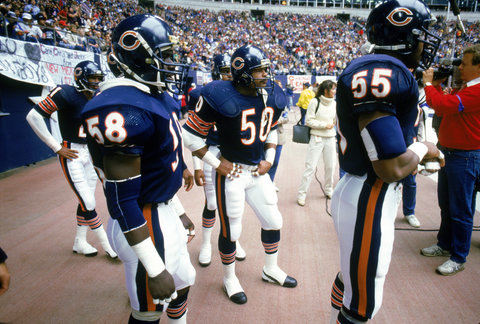
Top Ten Single Season Defenses in NFL History : #10 1986 Chicago Bears

Welcome to the second installment on the 10 greatest defenses in NFL history. We are off to a rousing start as folks are putting in their reasons for their teams and why the honorable mention units should have made the top ten list. Truth of the matter is all bias has to be removed and the great equalizers lie in the season statistics, play against strongest offenses during their year, and what precedents they set.  If one team is sitting in front of another for having set a precedent, a team with less stature or ranking cannot sit above them on the list.

So now we have to countdown to the single season defenses in NFL history starting with #10.

The best trio of linebackers in the game in Mike Singletary, Wilber Marshall, and Otis Wilson.

The best trio of linebackers in the game in Mike Singletary, Wilber Marshall, and Otis Wilson.

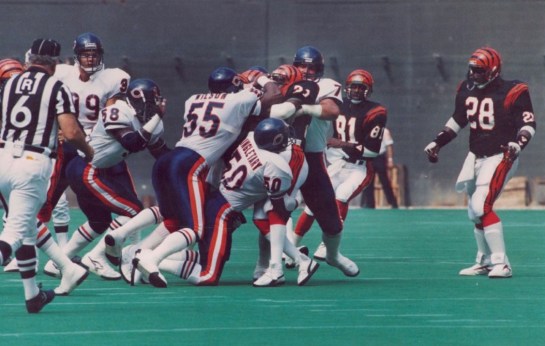
10. 1986 Chicago Bears –  A season after bludgeoning their way to the NFL title, this group was poised to repeat. If Mike Ditka would have stayed the course and not played Doug Flutie at quarterback who was on the team for four weeks, they would have. Having done so he robbed NFL fans of the greatest 2 year dynasty the NFL had ever seen. They were 15-1 in 1985 then went 14-2 which tied for the best record in the league that year. 29-3 over two seasons?? So why is this group in and the ’86 Giants and ’02 Bucs left off??

  • ’86 Bears – 187 pts allowed *NFL record / 10 of 16 opponents held to 10 or fewer points / 258.1 yds per game (1st) / 62 sacks (2nd) / 31 int. (2nd)
  • ’86 Giants- 236 pts allowed / 5 of 16 opponents held to 10 or fewer points *2 more in playoffs* / 297.3 yds per game (2nd) / 59 sacks (4th / 24 int. (tied 7th)
  • ’02 Bucs – 196 pts allowed / 9 of 16 opponents held to 10 or fewer points / 252.8 yds per game (1st) / 43 sacks (6th) / 31 int. (1st)

Furthermore in compiling these statistics the yardage difference between #1 & #2 in 1986 (258.1 to 297.3) is the second biggest difference since 1970. No way in hell you could say the Giants defense in 1986 was better than Chicago’s…no way.

In a year where two future Hall of Famers Dan Hampton (10 sacks) and Richard Dent (11.5 sacks) didn’t make the Pro Bowl, LB Wilber Marshall, DT Steve McMichael, late SS Dave Duerson, and MLB Mike Singletary did. All this before we bring up FS Gary Fencik. They were 2-1 against Pro Bowl quarterbacks. They split with the Vikings and Tommy Kramer beating him once 23-0.

Then they pasted Boomer Esiason and the NFL’s #1 offense 44-7 on the road. By the way the Bengals were 10-6 that year and the Browns were 12-4 and played for the AFC Championship. The Bears beat them also. In fact they were 4-1 on the year vs top ten offenses.

This group had to drag a Bears offense that had been handicapped by the loss of Jim McMahon through several qbs that couldn’t complete 50% of their passes. The true reason the ’86 Bears didn’t win Super Bowl XXI and the ’86 Giants did was this incident right here.

The defense drug a team with no offensive continuity to the best record in the NFL at 14-2. However since the 2 losses came within the NFC and only 1 of the Giants had, New York got homefield advantage. The Bears fell to the Redskins in the divisional round 27-13 behind 3 turnovers on their own side of the 50 in the 2nd half. Even the 10th best defense in NFL history could save them from that. As for would the ’86 Bears have beaten the ’86 Giants had they played?? The first game of 1987 had both teams healthy and the Bears, without McMahon again, won 34-19. Two of New York’s touchdowns were on defense and special teams. Couple this with the fact the Bears shut out New York in the ’85 playoffs 21-0. The Bears would have taken them as New York couldn’t score on this defense.

The Bears season in microcosm was this game against the Lions:

This defense really should be higher but we’re starting the top ten off with a bang. Thanks for reading and please share the article.

Top Ten Single Season Defenses in NFL History: Honorable Mention

When Malcolm Smith crossed the goal line to put Seattle up 22-0 in last February’s Super Bowl, pundits were already arguing where they ranked among the NFL’s greatest defenses. Here at Taylor Blitz Times we wanted to let some time pass before we waxed too philosophical about their exploits. As the keeper of the flame, it’s up to The Chancellor of Football to accurately place each great defense. We will do this in 3 parts.
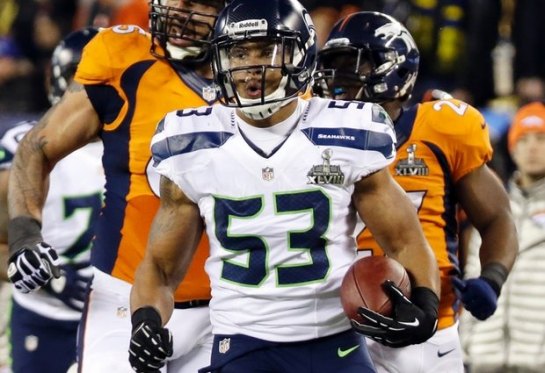
Smith's 69 yard interception in Super Bowl XLVIII ended the competitive phase of the game.

Smith’s 69 yard interception in Super Bowl XLVIII ended the competitive phase of the game and trumpeted the question: Where would you rank Seattle’s defense with  the all-time greats??

One of the criteria for greatest ever defenses you have to ask is: How dominant were they at their peak? They had to bring the lumber over an entire season. These defenses had to be stout with a performance that stands the test of time in remembrance. Without further adieu we have to get on with the Honorable Mention. Those right outside the top ten.

1977 Denver Broncos – The original Orange Crush defense that led the Broncos to Super Bowl XII and Denver’s first ever winning season. This was the first great full time 3-4 defense that yielded only 148 points (10.6 pts / game) and just 18 touchdowns for the season. Holding 7 of their opponents to 10 points or less.
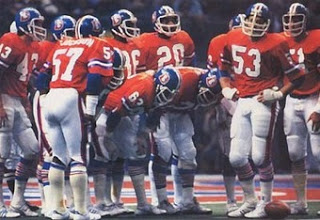
Even with an offense that turned it over 8 times, the still held Dallas to 27 points in Super Bowl XII.

Even with an offense that turned it over 8 times, the still held Dallas to 27 points in Super Bowl XII.

Led by Randy Gradishar, ESPN’s Tom Jackson, and the late Lyle Alzado this defense had an unheard of 4 All Pros concentrated on this defense and 5 Pro Bowlers. This not ready for primetime group came out of nowhere and swallowed the Steelers and Raiders in the playoffs before falling to Dallas in New Orleans in Super Bowl XII. This group swarmed like bees and ushered in the era where 3-4 defenses took over the NFL.

1978 Pittsburgh Steelers – In the first year in which the NFL moved to a 16 game schedule, this group set the new record with fewest points allowed in a season with 195. Powered by the Steel Curtain, they held 8 of 16 opponents to 10 or fewer points. This group did more blitzing than in years past to get to the quarterback. They did have 5 Pro Bowl defenders and 1 All Pro in Jack Ham, but there were stronger incarnations of the Steeler defense.

A fact that gets lost is going into Super Bowl XIII, the consensus was Pittsburgh force vs the finesse Cowboys. Yet it was Dallas whose defense was ranked #2 and Pittsburgh’s #3, For the season they yielded 260.5 yards per game, unofficially had 52 sacks and 27 interceptions which ranked 7th. They peaked in the playoffs holding both Denver and Houston to 10 points and 5 points respectively. Yet gave up some serious candy to the Dallas offense (320 yards & 31 points)

1968 Baltimore Colts – The team that is best known for coming up short in Super Bowl III against the AFL’s New York Jets. In The Chancellor of Football’s estimation, this was the best team that Don Shula ever coached and one of his defensive assistants was the late Chuck Noll. This defense held 10 of 14 regular season opponents to 10 or fewer points. At one point late in the season, they gave up 1 touchdown over 25 quarters including a string of 16 straight quarters w/out a touchdown allowed.
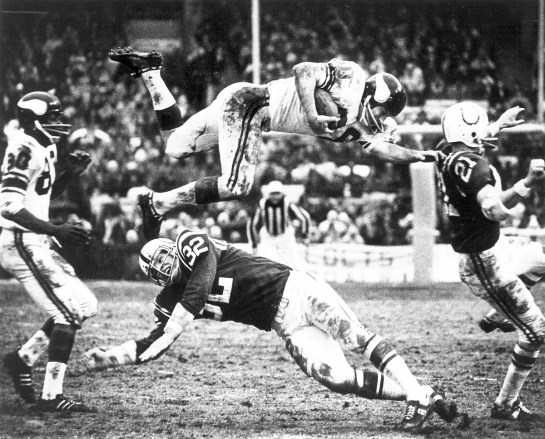
md-darkroom-hutchins-curtisThe Colts of ’68 shut out 3 regular season opponents and the fourth was against the Browns who gave the 13-1 team their only loss. That drubbing was avenged 34-0 in the NFL Championship Game. They even set the record with only 144 points allowed. Between 1967 & 1968 their record was 24-2-2. If only this team had won on January 12th 1969…..but….

2000 Tennessee Titans – Lost in the delirium over the great 2000 Ravens defense, is the fact they finished #2 to the Titans that year in rankings. Jeff Fisher’s bunch only allowed 238.9 yards per game and held 6 opponents to 10 points or less over the campaign.

Second year DE Jevon Kearse led the team with 11.5 sacks and 4 forced fumbles. Samri Rolle had 7 interceptions he returned for 140 yards and a touchdown. SS Blaine Bishop had 84 tackles to go with 2.5 sacks but 0 interceptions. All three were Pro Bowlers but only Samari was an All Pro Player. One issue is they didn’t force enough turnovers (29) and they finished just +1 in turnover ratio. These are poor marks considering they only saw 1 Pro Bowl quarterback the entire season. Yet they were #1 against the pass (151 yds /gm) and #3 against the run (86 yds /gm).

1987 San Francisco 49ers – One of the last teams to finish with the NFL’s #1 offense and defense happened with this group in 1987. They were gaining momentum allowing only 1 touchdown in the final 16 quarters of the season and none in the final 12 as the playoffs beckoned. They held 5 opponents to 10 or fewer points including two shutouts in their final three games. One of which was a 41-0 hammering of the NFC Central Champion Chicago Bears on Monday Night Football. 

Led by All Pro and Pro Bowler Ronnie Lott (5 ints) this group was #1 against the pass (165 yds /gm) while only yielding 273 yards for the game. What makes this more remarkable are 3 games were played with replacement players due to the strike. Had the season been 16 games instead of 15 and no strike, these numbers could have been even better. They were also #5 against the run (107.4 yds / gm) thanks to All Pro and Pro Bowl Nose Tackle Michael Carter.
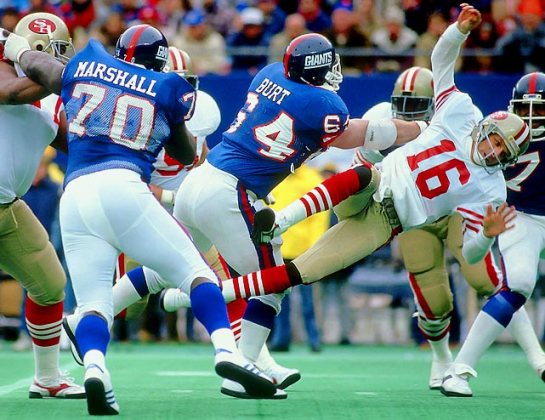
Jim Burt knocking Joe Montana out with a concussion in their 49-3 rout in the '86 playoffs.

Jim Burt knocking Joe Montana out with a concussion in their 49-3 rout in the ’86 playoffs.

1986 New York Giants – A romanticized defense that knocked 5 quarterbacks out on their way to the Super Bowl XXI championship. Yet they were #2 in 1986 and allowed 39 more yards per game than the #1 Chicago Bears with 297.3 yards per game. Second biggest discrepancy between #1 and #2 since 1970.

Led by League MVP and Defensive Player of the Year Lawrence Taylor’s 20 sacks, New York held 5 teams to 10 points or fewer during the regular season. They held their 2 NFC playoff opponents to 3 & 0 points respectively. There were 4 Pro Bowl defenders on this defense in LB Harry Carson, NT Jim Burt, DE Leonard Marshall, and the aforementioned LT.

2008 Pittsburgh Steelers – Close but no cigar. This team finished with the #1 ranking allowing just 237.2 yards per game. They held 8 opponents to 10 or fewer points yet gave up 223 for the season. One mark against them is they only faced 2 Pro Bowl QBs and lost both games. Losing 24-20 to Peyton’s Colts and 21-14 against Eli’s Giants. This was also the year they beat the Patriots 33-10 with Matt Cassel at QB not an injured Tom Brady. Big difference. This group had 51 sacks but only 20 interceptions. The last time we saw them, Kurt Warner passed for 377 yards, 2nd highest in Super Bowl history, and needed Big Ben to bail them out with a game winning pass with :32 left.

This group did have NFL Defensive Player of the Year James Harrison and Pro Bowl SS Troy Palamalu who would win the award 2 years later. Harrison had 16 sacks with 7 forced fumbles. James Farrior (122 tackles) was the 3rd and final Pro Bowler on a talented roster which included LaMarr Woodley (11 sacks).  They were a world champion but this group didn’t perform high enough against the best competition. The top ten is a Sugar Ray Leonard’s list, the honorable mention is where Thomas Hearns resides.
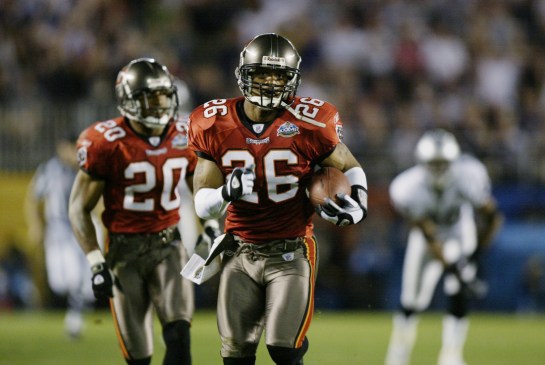
Dwight Smith capped off Super Bowl XXXVII with 2 defensive touchdowns. Should have been the MVP.

Dwight Smith capped off Super Bowl XXXVII with 2 defensive touchdowns. Should have been the MVP.

2002 Tampa Bay Buccaneers – The final team to miss the call to the top ten was the 2002 Buccaneers. The undisputed #1 defense that year. However playing in the new NFC South they feasted on patsies. On 3 occasions they took on top 10 offenses and they lost two of those games to Philadelphia (10th) and Pittsburgh (5th).

This team yielded 252.8 yards per game had 43 sacks and 31 interceptions which ranked 6th and 1st respectively. This team only gave up 196 points while holding 9 regular season opponents to 10 or fewer points. However a closer look reveals they came against offenses ranked 26th, 18th, 14th, 23rd, 31st, 31st, 12th, 14th, and 29th. Chris Redman (who??) quarterbacked the Ravens who was the first in this group. While NFL journeyman Jim Miller led the Bears in the last game.

This team fielded 5 Pro Bowl players in NFL Defensive Player of the Year Derrick Brooks, Shelton Quarles, Hall of Famer Warren Sapp, Simeon Rice (15.5 sacks), and S John Lynch. This group scored on defense. Brooks tied the NFL record with 4 defensive touchdowns and CB Dwight Smith set a Super Bowl record with 2 interception returns for touchdowns. Their numbers and performance should get them in until you look at the competition. Someone reading this is going to describe how they throttled the #1 Raider offense in the Super Bowl. Yet how much do you attribute to Monte Kiffin’s defense or Jon Gruden knowing the Raider offense and personnel??

Thanks for reading and now its time for the top 10.

The Immaculate Reception Encore: 1972 AFC Championship Game

The No Name Defense stopping Franco Harris in the '72 AFC Championship Game.

The No Name Defense stopping Franco Harris in the ’72 AFC Championship Game.

One of the unique themes in NFL history is whenever a team has a famous miracle playoff win, those teams rarely win the Super Bowl. Well even the NFL championship for that matter when you think back to Detroit’s 31-27 win over San Francisco in the 1957 playoffs. In that game the 49ers were up 24-7 in the 3rd quarter only to lose to a series of backups for the Lions. It was the only instance where a miracle playoff win would culminate with a league championship. Fast forward to The Immaculate Reception and the Pittsburgh Steelers in the 1972 playoffs.

After winning their first ever playoff game over the Oakland Raiders, most people forget they ran smack into the undefeated Miami Dolphins. As far as the AFC Championship Game, the Steelers were playing with house money. They were one game away from the Super Bowl and were able to host the championship game since it was rotated by division back then.

Pete Rozelle didn’t institute home field advantage until 1978. He did it as a means to reward not only the team with the best record. He wanted to insure teams would play all the way through their schedule and not take the final weeks off. Yet in ’72, the 14-0 Miami Dolphins traveled to the 11-3 steel city to take on Franco’s Italian Army for the right to go to Super Bowl VII.

It was the first of only three times Don Shula and Miami would meet Chuck Noll’s Steelers in the playoffs during their coaching careers. Noll had served on Shula’s staff in Baltimore and had ties dating back to the Cleveland Browns of the 1950’s where they were both players.

Ironically the case remains. Why is it when a team should be riding an emotional lift like a miracle finish in the playoffs, they don’t win it all?? It’s easy to say they let down but would it be more that they’re an incomplete team that gets exposed as competition gets better?? The ’72 Steelers (Immaculate Reception) the ’72 Cowboys (Roger’s 1st comeback) the ’75 Cowboys (Hail Mary) ’80 Cowboys (Duel In Dixie) ’86 Denver Broncos (The Drive) ’99 Tennessee Titans (Homerun Throwback) all fell short of winning it all….. The lone exception would be the 1981 San Francisco 49ers with The Catch. 

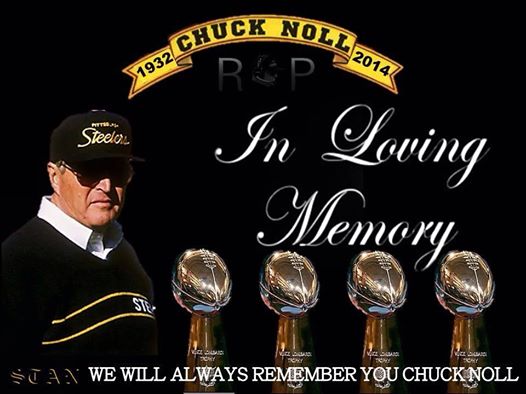
RIP Coach Noll

RIP Coach Noll

Chuck Noll would obviously make his mark, embarking on one of the greatest runs in history. Over the next 7 seasons, his team made the playoffs every year with their winning a Super Bowl in 4 of those seasons. We lost another legend with Noll’s passing Friday night. This article is dedicated to the Hall of Fame coach…

SUPER BOWL VII RUNNER UP 1972 WASHINGTON REDSKINS

“The Over the Hill Gang” reclamation project of the late George Allen, was built on the heels of the turnaround ushered by the late Vince Lombardi in 1969. The Redskins had been losers for nearly 20 years. Allen was named his successor after Lombardi’s death in June of 1970. He had a disdain for rookies and young players which drove Allen into bringing in old vets. Many of which he brought over from the LA Rams where he served as Head Coach in the mid to late 60s.

He brought in Billy Kilmer to be his quarterback and the subsequent QB battle between he and Sonny Jurgenson tore at the Redskins fan base yet they won in spite of all that. A defense with Jack Pardee and feisty cornerback Pat Fischer, who should be in the Hall of Fame, held most teams down with conservative mistake proof defense.

super-bowl-logo-1972Meanwhile a transplanted Baltimore Colt WR Roy Jefferson teamed with Hall of Fame wideout Charlie Taylor, and the late Jerry Smith to form a decent receiving combination.

However the engine that powered this team was RB Larry Brown, the first Redskin in history to rush for 1,000 yards and a man who ran so violently he burned out after a short career. Yet in 1972, he was one of the finest running backs in the NFL and if there was a yard to get he’d give his all to get it. He really reminded me of Walter Payton in that regard.

superbowlvii2After a hard fought win from the shutting down of RB John Brockington and the Green Bay Packers 16-3. This team gave the Redskin faithful one of the team’s landmark wins when they beat the defending champion Cowboys to win the NFC Championship 26-3.  Having outscored their NFC playoff opponents 42-6 this apparently was enough for the Redskins to be favored by 3 in Super Bowl VII over the undefeated Miami Dolphins.  Really??

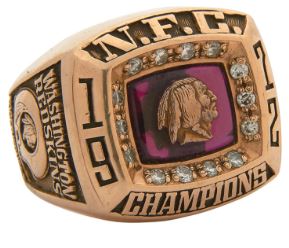
This was the ring for capturing the NFC Championship for 1972.