Lester Hayes Belongs In The Hall of Fame

As the NFL changed the rules in 1978 to liberate the passing game, many thought the big physical cornerback would give way to smaller quicker men. Those who could turn and run with receivers after the 5 yard “chuck” zone (The Mel Blount Rule) would be highly sought after. Yet one team held steadfast to the belief of not allowing that receiver a free ride off the line of scrimmage.

The Oakland Raiders who in 1977, just one year removed from winning Super Bowl XI, selected Lester Hayes out of Texas A&M. Where the league saw smaller cornerbacks at 175-180 lbs enter the league at that time. Hayes was a converted college safety who stood 6’0 and weighed 200 lbs.

Does he have on enough stickum??

His inclusion into the Raiders organization was at the right time as Hall of Fame cornerback Willie Brown retired and took over as secondary coach. Under his tutelage Hayes became a master of bump and run coverage and with his size, manhandled receivers at the line of scrimmage. Sure a receiver could run free after 5 yards but he had to get there first.

Another retiring Hall of Fame Raider was WR Fred Biletnikoff who went against Hayes in practice. Fred ran crisp routes and was a slower version of Steve Largent or a Charlie Joiner. Going up against he and Cliff Branch, who was the one of the league’s perennial deep threats, honed his skills to that of one of the greatest cornerbacks the game had ever seen. He also borrowed Biletnikoff’s use of stickum and took it to obscene levels. Take a look at the pic on the right if you think we’re joking.

Stickum talk aside, his true coming out party was the 1979 season where he led the team with 7 interceptions, returning 2 for touchdowns in the only losing season for the Raider organization during the 1970’s. John Madden had retired and Tom Flores had taken over as Head Coach and the Raiders were a team in transition.

Most teams make a transition in personnel with a defensive leader being a linebacker or a star defensive lineman being a marquee player yet here was a cornerback just starting to make a name for himself at the helm. However he couldn’t unseat Louis Wright of Denver, Mel Blount of Pittsburgh, or Mike Haynes of New England on the 1979 AFC Pro Bowl roster. Naturally you’ll conclude they had better seasons yet Blount and Haynes made it on reputation with only 3 interceptions each and Wright only had 2. A gross injustice just because Hayes team had slipped that year.

Enter the greatest single season for a cornerback in NFL history and the greatest coaching job in NFL history…the 1980 Oakland Raiders. In the second season for Tom Flores, the Raiders became the first team to win the Super Bowl from a wildcard position. The team had replaced nine defensive starters from a Super Bowl team just four years before.

Lester Hayes intimidating style at cornerback belied his agility to cover the fastest and best route runners in the NFL.For the season, he picked off 13 passes, just one short of the NFL record by “Night Train” Lane in 1951.  Not only was that the highest total in 29 years, no cornerback has come within 2 of that performance since then (Everson Walls in 1981). He returned those passes for 273 yards and one touchdown and went on to be the Associated Press NFL Defensive Player of the Year.

He was the first player to receive the award while playing for a team that didn’t finish as a top 10 defense with the Raiders finishing 11th. He did this while facing Hall of Fame WRs Steve Largent in Seattle, Charlie Joiner and Kellen Winslow in San Diego, and the electrifying John Jefferson also of the Chargers with whom he had epic battles with.

During the 1980 season teams kept testing him and coming up snake eyes. If you added his 4 interceptions during the playoffs he finished with 17 interceptions in one season. If you look at that against the year Hall of Famer Deion Sanders won his NFL MVP (1994 with San Francisco) from the same position, 6 interceptions for 303 yards and 3 TDs with 2 more ints. in the postseason, it dwarfs it tremendously. Sanders needed another NINE interceptions just to tie him!!!  You would have to add Deion’s next FOUR seasons with Dallas just to tie him with 17!! Tremendous

Oakland went on to win Super Bowl XV and the 80 playoffs began with a wildcard battle against Houston and former quarterback Ken Stabler. The Raiders prevailed 27-7 with the final points scored on Hayes intercepting Stabler and returning it 20 yards hand held high to send the Raiders to Cleveland and the divisional round.

He intercepted Stabler twice then intercepted 1980 NFL MVP Brian Sipe twice in the 14-12 upset of the Browns. In the AFC Championship against the Chargers and the Super Bowl with the Eagles, Dan Fouts and Ron Jaworski just didn’t throw into his area. How do we know this?? In Super Bowl XV Hayes was the left cornerback. Jaworski threw exclusively to his left and Right OLB Rod Martin picked off a Super Bowl record 3 interceptions in a 27-10 win.

The NFL outlawed stickum after that 1980 season in anther decision that Raider loyalist felt was the offspring from the court battle between Raiders’ owner Al Davis and commissioner Pete Rozelle. Some thought that Hayes inability to use stickum had a lot to do with his interception total dropping, when in fact quarterbacks just flat didn’t throw into his area. He never intercepted more than 3 passes in a season from that point forward.
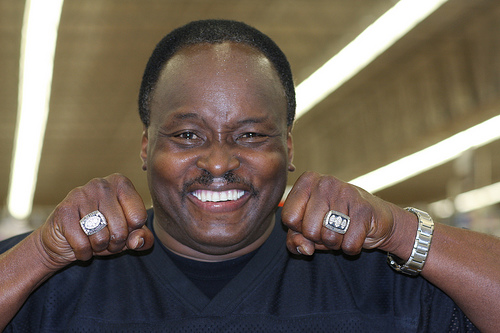
Lester Hayes showing off both rings from Super Bowl XV and XVIII

After being overshadowed by Mike Haynes for that 1979 Pro Bowl slot, he was joined by his former counterpart in 1983 to form one of the greatest CB tandem in NFL history. In that year the Washington Redskins became the highest scoring team in NFL history scoring 541 points on their way to Super Bowl XVIII. Washington’s quarterback Joe Theismann was the NFL’s MVP and the Redskins were being hailed as the greatest team in NFL history…yet they had to defend their title against Los Angeles.

The Raiders started their charge in the 83 playoffs with a 37-10 devastation of the Pittsburgh Steelers which ironically began with Hayes getting the team started with an 18 yard TD interception return. After a 30-14 win against the Seahawks in the AFC Championship experts had the Redskins winning a high scoring game.

What took place in Super Bowl XVIII was a dismantling of epic proportions. Charlie Brown, who had caught 78 for 1,225 and 8 TDs during the regular season, was smothered along with Art Monk and held to a combined 4 receptions by Hayes and Haynes. The coverage was so superb the Raiders blitzed their linebackers and recorded 6 sacks as Joe Theismann had his worst game of the year. His stat-line?? Theismann was held to 16 of 35 for 243 yards and 2 ints. Only one pass was completed in Lester Hayes area the entire day. He won his second championship ring as the Raiders won in dominating fashion 38-9.

Hayes at this point was the best cornerback in all of football. He played in 5 straight Pro Bowls from 1980-1984 and was the player most future NFL’ers modeled their game after. Most notably Hanford Dixon of the Cleveland Browns. Everything from the three foot long towel hanging from his waist to his aggressive play against a receiver at the line. Dixon and Frank Minnifield are the tandem that Lester Hayes and Mike Haynes are most often compared to. As a combo… Dixon and Minnifield were the best tandem in NFL history. Yet the man who coined the Brown’s “Dawg Defense”, was a 3 time Pro Bowler who modeled himself to be like Lester, what would you call Hayes?? In The Chancellor’s book, he’s a Hall of Famer.

Please lend your thoughts as well by writing in to the Pro Football Hall of Fame to the address below. Please be respectful and positively lend your voice:

Please write & nominate #37 Lester Hayes
Send letters to:
Pro Football Hall of Fame
Attention Senior Selection Committee
2121 George Halas Dr NW, Canton, 
OH 44708

For induction into the Pro Football Hall of Fame, I present to you Lester Hayes

lester

The Soul of The Game: Ronnie Lott

Hall of Famer Ronnie Lott

One of the greatest defensive backs in NFL history was Ronnie Lott. He carried on the type of physical play that made Jack Tatum feared by receivers in the 1970’s. Lott was drafted out of USC in 1981 by the San Francisco 49ers as a safety, yet had to play out of position as a cornerback his first 5 seasons. He supported the run as fiercely as the pass and made plenty of hits on receivers crossing into his zone. His highlight package contained here have more bone jarring collisions once he was moved back to safety starting in 1986.

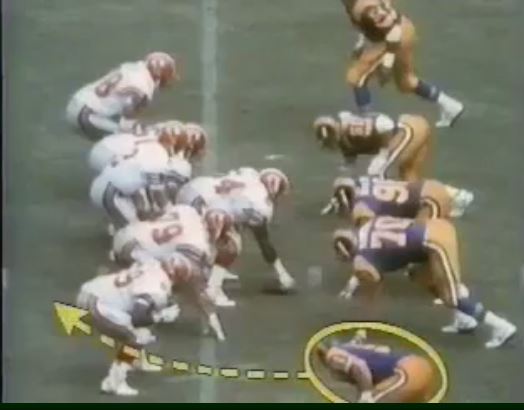
A notable point to make about Lott’s aggressive play was how clean it was. You’ll see him close on a receiver and always hit him with a shoulder or forearm and never lead with his helmet. Furthermore he didn’t hit receivers in the head either. As the modern NFL is changing the rules to protect defenseless receivers, Ronnie’s play shows that you can hit these players without it being a cheap shot.  There were several times when he came out on the short end of the stick. I can remember once in 1982 when he was knocked cold by powerful Atlanta Falcon RB William Andrews, as he was by the Vikings RB Alan Rice #36 shown here) in the ’87 playoffs.

It’s the will to stick their nose in and take on all comers that make great hitters immortal.

Epilogue: Walking through my favorite part of Newport Beach after my wife and I were just married and going over to Catalina I walked passed this on the way to breakfast.

Ronnie Lott was a collision waiting to happen. Thanks for all the great memories!

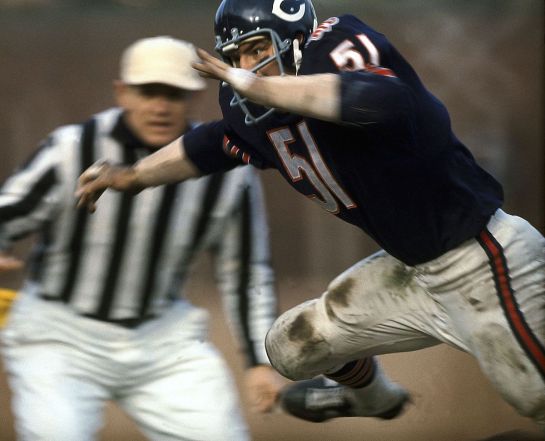
The Soul of the Game: Dick Butkus

When it comes to the soul of the game, we’re talking about hitters, those that epitomized the toughness when you think of NFL football. Without question one of the first, if not the first person who comes to mind is Dick Butkus.Butkus2

If only Jim Brown had played a few more years. What would the highlights of their collisions look like?? Yikes!! At 6’3 245 lbs, Butkus was the size of most offensive linemen in the 1960s and he used that mass to crush ball carriers. If you love the hitting element of football, you have to love the way he played.

One element of how fiercely he competed had to come from playing on such bad teams. During his 9 year career the Chicago Bears were bottom feeders in the NFL. In 1969 the Bears went 1-13 on a team with he and Gale Sayers who are both Hall of Famers. How bad was the rest of that team? He channeled that rage and frustration and took it out on his opponents. He was to the NFL’s first 50 years what Ray Lewis has been to the last 50 years: The best and hardest hitting linebacker of his era

Once we move into the future and the way football is played now we have to look at the next 50 years. Ray Lewis defined the 50 after Butkus and Hall of Famer Brian Urlacher was the next in Chicago Bears lineage that suited up after 2000. Great player but didnt engender the menace a visceral hitter like Butkus did. The two vids we just watched and you cringed at the hitting of an era gone by.

Butkus Dick Butkus was a legendary “Soul of The Game” performer.
Thanks for reading and share the article.

Fritz Shurmur’s Eagle Defense: The Birthplace of the Zone Blitz

The NFL has had several geniuses when it comes to coaches. Yet when it comes to coordinators many have not received their due nor have any made the Pro Football Hall of Fame based on their contributions.

One coach that did receive Hall of Fame consideration was Dick LeBeau (enshrined in 2011 as a player), who as a long time defensive coordinator has been credited (with Dom Capers) for creating the zone blitz in the modern NFL. Yes Pittsburgh became Blitzburgh but the true zone blitz, as a scheme, came from the mind of Fritz Shurmur. Another assistant deserving enshrinement in Canton.
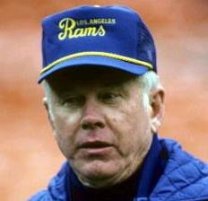
In 1989, Shurmur was the defensive coordinator of the Los Angeles Rams. When the team suffered multiple injuries along the front line, yet had all their linebackers healthy, necessity became the mother of invention. His team employed a 3-4 defense that featured Kevin Greene, who had back to back 16.5 sacks in 1988 and 1989 (thanks Kevin), coming off the corner. Yet going into the wildcard matchup as an underdog, Shurmur decided  to go with emphasizing his linebackers over his linemen and came up with a 2 down lineman 5 linebacker set up to confuse Randall Cunningham.

You have to understand that this was Randall Cunningham at the height of his career, in fact the next year 1990 he was labeled “The NFL’s Ultimate Weapon by Spports Illustrated. However in 1989 he was on his way to stardom when he electrified a national audience on a Monday night by shaking off a hit by New York Giant Carl Banks, and throwing a touchdown to TE Jimmie Giles. He was a threat to run for 100 yards in any game. He was John Elway 2.0 and the league was having serious problems in defending against such an athletic talent at QB.

In 1989 he led the Eagles in rushing with 621 yards while throwing for 3,400 yards 23 TDs and only 16 interceptions. The Eagles had won 5 of their final 6 games in 1989 and wanted to make amends in the playoffs for their 1988 playoff Fog Bowl loss in Chicago. Although they lost a toe to toe battle with the defending champion San Francisco 49ers in the regular season, the Eagles believed they could play with anyone and wanted a rematch with Joe Montana and company. But first they had to get through a wild card battle with the Los Angeles Rams, whom they taunted in the papers heading into the game. How would Shurmur defend Randall??

Shurmur opted for speed and confusion. One of the first items for a quarterback to determine is who the Mike (Middle) linebacker is. This is to set not only the blocking schemes but where the focal point to how the offense could attack the defense. Well the Rams shifted into their “Eagle” defense where OLBs Kevin Greene #91, Mel Owens #58, and Mike Wilcher #54 manned the outside with ILBs Larry Kelm #52, and Fred Strickland #53 were supplemented by either Brett Faryniarz #51 or George Bethune #57.

You have to understand the Rams weren’t doing this as a nickel defense, they were doing this on first and second downs also. Strickland would take the role of ‘nose-backer’ sometimes lining up as a nose tackle 1 yard off the ball. Or he would stand up to join the other four linebackers in a stand up position. Strickland wouldn’t give away if he was blitzing or dropping based upon where he would line up as you’ll see in the vids coming up. They played a cat and mouse game as to who was the Mike on most plays.

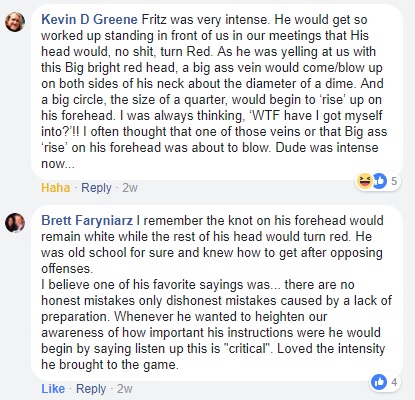
Along with the outside linebackers taking a page out of Buddy Ryan’s 46 defense and stacking two OLBs over the tight end.  The Rams jumped on the Eagles  14-0 in the first quarter forcing Philadelphia to pass. There were plays where Los Angeles would have as many as 4 linebackers lined up on one side of the formation yet only rushed  one with a blitzing DB.  Along with confusing Cunningham from an alignment standpoint, Shurmur drew up defenses that had DE Mike Piel #95 either dropping or spying.

With an array of blitzes off the corner and so much speed on the field  to chase Cunningham once he scrambled, had one of his worse days. The Eagles had little continuity and one of the reason the offense couldn’t adjust was the untimely death of Eagle quarterback coach Doug Scovil just a couple weeks prior to the game. Without his working confidante, Randall and Buddy Ryan’s offense couldn’t adjust as Kevin Greene recorded 2 sacks and hurried him into a 24 of 40 for 238 yards, 1 interception performance and no splash plays whatsoever.

Once the game was over and the Rams danced out of Philadelphia’s Veteran’s Stadium 21-7 winners, the league took notice of Shurmur’s masterpiece. Every other coordinator running a 3-4 during that time employed some of the same tactics Fritz pioneered. At the time it was thought by pundits that they couldn’t employ that gimmicky type of defense against a down hill running team.

In fact their next opponents would be exactly that style of offense and many waited for the Rams to sign a DL during the week, and when they didn’t, knew they’d see the defense again. An underdog for a second consecutive playoff game they traveled to the Meadowlands where Ottis “OJ” Anderson and the New York Giants would run into the belly of the Rams “Eagle” defense. No way could they win a second cold weather road game…right??

In this first vignette, you see the Eagle defense against the Giants on a sweep play. Notice how Shurmur has “nose backer” Strickland #53 off the ball? A concept borrowed from Tom Landry’s defensive tackle position in his Flex Defense, allowing Strickland to use his speed and agility against New York center Bart Oates. Notice Strickland’s heft allowed him to take Oates charge and agility beat him to the point of making the tackle on a play that gained a yard at most.

On this play you recognize the cat and mouse game Shurmur’s defense is playing with Phil Simms. Not only does ‘nose backer’ Fred Strickland #53 line up over center in a 3 point stance, he then stands up to give the Rams 4 standing linebackers from the center to the weak side of the formation. Who’s coming?? Who’s dropping?? Simms is so rattled at this point he overthrows Lionel Emanuel and the boo birds were out in the Meadowlands.

On this play you’ll notice that SS Michael Stewart is up on the line to the strong side yet Shurmur still employed twin outside linebackers to the top of the screen in Mel Owens #58 and Mike Wilcher #54.  With the two linebackers up near the line of scrimmage they have to be accounted for by the Giants front line. You’ll notice they engage the OL which kept them from sliding their blocking attention to Kevin Greene who runs over FB Maurice Carthon #44.

Since they were in a 2TE max protection, the only outlet for Simms to throw to as he scrambles to his left is Ottis Anderson #24, yet the aforementioned Owens (who backed off after engaging Giant T Jumbo Elliot) and ILB Larry Kelm were sitting right there. With nowhere to throw the ball, time was up and Greene was right there for the sack. You can clearly see the confusion in the Giants offense. Look at Zeke Mowatt #84 who completely does a 360 and didn’t help Carthon on Greene. Why?? SS Stewart was there to occupy him. Genius

The Rams had been losing 6-0 when the Giants, late in the second quarter, uncharacteristically threw into the teeth of the Eagle defense and an interception set the Rams up to take a 7-6 lead at the half. The biggest play in the game and the turning point that allowed the Rams to upset the Giants 19-13. On this final play DE Mike Piel #95 drops off in the weak flat along with LB Strickland, lined up in 3 point stance in front of Giants guard William Roberts, who also drops.

George Bethune #57, takes over as the ‘nose backer with Brett Faryniarz #51 rushing from the weak-side along with Greene #91 on the strong side. Since Strickland’s first step is forward, Roberts #66 has to honor his charge and not help out LT Jumbo Elliot.  He has no one to block!! Greene and Faryniarz’s rush is so strong Simms has to get rid of the ball and Jerry Gray, zoning away from RB Dave Meggett,  tips the pass that Michael Stewart intercepts. You also notice that Meggett’s “scat” route was to his right and away from the DE that dropped in the weak flat.  Shurmur fielded ONE DL and didn’t rush him!! In a nickel defense?? Think about that for a second…

This was a masterpiece performance by a true NFL genius in Fritz Shurmur. The ’89 Rams fell to the eventual Super Bowl champion San Francisco 49ers in the NFC Championship and this defense never got the attention the 46 defense, the Steel Curtain, or the Ravens defense did because they didn’t win it all. Had they beat the 49ers and then the Broncos to win Super Bowl XXIV, this defense would have gone down in history. Yet what is interesting is this defense had it’s prime note taker in Giant defensive coordinator and current Patriot coach Bill Belichick.

How do we know this??

He used the 2 man front 1 year later in Super Bowl XXV to stop the Buffalo Bills to win that trophy. Just last year he used the defense with 5 standing players to force NY Jet QB Mark Sanchez into several interceptions. He used it against Tim Tebow also in both the regular season win and again in the playoffs. What Shurmur started in the 1989 playoffs live on to this day in a few 3-4 defenses. One centerpiece to this defense was Kevin Greene who moved on to the Pittsburgh Steelers in 1993 to help form Blitzburgh.  Surely Greene took his playbook with him to Pittsburgh and may have shared some of these principles with Steeler coaches.


EPILOGUE: As for Shurmur, he moved on to become a champion defensive coordinator with the Green Bay Packers in Super Bowl XXXI with Mike Holmgren. You want to hear about the ties that bind?? From the late 80s into the early 90’s, Mike Holmgren was the offensive coordinator for the San Francisco 49ers while Fritz Shurmur was his nemesis counterpart within the division for the Rams. Trust us…going into that 1989 NFC Championship it wasn’t a forgone conclusion that the Niners would win.

In fact, in ’89 the Rams won game 2, 13-12 in Candlestick and even though the Rams lost the NFC Championship to SF, they did get a measure of revenge in 1990. In that game the ‘Niners were 10-0 and the Rams were 3-7 when the Rams hammered them 28-17 when the Niners were trying to 3peat. So when Holmgren took the head coaching job in Green Bay he took Fritz Shurmur with him. Shurmur also followed Holmgren to Seattle in 1999.

However he passed away before the season. Yet now as the Cleveland Browns GM, Holmgren hired current head coach Pat Shurmur, who is the nephew of Fritz.  Shurmur developed other defenses that we will give mention to in the near future yet this 1989 run with his “Eagle defense” was his masterpiece. Even though he went on to coach a 4-3 in Green Bay, his use and expertise to adapt to personnel turned his 3-4 into a juggernaut that nearly stole an NFL title.

NFL Guru: Defensive coordinator Fritz Shurmur

This article is dedicated to the memories of Leonard Frank “Fritz” Shurmur (July 15, 1932 – August 30, 1999) & Kevin Greene (July 31, 1962 – December 21, 2020)

A couple words on his future Hall of Fame protege’  in Shurmur’s “Eagle Defense”:

Thanks for reading and share the article. Coaches don’t forget to adapt to your personnel instead of forcing your plays down the throat of a group that may not be able to run it.

Having  some fun with Fritz’s former players and egging them on for a few stories…

kg.bf.fritzkg.fred.george.fritz

New York Giants Super Bowl XLVI Ring: A Design For All Seasons

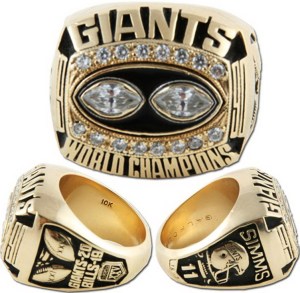
The exquisite ring designed for the New York Giant’s Super Bowl XLVI win over New England.

One of the greatest championship rings ever commissioned. When you look at the ring the first thing you look at are the sapphire stones that adorn the “World Championsip” moniker as though its’ the lighted ring around the new Meadowlands.  Yet it’s the old fashioned “NY” adorned in blue that really sets this ring off. Although the Giants have amassed 8 NFL titles, they have garnered 4 in the Super Bowl era. Hence the four Super Bowl trophies atop the design.

One of the more intriguing aspects of this ring is the fact that they used the block “GIANTS” logo from the previous era (1980’s-1999). This being put on the same side as the Super Bowl trophy and score, a 21-17 triumph over Bill Belichick, Tom Brady and the New England Patriots. In our CEO’s estimation, this is the best looking Super Bowl ring ever.

Eli Manning showing off his second earned Super Bowl ring.

An irony that can’t go dismissed is the fact that in a stadium that Peyton Manning’s success help construct, his little brother dispatched this generation’s greatest quarterback in Brady, for a second time in the Super Bowl in a 4 year period.

Now Eli Manning has brought another title to Gotham and is just now entering his prime. Think about that for a second. A fleet of receivers and with the rule changes favoring the passing game, he became the quarterback with the most passing yards in a single season to win a Super Bowl with 4,933.

In other words he and the Giants will be back for another one within 3 years. Mark it down in 3 inch bold letters… As for now congratulations to the New York Giants who will be receiving these rings at a gala ceremony sometime in June when they are all finished.

So as we did last year to commemorate the unveiling of the championship ring for the new year, but to offer those rings of  years gone by….

This is the ring for the 1956 New York Giants to commemorate the 1956 NFL Title Game. The Giants won 47-7  in the famous house that “Ruth built”, Yankee Stadium. The 50.000 plus braved the elements to watch Vince Lombardi’s offense put up 47 points and Tom Landry’s defense allowed only 1 touchdown.  The Giants appeared in 6 world championship games between 1956-1963 with the lone year they won in 1956.

The famous chant of “defense…defense” rose from the rafters of Yankee Stadium during this era as well as the original mastery of Tom Landry’s 4-3 defense bore fruit. It became the rage of the league and a staple of how modern NFL teams would platoon their 11 defenders. One note to offer is that the 4-3 as a defense gained it’s notoriety here although it’s original teachings came from head coach Joe Kuharick out of Philadelphia. Landry and New York got the credit because they won with it. Something to think about.

The Giants only won one championship during this era while dropping 2 titles in 1958 and 1959 to the Baltimore Colts. Then dropping two to Green Bay in 1961 and 1962…then a famous defensive struggle to the Chicago Bears in 1963. They were a juggernaut that dominated an era that ushered in pro football as the premier sport of America and fruit that sprang forth from this team were two of the greatest coaches in NFL history.

Tom Landry who went on to win 2 championships while piloting the Dallas Cowboys from 1960-1989. Then Vince Lombardi, the universally accepted greatest coach of all time, who was the winningest coach of the 1960’s with 5 title wins in a decade with the Green Bay Packers. He became the measure of all NFL coaches once his tenure was over and had the Giants not accepted racial and religious popular prejudice during that long forgotten time, could have had an Italian Catholic rule the football world the same year an Irish Catholic in John F Kennedy became President of the United States.

After a 30 year drought, the New York Giants became the world champion after bludgeoning the Denver Broncos 39-20 out in Pasadena for Super Bowl XXI. NFL MVP Lawrence Taylor and the Giants defense was in the  midst of allowing only 2 yards during the 3rd period. While consequently the Giants, led by Super Bowl XXI MVP Phil Simms, was in the midst of scoring 17 unanswered points to pull ahead 26-10. Erasing a 10-9 halftime lead that the Broncos had everything go right for them yet were undone after a brilliant goal line stand.

Once that stand had taken place and the Broncos Rich Karlis missed two chip shot field goals, the Broncos fate was sealed as the Giants roared back. Bill Parcells had restored the dignity of a once proud franchise with this win and an up and coming Bill Belichick was the architect of this swarming 3-4 defense.

In the NFC playoff games that preceded Super Bowl XXI, the Giants had bested the San Francisco 49ers (team of the 1980s) by a score of 49-3 and the Washington Redskins in the NFC Championship 17-0. The win over the Niners was one of the most lopsided in modern NFL history and was one where the Giants defense knocked Joe Montana from the game. Many speculated that this would be the end for Montana’s playing career. He did come back yet thoughts of this game lingered whenever the Giants played the 49ers for the rest of the decade.

The NFC championship represented the third straight year the game ended in a shutout. It also marked the 2nd time in 3 years that the loser of the NFC Championship would go on to win the Super Bowl the following year. So 1986 was the Giant’s year….Super Bowl MVP Phil Simms, NFL MVP Lawrence Taylor. and 1,516 yard rusher and 21TDs from RB Joe Morris powered this championship. Bill Parcells became a household name as coach and a little known defensive co-ordinator in Bill Belichick started receiving recognition.

Coming on the heels of that ’86 champion some 4 years later was a monumental champion that somehow seems forgotten about in remembrance. The 1990 unit that won it all in Super Bowl XXV was the first team ever to average less than a turnover a game (13 in 16 games) and had to overcome the two time defending champion San Francisco 49ers 15-13  in the NFC Championship just to make it to the big dance.

Once there they had to best the greatest AFC team in a decade to win it all. So powerful was that 1990 Buffalo Bills squad that they had won the AFC Championship 51-3 while forcing the Raiders to just 3 turnovers. They were that much better than their AFC counterpart on that day. Yet the Giants roped them into a defensive slugfest while employing just two defensive linemen and funneling the Bills potent receivers into the middle of a defense that had linebackers waiting for them.

Although Phil Simms sat on the sideline, the ’90 Giants became the second team to win it all with a quarterback who began the season as second string. Jeff Hostetler ironically repaced the incumbent Simms during a week 13 game against the Buffalo Bills where Phil was lost for the season with a foot injury. He added a scrambling element that supplemented the power running game of Ottis OJ Anderson (the [[_]]) to keep defenses guessing and furthermore blitzing. This was the missing ingredient to a rather pedestrian offense that gave the Giants an edge once the post season came around. Teams already had to account for the dangerous Dave Meggett, and now were totally afraid to blitz the conservative Giants QB for fear of what could now be gained with his scrambling ability.

Not only was this the last championship won by Bill Parcells, Lawrence Taylor, Bill Belichick and George Young. The Giants won with a young WR coach in Tom Coughlin who had a protege in WR Mark Ingram, who’s son would go on to win the Heisman Trophy in 2009. The Giants also featured DE Leonard Marshall, who should be in the Pro Football Hall of Fame. Marshall is the only Giant to record sacks in both Super Bowl XXI and XXV triumphs along with new ILB starter Thomas “Pepper” Johnson who would go on to the New England Patriots with Romeo Crennel and go on to win 3 Super Bowls as a member of that staff under Bill Belichick.

Speaking of Bill Belichick, after a failed stint in Cleveland he resurfaced with the New England Patriots to start the 2000 season.  He along with the aforementioned former Giants went on to create a dynasty 2 decades later in New England. Their crowning jewel was to become the first 19-0 NFL champion ever.

After winning 3 Super Bowls in 4 years, it seemed the Patritots had run their course as the NFL’s vanguard. With some slight retooling, they acquired WR Randy Moss and WR Wes Welker and went on to become the winningest team in NFL history at 16-0 and became it’s highest scoring ever with 589 points during the 2007 NFL season. To become the greatest ever all they had to do was win Super Bowl XLII. Easy money…right?? After all they beat the Giants in the final week 38-35.

Well after Randy Moss scored to make it 17-14, the Patriots had finally overcome the New York pass rush, which had hounded Brady all night long. Eli Manning started his ascent to greatness with several plays in the final drive. He did have a little bit of luck though… Asante Samuel had the win sealed for the Patriots….but he dropped the interception.

Never give your enemy a second chance.

With that came one of the most famous plays in Super Bowl history. Eli broke free from two Patriots who had their hands on him… he broke free to scramble right and heaved a prayer of a pass that David Tyree caught using the top of his helmet. Once that happened the will of the Patriots totally broke as Eli and the Giants marched into history with a monumental upset. So resigned to their fate where the Patriots they left CB Ellis Hobbs (5″10) alone on Plaxico Burress (6’5) and blitzed while Eli feathered a pass into the left flank of the endzone. Michael Strahan finished his distinguished career as a Super Bowl champion. Champagne popped for Head Coach Tom Coughlin, Eli Manning, Michael Strahan, the New York Giants…AND the ’72 Dolphins!! Perfect!!

Now the Giants proved it was no fluke beating the Patriots again and had this latest crown jewel to add to their collection. Enjoy it for one more year and the Giants aren’t finished yet either. They will be back for their 5th Super Bowl win within the next few years…quite possibly when their Meadowlands hosts the first outdoor cold weather Super Bowl. Stay tuned… Eli is a silent killer.

Thanks for reading and share the article…

Requiem of An Upset – The Sequel: Judas Falls as AFL Gains Complete Vindication

Have you ever started a project only to have one of your partners try to sabotage it from within?? If you ever got back at that party wouldn’t you want it to be one where it came back and haunted at the most inopportune time??


Well sit down have we got a story for you. During the 1960’s, the NFL and AFL were rival leagues with the AFL’s having originated on the heels of the famous 1958 NFL Championship Game. Principles moved quickly to form a new football league that would rival the 40 year old NFL and had a new style of play that was scoffed at by the sporting press. The AFL fought for over half a decade for respect.


After an aggressive bidding war for players brought the rival leagues to the table to talk merger, a byproduct would be a championship game between the two leagues. The Super Bowl beginning in 1966. Sports writers of the time and most pundits thought the play in the NFL was superior to their younger counterpart. Although the AFL fought for respectability for the first 6 years, their Kansas City Chiefs were handled by the Green Bay Packers 35-10 in the inaugural game, and Oakland Raiders 33-14 in the second edition. Surely talk of a merger was still there but loyalists to both leagues were still at ends until the New York Jets defeated the Baltimore Colts in Super Bowl III.

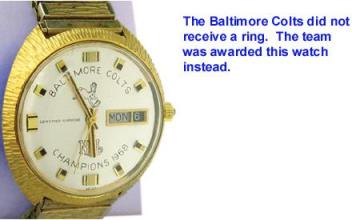
After losing Super Bowl III, the Baltimore Colts were the only team of the 92 who have participated in the Super Bowl, NOT to be issued a ring for doing so.

The shock and awe was so great that the sporing press scrambled to give the Jets credit for a David vs. Goliath type  upset victory. Yet beneath the surface, the establishment raged at the thought of the AFL being on a par with the NFL. Think not??  To the left of this paragraph lies the remnant of that embarrassment. To not commission a championship ring along with the fallout from Baltimore Colt brass losing Don Shula, and swapping franchise’s with Robert Irsay (Rams) a few years later was tantamount to the size of the loss. This is the sequel to our original Requiem of An Upset.

So seismic was the loss that commissioner Pete Rozelle decided to come up with a new round of playoffs called the wild card round. This would allow the team with the 2 best records who didn’t win their division to enter the championship race with the 2 division winners. Many believed that it was a move to keep a tremendous underdog like the Jets from making it to the Super Bowl. Another slap at the AFL if you will… Given the new landscape the Kansas City Chiefs and the Houston Oilers lined up to take on the AFL East Champion New York Jets and West Champion Oakland Raiders.

Enter the Kansas City Chiefs of Hank Stram and Lamar Hunt. It was Hunt who was the founder of the AFL and began with his team in Dallas and not Kansas City. As we entered 1969, the tenth AFL season, it was fitting that his team would have the last shot to win the overall championship in the last game ever for the AFL. They were the winningest team in league history and had played in championships in 1962 and the first Super Bowl in 1966.

On-board they had players who had spent their entire careers with them like FS Johnny Robinson and DE Jerry Mays (both should be in the Hall of Fame). Yet they finished the season with a loss in the finale to the Oakland Raiders. Couple that with the fact the 1968 season ended with a humiliating 41-6 loss to those same Raiders, confidence wasn’t that high outside Kansas City. The underdog  Chiefs upset the New York Jets 13-6 to make it to the AFL Championship Game. There they bested the Raiders in Oakland 17-7 to make it to New Orleans and Super Bowl IV.

sbiv2Their opponent would be Judas, otherwise known as the Minnesota Vikings. What are we talking about?? It has to do with the origin of the American Football League and told in our championship ring series for the ’69 Chiefs.
So January 11th, 1970 was the last game ever for the AFL. Starting with the 1970 regular season, the NFL would have an all inclusive regular season combining both leagues.  How did that game appear on television?? Here is the game in it’s entirety

SUPER BOWL IV: FIRST HALF

part 1(00h41m22s-01h22m44s)

SUPER BOWL IV: SECOND HALF

EPILOGUE: So there you have it. The AFL ended the 1960’s on a par with the NFL, not only on the field but in Super Bowl competition with a 2-2 record. The regular season of 1970 had the AFL’s 10 teams joined by the Cleveland Browns, Baltimore Colts, and Pittsburgh Steelers in the newly formed American Football Conference. League play between the 26 team NFL began in 1970 yet the Super Bowl stayed an American staple as a championship game born from two rivaling leagues. Yet so many ironies  can be pointed out within these stories.

One irony is the AFL’s founder, Lamar Hunt and the Chiefs were able to get revenge on the Minnesota Vikings ownership group that tried to sink the new league. Ironically it came in the last ever game but it came. Another irony is the fact that New Orleans was the site for Super Bowl IV and was where the 1964 AFL All Star Game was to have been played.  New Orleans, at the time had wanted an AFL team and bid to host this game to showcase the city as a sports town. After multiple incidents of discrimination against many of it’s African American players, the AFL All Stars called for a boycott of the game being in New Orleans.

All this took place during the week prior to the game. The AFL All Star Game was subsequently moved to Houston’s Jeppeson Stadium honoring the stance of the player’s right to be treated with respect. There was a backlash toward those players later recounted by Abner Haynes in NFL Films’ Black Star Rising (circa 1995), then Ernie Ladd & Earl Faison for HBO’s History of the AFL: Rebels With A Cause (circa 1995) by the AFL, but that is another story for another time.

One final irony was that in the end, where a city’s populace had discriminated against African American players in 1964, in 1969 we saw the Kansas City Chiefs become the first team to win the World Championship with African Americans comprising more than half of their starters. It was a powerful notion along with the 1968 Olympics that many of America’s athletes were black. Up until that point amongst those that played pro football, there was a quota system in place over in the NFL. “That players had to be stars just to play.” as recounted by Jim Marshall in Black Star Rising.

chancellor.e.thomas.w.lanier

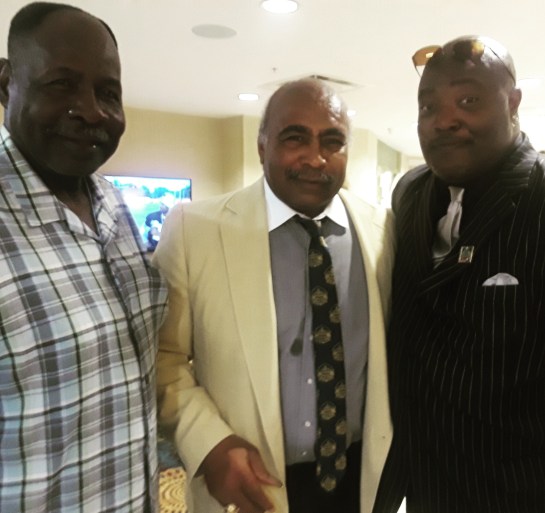
Hall of Fame CB Emmitt Thomas and MLB Willie Lanier of the 69 AFL Champion Chiefs.

They weren’t taxi squad (special teams) or even second string players on NFL rosters. The Chiefs also were the first to win with an African American Middle Linebacker in Hall of Famer Willie Lanier, and had the first Hispanic quarterback to win a Super Bowl with Tom Flores. Flores would go on to glory later as an NFL head coach, yet it was ironic that his team beat the Vikings who were the first to have a Hispanic (Mexican American) to lead his team to the Super Bowl in Joe Kapp. The MVP was Chief QB Len Dawson who would go on to know a generation of NFL fans as half of the duo of Inside the NFL for nearly 30 years.

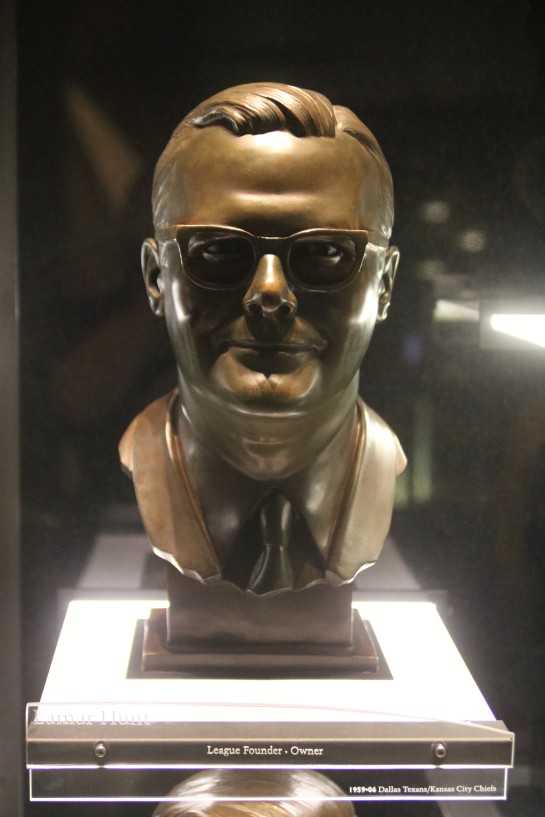
hof-lamar-huntThe AFL came to a close in the bowels of New Orleans’ Tulane Stadium, with Lamar Hunt and Hank Stram, receiving the Vince Lombardi Trophy from Commissioner Pete Rozelle. There is no way that at that moment, Hunt had more than a feeling of irony that he was thwarted in an attempt to gain an NFL franchise in 1959. Now here he was being granted the ultimate prize with a rival league and could claim victory against the NFL. Not just for Super Bowl IV, but for the last 10 years.
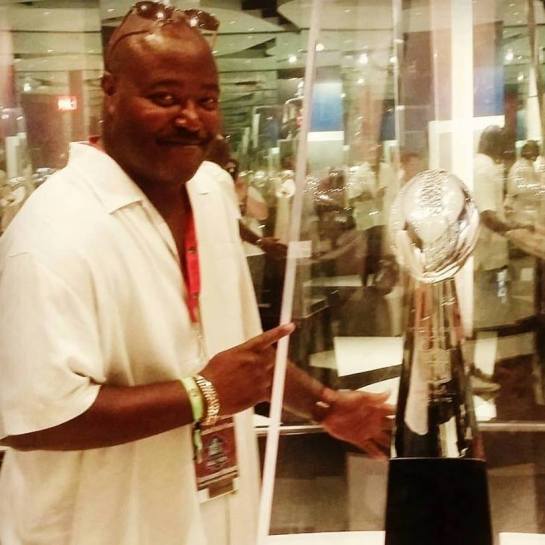
The Chancellor & The Super Bowl LI Trophy

The Chancellor & Super Bowl LI Trophy at the Hall of Fame.

Thanks for reading and please share the article.