Top Ten Single Season Defenses in NFL History : #6 1971 Baltimore Colts

Article Reissue: 29, June 2014

“In this study every season’s #1 defense, record setting defenses, trend setting defenses, and every Super Bowl & NFL championship defenses dating back to 1960. The nod would lend to those post the AFL/NFL merger of 1970. That wasn’t enough as now lets take each defense and cover what they did vs Pro Bowl QBs that season, 1,000 yard rushers, and playoff teams and talk about their effectiveness along with their statistics. Here turnovers forced is a big marker. Nothing watered down so a favorite team can’t be given favor. So The Chancellor of Football took over 200 defenses and boiled it down to this 11 article series and this team was a surprising 6th…”

One of the greatest defensive performances in NFL history happened in 1971. The defending Super Bowl champion Colts had the #1 defense and drug a struggling offense to the AFC Championship Game. They allowed the 2nd fewest yards per game mark in the NFL since 1970 with 203.7 yards. With only 140 points allowed, it would have been an NFL record had the ’69 Vikings not broken the ’68 Colts old scoring record of 144 with 133.

Another interesting aspect of the ’71 Colts was how anemic their once great passing offense had become.  The 38 year old Unitas completed just 52.3% of his passes for 3 TDs and 9 interceptions. Earl Morrall, who was 37, fared no better with an even lower 50.3% with 7 TDs to 12 ints. They were 21st in passing offense and 12th overall making the defense work harder.
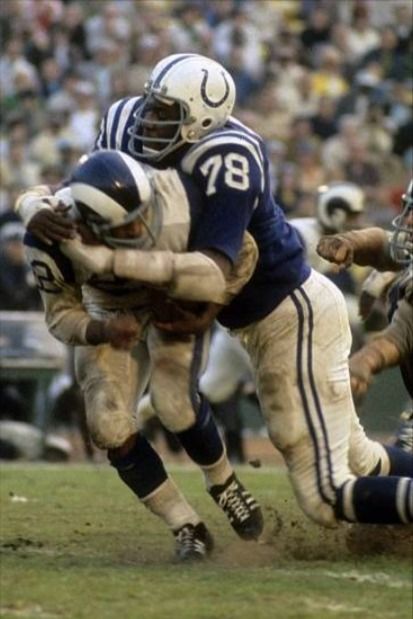
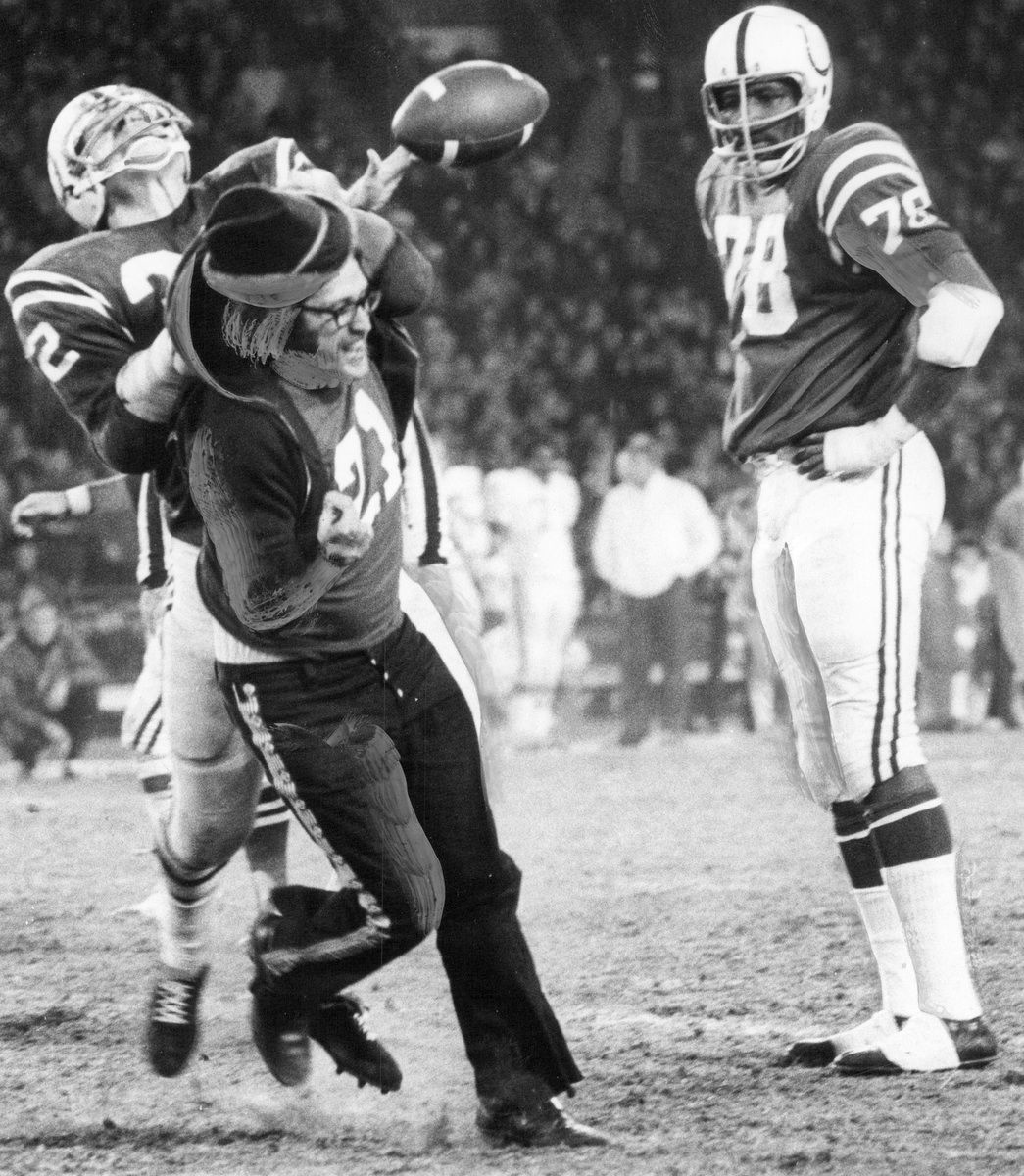
Kill, Bubba, Kill!

During the ’71 season the defense held 7 of their 14 opponents to 10 points or less. Including 5 of their first 6. Baltimore’s D recorded 3 shutouts and held their first playoff opponent to 3 points. In facing 5 top ten offenses that year, they were 4-1 and held two of those to 10 points or less. Yet why aren’t they remembered?? The sporting press of that era never forgave the 1968 Colts for losing Super Bowl III and the media tarnished this once great defense in the memory.

Now the media anoints others of that era and obscures this team…lets compare a few:

  • 1971 Baltimore Colts – #1 overall / 203.7 yds all. / 140 points given up / 28 int
  • 1971 Dallas Cowboys – #3 overall / 243.3 yds all. / 222 points given up / 26 int
  • 1972 Miami Dolphins – #1 overall / 235.5 yds all. / 171 points given up / 26 int
  • 1970 Minnesota Vikings – #1 overall / 200.2 yds all. / 143 points given up / 28 int
  • 1975 Pittsburgh Steelers – #4 overall / 261.5 yds all. / 162 points given up / 27 ints

Right now fans of the Doomsday Defense, The No Name Defense, and the Steel Curtain are saying to themselves ‘Its not all about stats”. Which is true until you realize this was a defending Super Bowl champion that made it back to the AFC Championship Game despite its offense. Had they won against Miami, they would have taken on the Dallas Cowboys in Super Bowl VI. Well that is who they beat in Super Bowl V to become champions in the first place.
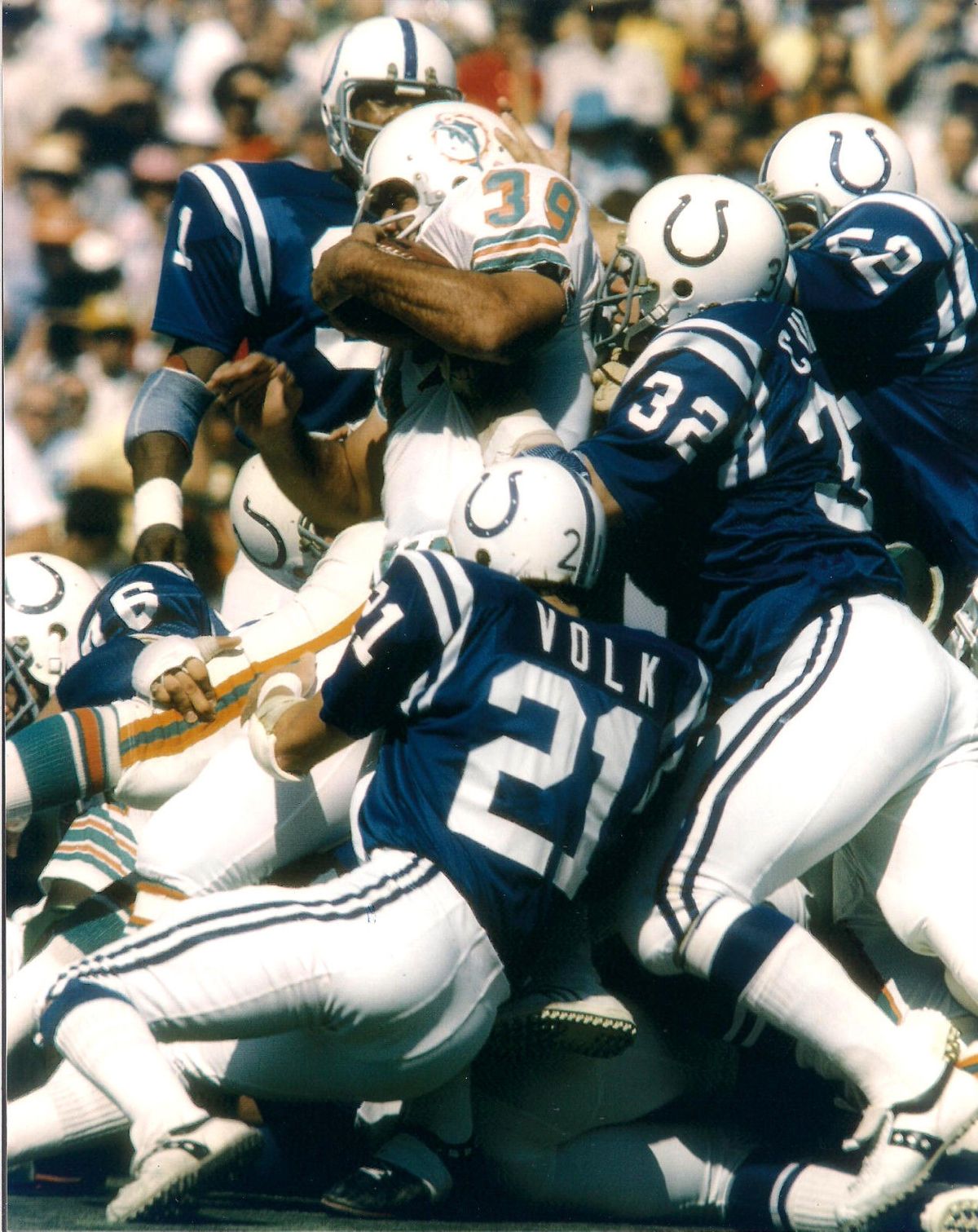
Led by Pro Bowlers DE Bubba Smith, MLB Mike Curtis, LB Ted Hendricks, SS Jerry Logan, and FS Rick Volk, its amazing only Hendricks is in the Hall of Fame. Curtis definitely should be but when you think of Hendricks making the Hall that is primarily from his work with the Raiders.

This was the last hurrah for the Colts as everything came apart starting in 1972. That was the year owner Carroll Rosenbloom swapped franchises with Robert Irsay. Head Coach Don McCafferty fired, John Unitas sent to the bench and the run as an NFL elite team ended.

Yet a tremendous performance by the defense in 1971 allowed them to hang on for one more season.

Dedicated to the memories of Don McCafferty, Bubba Smith, & Carroll Rosenbloom

The Soul Of The Game: The Purple People Eaters

The Minnesota Vikings front four was anchored one of the greatest defenses in NFL history. They were the NFL’s first super front four and it’s members consisted of Hall of Famers Carl Eller & Alan Page. Gary Larsen was the other DT, later replaced by Doug Sutherland, and DE and team captain Jim Marshall who should be. Although the 1968 Baltimore Colts were heralded as the greatest defense in NFL history for giving up a record 144 points on the way to Super Bowl III, it was this group that broke that record with 133 allowed  in 1969. They also powered the Vikings to 12 straight wins (longest win streak in 35 years) and carried the team on it’s back to Super Bowl IV.

All four made the Pro Bowl in 1969.

All four made the Pro Bowl in 1969.

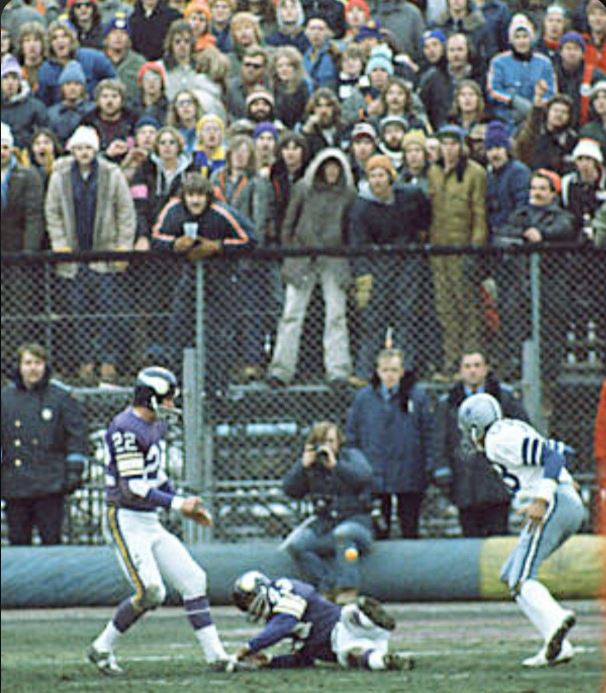
This defense made history as well. DT Alan Page was the first defensive player in NFL history to win the MVP of the league in 1971. No player would win that honor again until New York Giants LB Lawrence Taylor, who won the honor in 1986. What is interesting was the year Page won the award the Vikings didn’t make it to the Super Bowl. They lost to the Dallas Cowboys, who went on to win Super Bowl VI.

Yet this team was remembered for having reached the Super Bowl 4 times. Although they came up short in the big game as a team, what this defensive unit was able to do from 1968-1977 was spectacular. The team won 9 division championships on the way to 4 conference championships. It’s possible that they would have won a fifth conference championships and played in 4 straight Super Bowls had Dallas not completed the Hail Mary in the 1975 divisional playoff game. They preceded the Dallas Cowboys Doomsday Defense, the Steelers Steel Curtain, or the Denver Broncos Orange Crush.  These were the super defenses of the 1970s immortalized by nicknames to accompany their fierce play. At the head of that pack for a decade of dominance wrests the Purple People Eaters.

Thanks for the years of great play gentlemen.vikings today

Hail Mary: Dallas Cowboys 1975 Miracle Finish

Roger Staubach lets fly against the Minnesota Vikings in the 1975 Hail Mary Game

There are some NFL games that last in the memory longer than others, especially when it comes to playoff games.  None holds true more than the miracle finish that won the 1975 NFC Playoff game for the Dallas Cowboys over the Minnesota Vikings 17-14. Minnesota was trying to equal the feat of the Dolphins in terms of reaching their 3rd straight Super Bowl. Yet they had to get by the rebuilding Cinderella Cowboys who were in the midst of a rebuilding year. The window was closing for this great team to win that elusive Super Bowl.

After the upset loss to the Kansas City Chiefs in Super Bowl IV, the Purple People Eater defense had stayed among the league’s best while the offense had to be revamped. After going a few seasons without having adequately replaced Joe Kapp, the Vikings reacquired Fran Tarkenton in 1972 to add leadership and a grade A quarterback to the offense.  Also in 1972, they acquired John Gilliam who became the first deep threat ever for the Vikings. In that first year, Gilliam teamed with Tarkenton to become the first Viking in team history to top 1000 yards in receiving.

They finally had some offense but needed one more element and got that boost in the 1973 draft.  Chuck Foreman gave the Vikings their first great running back. Combining his skills with Gilliam and Tarkenton and the Vikings made it to the top of the NFC.  However back to back Super Bowl losses to Miami and Pittsburgh dulled some of the luster to the 1973 and ’74 seasons. Yet they were seasoned and primed to win it all in 1975. Just have to get past a youthful Dallas Cowboys team that made the playoffs as a wildcard. Easy money….right??

After missing the playoffs in 1974 while transitioning in 14 new players, the Cowboys had said goodbye to familiar faces like Bob Lilly, George Andrie, Chuck Howley, Calvin Hill, and Walt Garrison.  Players that had epitomized the era of the “Next Year’s Champion” Cowboys through their ultimate triumph in Super Bowl VI.  From 1966-1972 this team was among the league’s elite playing for multiple championships. Yet as we make it into the mid 70s, those aging great players started to retire and a new breed of Cowboys started to infuse the roster. An Ed “Too Tall” Jones in place of a George Andrie, a D.D. Lewis to replace a Chuck Howley. Understand this team had plenty of veterans to lead this young team into this playoff game. MLB Lee Roy Jordan, OLB Dave Edwards, DT Jethro Pugh, and CB Mel Renfro were among the mainstays on defense.

On offense Roger Staubach had developed into a complete NFL quarterback. His ability to move within the pocket was enhanced with the installation of the “Shotgun” formation. Coach Landry had re-introduced a formation that was the birth-child of the early 1960s San Francisco 49ers and Coach “Red” Hickey.  This hodge podge set of Cowboys made the pilgrimmage to Minnesota’s Metropolitan Stadium for an NFC Playoff Game.  The ’75 Cowboys didn’t even win their division, they came in with a 10-4 record and seemed to go as far as their talent could take them…right??

To borrow a line from Chris Berman “That’s why they play the games!!”

Drew Pearson scoring on the “Hail Mary” with :18

Epilogue: It was this game that launched the mid to late 70’s Dallas Cowboys. Roger Staubach had already performed a great come from behind playoff game against the 49ers in the 30-28 epic1973 NFC Divisional Game out in Candlestick. Yet it was this second one that spread the belief in his team psychologically that they were never out of a ball game with Roger at the controls.

This was also the game that ushered in Drew Pearson as a playmaker that would be a scourge for many a Cowboy foe over the next decade or so in the playoffs. They would go on to win the NFC Championship in an upset blowout of the Los Angeles Rams in the LA Coliseum 37-7 before falling to the Pittsburgh Steelers, 21-17,  in Super Bowl X.

As for the Minnesota Vikings a window was narrowing shut on their championship chances.  The great line of Hall of Famer Carl Eller, Hall of Famer Alan Page, Jim Marshall, and Doug Sutherland was aging and wasn’t as dominant as in years past. In the 1976 season, Buddy Ryan was hired to coax one more good year out of this group. They got it even though they wore down toward the end of the season. They made it to their 3rd Super Bowl in 4 years, and 4th  Super Bowl in 8 years total yet they lost to the Oakland Raiders 32-14 in the 11th edition.

The latter part of the 1970s saw the great play of the Vikings diminish as their stars retired or were phased out. Fran Tarkenton would go on to retire with more passing yards than any quarterback in  NFL history with 47,003 yards. The day of the “Hail Mary” game dealt Tarkenton a more severe blow when he learned his father had died of a heart attack while watching the game in Georgia.  He was standing in a CBS truck when he learned of his father’s passing.

Yet there is one lingering question from the “Hail Mary” game… Did Drew Pearson interfere with CB Nate Wright or did Nate Wright simply overrun the play?? While it can be noted that if you look at the play before the touchdown, you can see Preston Pearson lose his footing. So it doesn’t seem implausible…. Did he push off??