Roger Craig Should Be In Pro Football Hall of Fame

When you think back to Bill Walsh’s great 49er teams, who are the first players you think of?? Right there with the Joe Montanas, the Jerry Rices, and Ronnie Lotts it only takes a fraction of a second to think of Roger Craig. His high knee running style brought a physicality to the San Francisco offense that was seen as a finesse group up until his arrival. In fact he came to San Francisco as a fullback when they drafted him from Nebraska before the 1983 season.

In college he had been primarily a blocking back in the Cornhuskers wishbone offense. Normally he paved the way for Jarvis Redwine and then Mike Rozier. Yet when Bill Walsh decided to revamp San Francisco’s dismal backfield after a 3-6 season in 1982, he drafted Craig in the second round.

Although the 49ers had won it all in 1981, it had become apparent Bill Ring, Amos Lawrence, Walt Easley, and Earl Cooper just wasn’t cutting it in the backfield. To raise the stakes in the NFC for 1983, Craig and newly acquired Wendell Tyler would form a more potent backfield.

After posting the worst yards per carry average (3.4) and yardage (742) in 1982, the new backfield duo of Craig and Tyler turned that around completely. The much improved ground game of 1983 ranked 8th with 2,257 yards rushing and a gaudy 4.4 yard average. Ironically just ahead of the Los Angeles Rams, who had traded Tyler to San Francisco so they could draft Eric Dickerson.

You had to give the nod to Craig who ran for 783 yards a team leading 8 TDs, while catching 42 passes for 427 yards and another 4 scores. This more dynamic backfield, along with Joe Montana, powered San Francisco to the NFC Championship Game. A 24-21 loss to the Washington Redskins was shrouded in controversy, thanks to some questionable calls, yet Walsh had the backfield he envisioned. Craig had reinvented himself from a collegiate player who rarely touched the football to a dual threat pro.
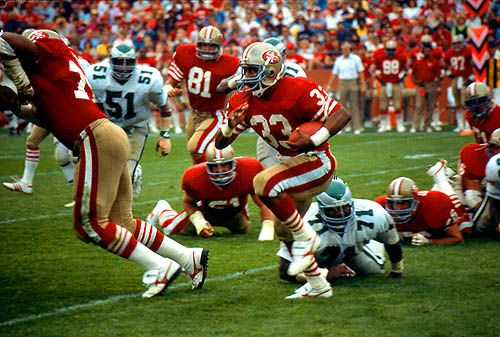
The 1984 49ers were a juggernaut becoming the first team to go 15-1 during the regular season. Everyone of the 49 man roster played their role so no one had outstanding stats. However once the 49ers moved past the New York Giants and Chicago Bears during the playoffs, the stage was set for a coming out party in Super Bowl XIX. With all eyes on Joe Montana’s possible second Super Bowl trophy and the electrifying record setting Dan Marino, Craig’s name didn’t even make the marquee.


Roger Craig graces the cover of Sports Illustrated after his record breaking performance in Super Bowl XIX.

Roger Craig graces the cover of Sports Illustrated after his record breaking performance in Super Bowl XIX.

It was his 1985 that set Craig apart as he amassed his 1,000/ 1,000 yard seasons both rushing and receiving. The first player in league history to do so. Some 27 years later, only Hall of Famer Marshall Faulk shares that accomplishment when he did it in 1999. How dominating was his performance?? Well his 1,050 yards rushing doesn’t jump out at you until you realize he only ran 214 times for a whopping 4.9 yards per carry. The league average is always around 4.0.

Oh by the way, he led the NFL in receiving that year with 92, which set a record for running backs, that amassed 1,016 more yards. His 15 total touchdowns was second to Joe Morris and was 1 better than NFL MVP Marcus Allen. In fact many pundits, including our CEO believes Craig should have been the MVP in 1985 with that dominating performance.

Now buoy his 1985 record setting season not culminating with the league MVP, on the backdrop of a Super Bowl record 3 TDs yet not winning that MVP and you’ll see where we’re going in a minute. Don’t forget he did this on a 10-6 San Francisco team that was a defending champion with Jerry Rice being a rookie that didn’t have 1,000 yards receiving and only 3 touchdowns. Craig quite simply fueled that offense.

Once the 49ers won Super Bowl XIX, they were forced to retool and become a bigger physical team. In 1985, the Chicago Bears emerged with one of the most imposing defenses in NFL history. The Giants followed suit with an overwhelming defense that featured 4 linebackers in the 250 lbs category. When Bill Walsh and his 49ers were dominated 49-3 in the 1986 NFC Divisional Playoffs by the Giants something had to be done.

These were teams the 49ers had beaten on their way to the ’84 championship, now they had taken the game to a new level of brute force. In reinventing the offense from a size perspective, it was Craig who was switched from fullback to halfback to allow for the insertion of Tom Rathman at fullback. The entire offensive line was overhauled.

You have to keep in mind the average career for a runner in pro football is less than 4 years. Yet here Craig was making the switch in year 5 to a position that called for him to be quicker. This at a time where he should have been slowing down from a physical standpoint. Yet he, Jerry Rice and Joe Montana spearheaded one of history’s most accomplished runs. From 1987-1990 the 49ers went 51-12 in the regular season, winning back to back Super Bowls in ’88 & ’89 and were the prohibitive favorites to win it all in 1987 as well as 1990. They finished #1 in offense in ’87 and ’89 and #2 in ’88 and ’90. In each year they made it to at least the divisional round of the playoffs and 3 straight NFC Championship Games as they were trying to threepeat.

Playing in only 12 games due to the ’87 strike, Craig ran for 815 yards which projects out to 1,086 over a full season. The 13-2 Niners were poised to become the greatest team of the modern era yet were upset by the Vikings in the playoffs. They were #1 in both offense and defense yet proved fallible in the playoff loss. Craig went on to his greatest performance in the 1988 campaign. In rushing for a career high and club record 1,502 yards, he also caught 76 passes for an additional 534  yards for his second season with over 2,000 yards from scrimmage. More important, he powered San Francisco to another Super Bowl championship with a win over Cincinnati in the XXIII’d edition.

Roger Craig was a hard nosed runner.

Roger Craig was a hard nosed runner.

Yet go back to 1988 being his second season with more than 2,000 yards from scrimmage. Keep in mind this was no sleek, make ’em miss halfback. He brought a punishing style to his position where he bludgeoned the opposition. As you’re reading this you can picture his high knee running style like when he trampled through the Rams on his most famous run in 1988.

Yet did you know that Emmitt Smith, Thurman Thomas, and Barry Sanders only had 2 different seasons amassing 2,000 yards from scrimmage also?? Did you also know that Marcus Allen and Adrian Peterson have only had one?? Only Edgerrin James, Marshall Faulk, Ladainian Tomlinson, and Eric Dickerson had more. What do all of these runners have in common?? Peterson and Tomlinson will be in the Hall of Fame and all the others are in. Roger Craig is right there with them.

Now going into the Hall of Fame is based on impact on the game. By the time we bring up the 1989 team that won Super Bowl XXIV, Craig was a driving force behind the team of the decade. Again he was a 1,000 yard rusher as the team won their fourth Super Bowl and Roger had his 3rd ring. When he left the game in 1993, his 566 career receptions was #1 among running backs all time and still remains 7th.

He is in the linear line of great NFL running backs when it comes to catching the football and is a part of the game’s evolution. He took the mantle from Chuck Foreman and propelled it forward. Since then, only a handful of every down running backs have provided that type of versatility. Now everyone has a receiving running back who comes in on 3rd downs where Roger was in every play.

It was Craig’s play that allowed a young Jerry Rice to flourish as teams concentrated their efforts to stop him. If Craig’s move to halfback in 1987 hadn’t panned out, what would have been the legacy of Bill Walsh’s “West Coast Offense”?? It was the run from 1987-1990 that made the offense spread it’s wings throughout the National Football League. During this time is when it proved it could take on the big bad Chicago Bears defense (see 41-0 1987 Monday Night shutout) and 28-3 NFC Championship win in Soldier Field in ’88. Then you add the rivalry with the New York Giants.

From Mike Holmgren to Denny Green to Mike White to Jon Gruden ( who had just begun coaching on the 1990 SF coaching staff) and George Seifert succeeding Bill Walsh. They all could attribute their Head Coaching jobs to some extent to Craig’s performance along with Montana and Rice. Yet the foundation of that offense running and receiving along with goal line and short yardage was #33.

By the way, when did Roger Craig become the the first running back to have a 100 yard receiving game in a Super Bowl?? You guessed it… Super Bowl XXIII against Cincinnati and not his record setting performance against Miami. Now had he won the Super Bowl XIX MVP, or the 1985 NFL MVP, would that have propelled him to winning the NFL MVP in 1988?? Give it some thought.

For induction into the Pro Football Hall of Fame, I present to you…Roger Craig

The Chancellor’s Take on Tributes At NFL Games

The NFL is built on the backs of great players who have made this game into an American institution. Great players have come and gone and their exploits were usually passed down generation to generation by fathers to sons, uncles to nephews, and every combination of sons and daughters you can think of.  Newspapers and word of mouth were how legends were built as the NFL emerged from the 1940’s on. That’s until television began to take over as the major story teller of the modern game. However in the last decade even television lost it’s soul for passing down stories that newspaper and families failed to miss.

Raven GM Ozzie Newsome addressing Ray Lewis during his "ring of honor" ceremony earlier this year.

Raven GM Ozzie Newsome addressing Ray Lewis during his “ring of honor” ceremony earlier this year.

Yet if you make it to an NFL game during the early portion of the season, you may run into an onfield tribute to a player or championship team from years gone by. However television execs don’t think the television audience should see it. That has to be the attitude taken as we didn’t get to see any of Ray Lewis’ tribute a month ago. Instead, we had to hear talking heads at the half talk about a game we had already spent an hour and a half watching. Seriously??

To not watch Ray Lewis tribute was glaring but wasn’t the worst example of this. That happened on Thursday Night to start week 4. The St. Louis Rams were playing the San Francisco 49ers and hosting alumni of over 5 decades of excellence. Including former players who played their careers back in Los Angeles. Men like “Jaguar” Jon Arnett.

The legendary Jon Arnett along with current Ram coach Jeff Fisher, former players Les Josephson, and Roger Brown.

The legendary Jon Arnett along with current Ram coach Jeff Fisher, former players Les Josephson, and Roger Brown.

If you asked who is  Jon Arnett, you’re exactly who would have benefited from the game broadcast including the tribute to all the former Ram players. What made this painful is this was NFL Network that was broadcasting the game and not Fox, CBS, or ESPN. The NFL Network commentators would make mention when the camera would catch a former Ram on the sideline.  But only when it was an Eric Dickerson, or a Greatest Show on Turf player from the early 2000s. I can’t believe the NFL’s own network would miss that opportunity to be the catalyst to start some of those father /son stories of the men that shaped the league.

Some of the Ram alumni on the sideline during the Rams v. 49ers in week 4.

Some of the Ram alumni on the sideline during the Rams v. 49ers in week 4.

As the NFL has gone more corporate, it hasn’t cared about the players who built the league and fight for their benefits later in life. Yet these are proud men whose accomplishments and contributions shouldn’t be swept into the dustbin of history. How do we know this??

Well let’s take you back to the turn of the century. No, not 1900, I’m talking about 2000. Twice on Monday Night Football we were offered retirement ceremonies for both Dan Marino, and John Elway. ABC allowed the viewer to enjoy what fans in Joe Robbie, and Mile High Stadium were able to witness. How many stories were told those nights to young football players around the country?? How many of today’s NFL players had fathers, uncles, or grandparents, share stories of Elway and Marino on those nights??

An all purpose threat for the Los Angeles Rams and later the Chicago Bears, Arnett was a 5 time Pro Bowler. Worthy of the Pro Football Hall of Fame, Arnett has been a friend to Taylor Blitz Times since it's inception. I call him "Captain Cutback" and he was right behind Frank Gifford in the lineage of great USC tailbacks.

An all purpose threat for the Los Angeles Rams and later the Chicago Bears, Arnett was a 5 time Pro Bowler. Worthy of the Pro Football Hall of Fame, Arnett has been a friend to Taylor Blitz Times since it’s inception. I call him “Captain Cutback” and he was right behind Frank Gifford in the lineage of great USC tailbacks.

ABC did this again before the 2001 season when Terrell Davis had his retirement ceremony live before a televised audience. Before that we had Phil Simms throw a pass to Lawrence Taylor during his retirement ceremony in 1995. Also on Monday Night. it was understood what it meant to share the games history and aid in story telling that inspired the next generation of football players. Now even the NFL’s own network doesn’t even recognize this.

They robbed some little boy or girl of watching the pregame / halftime ceremony of former Ram players and ask: “Dad, who is that guy in the white jersey?? You know #26 right there??”  just before his father could answer, his uncle or grandfather would walk in with a beer and a bowl of chips and respond “That’s Jaguar John Arnett…and you should have seen him play. He was the most elusive….

If the networks won’t stop and offer something more rewarding than studio analysis of a game we have watched for nearly 2 hours. To hell with it, Taylor Blitz Times will do it.  Shut up and let us see the ceremonies in the stadium…please.

Thanks for reading and please share the article.

The Soul Of The Game: Randy White

Randy White... easily a Hall of Fame player.

Randy White… easily a Hall of Fame player.

When it comes to great hitting in the NFL, much of it takes place on the line of scrimmage, away from the camera following the football. However there are players who deliver those hits on quarterbacks, running backs and those same offensive linemen. Randy White was one of those players. An intense desire burned in him if you ever watched him play.

In fact it was that desire which helped him turn in probably the NFL’s greatest defensive play in our CEO’s estimation. In the 1980 season finale, Dallas needed to beat the Eagles by 25 points to win the NFC East. The Eagles were near midfield when they completed a slant to wide receiver Scott Fitzkee, who took off for the goal line. White, who had seen the pass whiz by turned and chased down Fitzkee tackling him at the 5 yard line. Ask yourself when was the last time you saw a defensive lineman chase down a receiver after a 49 yard gain??

Of course that wasn’t a great hit but it showed unbelievable heart. When you thought of the Dallas Cowboys during the late 1970’s and thought of toughness, he was the one that came to mind. He wasn’t that big either and thrived on his quickness to get into the “A” gap of opposing offenses.

One aspect of his play that is unusual is his size for a defensive tackle. The Cowboys had him listed at 6’4″ 257 lbs but that was a smokescreen. He looks like he’s about 6’1 or 6’2 and played at a weight where most of his contemporaries were pushing 275-280 lbs. We have yet to see in any film where White was bigger than a player trying to block him.

Randy White was a flat out beast for the Dallas Cowboys.

Randy White was a flat out beast for the Dallas Cowboys.

Over his 14 year career he made the Pro Bowl 9 times and was voted All Pro in 8 of them.  He was the impetus to the Doomsday Defense II that followed the original unit Bob Lilly, Lee Roy Jordan, Dave Edwards, and Chuck Howley played on. In fact along with Howley, White shares the distinction of being named Super Bowl MVP while wearing #54 for the Cowboys. Howley did so as the only player from a losing team, to nab that distinction in Super Bowl V.

As for White, he was the co-winner along with the late Harvey Martin for chasing Craig Morton all over the Super Dome in game number XII. In that contest he and the defensive line hounded Denver quarterbacks into 4 interceptions on 8 of 25 passing for 61 yards. In a Super Bowl?? Yikes. For his career he finished with 9 Pro Bowls and 7 – 1st team All Pro selections. A sure Hall of Fame performer which raises an interesting question: Who was the Dallas Cowboys all time greatest defensive tackle?? Bob “Mr. Cowboy” Lilly or Randy “Manster” White??

Thanks for reading and please share the article.

NEXT: Andre Reed Belongs In The Pro Football Hall of Fame

The Soul Of The Game: Pat Fischer

In the long history of the NFL there have been players who defined their positions because of their physicality. Men like Dick Butkus, Dick “Night Train” Lane, and Lawrence Taylor were freaks at their position. They were bigger than what other teams were geared to deal with normally. Yet there are those that stand out as hitters first although their size would suggest something different. Enter Pat Fischer.

Standing only 5’9, and 170 lbs (that can’t be right) Smith played in an era where the NFL was a running league. Unlike today’s game where he could play out in space chasing an X, Z, or slot receiver, Fischer had to come up and tackle in an era where everyone was emulating Green Bay’s power sweep. He had to take on pulling guards,  some fullbacks along with his coverage responsibilities. Yet he only missed 10 games in his first 16 years.

Pat Fisher played cornerback for 17 NFL seasons.

Pat Fisher played cornerback for 17 NFL seasons.

His physical play belied his diminutive size as he played as a pint sized intimidator. Lionel “Train” James loves to say “It’s not the size of the dog in the fight, it’s the size of the fight in the dog.” Never was this more true than of Pat Fisher. Even in the Super Bowl VII highlight, NFL Films had John Facenda narrate how much a nemesis he was against the run and the pass. Let’s face it, a cornerback his size now is primarily a special team guy who is platooned only against multiple receiver sets. They rarely tackle players other than small slot receivers. Take a look at how Fisher played…

In the NFL of the 1960’s there was a concentration of talent that stayed with the same teams and systems for many years. Fischer was caught in this vice where Hall of Fame cornerbacks Dick “Night Train” Lane, Herb Adderley, Jimmy Johnson, and Lem Barney were playing. He was an overlooked player for awhile and some of it could have been other players not leaving behind on-field animosity when voting for fellow players.

There has to be some truth to it or Fischer wouldn’t have had one of his 3 Pro Bowl seasons in 1969 when he had just 2 interceptions. Now his first, in 1964, where he picked off 10 returning them for 164 yards and 2 touchdowns couldn’t be ignored. That was 1 TD short of the all time record. Yet other years he was overshadowed by these other players.

mel-gray-05893042

Pat Fischer played well into the 70’s and here he is going against Mel Gray in the mid ’70s.

One could also make the argument Fischer’s 1969 Pro Bowl and All Pro season came because of the higher visibility Vince Lombardi brought to the team in his only year coaching there.

Whatever the reason, Fischer played from 1961-1977 and retired having played in more games at cornerback in NFL history. If you think about that time frame, he came in 9 years before the AFL / NFL merger and played through the 12th Super Bowl. This is before the modern athlete could have arthroscopic surgery between seasons to prolong their careers. Does he belong in the Hall of Fame??

Thanks for reading and please share the article.

The Golden Age of Hating The Dallas Cowboys

It was a feeling which manifested sometime during the 1970’s. We can put it on the late George Allen, former coach of the Washington Redskins, who was first to voice a total disdain for everything Dallas Cowboys. It raised the level of rancor between the Redskins and Cowboys elevating the rivalry to the national level.
Below the surface the rivalry began to take shape when the Cowboys became the NFL’s southern most team when they began play in 1960. Prior to this, the Redskins of George Preston Marshall were. It’s one of the reasons they sang “Dixie” at their welcome back luncheon when the team reported to camp. Yet this new team came along and began to eat into their fan base.

Keep in mind the Atlanta Flacons and. New Orleans Saints werent founded for another half decade. With the Falcons beginning play in ’66 and the Saints following in ’67. By then the Cowboys were had grown in stature and had taken the Packers for NFL supremacy.

However the disdain Allen felt during the early 1970’s was more palpable. More real.

A growing resentment felt by many teams and fans. The feeling was the late Tom Landry and his Dallas Cowboys were given too much publicity by the networks and the print media. CBS was constantly covering the Cowboys and the level of success they had in the 1970’s, with 5 Super Bowl visits, seeded hatred in their rivals. Especially within their division. Yet none of them were good enough to challenge them in the NFC East.

By the time NFL Films made the 1978 Dallas Cowboys yearbook and labeled it “America’s Team” hatred was at an all time high. Even jealousy if you will. It was the arrogance and air of supremacy the Cowboys organization painted during those CBS days that fueled two schools of fans.

You had those who thought of themselves as beautiful and carried themselves with a sense of arrogance and identified with the team and their cheerleaders. Then you had the regular meat and potatoes folks who loved when the Pittsburgh Steelers punched them square in the mouth during Super Bowls X and XIII. They were also fans of all other teams. Yet when your team is no longer in it, they cheered for whoever was facing Dallas in the playoffs or Super Bowl.

Ironically, this is where the Steelers gained their nationwide fan base. It had nothing to do with the fact they won 4 Super Bowls in the 1970’s, it was the fact they beat the Cowboys in two of those Super Bowls that made them remain as fans.

As the 1980’s beckoned, many of the teams that Dallas had squashed the last decade began to grow anew. A fresh generation of coaches and players started to internalize the disdain for the bully on the block and began their ascent. It was known that you had to take out Landry’s Cowboys if you really want to be recognized as champions. Although the Redskins were the one with the more acknowledged rivalry, it was the Philadelphia Eagles under Dick Vermeil that got the first crack at the boys from the Lone Star State.

Much of the animosity started at the beginning of the week, when the Eagles were cast as underdogs against Landry’s Cowboys in the 1980 NFC Championship Game. Although they were hosting, the Eagles were made underdogs by Vegas. Right on cue, the Eagles were being treated as bit role players even though they split their games with Dallas that year.

An upset Dick Vermeil made a declaration that ratcheted feelings up when he vowed “Never allow anyone to take you for granted! I get the feeling the Dallas Cowboys are taking us for granted right now. We’re here because we earned the right to be here. If the Dallas Cowboys are going to take us for granted, we’ll whip their ass!”

To further irk Tom Landry, Vermeil opted to play in their white uniforms forcing the Cowboys to play in the blue jerseys, which they felt were jinxed. Dallas complained to the league office yet for once the powers that be didn’t allow Gil Brandt and Tex Schramm to get their way. The crowd at Veteran’s Stadium was unforgiving as the two teams emerged from the tunnel. It was 4* and -17* windchill when on the Eagles second play from scrimmage:

The roar of the crowd during Wilbert Montgomery’s touchdown was the loudest ever at Veteran’s Stadium. Cowboy haters everywhere delighted as the Eagles held the early upper hand on the Cowboys 7-0. As the game wore on and Landry’s charges behind 17-7 late in the fourth quarter, they were able to punt and pin the Eagles to their own 5 yard line. From their own 5 yard line the Eagles ended fading hopes for Dallas when in 3 runs Philadelphia moved the football to the Dallas 25. Montgomery was putting the finishing touches on a signature day when he struck with this 54 yard masterpiece.

The Eagles vanquished the Cowboys 20-7 on their way to Super Bowl XV. Wilbert Montgomery etched his name into Philadelphia lore with a 194 yard performance. They had destroyed the Flex Defence, rushing for 263 yards on 40 carries averaging 6.575 yards a pop!! Cowboy haters everywhere rejoiced in hearing Landry, Danny White and Cowboy apologists have to answer the questions as the defeated football team. In fact many Cowboy haters pulled for the Oakland Raiders in the Super Bowl two weeks later. People weren’t cheering for the Eagles as much as they were for Dallas to lose.

The following year the Cowboys had revamped their secondary & national press covered the exploits of rookies Everson Walls (who should be a Hall of Famer), Michael Downs, and Ron Fellows. Although the publicity was on this group in Big D, they were overshadowing an even greater group in San Francisco. Where Bill Walsh had drafted and started rookie CB Ronnie Lott, CB Eric Wright, and S Carlton Williamson to go along with scrappy veteran S Dwight Hicks. Yet through most of the 1981 season, you didn’t hear about the 49ers. Even after a 45-14 devastation of the Cowboys in week 5 with Ronnie Lott scoring the decisive touchdown.

Did you know the 49ers didn’t make the Monday Night Football highlight package?? Don’t tell our CEO there was no media bias. Nor can you say the coverage of Dallas’ rookie trio of defensive backs didn’t motivate the group by the bay. Was it borne from the Cowboys propaganda and success of the 1970s?? Or was it borne from Tom Landry’s ties to the New York media since his pro coaching career started there??

Did you know the late Pat Summerall who broadcast many of the Cowboys games in that era, was a teammate and friend of Landry back in New York?? So when they didn’t make the ABC Monday Night package it fed into the hating Dallas mantra that much more by the 1981 NFC Championship Game.

There had been a history between the San Francisco 49ers and Dallas. In fact you could say the 49ers were who Dallas had built their reputation on with wins over them in the 1970 and 1971 NFC Championship Games. At that point the Cowboys were called “Next Year’s Champions” for four straight playoff defeats to Vince Lombardi’s Packers and the Cleveland Browns. As a new decade beckoned it was the Niners and the Cowboys who stepped to the fore.

Once Dallas emerged and won Super Bowl VI, their prestige soared where the vanquished 49ers went into a tailspin the rest of the decade. Yet before that happened, there was the 1972 NFC Divisional playoff where a measure of revenge was going to be exacted against Landry’s troops when Roger Staubach led a furious 4th quarter rally. Staubach led Dallas to a 30-28 win after they were behind 28-13 with 5:00 to go in the game. This is when he earned the nickname Captain Comeback.

Fast forward to the 1981 NFC Championship where the resurrected 49er franchise, now under Eddie DeBartolo, were preparing for the game. Still smarting from the lack of respect afforded his group after the 45-14 win and no media coverage, set the tone of a franchise when talking to a reporter. “They ate it once and they can eat it (defeat) again.” Reminiscent of Dick Vermeil the year before, Cowboy haters were all pulling for the 49ers in this game when they took the field.

The final stint came when the Washington Redskins had their turn to climb over Dallas to make it to the summit of pro football. After a strike shortened season where the 8-1 Redskins entered a playoff tournament to make it to Super Bowl XVII, most pundits picked the media darling Cowboys to win the NFC Champoinship citing the Redskins only loss was courtesy of the Cowboys. Our CEO can remember being fired up for the NFC Championship between Washington and Dallas and knew it was going to be a thing of beauty.

It actually started when the Redskins were putting the finishing touches on a 21-7 win over the Vikings to set up the NFC Conference final when the chant “We want Dallas!! We want Dallas!!” resonated from the jam packed crowd at RFK. Just moments before, John Riggins who had rushed for 185 yard was in the midst of a curtain call, turned and gave a bow to the crowd sending them into a frenzy. Those sights and sounds reverberated throughout the stadium and CBS chose instead of showing the final plays of that game, panoramic views of the raucous fans.

As for the rest of the Cowboy haters who gathered to watch this team go down again. Look no further than another bulletin board comment that jump started the festivities. It started with Dexter Manley professing in the paper that he “hated Dallas” that Monday that got the ball rolling. Then back and forth in the newspaper ensued from Danny White of the Cowboys, to Redskin owner Jack Kent Cooke, EVERYONE was stoking the fire. How bad did it get? There was even a heated argument about the game within the House of Representatives the Friday before the game and the late Thomas “Tip” O’Neill adjourned session an hour early. It was on!!!!

Over a football game? Yes over a football game. The hating of Dallas really grew wings in the George Allen era. He preached it, lived it, and over all the treatment America’s Team received as a media darling kept breeding that hatred within rival teams. Real Redskin fans will talk with high regard of the fact that they beat Dallas in the ’72 NFC Championship when the Cowboys were defending champions. So here we were some 10 years later and all that animosity was a thing of the past right? After all new owner, new coach, new quarterback and cast of characters comprised the Redskins roster. Right?

For a more visceral look:

With that we were at an end of an era where other NFL teams were able to get their due as the 1980’s moved on. Media coverage transferred from Dallas to new teams coming from Chicago, the New York Giants, Denver Broncos, of course the 49ers and the Redskins who were dominant the rest of the decade. From this era came the nationwide fan base of the San Francisco 49ers much like the Steelers. The backlash of the “America’s Team” name and over favorable coverage brewed hatred from the majority of NFL fans and players.

Notice in these videos, the look in their eye and the description of elation for vanquishing the Dallas Cowboys of that era. In all three cases before the NFC Championship, where decorum was to be quiet, and not give the Cowboys bulletin board material. Coaches and owners in these instances were doing it let alone players. It set the table for things to come and put their organizations on high alert of what was expected of them.

The hatred for everything Dallas began to dissipate at this time. There was some animosity left when the ’85 Bears bloodied them 44-0 in Texas Stadium after 9 straight losses to them. Yet by the time of Tom Landry’s departure, people felt bad about what happened to the Cowboys and watched the dismantling of a franchise with mixed emotions.

You were almost mad that they were 1-15 in 1989, because the villain from Texas was gone. The Jimmy Johnson Cowboys of the 1990’s were an envied team, not a hated one. To be hated you had to be more than a good football team, and in retrospect that was what made hating the Dallas Cowboys worthwhile.

The way they were marketed, branded, and packaged. The way their coach was treated like a God and their quarterback in Roger Staubach was the idol which gave way to Danny White. Well until these NFC Championship losses tarnished White’s legacy.

Their cheerleaders were even made famous. They had telvision specials and still do to this very day. All of this tapped into the inferiority complex of many players and fans of other teams. When it came time to beat them for a championship or a game of importance, it was the Holy Grail.

One of Taylor Blitz’s finest shrugs it off and has this message “How ’bout them Cowboys?”

Thanks for reading and please share the article.

Taylor Blitz Times new logo!!

Taylor Blitz Times new logo!!

Baltimore Ravens Super Bowl XLVII Ring: Rich City of Tradition

The bauble earned for the Baltimore Ravens winning Super Bowl XLVII.

The bauble earned for the Baltimore Ravens winning Super Bowl XLVII.

So to conclude a reunion week of the team that vanquished the San Francisco 49ers in the Super Bowl last February, the Baltimore Ravens were on tour again. First a trip to the White House where they met with President Obama where they presented him with a ceremonial jersey. Then to have the week culminate in the presentation of their Super Bowl rings in a gala on Friday night.  Ray Lewis and most of the players who have moved on from the organization, were back to bask in the evening commemorating their achievement sitting atop the NFL for 2012.

The first view leaked on the day by CBS Sports didn’t do the ring justice. This professional shot from the Ravens organization shows off the quality of the ring and downplays it’s size. The oval design of the top distinguishes it from the rectangular face of the first championship ring. This ring needed to say more where the typical design of a first ring is normally the team logo and a series of diamonds. With the oval face we see the off centered dual Super Bowl trophies layered beneath the logo amid a bed of diamonds.

The best aspect of the ring is it was made in white gold which gives it a clean and sleek look. Much like the Super Bowl trophy itself, it has a steely look to it. One that reflects the clinical moves that an organization makes with awarding a Ray Rice with a $35 million contract before the season, yet make Joe Flacco sweat it out in a contract year. Another that comes to mind is the steely resolve Flacco exhibited in his road performances in Denver and New England. Where he took the measure of the two best quarterbacks whose status kept his in question when you think of the AFC’s elite quarterbacks.

The ring will forever reflect the steely grit a team showcased once their leader in Ray Lewis announced he would retire after the 2012 postseason. Finally, it reflects the steely nerves a tired Raven defense had to display in the greatest goal line stand in Super Bowl history. Greater than the 49er stand in Super Bowl XVI?? Absolutely!! This one won the Super Bowl with seconds left where the one the 49ers put on was in the third quarter.

By doing so the Baltimore Ravens brought the city its fifth NFL championship. Just as Johnny Unitas used to attend Ravens games, those old titles belong to this city, not with the original franchise that sits in Indianapolis.

1958 NFL Championship ring

1958 NFL Championship ring

The championship team that put the city of Baltimore on the map forever was the one that won this ring right here. Arguably the most influential NFL Championship ever played was the 1958 epic where the Colts beat the New York Giants in overtime 23-17. In fact it’s moniker has been “The Greatest Game Ever Played”. Although there had been winning drives in championship games before, Johnny Unitas came of age as a quarterback during his. With the Colts down 17-14, where they hadn’t scored since the second quarter, Unitas took to the air. Through his will and determination he directed Baltimore on a long drive to tie the score on a Steve Myra kick. Forcing the first “sudden death” overtime in NFL playoff history.

You have to remember we were just two years removed from the New York Giants having won the 1956 championship with the league’s best defense 47-7 over the Chicago Bears. This was to be their era and the New York media was there en masse to cover their second championship triumph in 3 years. Yet as Unitas to Raymond Berry began to dominate the overtime period, media attention switched to; “Who is this skinny quarterback riddling the NFL’s best defense?” Unitas was inventing the “two minute quarterback” with his every move from quick passes, to his deft play calling. He had total command of the game and performed with glacial calm.

Unitas famous drive showcased his flair for the dramatic as well as his play calling taking advantage of what the Giants defense would think he would do. Once inside the 10 yard line where the Colts could kick the winning field goal, Unitas threw an out to TE Jim Mutscheller to get down to the 1. The Giants were out of position as they were geared to stop the run. Just as the Giants braced themselves for the customary fullback leading the halfback into the line, Unitas called the opposite. Alan Ameche crashed into the endzone behind a Lenny Moore block through a gaping hole.

The game was over with the city of Balitmore champions of the football world and Johnny Unitas was on the map forever. On the heels of the excitement of this game, Lamar Hunt formed the principles of what would become the American Football League. Football became the new American obsession after this game and began to rival baseball as the #1 sport.

Watch that was awarded to the 1958 NFL Champion Colts. Unsure if this went to the coaches and owners or the complete story.

Watch that was awarded to the 1959 NFL Champion Colts. Unsure if this went to the coaches and owners or the complete story.

In a rematch that concluded the NFL’s “Golden Age” of the fabulous 1950s, the New York Giants again faced the Colts for the league championship. This time the Colts would be at home. A city that famous Baltimore writer John Steadman once said “Baltimore was known for being the train stop between Washington DC and New York.” Tapping into the city’s inferiority complex. The Colts and principally Johnny Unitas gave the city a legitimacy on a nationwide scale that it hadn’t experienced before. Yet here they were again facing the evil empire that was New York’s Football Giants coming to take back the crown.

However in a dominating performance, Unitas and the Colts throttled the Giants 31-16 thanks to a 24 point 4th quarter. They were down 9-7 when the highest scoring team in football scored with a Johnny Unitas 4 yard scamper around end. Then Unitas found Jerry Richardson for a 12 yard touchdown to push the lead to 21-9. Then Johnny Sample, yes the same one that played with the Jets and intercepted Unitas twice in Super Bowl III, returned a Charlie Conerly pass  42 yards to push the Colts to an insurmountable 28-9 lead with half a quarter to go.

Richardson would go on to own the Carolina Panthers many years later.

Gino Marchetti and Eugene “Big Daddy” Lipscomb and the Colt defense came up with timely plays to hold the Giants to 3 first half field goals by Pat Summerall.  In Tom Landry’s last game as the defensive coach (defensive coordinator) of the Giants, the Colts were held to only 280 yards of total offense to the Giants 323.

The NFL Championship ring of the 1959 Baltimore Colts.

The NFL Championship ring of the 1959 Baltimore Colts.

The Colts winning back to back championships made them a dynasty and one of the greatest champions in NFL history. Not bad for a team that had come into the league from a defunct All American Football Conference with the San Francisco 49ers and Cleveland Browns in 1950. In 10 years, these 3 teams from the inferior league won half the decades NFL championships. Winning the first in 1950, the last in 1959, and the Browns playing for 3 more championships. Yet it was the team from Baltimore that ushered football into the modern age as the 1960s dawned.

The ring commissioned for winning Super Bowl V.

The ring commissioned for winning Super Bowl V.

The last Colts team that won Super Bowl V for Baltimore was one that suffered from the fallout from having lost Super Bowl III. The turbulent 1960s were over and the merger between the NFL and AFL happened with a championship between the two leagues starting after the 1966 season.  The Super Bowl III loss to the New York Jets legitimized the AFL and the merger but the Colts suffered from the fallout that lasted the rest of their lives VIDEO.

The Colts were led by an aged Johnny Unitas who was getting by on guile. He now had All Pro Tight End and fellow Hall of Famer John Mackey on offense along with Roy Jefferson and Eddie Hinton at the wide outs. Gone were Raymond Berry, Tom Matte and familiar names with the Colts. They were transitioning from the team that won for most of the decade of the 1960s but couldn’t overcome the Green Bay Packers in the Western Conference. Now they found themselves in the first year of interleague play under the AFC along with former AFL teams and the Browns and Pittsburgh Steelers who were paid $3 million to move from the NFL to the AFC. Each conference now had 13 teams.

After posting an 11-2-1 record, they bested the Oakland Raiders in the first ever AFC Championship Game 27-17 to make their way to play for the Vince Lombardi Trophy in the Orange Bowl. Rookie Jim O’Brien kicked a last second field goal to win Super Bowl V 16-13 over the Dallas Cowboys. Unitas who would be gone from the Colts in less than two years was knocked from the game in the second quarter. The Colts put themselves in position for the winning field goal when Mike Curtis intercepted a Craig Morton pass with seconds left to put the ball on the Dallas 28 with seconds left.

This ring was the first for the city of Baltimore with it’s new team, the Ravens. Art Modell had moved the former Cleveland Browns (ironically) to town in 1996. Free agency had dawned after the 1993 season and teams were struggling to put offenses together. Yet the trend became one where a suffocating defense through free agency could be built, and the Ravens built one of history’s finest. After drafting Ray Lewis, Jamie Sharper, Duane Starks, and Chris McAlister, they filled in the blanks with free agents Tony Siragusa, Robert Bailey, Corey Harris, and future Hall of Famer Rod Woodson to form a defense the league hadn’t seen since the 1991 Philadelphia Eagles.

The first ring won by the Baltimore Ravens after Super Bowl XXXV.

The first ring won by the Baltimore Ravens after Super Bowl XXXV.

The Ravens first ever foray into the NFL playoffs came after a regular season where they had given up a league record 165 points for the season. The old record had been 187 points allowed by the 1986 Chicago Bears.  Although the Ravens defense was ranked #2 on the year, they yielded the fewest points, highlighted by four shutouts. They had become the first team since the ’85 Bears to record back to back shutouts during any NFL season. How dominating were they?? If you include the 3 points allowed to Denver in the wildcard 21-3 win, the 10 points given up to defending AFC Champion Tennessee Titans in a 24-10 win, and the 6 points given up in the AFC Championship win over Oakland 16-6, in 19 games they still gave up less points than the Bears old 16 game record. (184-187 points) Yikes!!

Couple that with the fact the Giants only touchdown in Super Bowl XXXV had been a kick return by Ron Dixon, they would have ended the game with a fifth shutout which would have been a Super Bowl first. Ray Lewis was the 2000 NFL Defensive Player of the Year and MVP of the Super Bowl as well. Trent Dilfer, Jamal Lewis, and free agent acquisition Hall of Fame Tight End Shannon Sharpe powered an efficient offense. This was one of the greatest defensive champions of all time.

There you have it… Baltimore’s rich NFL tradition punctuated by championships from different eras. Ironically there is a lot more to the Cleveland Baltimore rivalry than meets the eye. They have been joined from the hip since their 1950 NFL inception and the present day franchise started in Cleveland. Yet here they sit as champions of the football world for another year. How will they fare in 2013?? Go read our previews.

Thanks for reading and please share the article.