Corey Dillon Belongs In The Hall of Fame

There are many NFL fans who miss true talents around the league and just focus on their team. That narrow focus can keep one from seeing a Hall of Fame talent at work. That doesn’t mean an overlooked player should miss the call to the hall if he doesn’t garner great media attention. It’s about what they accomplished on the field and how well their peers respected their exploits.
Did you know that at one point Corey Dillon owned the greatest single game rushing performance and the #6 performance in NFL history?? Not Emmitt Smith, Barry Sanders, Eric Dickerson, LaDanian Tomlinson, nor Adrian Peterson or any great back you’ve ever watched accomplished that . Well, you have to be in your mid fifties at least to say you saw someone perform to that high a level. That was when OJ Simpson held sway in the NFL. You’d have to be in your fifties!!

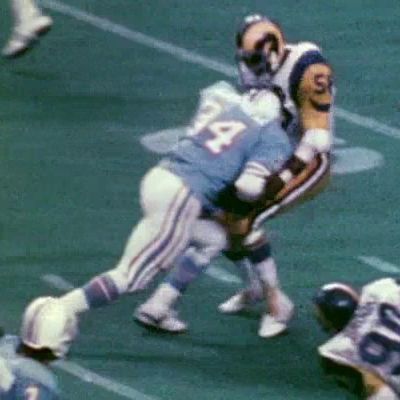
Not only that, his 6th place (at the time) performance stood as the NFL’s rookie rushing record at 247 yards in a 1997 game against the Tennessee Oilers. That record Dillon broke had been Jim Brown’s. Each of these have since been broken but it was the manner in which they were set that sets them apart.

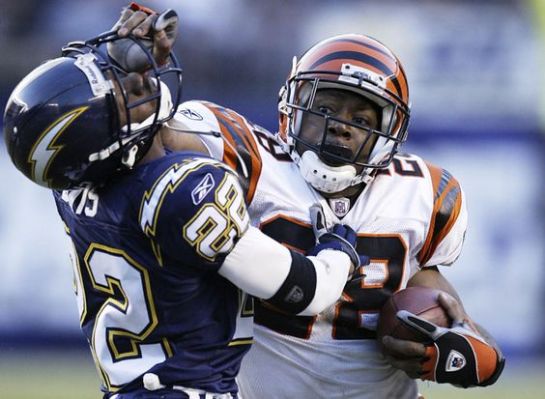
Unlike the shifty make ’em miss running style of most halfbacks, Dillon struck like the hammer of Thor. He was a passionate violent runner that thrived on contact. Once he positioned a defender to one side, he’d forearm, stiff-arm, or shoulder right through them. He made a joke of arm tackles and if you wanted to tackle him, your heart had better be in it.

For years media pundits painted him with the broad brush of that of a malcontent. Yet let me ask: If you were one of the best talents in the league, how frustrated would you be with a team that couldn’t get you any help?? In 1999 Inside The NFL broadcast their show from Cincinnati asking “Why can’t the Bengals tun it around?? Were they the JV of the NFL??” They interviewed player after player and the only one whose eyes burned fire with frustration were Dillon’s.
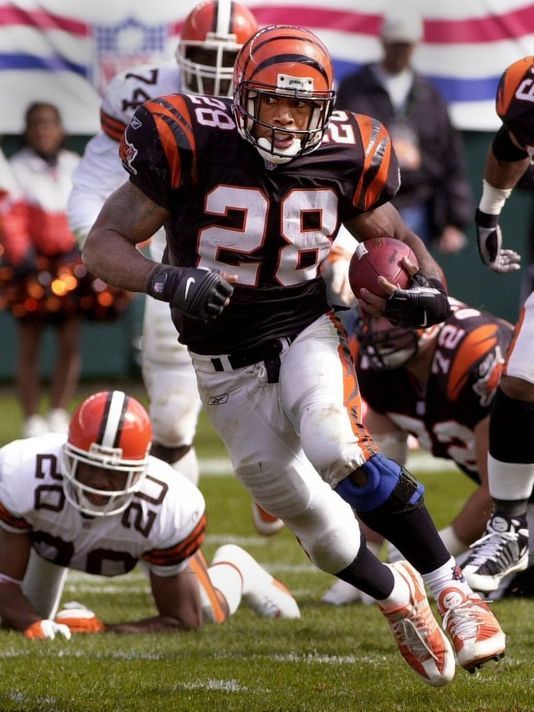
For an instant you could peer into his soul and you understood him completely. For all the hard work to make it to the NFL, then play for a franchise that couldn’t field a better team. He was toiling in anonymity loss after loss. All those childhood dreams of playing in a Super Bowl were dying an agonizing death.

It looked like 2000 would be no different as the Bengals started out 0-6. The optimism of having their 1st season in Paul Brown Stadium was fading fast. They had only scored 34 points while being shut out 3 times when the Denver Broncos, just two years removed from back to back championships, came to town. At the time the Broncos had the NFL’s 2nd ranked run defense.

The heavens opened up and the football god’s touched Dillon, allowing his fury to be unleashed in the greatest rushing display in NFL history.

Inside The NFL Perspective:

Did The Chancellor of Football say the greatest rushing display in the history of pro football?? Absolutely!! Listen, on a day when the Bengals completed just 4 passes, Dillon got off on a defense focused squarely on him. As for the record of 278 yards being broken twice by Jamal Lewis and Adrian Peterson, we will put them side by side in a minute. You have to remember the football world was still reeling from Walter Payton’s death. We were just 1 week short of the 1 year anniversary of his passing. As for the record comparison:

  • 2000 Corey Dillon 22 car. 278 yds 2TDs
  • 1977 Walter Payton 40 car. 275 yds 1 TD
  • 2003 Jamal Lewis 30 car. 295 yds 3TDs
  • 2007 Adrian Peterson 30 car. 296 yds 3TDs

However a closer look and Corey lost 6 yds on 6 of his carries. So in essence he ran for 284 yards in 16 carries or 17.75 yards per rush!!! Yikes!!! Best in history by a wide margin… It was Corey who wiped Jim Brown and Walter Payton from the record book, proving to a generation those records weren’t unbreakable. Payton’s record had stood for 23 years.

Dillon finished the 2000 season with a team record 1,435 yards rushing. Don’t forget he had two games against the  record setting Super Bowl champion Raven’s defense that ranked #2, and two more vs. Tennessee’s ranked at #1. What would he have done had he played in a less stout division defense-wise??

What would he have done behind a line like the Dallas wall with Larry Allen??

In 7 years he only played once with a Pro Bowl lineman.  That was T Willie Anderson in 2003. By then he was splitting time with Rudi Johnson. In that same year Chad Johnson (Ocho Cinco) made the Pro Bowl. Other than that he played with NO Pro Bowl players during his Cincinnati years. In those circumstances he ran for 1,000 yards in 6 of 7 seasons. In stark contrast Emmitt Smith’s line had 16 Pro Bowl Linemen and TEs between 1991-1995 alone. But alas he was traded to the New England Patriots for a second round pick when he failed to rush for 1,000 in 2003.

What did the Patriots get??
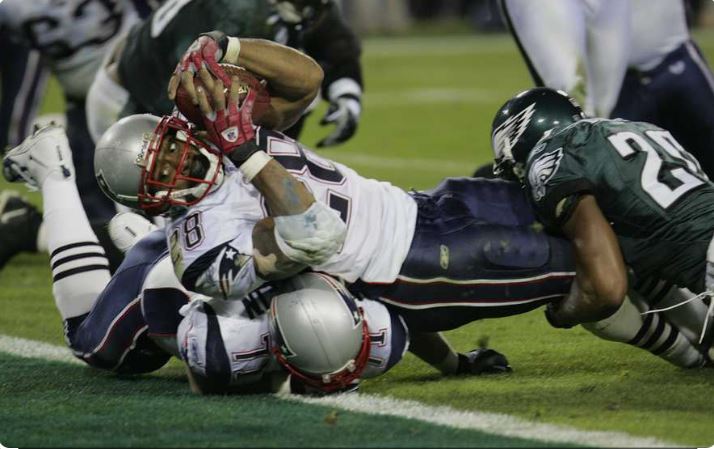
Try the driving force for their back to back championship season of 2004. He wasn’t just a member of that team. Dillon ran for a Patriots team record 1,635 yards and 13TDs & was the closer for the best of the three champions in their dynasty. He had 9 100 yard performances that year and the playoff clinching win came against Cincinnati. Where he received the game ball from Bill Belichick.

The Patriots went on to win Super Bowl XXXIX 24-21 which validated the career of Corey Dillon. Overall he rushed for 11,241 yards and 82 TDs. Dillon is one of a select few to set the franchise single season rushing record for two different teams.

As the argument heats up about the candidacy of other power runners like Eddie George and Jerome Bettis, neither showed the exhibition of power and speed Dillon displayed. Not to record breaking levels. He had 7 1,000 yard seasons and was a world champion. What could have become of Dillon’s career had he more talent around him??
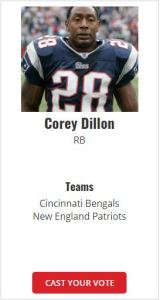
Please lend your thoughts as well by writing in to the Pro Football Hall of Fame to the address below. Be respectful and positively lend your voice:

Please write & nominate Corey Dillon
Send letters to:
Pro Football Hall of Fame
Attention Hall of Fame Selection Committee
2121 George Halas Dr NW, Canton, 
OH 44708

There is also a fan vote here on the PFHOF website

For induction into the Pro Football Hall of Fame, I present to you Corey Dillon.


The Chancellor’s Take on Peyton Manning

The old NFL logo

The old NFL logo

When it comes to NFL football no one has watched more games and studied the game more than The Chancellor of Football. It has always been the great escape for me to study the players, analyze games, dissect teams and playing styles of different eras. I can think back to the early 80’s when someone was watching “The Cosby Show” in the other room, I had a ton of paper out drawing up the “46 defense” and studying Bears games I recorded over in mine.

If I didn’t have a football video game going, I was outside playing it with friends. All  the while my mind was studying the nuances of the game. Then the study migrated to understanding the dynamics of coaches, the sociological aspects of football, the psyche of players, and the psychological make up of a team. What made the player tick…and why certain players received the coverage they did.

One of the real reasons I have been such a harsh Peyton Manning critic is the Alpha or Beta quarterback argument. He’s proven to be an alpha quarterback obviously but I wasn’t going to give him a pass because he was Archie’s son the way the mainstream media did.  I have never been a media darling type. I abhor it. The reason I gravitated to sports and football in general from the beginning was the exploits the athletes made were earned on the field of endeavor. Not what someone made up for them like a Hollywood movie or covered favorably when others are tortured by media types for the same short comings. Take a look at this comment from Facebook earlier when I described Matt Schaub in yesterday’s article. The Beta Quarterback.

“To come off this list you have to start winning the big games. I knew Schaub would regress for one simple reason. He NEVER beat the bully on his block. The Indianapolis Colts own him and even retooled on the run. He NEVER bested the Colts in significant games while Peyton Manning was there and now a whole new regime is in place and he still hasn’t grown. Pundits started to pick the Texans as a possible Super Bowl team because of other talent on the squad. Truth is…he’s a beta qb until he proves it beating good teams like Joe Flacco did last year. Only one way past the bully…you have to kick his ass…. If you don’t, you remain in this twilight.”

Peyton Manning with his college coach Phil Fulmer.

Peyton Manning with his college coach Phil Fulmer.

Think back to Peyton Manning’s inability to beat Florida when he was at Tennessee. The Chancellor of Football watched “the next big thing” all throughout his college career. I still have the highlights recorded when he and Jay Graham powered past Eddie George, Terry Glenn and the 4th ranked Buckeyes in the Outback Bowl in 1996…yet I digress

The fundamental flaw to NEVER take down your bully on your block goes with you psychologically for a lifetime. That bully is just substituted later by other people. i.e. Tom Brady and the New England Patriots. Yet in his coverage the mainstream media wanted to “make” him a champion before he became one.

What got his career launched is he played with 3 Hall of Fame talents that didn’t get the credit for it. Marshall Faulk, Edgerrin James, and Marvin Harrison. Faulk, who in 1998 nearly had the same stats as he did when the St Louis Rams won it all in 1999. He had 1319 yards to go with 86 receptions and 908 more yards and 10 TDs. Sure a baby faced rookie Manning showed promise, but he threw a rookie record 28 interceptions. Yet you didn’t hear of that through the mainstream media. However Kurt Warner in 1999, who had never started in the NFL won the Super Bowl the following season with Faulk.

Marshll had been relieved of duty when the Colts traded him to the Rams to so they could draft Edgerrin James. In 1999, James became the first rookie to lead the NFL in  rushing in nearly 20 years. In fact he joined Jim Brown, Earl Campell, and Eric Dickerson as the only runners to lead the league in rushing in their first two seasons. That is dating back to 1957. Yet all the coverage went to Manning as though Edgerrin wasn’t even there. James is one of only 3 running backs (Barry Sanders & Eric Dickerson) to have 4 seasons of over 1,500 yards rushing yet when we suggest he’s a Hall of Fame player, some scoff at the notion. Why?? All the coverage was on Peyton Manning and the mainstream media NEVER fed this information to the football masses. Never. He also went on to a Super Bowl without Manning with Kurt Warner ironically in Arizona 2008.

Then you have the quiet Marvin Harrison. Although the end of his career was somewhat shrouded with the backdrop of a gang related shooting death. This performer is the current record holder for receptions in an NFL season with 143 in 2002, and caught 1,102 passes for 14,580 yards and 128 touchdowns during his career. Just about the same as new Hall of Fame enshrinee Cris Carter, and finally we’re hearing about his Pro Football Hall of Fame candidacy. This was a #1 draft pick and All America talent at Syracuse catching passes from Donovan McNabb. Yet here is another that rarely received coverage because Manning was the national media’s end all be all when it came to covering the Indianapolis Colts.

The biggest issue is how the media chose to cover him as they thought he would be and not cover him fairly for how he performed. His first forays into the playoffs were underwhelming to say the least. In ’99 when they were the 2nd seed, they only managed 13 at home in a loss to the Titans. Three years later came the worst playoff loss of this millenia in a 41-0 loss to the New York Jets in the Meadowlands. Ironically the site of this year’s Super Bowl. They only gained 167 yards total in that game which was nearly a record low performance. Yet you never heard of these performances or the fact he has a record 11 playoff losses. Why?? Too much jock sniffing by the national media. Guys who wished they were Peyton Manning instead of just covering him.

One of the reasons you're seeing a record breaking season for Manning started here. The 2003 AFC Championship Game.

One of the reasons you’re seeing a record breaking season for Manning started here. The 2003 AFC Championship Game.

Keep in mind he was favored in Super Bowl XLIV and fell behind the New Orleans Saints. Marching for the tying touchdown in the fourth quarter he threw the pick six to Tracy Porter to seal the Colts fate. What would the media have said had that been Eli Manning?? Tony Romo?? Jay Cutler?? They would have buried him like he was Rex Grossman. You have to keep in mind the NFL offices pay attention to media coverage. We saw how much sway media had when the Colts lost the 2003 AFC Championship 24-14 to Brady’s Patriots.

The immediate coverage was on how the Patriots held their receivers and stretched the 5 yard “chuck zone” further downfield. Complaints from the Colts were all over ESPN and dominated the airwaves leading into Super Bowl XXXVIII between the Patriots and Panthers. Ironically they set a Super Bowl record with both quarterbacks throwing for more than 300 yards for the first time in history.

That off-season the NFL stated they were going to reinforce that rule just because of the complaints from Manning and the Colts. No one was able to touch his receivers without a flag and ironically this was the season he broke Marino’s touchdown record of 48. Funny, he couldn’t come within 16 touchdowns of it in his 6 previous seasons.

Is Manning a Hall of Fame??? Absolutely

Is Manning a Hall of Famer??? Absolutely

The coddling of Manning and the favorable officiating is why the Broncos receivers are able to run pass interference routes at their leisure. Whenever you hear these announcers say “pick” its a form of offensive pass interference. Ironically the league hasn’t had a knee jerk reaction to reinforce those rules. So the record book has shattered from this.

The real problem here is it cheapens the record book and cheapens the league as a whole. Just like rules for Michael Jordan ruined the NBA for purists, the same thing is happening in the NFL. What you’re doing is turning the sport into a television show. One where his games are officiated differently than other teams to manufacture a successful environment. Don’t tell me it’s a quarterback driven league when there are just as many who tune in for a stout defense or a record breaking runner. Then you hear the corporate types, who are wholly responsible for this, talk about ratings. Listen, in 1986 the Chicago Bears won Super Bowl XX in front of 120 million viewers. At the time on American television, the top 20 watched shows were 18 Super Bowls, the MASH finale, and Roots. The ratings have always been there, so come off that excuse.

Where Peyton Manning was / is concerned he’s given a pass for his flaws and celebrated for what he has done right as though it’s never been done before. Is he really better than Joe Montana when it comes to pre-snap reads?? He’s a better gun slinger than Dan Fouts?? A better deep ball than Terry Bradshaw or Johnny Unitas?? Is he better than Joe Montana at any aspect of quarterbacking?? I know he wasn’t better than Dan Marino in his prime. Yet you hear these pundits wax philosophical as though there is no footage of the 77 years of the NFL before his arrival.

Well here at Taylor Blitz Times, we do have tons of footage of all the greats. No, Manning isn’t the first who handled pre-snap adjustments. Audibles have been a part of the league for greater than 50 years.  The one description I love is how he plays with what scouts call “nervous feet”, which was to a quarterbacks detriment. All of a sudden pundits helped change that to a positive attribute.  Go figure.  He is a Hall of Fame player but keep it in perspective from a historical sense. Everything happening today isn’t the greatest ever seen and make sure you cover players fairly for what they do. After all it is a sport, right??

Thanks for reading and please share the article.

Protecting The Quarterback: A Knee Jerk Reaction

Remember when Jack Lambert was quoted “Quarterbacks should wear skirts.” back in 1975?? Well with another rule change or two they may actually be doing that. What happened yesterday was a complete travesty that could wind up derailing the season for the San Franciso 49ers.

Drew Brees is about to be sacked by Ahmad Brooks of the 49ers.

Drew Brees is about to be sacked by Ahmad Brooks of the 49ers.

Toward the end of yesterday’s game between the Niners battle with the New Orleans Saints, the game had boiled down to a critical third down. San Francisco had played a brilliant game on the road and were about to put on the finishing touches on what would have been a 20-17 win. Up until the moment of the hit, the Niners had held Drew Brees to just 200 yards passing the entire game.

It was 3rd and 2 from the San Francisco 35. Brees takes a Pistol snap and takes the equivalent of a seven step drop when Ahmad Brooks levels him. The ball comes out and Patrick Willis recovered back at the 48 with 3:17 to go. The first substantial drive of the fourth quarter by the Saints had been squashed and the Niners could run out the clock in a quiet Superdome….right?? Well there was a flag on the prescription turf.

Brooks was flagged for hitting Brees in the head.  Replay clearly showed that he hit him across the chest causing a fumble.

Brooks was flagged for hitting Brees in the head. Replay clearly showed that he hit him across the chest causing a fumble.

Unecessary roughness was called on Brooks indicating he had hit Brees in the head. During the call we heard the ref describe “attacking the neck of the quarterback”. The Saints retained possession and thanks to the 15 yard penalty were in position to tie the game with a field goal, changing the momentum.

The turn of events led to the Saints being in field goal range to tie the game. The subsequent change of momentum stymied San Francisco’s last drive and New Orleans last second kick to win it 23-20. A travesty had occurred with the Niners losing that game. You didn’t go away feeling the best team won, you felt something else. The Niners hadn’t been cheated like that since the 1983 NFC Championship Game.

The over-protection of quarterbacks is at an all time high and it’s ruining the game of football. On the play in question Ahmad Brooks came storming around the strong side and hit Drew Brees high but with his arm and shoulder across the chest. Because Brees wasn’t ready for it and didn’t brace himself causing a whiplash effect doesn’t make it a penalty. Brooks didn’t hit him in the head nor did he use his in making the tackle. Now thanks to a terrible call, the defending NFC Champions may not make the playoffs with a 6-4 record. They now have 3 conference losses and tie breaker advantages to several teams.

If this is a roughing the passer penalty, I'm from Mars.

If this is a roughing the passer penalty, I’m from Mars.

Quarterbacks are playing the game of football too. Personally, I like seeing quarterbacks knocked about, it’s one of the reasons you’re reading the Taylor BLITZ Times and not the Taylor Long Pass Times. We here understand the necessary measures but this is getting ridiculous.

Thanks to the knee injury suffered by Tom Brady in week 1 of 2008, a falling lineman can’t fall into the legs of a quarterback. The league always had a rule where if the defender was reaching to knock down a pass and hit the helmet, it’s a penalty. Now the referee is worried that Brooks hit Brees in the neck when replay showed clearly he didn’t. Never knew a quarterback’s neck was off limits. By the time we put in quarterback hook slides and such….Jack Lambert was 100% right. Not only should they wear skirts, they should take off their shoulder pads and helmets also.

Thanks for reading and please share the article.

The Soul of The Game: Earl Campbell

When it comes to great hitting in the NFL, the first vision that comes to mind are those of defenders teeing off on offensive players. Yet some of the most frightening collisions were those that took place when Earl Campbell ran with the football.

earl.isiahHis aggressive style of play burst onto the NFL scene in 1978 and for the next four seasons was the most dynamic force the league had seen since Jim Brown’s retirement more than a decade before.

In the lineage of great power backs he was Larry Csonka’s successor in the 1970’s while raising the profile of the Houston Oilers. He was used as a bludgeoning weapon to hammer defenses into submission. The only defense he couldn’t beat down with regularity was the Steel Curtain in Pittsburgh. In back to back AFC Championship Games in 1978 and 1979, they kept Campbell short of a deserved Super Bowl visit. Yet against Atlanta’s Gritz Blitz, Denver’s Orange Crush, or even Dallas’ Doomsday Defense, he was the Oilers complete gameplan. Some of his best games came against the best defenses of his day.


In 1977 the Atlanta Falcons had set the record for fewest points given up in a 14 game NFL season with 129. They’re “Gritz Blitz” of Jerry Glanville had first shot at the former Heisman winner in game one of 1978. Campbell smashed off tackle for a 73 yard touchdown in the 1st quarter en route to 137 yards for the game. The fact they were behind for much of the game is why he only carried 15 times. He showed he belonged.

Against the Dallas Cowboys in 1979, a national televised audience tuned in on Thanksgiving to see Earl Campbell vs. Doomsday at Texas Stadium. Again he broke off tackle trampling Cowboys on the way to a 61 yard touchdown that set the tone for the day. His 195 yards rushing was the most ever given up (at that time) in the history of Texas Stadium. He was the star of the game.

Yet when you think of Earl Campbell, it was the collisions that come to mind. He was the most physical runner in NFL history. You’d have to give him the nod over Jim Brown because of the size of the fronts he faced. In the 1960s Brown faced defenses that averaged 250 lbs on the defensive line. He outweighed the linebackers of the time and the contemporary talent was fractured with so much defensive size being displayed over in the AFL. Campbell was facing defensive linemen in the 280 lbs range with middle linebackers outweighing his 225 lbs.

He was able to produce more force than both Brown and Larry Csonka because of the additional room taking the ball on pitches and handoffs back in the I formation and not from a fullback setting. Who was the most punishing runner in NFL history in your eyes?? The Chancellor’s vote is in.

Roger Craig Should Be In Pro Football Hall of Fame

When you think back to Bill Walsh’s great 49er teams, who are the first players you think of?? Right there with the Joe Montanas, the Jerry Rices, and Ronnie Lotts it only takes a fraction of a second to think of Roger Craig. His high knee running style brought a physicality to the San Francisco offense that was seen as a finesse group up until his arrival. In fact he came to San Francisco as a fullback when they drafted him from Nebraska before the 1983 season.
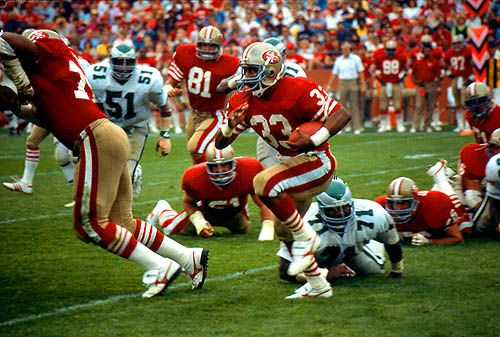
In college he had been primarily a blocking back in the Cornhuskers wishbone offense. Normally he paved the way for Jarvis Redwine and then Mike Rozier. Yet when Bill Walsh decided to revamp San Francisco’s dismal backfield after a 3-6 season in 1982, he drafted Craig in the second round.

Although the 49ers had won it all in 1981, it had become apparent Bill Ring, Amos Lawrence, Walt Easley, and Earl Cooper just wasn’t cutting it in the backfield. To raise the stakes in the NFC for 1983, Craig and newly acquired Wendell Tyler would form a more potent backfield.

After posting the worst yards per carry average (3.4) and yardage (742) in 1982, the new backfield duo of Craig and Tyler turned that around completely. The much improved ground game of 1983 ranked 8th with 2,257 yards rushing and a gaudy 4.4 yard average. Ironically just ahead of the Los Angeles Rams, who had traded Tyler to San Francisco so they could draft Eric Dickerson.

You had to give the nod to Craig who ran for 783 yards a team leading 8 TDs, while catching 42 passes for 427 yards and another 4 scores. This more dynamic backfield, along with Joe Montana, powered San Francisco to the NFC Championship Game. A 24-21 loss to the Washington Redskins was shrouded in controversy, thanks to some questionable calls, yet Walsh had the backfield he envisioned. Craig had reinvented himself from a collegiate player who rarely touched the football to a dual threat pro.

The 1984 49ers were a juggernaut becoming the first team to go 15-1 during the regular season. Everyone of the 49 man roster played their role so no one had outstanding stats. However once the 49ers moved past the New York Giants and Chicago Bears during the playoffs, the stage was set for a coming out party in Super Bowl XIX. With all eyes on Joe Montana’s possible second Super Bowl trophy and the electrifying record setting Dan Marino, Craig’s name didn’t even make the marquee.


Roger Craig graces the cover of Sports Illustrated after his record breaking performance in Super Bowl XIX.

Roger Craig graces the cover of Sports Illustrated after his record breaking performance in Super Bowl XIX.

It was his 1985 that set Craig apart as he amassed his 1,000/ 1,000 yard seasons both rushing and receiving. The first player in league history to do so. Some 27 years later, only Hall of Famer Marshall Faulk shares that accomplishment when he did it in 1999. How dominating was his performance?? Well his 1,050 yards rushing doesn’t jump out at you until you realize he only ran 214 times for a whopping 4.9 yards per carry. The league average is always around 4.0.

Oh by the way, he led the NFL in receiving that year with 92, which set a record for running backs, that amassed 1,016 more yards. His 15 total touchdowns was second to Joe Morris and was 1 better than NFL MVP Marcus Allen. In fact many pundits, including our CEO believes Craig should have been the MVP in 1985 with that dominating performance.

Now buoy his 1985 record setting season not culminating with the league MVP, on the backdrop of a Super Bowl record 3 TDs yet not winning that MVP and you’ll see where we’re going in a minute. Don’t forget he did this on a 10-6 San Francisco team that was a defending champion with Jerry Rice being a rookie that didn’t have 1,000 yards receiving and only 3 touchdowns. Craig quite simply fueled that offense.

Once the 49ers won Super Bowl XIX, they were forced to retool and become a bigger physical team. In 1985, the Chicago Bears emerged with one of the most imposing defenses in NFL history. The Giants followed suit with an overwhelming defense that featured 4 linebackers in the 250 lbs category. When Bill Walsh and his 49ers were dominated 49-3 in the 1986 NFC Divisional Playoffs by the Giants something had to be done.

These were teams the 49ers had beaten on their way to the ’84 championship, now they had taken the game to a new level of brute force. In reinventing the offense from a size perspective, it was Craig who was switched from fullback to halfback to allow for the insertion of Tom Rathman at fullback. The entire offensive line was overhauled.

You have to keep in mind the average career for a runner in pro football is less than 4 years. Yet here Craig was making the switch in year 5 to a position that called for him to be quicker. This at a time where he should have been slowing down from a physical standpoint. Yet he, Jerry Rice and Joe Montana spearheaded one of history’s most accomplished runs. From 1987-1990 the 49ers went 51-12 in the regular season, winning back to back Super Bowls in ’88 & ’89 and were the prohibitive favorites to win it all in 1987 as well as 1990. They finished #1 in offense in ’87 and ’89 and #2 in ’88 and ’90. In each year they made it to at least the divisional round of the playoffs and 3 straight NFC Championship Games as they were trying to threepeat.

Playing in only 12 games due to the ’87 strike, Craig ran for 815 yards which projects out to 1,086 over a full season. The 13-2 Niners were poised to become the greatest team of the modern era yet were upset by the Vikings in the playoffs. They were #1 in both offense and defense yet proved fallible in the playoff loss. Craig went on to his greatest performance in the 1988 campaign. In rushing for a career high and club record 1,502 yards, he also caught 76 passes for an additional 534  yards for his second season with over 2,000 yards from scrimmage. More important, he powered San Francisco to another Super Bowl championship with a win over Cincinnati in the XXIII’d edition.

Roger Craig was a hard nosed runner.

Roger Craig was a hard nosed runner.

Yet go back to 1988 being his second season with more than 2,000 yards from scrimmage. Keep in mind this was no sleek, make ’em miss halfback. He brought a punishing style to his position where he bludgeoned the opposition. As you’re reading this you can picture his high knee running style like when he trampled through the Rams on his most famous run in 1988.

Yet did you know that Emmitt Smith, Thurman Thomas, and Barry Sanders only had 2 different seasons amassing 2,000 yards from scrimmage also?? Did you also know that Marcus Allen and Adrian Peterson have only had one?? Only Edgerrin James, Marshall Faulk, Ladainian Tomlinson, and Eric Dickerson had more. What do all of these runners have in common?? Peterson and Tomlinson will be in the Hall of Fame and all the others are in. Roger Craig is right there with them.

Now going into the Hall of Fame is based on impact on the game. By the time we bring up the 1989 team that won Super Bowl XXIV, Craig was a driving force behind the team of the decade. Again he was a 1,000 yard rusher as the team won their fourth Super Bowl and Roger had his 3rd ring. When he left the game in 1993, his 566 career receptions was #1 among running backs all time and still remains 7th.

He is in the linear line of great NFL running backs when it comes to catching the football and is a part of the game’s evolution. He took the mantle from Chuck Foreman and propelled it forward. Since then, only a handful of every down running backs have provided that type of versatility. Now everyone has a receiving running back who comes in on 3rd downs where Roger was in every play.

It was Craig’s play that allowed a young Jerry Rice to flourish as teams concentrated their efforts to stop him. If Craig’s move to halfback in 1987 hadn’t panned out, what would have been the legacy of Bill Walsh’s “West Coast Offense”?? It was the run from 1987-1990 that made the offense spread it’s wings throughout the National Football League. During this time is when it proved it could take on the big bad Chicago Bears defense (see 41-0 1987 Monday Night shutout) and 28-3 NFC Championship win in Soldier Field in ’88. Then you add the rivalry with the New York Giants.

From Mike Holmgren to Denny Green to Mike White to Jon Gruden ( who had just begun coaching on the 1990 SF coaching staff) and George Seifert succeeding Bill Walsh. They all could attribute their Head Coaching jobs to some extent to Craig’s performance along with Montana and Rice. Yet the foundation of that offense running and receiving along with goal line and short yardage was #33.

By the way, when did Roger Craig become the the first running back to have a 100 yard receiving game in a Super Bowl?? You guessed it… Super Bowl XXIII against Cincinnati and not his record setting performance against Miami. Now had he won the Super Bowl XIX MVP, or the 1985 NFL MVP, would that have propelled him to winning the NFL MVP in 1988?? Give it some thought.

For induction into the Pro Football Hall of Fame, I present to you…Roger Craig

The Chancellor’s Take on Tributes At NFL Games

The NFL is built on the backs of great players who have made this game into an American institution. Great players have come and gone and their exploits were usually passed down generation to generation by fathers to sons, uncles to nephews, and every combination of sons and daughters you can think of.  Newspapers and word of mouth were how legends were built as the NFL emerged from the 1940’s on. That’s until television began to take over as the major story teller of the modern game. However in the last decade even television lost it’s soul for passing down stories that newspaper and families failed to miss.

Raven GM Ozzie Newsome addressing Ray Lewis during his "ring of honor" ceremony earlier this year.

Raven GM Ozzie Newsome addressing Ray Lewis during his “ring of honor” ceremony earlier this year.

Yet if you make it to an NFL game during the early portion of the season, you may run into an onfield tribute to a player or championship team from years gone by. However television execs don’t think the television audience should see it. That has to be the attitude taken as we didn’t get to see any of Ray Lewis’ tribute a month ago. Instead, we had to hear talking heads at the half talk about a game we had already spent an hour and a half watching. Seriously??

To not watch Ray Lewis tribute was glaring but wasn’t the worst example of this. That happened on Thursday Night to start week 4. The St. Louis Rams were playing the San Francisco 49ers and hosting alumni of over 5 decades of excellence. Including former players who played their careers back in Los Angeles. Men like “Jaguar” Jon Arnett.

The legendary Jon Arnett along with current Ram coach Jeff Fisher, former players Les Josephson, and Roger Brown.

The legendary Jon Arnett along with current Ram coach Jeff Fisher, former players Les Josephson, and Roger Brown.

If you asked who is  Jon Arnett, you’re exactly who would have benefited from the game broadcast including the tribute to all the former Ram players. What made this painful is this was NFL Network that was broadcasting the game and not Fox, CBS, or ESPN. The NFL Network commentators would make mention when the camera would catch a former Ram on the sideline.  But only when it was an Eric Dickerson, or a Greatest Show on Turf player from the early 2000s. I can’t believe the NFL’s own network would miss that opportunity to be the catalyst to start some of those father /son stories of the men that shaped the league.

Some of the Ram alumni on the sideline during the Rams v. 49ers in week 4.

Some of the Ram alumni on the sideline during the Rams v. 49ers in week 4.

As the NFL has gone more corporate, it hasn’t cared about the players who built the league and fight for their benefits later in life. Yet these are proud men whose accomplishments and contributions shouldn’t be swept into the dustbin of history. How do we know this??

Well let’s take you back to the turn of the century. No, not 1900, I’m talking about 2000. Twice on Monday Night Football we were offered retirement ceremonies for both Dan Marino, and John Elway. ABC allowed the viewer to enjoy what fans in Joe Robbie, and Mile High Stadium were able to witness. How many stories were told those nights to young football players around the country?? How many of today’s NFL players had fathers, uncles, or grandparents, share stories of Elway and Marino on those nights??

An all purpose threat for the Los Angeles Rams and later the Chicago Bears, Arnett was a 5 time Pro Bowler. Worthy of the Pro Football Hall of Fame, Arnett has been a friend to Taylor Blitz Times since it's inception. I call him "Captain Cutback" and he was right behind Frank Gifford in the lineage of great USC tailbacks.

An all purpose threat for the Los Angeles Rams and later the Chicago Bears, Arnett was a 5 time Pro Bowler. Worthy of the Pro Football Hall of Fame, Arnett has been a friend to Taylor Blitz Times since it’s inception. I call him “Captain Cutback” and he was right behind Frank Gifford in the lineage of great USC tailbacks.

ABC did this again before the 2001 season when Terrell Davis had his retirement ceremony live before a televised audience. Before that we had Phil Simms throw a pass to Lawrence Taylor during his retirement ceremony in 1995. Also on Monday Night. it was understood what it meant to share the games history and aid in story telling that inspired the next generation of football players. Now even the NFL’s own network doesn’t even recognize this.

They robbed some little boy or girl of watching the pregame / halftime ceremony of former Ram players and ask: “Dad, who is that guy in the white jersey?? You know #26 right there??”  just before his father could answer, his uncle or grandfather would walk in with a beer and a bowl of chips and respond “That’s Jaguar John Arnett…and you should have seen him play. He was the most elusive….

If the networks won’t stop and offer something more rewarding than studio analysis of a game we have watched for nearly 2 hours. To hell with it, Taylor Blitz Times will do it.  Shut up and let us see the ceremonies in the stadium…please.

Thanks for reading and please share the article.