Missing Rings: The 1986 Seattle Seahawks

Now that the ink is drying in the record book for the Super Bowl Champion Seattle Seahawks, it’s interesting to look at the team’s overall history. When we travel down the road to yesteryear, our remembrance of great teams that should have won the Super Bowl are normally teams that appeared in it. Yet if we returned to the last week of the season of 1986, you’d be surprised to learn the team that scared everyone going into the playoffs that year was the Seattle Seahawks.

The real Curt Warner was the first real super star in the history of the Seahawks.

The real Curt Warner was the first super star in the history of the Seahawks.

I know what you’re thinking. How could one of the best teams in Seahawk history be better than a team that appeared in the Super Bowl?? Well for starters the squad that made it to Super Bowl XL survived a fairly weak NFC playoff pool. Even the NFC Championship win had them best the Carolina Panthers who were starting a 4th string running back.

The team was born out of the expansion draft in 1976 along with the Tampa Bay Buccaneers. They struggled mightily early on until a couple drafts in the early 80s brought superstars to the Pacific Northwest. In 1981 they drafted 3 time All American Safety Kenny Easley to fortify the defense. Two years later they brought in RB Curt Warner to bring juice to the offense. Where the bulk of media attention was on the class of ’83 quarterbacks, the real Curt Warner had a great rookie season with 1,449 yards rushing and 13 TDs.

They made their first foray into the NFL playoffs where they ended John Elway’s rookie season with a 31-7 win under the artificial sky of the Kingdome. Where it was thought this was as far as they could go, they went on to a huge upset over Don Shula’s Dolphins on the road 27-20. The Seahawks found themselves just one game away from Super Bowl XVIII and a trip to Los Angeles beckoned. They had swept the 12-4 Raiders during the regular season and were playing in their first championship in team history. One more win and the cinderella Seahawks would play for it all down in Tampa.

Another big time defender Seattle had was Jacob Green

Another big time defender Seattle had was Jacob Green

In the AFC Championship, Marcus Allen came of age rushing for 154 yards while snagging passes for 62 more as the Raiders prevailed 34-14. It seemed the Seahawks had turned the corner, yet the team was unable to put together a championship run in 1984 when Warner was lost for the season. They were bound together by their defense but the lack of offensive firepower came back to haunt them in a 31-14 playoff loss to the Dolphins.

Hall of Fame receiver Steve Largeant was the steady star who was a perennial 1,000 yard receiver.

Hall of Fame receiver Steve Largeant was the steady star who was a perennial 1,000 yard receiver.

They followed that with an 8-8 record in 1985 as they eased Warner back after a knee reconstruction. He did make it past 1,000 yards but it was Dave Krieg who came of age. He made the Pro Bowl in ’84 after throwing a team record 32 touchdowns, yet tossed 24 interceptions. He reduced his picks to 20 in 1985 in his second full season as a starter.

After back to back campaigns with over 3,600 yards passing from Krieg, Warner’s knee gaining full strength, and returning with the NFL’s 11th ranked defense featuring the 1984 NFL Defensive Player of the year in Kenny Easley…1986 looked like it would be the Seahawk’s year.

From the outset of 1986, Seattle was on a mission. They opened with a rousing 30-0 win over Pittsburgh. They made it to 2-0 before having to take on the defending AFC Champion Patriots on the road. Down 31-21 with less than 8 minutes to go, the Seahawks turned it on scoring 17 points including a blocked kick to stun the Patriots 38-31. Despite the fact Tony Eason passed for 414 yards and 3 TDs, Seattle showed how strong they could turn it on offense, defense, and special teams to win against a quality opponent.

At no time was this more evident than when they took on the eventual Super Bowl champion New York Giants  in week 7. The Seahawk defense took over and sacked Phil Simms 7 times while intercepting 3 of his passes. Jacob Green had the best game of his career as he registered 4 sacks. He did this against T Brad Benson, who 8 weeks later, became the first offensive lineman ever named NFC Offensive Player of the week for his performance against Dexter Manley. On this day in the Kingdome however, they couldn’t slide the line or help Benson as the Seahaks won a slugfest 17-12.

At 5-2 the Seahawks had proven to win every type of game against the stiffest of competition. This is the mark of a champion. The only opponent they couldn’t overcome was themselves. Following the win in New York, they lost a marquee game against Denver for the AFC West divsion lead 20-13. What was painful is they had two touchdowns in that game called back. They lost their mojo and went on a four game tailspin and fell out of contention.

The one constant that kept the season from turning sour in 1986: Curt Warner

After a team meeting, the Seahawks went on a tear as they finished with a five game winning streak. Curt Warner was the lead horse as he ran for 556 yards on 110 carries with 6 touchdowns over that time. The assault started with 122 yards in a 31-14 win in Dallas on Thanksgiving. He scored twice as he tallied 116 yards in a 37-0 Monday Night massacre against the division rival LA Raiders. Which set up the final game of the season where he saved his best performance for last.

Before we go there we have to mention the defense raising their level of play. During the 4 game losing streak, the defense had broken allowing an average of 451 yards / 29.75 points per game and only logged 5 sacks. Over the last five weeks the defense improved dramatically. They only surrendered 272 yards and only 10 points per game. The #1 and #2 defense in Chicago  and New York gave up 258 and 297 yds per game respectively. In the Monday Night 37-0 win against the Raiders, they registered a team record 11 sacks.

This five game streak included a match-up with the eventual AFC Champion and Division Champion Denver Broncos, in the regular season finale.

That rousing 41-16 win was the culmination of the team finally firing on all cylinders. NFL playoff tie-breakers kept the 10-6 Seahawks out. Yet for the first time in the Super Bowl era, one team beat both Super Bowl participants during the season. The Giants last loss was a 17-12 defeat up in the Kingdome in week 7. Then the finale blowout of the Broncos.

To this day, the Dave Krieg to Steve Largent connection remains the best in team history.

To this day, the Dave Krieg to Steve Largent connection remains the best in team history.

No one wanted to face this team as the ’86 playoffs were being set up. You had Curt Warner’s conference leading 1,481 yards and 13 touchdowns. Fellow Pro Bowler and future Hall of Famer Steve Largent’s 70 receptions for 1,070 yards and 9 TDs. The league’s  best kick returner in Bobby Joe Edmunds. Emerging star in Pro Bowl linebacker Fredd Young and a now healthy quarterback in Dave Krieg (60% completion rate/ 21TDs – 11 ints). They had to sit and watch a knock kneed New York Jet team become the first team in NFL history to make the playoffs after losing their last five games.

This is a cautionary tale as to why you have to win every game. During their 4 game losing streak they lost to those Jets 38-7. Cautionary?? This easily could have been your Super Bowl XXI champion. They finished 8th in offense and their defense was 8th in points allowed. They were jelling as the playoffs neared and in 1986 they played the league’s toughest schedule. They faced 3 of the 4 teams that made the conference title games that year.

In that regular season loss to the Jets, they may have left their ring on the table.

Thanks for reading and please share the article.

chancellor.krieg

Legends Of The Fall: Mike Quick

When you talk about the greatest receivers in NFL history, the name undoubtedly at the top of the list is Jerry Rice. Yet when you think of being able to catch passes from back to back Hall of Famers, it made it easier to accomplish what he did. With sporadic quarterbacking what would Rice’s career resemble most?? That of Mike Quick the player who most reminds our CEO of Rice.

Some may scoff but you have to remember in the early 1980’s, the big numbers coming from receivers were all in the AFC. The great quarterback class of ’83, the Air Coryell Charger receivers, Marino and the Marks Bros., and Steve Largent up in Seattle.

From 1983 through 1986, no one was better than Quick who caught 263 passes for 4,647 yards and 42 touchdowns. He was Jerry Rice before Jerry Rice yet was stuck between the aging Ron Jaworski and the emergence of Randall Cunningham which cost him in the end. Think about it… In 1986 Quick had the 4th of his 5 straight Pro Bowl appearances. He totaled 60 receptions for 939 yards and 9 touchdowns. Not great totals until you realize the Eagles set an NFL record allowing 104 sacks.

His 1983 total of 1,409 yards receiving was the most since Hall of Famer Don Maynard in 1967. That was the year Joe Namath became the first quarterback in history to throw for 4,000 yards. Quick played on the 27th (2nd to last) ranked offense in the NFL in contrast. He played for defensive minded head coach Marion Campbell. What would the late Bill Walsh been able to accomplish drawing plays up for Quick??

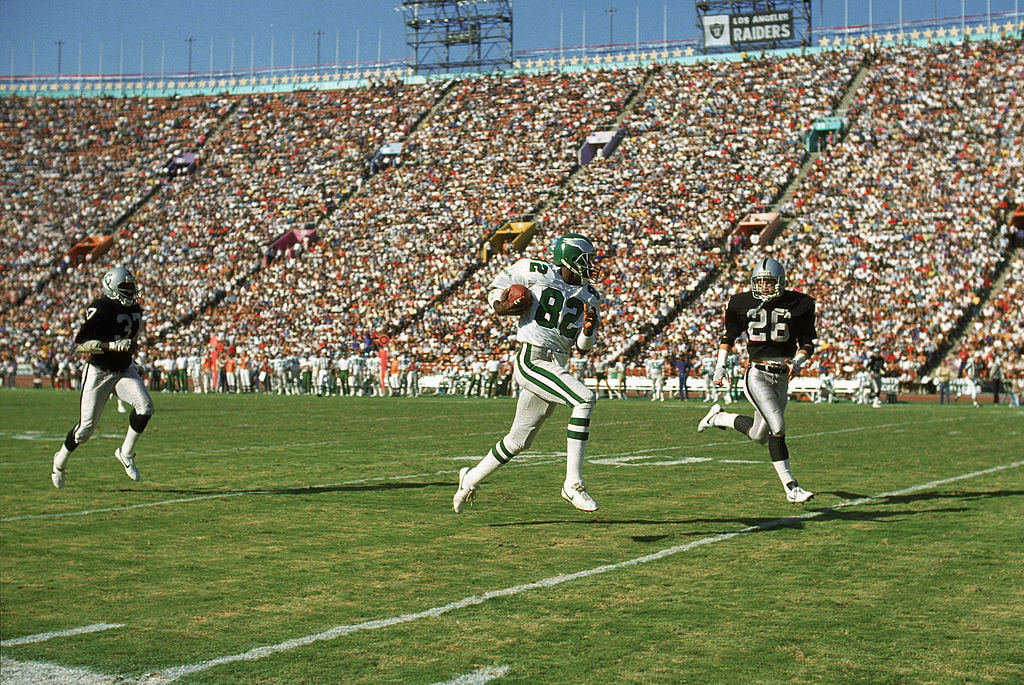
Quick making a big play against the Redskins.

Quick making a big play against the Redskins.

In the end you can understand the dilemma that affects certain careers. The cupboard was bare as he played his first 7 years without a single fellow Pro Bowler on offense. By the time Randall Cunningham made the Pro Bowl in ’88, the Eagles had drafted his heir apparent in Cris Carter.

After injuries robbed Quick of his once lethal speed, he retired after the 1990 season. His 363 catches for 6,464 yards and 61 TDs falls short of Hall of Fame consideration. Yet in his prime, he was an electrifying performer who could score from anywhere.

thanks for reading and please share the article.

Legends Of the Fall: James Brooks

From time to time you’ll find NFL teams trying to recreate what they once had and totally undervalue a current player on their roster. Never was this more evident than when the San Diego Chargers overreached for a big back to replace the aging Chuck Muncie. At first they signed late Ricky Bell who couldn’t stay healthy. Then they made one of the worst trades in NFL history, trading the multifaceted James Brooks to Cincinnati for FB Pete Johnson.

James Brooks burst onto the NFL scene in 1981 out of Auburn.

James Brooks burst onto the NFL scene in 1981 out of Auburn.

How lopsided was that trade in 1984?? Pete Johnson only played 3 games with the Chargers before being released. Brooks went on to play 8 seasons for Cincinnati gaining 9,459 combined yards and 64 touchdowns. During that time he ran for 1,000 yards on 3 occasions while compiling 5 seasons with over 1,200 yards from scrimmage. Not only did he make the Pro Bowl 4 times, he broke Johnson’s all time team rushing record and helped the Bengals to Super Bowl XXIII.

Although they brought in another Auburn tailback in Lionel James, this was the end of the Air Coryell reign. Age and injuries derailed their effectiveness where Brooks played on with the Bengals through the 1991 season. Why would you trade a proven commodity that led the league in all purpose yards in his first two years?? One could speculate how Chargers ownership under Gene Klein was dreading impending contract demands. Don’t forget this was only 3 years removed from trading away WR John Jefferson and DE Fred Dean for the same thing.

JamesBrooks2Brooks was one of the toughest and most durable runners at 180 lbs in NFL history. His game was a speed game but he broke tackles when he ran inside traps. He took on linebackers and safeties. His best run ever was a 56 yard TD run against the Patriots in 1986 in which he broke several tackles and drug SS Roland James into the endzone.

James Brooks was a great performer whose numbers will fall just short of Hall of Fame consideration. His trade stands as a cautionary tale to GMs everywhere. He was one of a long line of Auburn running backs that came into the NFL starting with Joe Cribbs, himself, Lionel James, and Bo Jackson during the 1980’s. Yet it was Brooks who out rushed them all.

Thanks for reading and please share the article.
Rashard Mendenhall Retires

Now when most heard the news of Rashard Mendenhall’s retirement earlier today, many compared him to Ricky Williams for stepping away at only 26. Yet the player that came to The Chancellor’s mind was former RB Robert Smith who retired from the Minnesota Vikings after 2000 at the age of 28.

Retired at 26.

Retired at 26.

Talk radio exploded with “How could he walk away from millions of dollars?” Yet these same pundits would have barbecued him had he been one of those that hung on past his prime just for a check. Good morning my nation of cynics.

His reasons for retirement only need to satisfy him. It reminds me of Robert Smith’s retirement because he wanted to pursue other interests when he could stay a few more years. Citing his wish to walk away from the game for the sake of his future health is noble. After all hasn’t concussion and post career health been the major topic the last few NFL off-seasons??

The cynical fan whines and pines for players of a woe be gone era where they played for the love of the game. Yet can’t understand the player who is leaving the game because has waned. Don’t worry Mendenhall your decision is respected here and we wish you well with future writing endeavors and whatever you decide to do in life. There is a lot of life left after 26. Enjoy it.

Thanks for reading and please share the article.

The Soul Of The Game: Gary Fencik

It’s not written in stone but it has been understood to play defense for the Chicago Bears, you have to be a hitter. Think back to the great Bears Safeties from yesteryear: Doug Plank, the late Todd Bell, the late Dave Duerson, and you have to place Gary Fencik as one of them. Receivers just didn’t cross the middle in Chicago.

Fencik upending Clint Didier in 1985

Fencik upending Clint Didier in 1985

Fencik played with disregard for his body. Over the years programs had him listed between 178-185 lbs. Recently, profootballreference.com had him listed at 194, no way. Anyone who watched him play saw how thin he was and with all the collisions he caused, are surprised at how few games he missed during his career.

In a 12 year career he made the Pro Bowl twice and was voted All Pro once. He may not make the Pro Football Hall of Fame but he has been immortalized as one of the members of the ’85 Bears and the legendary 46 Defense. He was a warrior that manned the last line of defense if you made it past the Bears great front seven. He was a great hitter who lives on in the memory of those historians and fans who tell his story. One whose inclusion in my Soul of the Game series of great defenders took it to their opponents the way it was meant to be played.

Thanks for reading and please share the article.

Corey Dillon Belongs In The Hall of Fame

There are many NFL fans who miss true talents around the league and just focus on their team. That narrow focus can keep one from seeing a Hall of Fame talent at work. That doesn’t mean an overlooked player should miss the call to the hall if he doesn’t garner great media attention. It’s about what they accomplished on the field and how well their peers respected their exploits.

Did you know that at one point Corey Dillon owned the greatest single game rushing performance and the #6 performance in NFL history?? Not Emmitt Smith, Barry Sanders, Eric Dickerson, LaDanian Tomlinson, nor Adrian Peterson or any great back you’ve ever watched accomplished that . Well, you have to be in your mid fifties at least to say you saw someone perform to that high a level. That was when OJ Simpson held sway in the NFL. You’d have to be in your fifties!!
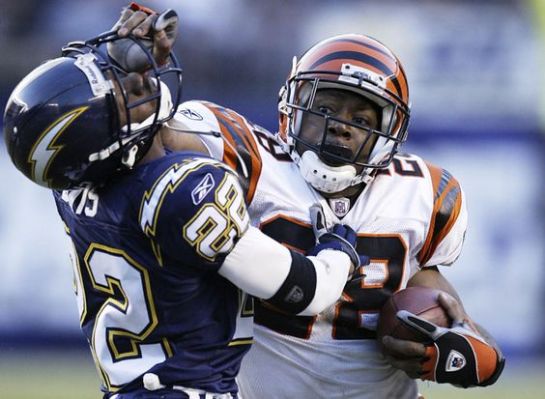
Not only that, his 6th place (at the time) performance stood as the NFL’s rookie rushing record at 247 yards in a 1997 game against the Tennessee Oilers. That record Dillon broke had been Jim Brown’s. Each of these have since been broken but it was the manner in which they were set that sets them apart.

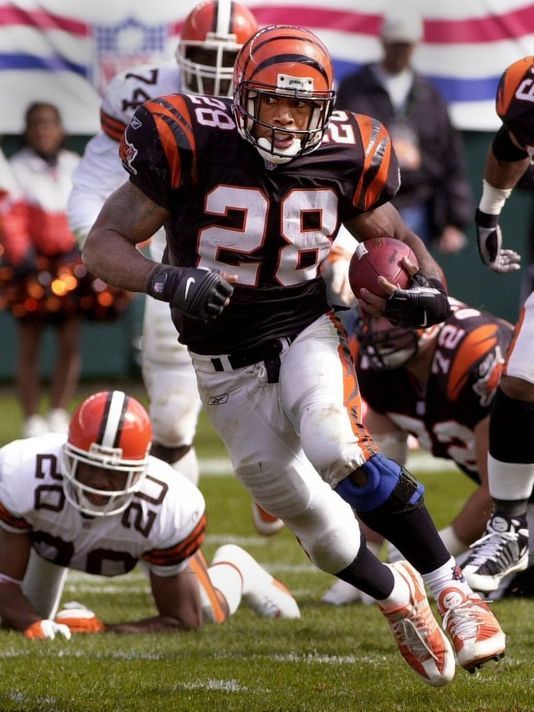
Unlike the shifty make ’em miss running style of most halfbacks, Dillon struck like the hammer of Thor. He was a passionate violent runner that thrived on contact. Once he positioned a defender to one side, he’d forearm, stiff-arm, or shoulder right through them. He made a joke of arm tackles and if you wanted to tackle him, your heart had better be in it.

For years media pundits painted him with the broad brush of that of a malcontent. Yet let me ask: If you were one of the best talents in the league, how frustrated would you be with a team that couldn’t get you any help?? In 1999 Inside The NFL broadcast their show from Cincinnati asking “Why can’t the Bengals tun it around?? Were they the JV of the NFL??” They interviewed player after player and the only one whose eyes burned fire with frustration were Dillon’s.

For an instant you could peer into his soul and you understood him completely. For all the hard work to make it to the NFL, then play for a franchise that couldn’t field a better team. He was toiling in anonymity loss after loss. All those childhood dreams of playing in a Super Bowl were dying an agonizing death.
It looked like 2000 would be no different as the Bengals started out 0-6. The optimism of having their 1st season in Paul Brown Stadium was fading fast. They had only scored 34 points while being shut out 3 times when the Denver Broncos, just two years removed from back to back championships, came to town. At the time the Broncos had the NFL’s 2nd ranked run defense.

The heavens opened up and the football god’s touched Dillon, allowing his fury to be unleashed in the greatest rushing display in NFL history.

Inside The NFL Perspective:

Did The Chancellor of Football say the greatest rushing display in the history of pro football?? Absolutely!! Listen, on a day when the Bengals completed just 4 passes, Dillon got off on a defense focused squarely on him. As for the record of 278 yards being broken twice by Jamal Lewis and Adrian Peterson, we will put them side by side in a minute. You have to remember the football world was still reeling from Walter Payton’s death. We were just 1 week short of the 1 year anniversary of his passing. As for the record comparison:

  • 2000 Corey Dillon 22 car. 278 yds 2TDs
  • 1977 Walter Payton 40 car. 275 yds 1 TD
  • 2003 Jamal Lewis 30 car. 295 yds 3TDs
  • 2007 Adrian Peterson 30 car. 296 yds 3TDs

However a closer look and Corey lost 6 yds on 6 of his carries. So in essence he ran for 284 yards in 16 carries or 17.75 yards per rush!!! Yikes!!! Best in history by a wide margin… It was Corey who wiped Jim Brown and Walter Payton from the record book, proving to a generation those records weren’t unbreakable. Payton’s record had stood for 23 years.

Dillon finished the 2000 season with a team record 1,435 yards rushing. Don’t forget he had two games against the  record setting Super Bowl champion Raven’s defense that ranked #2, and two more vs. Tennessee’s ranked at #1. What would he have done had he played in a less stout division defense-wise??

What would he have done behind a line like the Dallas wall with Larry Allen??

In 7 years he only played once with a Pro Bowl lineman.  That was T Willie Anderson in 2003. By then he was splitting time with Rudi Johnson. In that same year Chad Johnson (Ocho Cinco) made the Pro Bowl. Other than that he played with NO Pro Bowl players during his Cincinnati years. In those circumstances he ran for 1,000 yards in 6 of 7 seasons. In stark contrast Emmitt Smith’s line had 16 Pro Bowl Linemen and TEs between 1991-1995 alone. But alas he was traded to the New England Patriots for a second round pick when he failed to rush for 1,000 in 2003.

What did the Patriots get??

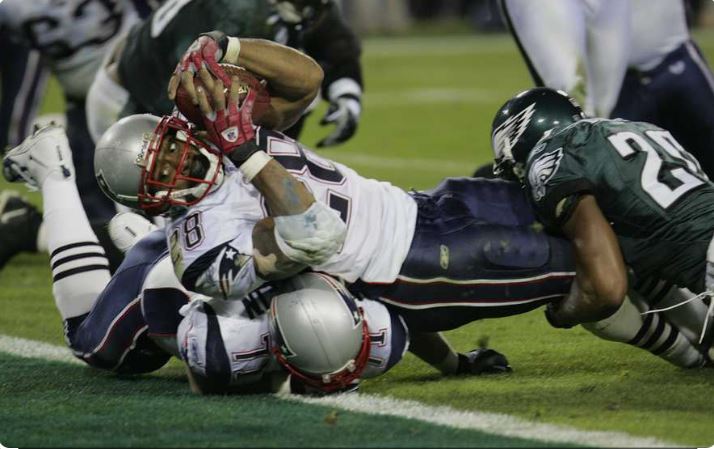
Try the driving force for their back to back championship season of 2004. He wasn’t just a member of that team. Dillon ran for a Patriots team record 1,635 yards and 13TDs & was the closer for the best of the three champions in their dynasty. He had 9 100 yard performances that year and the playoff clinching win came against Cincinnati. Where he received the game ball from Bill Belichick.
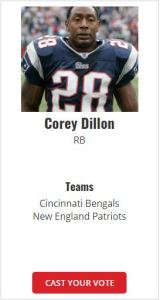
The Patriots went on to win Super Bowl XXXIX 24-21 which validated the career of Corey Dillon. Overall he rushed for 11,241 yards and 82 TDs. Dillon is one of a select few to set the franchise single season rushing record for two different teams.

As the argument heats up about the candidacy of other power runners like Eddie George and Jerome Bettis, neither showed the exhibition of power and speed Dillon displayed. Not to record breaking levels. He had 7 1,000 yard seasons and was a world champion. What could have become of Dillon’s career had he more talent around him??

Please lend your thoughts as well by writing in to the Pro Football Hall of Fame to the address below. Be respectful and positively lend your voice:

Please write & nominate Corey Dillon
Send letters to:
Pro Football Hall of Fame
Attention Hall of Fame Selection Committee
2121 George Halas Dr NW, Canton, 
OH 44708

There is also a fan vote here on the PFHOF website

For induction into the Pro Football Hall of Fame, I present to you Corey Dillon.