Devin Hester on one of his electrifying returns against Kansas City
The NFL is blowing it with this with this new rule change. A good kick return raises the hair on the back of your neck when it gets to that point where the returner is on the verge of breaking one. What is interesting is this rule reverses the 1994 decision to move kickoffs from the 35 to the 30 yard line to generate more excitement. Over these 17 years there have been many dynamic returnmen. From San Diego’s Andre Coleman to today’s Devin Hester (the U), you made sure your ass was back from the refrigerator to catch the kickoff. Now take the extra few minutes, you’re only going to miss a bunch of touchbacks.
In 1993 league brass responded when they heard fans explain why they liked the college game better. It was more exciting with the wide open offenses, kick returns, the two point conversion, the 1 point if the conversion was returned against you. Every element of the game had to be watched and lends an excitement when thinking ‘what is your team going to do in a given situation’. The NFL in contrast had a majority of their kickoffs flying out of the endzone having drafted all the top legs from the collegiate ranks. Where most teams have specialists just to return kicks, back in 1993 teams had specialist kickers just to kickoff!! Remember Brad Daluiso?? He made a career out of the fact he could boom the ball 70 yards on kickoffs http://www.pro-football-reference.com/players/D/daluibra01.htm. Notice his early career numbers for actual field goals. In the 1993 finale between the New York Giants v Dallas Cowboys, made famous for Emmitt Smith’s playing with a separated shoulder. The Giants had come from behind to cut the score to 13-10. Then on the ensuing kickoff Daluiso’s kickoff was so extreme that Cowboy kick returners Brock Marion and Kevin Williams (The U) stood in the middle of the endzone, as the kick was still 40 feet over their heads and hit the Meadowlands wall. The NFL wants that back??
So the NFL adopted the 2 point conversion and moved the kickoffs back from the 35 back to the 30 yard line with the sole purpose of generating excitement. What a noble concept?? What is the reversal of that going to do??
We here at Taylor Blitz Times are all about player safety but at some point you can’t take away the spirit of the game. Its still a collision sport!! Rules have been modified over the last two years to eliminate wedges on kickoffs. Moving down to just two people running interference before a kick returner in a tight formation instead of five. Therefore this eliminated the wedge buster, the kamikaze player whose sole purpose on returns was to violently throw himself at the chain of blockers in an attempt to strip the returner of his interference. We saw horrific injuries like Kevin Everett’s of Buffalo a few years back and that rule change was a good one. We saw less injuries on kickoffs over the last few years with more one on one area blocking on special teams.
This is a knee jerk reaction to the concussion epidemic and player safety awareness that is permeating the league right now. Rules need to be enforced where players aren’t leading with their heads (spearing) as they collide with another player. Ejections and fines for doing so will straighten that out right away. Yet eliminating the kickoff from the pro game is what will happen. Look at the advancements in workout regimens and body building supplements over the last 17-20 years. You don’t think kickers have gotten stronger?? If they were booting them out of the endzone in 1993 which precipitated the rule changes of 1994, what do you think will happen now??
Devin Hester
Between Super Bowls I and XXVIII (1-28 for the roman numeral impaired) there were only 2 kickoff for touchdowns, where from XXIX-XLI (sigh…29-41) there were five. Who could forget the back to back kickoff returns in Super Bowl XXXV between the Ravens and the Giants?? That was the most exciting point of that game. Or the electrifying start to Super Bowl XLI when Devin Hester blew by Adam Vinatieri and the Colts special teams on the opening kickoff?? Speaking of Hester, many pundits and experts believe that this is a rule change to limit Hester’s effectiveness for the Bears. We believe it as well. This eliminates the edge that the Bears had on their NFC brethren in special teams which could be born of their unexpected run to the NFC Championship last year.
The NFL needs to change this rule back to the one that was altered to add excitement to the game, not eliminate it. Vince Lombardi said that “football is a game of blocking and tackling.” So tackle the kick returner, don’t legislate his effectiveness into watching him down the ball on 50 % of his opportunities. Wake up!!
You can still hear Chris Berman saying “Marshall! Marshall! Marshall!” on NFL Primetime. Can’t you? When we think of great players we tend to think of them at their zenith. For Marshall Faulk it was definitely the years of “The Greatest Show on Turf” where he played his way into the Hall of Fame in just three years. The earlier years were just a harbinger of things to come.
Yet when I think of Marshall Faulk, I think of a faster version of Thurman Thomas. Better yet, if we spliced Thurman Thomas with Barry Sanders, this is the hybrid that would have been created. In fact it was Sanders departure that swung the door wide open for this talent to finally get his acclaim on a world wide basis. When Barry retired, the NFL lost it’s instant highlight reel. We were spoiled as fans because week after week we saw something spectacular and weren’t sure if we’d see that again. Enter Marshall Faulk.
The NFL world was mourning the loss of John Elway and Barry Sanders to retirement. Then we were thrown for another loop when the Indianapolis Colts selected Edgerrin James ahead of Heisman Trophy winner Ricky Williams. Almost as an afterthought Marshall Faulk was traded by the Colts to the Rams to make way for James. Instantly, I remember saying this is the Football Gods reversing the Eric Dickerson trade. Referring to the Rams trading Dickerson, the greatest runner of his era, to the Colts in 1987.
No one was really paying attention to Marshall Faulk going to St Louis yet being in Anaheim at the time, I was still in the Rams television market. My response was a flippant comment and not a premonition but it turned out to be. History would judge this trade on what happened with both teams. I thought the Colts had made a mistake letting Faulk go. So who won the Marshall Faulk / Edgerrin James trade??
Marshall Faulk in Super Bowl XXXIV
Super Bowl XXXIV Ring
The St Louis Rams became “The Greatest Show on Turf” thanks to a forgotten running back who could play receiver, had moves and an effortless running style with a burst. In three seasons (1999-2001) he rushed for 4,122 yards averaging 5.4 yards per carry while scoring 59 touchdowns!! Won 2 NFL Offensive Player of the Year awards and an NFL Most Valuable Player Award while taking the Rams to 2 Super Bowls. They won Super Bowl XXXIV beating the Tennessee Titans 23-16. Before Faulk the Rams had not been league champion since 1951.
In the 1999 championship season alone, he joined Roger Craig as the only other back to gain 1,000 yards rushing and receiving in the same season. When Craig did it he had 1,050 yards rushing, 1,016 receiving. Faulk burst by that with 1,381 yards rushing and 1,048 yards receiving while sitting out most of the last 3 quarters of the finale against Philadelphia.
That game the Rams lost 38-31 and Faulk would have stretched his numbers further had he played that game and the 4th quarter of 4 other blowouts at home. Not factoring that in, Faulk still broke Barry Sanders record for total yards from scrimmage with 2,429 yards. Greatness. He was the impetus for one of the NFL’s greatest champions.
How do you follow up a season like that? How about narrowly missing another 1,000/1,000 season with 1,359 yards rushing and 830 receiving while setting a new record by breaking Emmitt Smith’s TD record with 26 TDs. In 2001 he led the league with yards from scrimmage for the 4th straight year tying the record of Thurman Thomas. Yet all four of Faulk’s seasons were over 2,000 combined yards where Thomas only had 3. Now when you look back and see that in 1998, in his last season with the Colts, he ran for 1,319 yards and caught passes for 908 yards. He had four consecutive seasons where he flirted with 1,000/1,000.
He broke records and tied another of Hall of Fame running backs, how could he not be enshrined with them with numbers like that?? All this to lead the Rams in becoming the first team to score over 500 points in multiple seasons with 3 (1999-2001). The Rams also averaged 32.6 points per game for those 3 seasons which was the best in history narrowly beating their 1951 predecessors with just under 31 points.
Marshall Faulk on Saturday’s Hall of Fame Induction Ceremony
Marshall went on to finish his career with 12,279 yards rushing with another 6,875 receiving and 136 overall touchdowns. Yet it was this amazing 3 year run that catapulted him to the halls of Canton. Now its interesting to note that while Faulk was doing all this, Edgerrin James (The U) twice led the league in rushing.
Yet the Rams were participating in Super Bowls and became one of the most memorable teams in league history. Another irony is they each went to the Super Bowl while teaming with Kurt Warner when….wait for it…..the Colts let James go via free agency. *In all due respect, the Colts gave Edgerrin a Super Bowl XLI ring for all that he had done for them up to that point.* Jim Irsay don’t let any more running backs go because the one you let out of town in 1998 was one of the best in history. The Rams won that trade plain and simple. His induction speech was eloquent and he’s been the best analyst on the NFL Network. Congratulations Marshall Faulk…Hall of Famer
The changing faces of college football over the last fifteen years has been a unique situation upon the sporting landscape. Gone are the days when the traditional schools would line up and pummel a school from a smaller conference. Don’t get us wrong, there are still some lopsided contests but the talent level is closer than in the 1970’s,80’s, or even the 90’s. This is the byproduct of several things.
The first thing was with up to 20 cable televisions showcasing football around the country. Schools could recruit outside their region for talent and deliver the promise that their families and friends could still watch them play. Alternative schools to the traditional powers also offered players the chance to remain at their position of choice. One glaring example of this was when Marshall Faulk was coming out of New Orleans as a high school star.
Tons of schools were recruiting him and one of the heaviest was Florida State. They would offer Faulk a full scholarship yet they wanted him to switch from running back to cornerback. Faulk opted to go to San Diego State where he dazzled the nation as a freshman gaining 1,429 yards and 23TDs. Along the way he had a freshman record 386 yard, 7 touchdown performance against U of Pacific. Before you say something about the talent level, keep in mind he’s just 3 weeks away from giving his Pro Football Hall of Fame induction speech. So kill that noise.
The point being he didn’t have to play cornerback with Terrell Buckley and watch Amp Lee and Warrick Dunn as tailbacks at Florida St when he had other alternatives. Being on the west coast and playing in many night games, Faulk was watched all around the country and became the first freshman to get serious consideration as a Heisman Trophy candidate. There are other notable examples of this but an electrifying running back that made both Hall of Fames (college and pro) seemed like a logical example. Players know they can go anywhere and be seen all over the country.
Steve Slaton slashing up Marshall
The second was the scholarship limitations the NCAA instituted in 1990. Now the top 20 schools, the Miami’s, Florida St’s, Oklahoma’s, Nebraska’s, Texas’, Michigan’s, Ohio St’s, the USC’s couldnt swallow the top 100 tailbacks coming out in a given year. Some of them were talents that never developed or later developed. Some players actually blossomed at non traditional schools that struggled to get the blue chip prospect.
When you get a Steve Slaton at West Virginia, a LaDainian Tomlinson who opted to stay near home at Texas Christian, or a Jamal Anderson at Utah, or even a Doug Martin right now at a Boise St. These players could have split time or may not have started early in their careers at traditional schools. In most cases we never hear of these players as they fade into obscurity and don’t make the pros.
Some play in Canada but many fall by the way side. Two players that did play later were Jeff Smith of the Nebraska Cornhuskers of ’83 and Priest Holmes of Texas in the late 90’s. Each played RB behind Heisman winners in Mike Rozier and Ricky Williams. Yet both developed their talent in the NFL, Smith had a serviceable career with Kansas City Chiefs, where Holmes went on to rewrite the Chiefs record book after winning a Super Bowl ring in Baltimore.
Yet all of a sudden we were seeing electrifying, record breaking runners at schools we didn’t expect those performances from. The aforementioned LaDainian Tomlinson, A Troy Davis at Iowa St running for back to back 2,000 yard seasons in the mid 90s. A Barry Sanders rushing for 2,629 yards and 37TDs in a 1988 Heisman Campaign, who followed an All American Thurman Thomas. Who followed another All American and ’82 NCAA rushing leader Earnest “Sparkplug” Anderson with over 1,800 yards rushing. Yes the year Herschel Walker won the Heisman he didn’t lead the nation in rushing. The latter three talents went to Oklahoma St and not Texas or Oklahoma.
The third key component in leveling the collegiate playing field were the different strategies employed by college coaches. These evolving sets have been lifted from the antiquated wishbone offense to more pro style sets including the run and shoot, 3 receiver one back sets, to the variations of the spread offense. Teams that couldn’t field All American offensive linemen could opt for an attack that spread the defense and made it think. Why go toe to toe with an opponent when you can out think your opponent and outhit him when he is out of position? This has been the true equalizer in college football over this last ten years just ask Michigan how it feels about Appalchian St. Michigan became so confused that they thought “hell if you can’t understand it hire a coach who does” yet they didn’t have the type of talent needed to direct that offense under coach Rich Rodriguez.
With the run and shoot, different types of receivers were needed to make the offense go. You recruited your traditional large fast receiver(6’0-6’3 -215 lbs.) along with a new prototype that manned the slots. This player was smaller in stature yet quicker than the large fast receiver and stood (5’7-5’9 -175-185lbs.) which were the high school receivers that traditional schools didn’t recruit unless they were going to be switched to cornerback.
Yet these players found homes in offenses that spread the field and played their game in space throwing the football. Most teams realized that the third and fourth best WR were normally better than third and fourth corners on a given team. You had the University of Houston in the 80s and early 90s as the vanguard of the run and shoot teams and most recently June Jones University of Hawaii teams. Even the Miami Hurricanes employed these techniques winning two National Championships in1989 and 1991.
Then along came Rich Rodriguez and his West Virginia Mountaineers. He took the spread offense to a complete zenith with what you could do with a 53 1/3 yard wide field and implemented a power rushing attack from a spread formation. First he recruited Pat White from Alabama. At 6’0 (being generous) and 185 lbs. he was short for a quarterback and had a decent arm, yet it was his 4.28 40 yard dash that made it nearly impossible for interior linebackers to read blocking patterns, than get to the flank to defend against his options or pitch to Steve Slaton.
Slaton was brought down from Pennsylvania. One of the nation’s fastest running backs coming out of high school in 2005. He had committed to Maryland who had offered him a scholarship then retracted their offer. He took his 4.3 speed to West Virginia to team with Pat White, Owen Schmitt, recievers Darius Reynaud #82 and Brandon Miles#7 and a powerhouse was born. They spread from a traditional set and some 3 receivers yet ran what they call a speed option that most MLBs didnt have the lateral quickness to stay with. The result?? First we have to set the table for you.
The Miami Hurricanes and Boston College had just fled the Big East to join the ACC. Many felt that the Big East was no longer a top flight conference with two of their heavyweight schools having departed. Yet the Mountaineers started a redshirt freshman in Pat White, and a freshman tailback in Steve Slaton and a new offense took the country by storm. They improved as the season went on and Slaton finished the season with 1,128 yards and 17 TDs, while White finished with 952 yds rushing and 7 TDs to go along with moderate passing to keep defenses honest.
Once they ran out to a 10-1 record, their Big East championship gave them an automatic bid to the BCS Sugar Bowl where they would take on Georgia. The Bulldogs that year were 12-1 and only a close loss in SEC play had kept them from appearing in the National Championship Game. Experts scoffed that West Virginia’s offense couldn’t perform that well against a superior defense from a superior conference. Yes experts were treating the Big East as a second tier conference with the remaining teams. So the battle lines were drawn and since the Sugar Bowl had to be moved from New Orleans to Atlanta’s Georgia Dome, because of Hurricane Katrina, this would be a home crowd for the Bulldogs too. No way the Mountaineers could stay on the field with an SEC team……………….right??
Naturally underdogs play with a chip on their shoulder and Bulldogs were chasing Mountaineers all night. In a humiliating 38-35 defeat, SEC Champion Georgia never led in the ball game. http://scores.espn.go.com/ncf/boxscore?gameId=260020061 No one on the set picked West Virginia to win and the nation watched in stunned amazement as the Mountaineers burst onto the field and was up 28-0 before Georgia knew what hit them. Freshman Steve Slaton set the Sugar Bowl rushing record with 26 carries for 204 yards, 3 Tds with twin 52 yard touchdowns that were electrifying. Passing the exploits of Tony Dorsett, Herschel Walker, Major Ogilvie, Vegas Ferguson, and keep filling in blanks here…Slaton outrushed them all just being 7 months removed from high school. Yikes!!
This watershed game got more coaches on the bandwagon of the spread to be used as a rushing offense. By the time the point was hammered home that this was an offense to stay, was when Appalachian State upset Michigan in “The Big House” in 2007. Now even skeptics were using some variation of the offense in their playbooks. Though the SEC was embarrassed that night in the Sugar Bowl, we come to see that 5 years later Auburn wins the National Championship over Oregon and both were run first, spread option teams. In came the Cam Newtons and Terrelle Pryors to lead this new wave…
So the landscape has changed, first through the proliferation of cable television stations allowing players to play in far away places and still be seen back home. This changed the way colleges could approach players when they weren’t the clear cut favorite to land a particular recruit. Players weren’t forced to switch positions to go to a particular name school when there were other alternatives.
This happened simultaneously with the NCAA limiting the amount of scholarships teams which spread talent all over the collegiate landscape. Then in an effort to find the great equalizer, coaching innovations leveled the playing field even more with better tactics while landing a better athlete on their campus than ever before. Couple these factors with the natural chip on the shoulder that most underdogs play with and college football has turned into “On any given Saturday…” Making college football an even greater game than before. We’ll be back to help solve the National Championship Game and BCS problem later.
Randy Moss after a “lambeau leap” into the Metrodome Stands
With the advent of the bigger, stronger athlete on the defensive side of the ball starting in the mid 1980s, one of the plays that seemed to fade in the NFL was the bomb. As more teams mimicked the West Coast (hate that term) offense, quarterbacks were being taught to be more docile in their decisions on where to throw the ball. Gone was the daring of Darryle Lamonica, Dan Marino, Dan Fouts, Terry Bradshaw, and Kenny Stabler to throw the ball deep and give your receiver a fighting chance to catch a bomb. Teams were teaching quarterbacks to throw where the defense wasn’t and not take chances. Enter Randy Moss
Absolutely one of the most electrifying players ever when you think of explosive wide receivers, burst onto the scene after a 1997 collegiate season in which he should have won the Heisman Trophy. At 6’4 210lbs, Moss ran a sub 4.3 40yard dash and by some accounts ran a 4.2 with great leaping ability. As a junior at Marshall, he had 96 receptions for 1,820 yards and 26 touchdowns in a season so great, it could only be rivaled by Barry Sanders 1988 Heisman campaign.
Even though it was his second season with huge numbers, it was his checkered past that kept him from getting Heisman votes and Charles Woodson, became the first defensive player ever to win the coveted collegiate award. It was this reluctant acceptance of him that fueled him as a player and brought out some of his broodish behavior. Yet going into the 1998 draft, he certainly would be taken early, on the fact that he was tremendously talented.
Although teams had told him that they were interested, he slipped in the draft all the way to Minnesota where Head Coach Dennis Green had Cris Carter on board to mentor their prized #1 pick. Offensive Co-ordinator Brian Billick realized that at 6’4, Randy had the speed to run by most NFL cornerbacks and at the same time was normally 5-6 inches taller also. Why not throw it deep to him?? He epitomized the old John Madden axiom of “when he’s even, he’s leavin’.” Which meant that once a wide receiver reduced the cushion between he and a covering defensive back to the point they were side by side, the receiver would run by the defender giving him a scoring advantage.
Daring returned to the NFL and in Dennis Green’s words Moss “reinvented the bomb in the National Football League” as described in the NFL Films production “Missing Rings”. Moss electrified as he made good on his promise to “wreck the whole league.” He gathered in 69 receptions for 1,313 yards and an NFL rookie record 17TDs. Never had a rookie had that type of impact. He was the impetus for turning a good Viking offense into a great one. They went on to become the highest scoring team in league history to that point with 556 yards. Randall Cunningham won the Miller Lite NFL Player of the Year Award and Bert Bell Award winner for “Chuck it up there Dawg”, the matra spoken by Randy Moss which meant throw it up there and give him the chance to make a play.
Randy Moss hauls in his record breaking 23rd TD pass in the 4th quarter against the Giants
Yet we dont’ have time to go over all his career moments for so many of us already know them. His exploits on the football field are of legendary status. After being exiled in Oakland for several years, teams crept back up in their coverage with all these short throws. Bill Belichick resurrected his career teaming him with Tom Brady and the bomb was alive and well again in the NFL. Randy Moss again became the scourge of the league hauling in 98 passes for 1,493 yards and an NFL record 23 receiving touchdowns, which broke the old mark of 22 set by Jerry Rice. Tom Brady (NFL MVP) went on to throw for 50TDs to set the all time mark while the Patriots broke the record of the ’98 Vikings for most points ever with 589 to 556. Where the ’98Vikings went 15-1, the ’07 Patriots went 16-0.
Now it’s at this point that Moss detractors leap on the bandwagon. “Oh his team didn’t win a ring” and there is something that can be said for that, as short sighted as it may be. In the 1998 NFC Championship, he helped the Vikings to a 20-7 lead. Well before Gary Anderson’s missed FG with 3:00 left gave the Falcons hope. Had he made it, the Vikings are up 10 points and headed to Super Bowl XXXIII. As a result a great team went unfulfilled.
The same can be said for 2007 when the undefeated Patriots were held down in Super Bowl XLII, yet it was Randy Moss who scored the game winner with a little over 2:00 to go in the game at 14-10. Well, they thought was the game winner until the frantic final drive of the Giants. Randy Moss didn’tdrop the interception that would have sealed the game, that was Asante Samuel. He didn’t let David Tyree catch the ball, Rodney Harrison did. He didn’t get burned on a post corner fade route into the back corner for the real winning score, that was Ellis Hobbs. They lost 17-14. Yet some folks want to point to his not winning a ring as his not being worthy of the Hall.
Lets face facts, with 954 receptions 14,858 yards for 153 TDs, these are worthy numbers on their own. Its for those that can’t separate personal feeling from assessment that cant see past their blind spot. Many cite his attitude and his “I play when I want” mantra as to why they feel his candidacy is invalid. How can he not make the Hall of Fame?? Because of a few down years in Oakland?? He wouldn’t give former Head Coach Mike Tice his own vote of confidence?? Or was it the mock moon that Joe Buck, who was announcing the 2004 Minnesota v Green Bay Wildcard Game, voiced complete outrage to set another wave of bad publicity to descend on Moss.
First off Joe Buck, just announce the game, no one gives a rat’s ass what you think?? The next day other players up to and including Coach Tony Dungy came to Moss’ defense, explaining that he was mocking a ritual the Packer fans have in really mooning the other team as they approach the stadium. Sure there were a few times in his career he didn’t help himself with his antics yet the media painted him in a very terrible way. The truth is Randy Moss understood the reluctant acceptance of him and in interviews didn’t always channel it in a politically correct way… but on the field??
Aside from Barry Sanders, he was the one player defenses feared. You could see it in the demeanor of rival cornerbacks that knew he would get deep on them at least twice in that ball game. On all the offenses he ever played on, his deep threat capabilities backed off safeties which allowed teammates to flourish underneath. This is how and where a Wes Welker got his sea legs with a Tom Brady in 2007… This is how a Duante Culpepper thew for 4,717 yards and 39TDs with only 13 int. in 2004, Randy’s last year in Minnesota, then returned to throw 6TDs to 12 int in 2005. His career decline started the second Moss left town after shattering team records the year before.
Moss pulling away from the Saints in a 2000 NFC Playoff game
Randy Moss’ legacy? The greatest deep threat the NFL has ever seen! He is in league with the Lance Alworths, the Cliff Branchs, the Don Hutsons. Yet he was even bigger and faster than those Hall of Fame talents. For a career he averaged 73 rec. 1,142 yards and 11TDs for his 13 year career. Those numbers would get another player to the pro bowl. Yet he only made the Pro Bowl 7 times and couldn’t escape the negative stint the media portrayed him as until his play forced them to say something great. That is what happened during the 2007 season.
What fuels the fire for a player to be great is to overcome slights, even if they’re perceived slights, to force colleagues or officials to recognize you. As it is with many minorities it’s hard to overcome a negative stigma once its placed upon you. The media never let him run away from his demons as easily as he could defenses. Even when all was said and done in New England…he towed the company line. Accepted his trade to Minnesota and was still lambasted for his praising Bill Belichick as a coach.
Well The Chancellor of Football likes to think of Randy Moss and remember the 10, 1,000 yard seasons. The nine seasons with double digit touchdowns with 3 of which 17 TDs or more including a record 23 in 2007. The numerous records achieved in both a Viking uniform and a Patriots uniform. To remember that he is the only link to the two highest scoring teams in NFL history. The 556 points scored by the ’98 Vikings only to be surpassed by the 589 scored by the ’07 Patriots. Thats too much talent to go overlooked….way too much
For induction to the Hall of Fame, I present to you Randy Moss
One of the nation’s best running backs wasn’t even a guaranteed starter at his position just two years ago, let alone last year. Would you believe he was a complimentary back and special team standout who switched to and from safety several times at Boise State?? At 5’9 201lbs, he runs with a Mark Ingram-like low center of gravity, yet unlike the past Heisman Trophy winner, Martin has an explosive burst. He began the 2010 season as a complimentary option to incumbent starter Jeremy Avery and just flat unseated him. He wound up rushing for 1,260 yds on just 201 carries, had a whopping 6.2 yards per carry average and 12 TDs. Yikes! What would he have done if he had been the undisputed starter at the beginning of the season??
He exploded at the end of the season when he dazzled the nation with one of the best performances in college football against Nevada. Boise St was ranked #3 with a 10-0 record and traveled to play Nevada, who was on a 10 game winning streak, and were 10-1 with a #19 ranking. This was the last hurdle for the Broncos to push to play in that elusive National Championship Game. In a nationally televised game, the Broncos sprinted out to a 24-7 lead thanks to 2TDs by Martin. The last of which was a 51 yd sweep to the left that left Wolfpack defenders gasping for air as he sprinted into the endzone for what appeared to be a clinching touchdown. Yet the Wolfpack furiously fought to get back into the game tying the score at 24 with 5:10 left in the regulation.
The Boise offense had been stifled for the better part of two quarters when they turned to their dynamic junior running back. In what should have been a last possession time consuming drive, Martin accidentally showcased his flare for the dramatic. On 1st and 10, he took a routine screen pass, set up blocks with a few electrifying moves and powered through an attempted tackle and exploded for a 79 yard touchdown. The play was stunning by itself yet when his team was playing pensive and they needed it most he came through. Alas the finish to the game robbed the Broncos of their shot at playing for it all falling 34-31 in overtime. However that Saturday night in front of an ESPN audience Martin amassed 152 yds on 24 carries for 2TDs while gaining 78 yards on 3 receptions and another touchdown. Two of his scoring plays were from 51 and 79 yards out. For the season he had 11 plays of over 25 yds or more and 3 that were over 50.
After receiving a slight from the Bowl Committee and having to play December 22 in the Maaco Las Vegas Bowl, the Broncos again had a national television audience tune in. After both teams started off sluggish, Martin moved the crowd with an 84 yard touchdown run in which he outran the entire secondary the last 50 yards to the endzone. He had another breathtaking cutback run of 32 yards and finished the day with 17 carries for 147 yards and 1 touchdown in a 26-3 win. When the lights came on and it was time to perform, he played his absolute best.
So why the high expectations on Doug Martin? He finished with 6, 100 yard games and if he carries the football to the tune of 250-275 times this season he could rush for 1,700 yards and over 20TDs in the Mountain West Conference. He rushed for 15TDs in a complimentary role in 2009 so those numbers aren’t far-fetched. His stock is clearly on the rise and this is an NFL ready running back. As we debated the merits of a Boise St’s legitimacy to play for the National Championship last year, we expect some flack because of the Broncos schedule and conference. Until you realize
LaDainian Tomlinson -TCU Hornedfrogs WAC- 13,404 NFL Career Yards, 144 rushing TDs & NFL record 31TDs in one season
Walter Payton – Jackson St – SWAC- Former NFL All Time Rushing leader with 16,726 yards rushing
Jamal Anderson-Utah WAC- Ran for Atlanta Falcon record 1,750 yards on NFL record 410 carries in 1998
Mike Anderson-Utah WAC – Ran for NFL rookie game rushing record 250 yards against New Orleans Saints 2000
2011 Boise State Bronco Stadium Banner of Doug Martin
Just to name a few of the merits of those coming from smaller schools and their ability to compete with their BCS Conference School counterparts at the next level. Take a look at Reggie Bush for example….yet I digress. Ahem it’s at the collegiate level we’re talking about. As the video illustrates Martin can avoid the big hit with his quick feet yet when contact is imminent, he explodes into tacklers with the mentality of a defensive player. If you approach Boise St’s Stadium, you’ll see these huge banners of Kellen Moore and a few other players, yet its the one to the left of this column that will catch your eye. Keep your eye out for him this season and in next April’s draft. You haven’t heard the last of this talent and with an injury free season could be the best in the country and worthy of the Heisman Trophy.
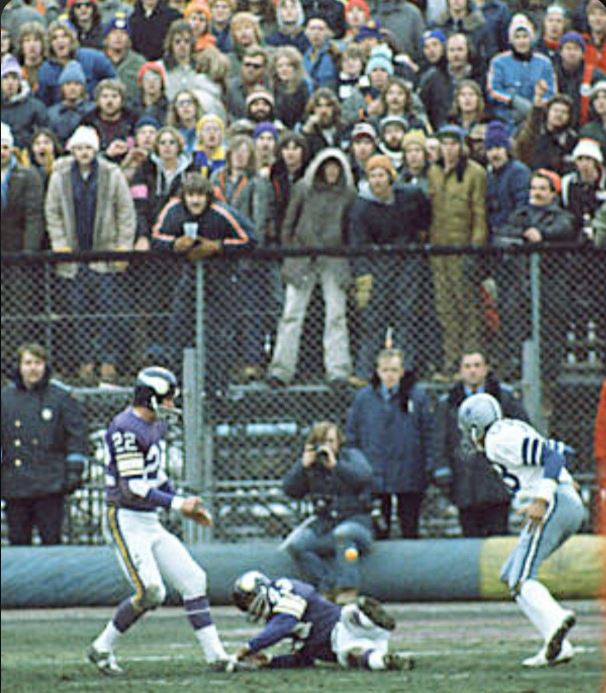
Roger Staubach lets fly against the Minnesota Vikings in the 1975 Hail Mary Game
There are some NFL games that last in the memory longer than others, especially when it comes to playoff games. None holds true more than the miracle finish that won the 1975 NFC Playoff game for the Dallas Cowboys over the Minnesota Vikings 17-14. Minnesota was trying to equal the feat of the Dolphins in terms of reaching their 3rd straight Super Bowl. Yet they had to get by the rebuilding Cinderella Cowboys who were in the midst of a rebuilding year. The window was closing for this great team to win that elusive Super Bowl.
After the upset loss to the Kansas City Chiefs in Super Bowl IV, the Purple People Eater defense had stayed among the league’s best while the offense had to be revamped. After going a few seasons without having adequately replaced Joe Kapp, the Vikings reacquired Fran Tarkenton in 1972 to add leadership and a grade A quarterback to the offense. Also in 1972, they acquired John Gilliam who became the first deep threat ever for the Vikings. In that first year, Gilliam teamed with Tarkenton to become the first Viking in team history to top 1000 yards in receiving.
They finally had some offense but needed one more element and got that boost in the 1973 draft. Chuck Foreman gave the Vikings their first great running back. Combining his skills with Gilliam and Tarkenton and the Vikings made it to the top of the NFC. However back to back Super Bowl losses to Miami and Pittsburgh dulled some of the luster to the 1973 and ’74 seasons. Yet they were seasoned and primed to win it all in 1975. Just have to get past a youthful Dallas Cowboys team that made the playoffs as a wildcard. Easy money….right??
After missing the playoffs in 1974 while transitioning in 14 new players, the Cowboys had said goodbye to familiar faces like Bob Lilly, George Andrie, Chuck Howley, Calvin Hill, and Walt Garrison. Players that had epitomized the era of the “Next Year’s Champion” Cowboys through their ultimate triumph in Super Bowl VI. From 1966-1972 this team was among the league’s elite playing for multiple championships. Yet as we make it into the mid 70s, those aging great players started to retire and a new breed of Cowboys started to infuse the roster. An Ed “Too Tall” Jones in place of a George Andrie, a D.D. Lewis to replace a Chuck Howley. Understand this team had plenty of veterans to lead this young team into this playoff game. MLB Lee Roy Jordan, OLB Dave Edwards, DT Jethro Pugh, and CB Mel Renfro were among the mainstays on defense.
On offense Roger Staubach had developed into a complete NFL quarterback. His ability to move within the pocket was enhanced with the installation of the “Shotgun” formation. Coach Landry had re-introduced a formation that was the birth-child of the early 1960s San Francisco 49ers and Coach “Red” Hickey. This hodge podge set of Cowboys made the pilgrimmage to Minnesota’s Metropolitan Stadium for an NFC Playoff Game. The ’75 Cowboys didn’t even win their division, they came in with a 10-4 record and seemed to go as far as their talent could take them…right??
To borrow a line from Chris Berman “That’s why they play the games!!”
Drew Pearson scoring on the “Hail Mary” with :18
Epilogue: It was this game that launched the mid to late 70’s Dallas Cowboys. Roger Staubach had already performed a great come from behind playoff game against the 49ers in the 30-28 epic1973 NFC Divisional Game out in Candlestick. Yet it was this second one that spread the belief in his team psychologically that they were never out of a ball game with Roger at the controls.
This was also the game that ushered in Drew Pearson as a playmaker that would be a scourge for many a Cowboy foe over the next decade or so in the playoffs. They would go on to win the NFC Championship in an upset blowout of the Los Angeles Rams in the LA Coliseum 37-7 before falling to the Pittsburgh Steelers, 21-17, in Super Bowl X.
As for the Minnesota Vikings a window was narrowing shut on their championship chances. The great line of Hall of Famer Carl Eller, Hall of Famer Alan Page, Jim Marshall, and Doug Sutherland was aging and wasn’t as dominant as in years past. In the 1976 season, Buddy Ryan was hired to coax one more good year out of this group. They got it even though they wore down toward the end of the season. They made it to their 3rd Super Bowl in 4 years, and 4th Super Bowl in 8 years total yet they lost to the Oakland Raiders 32-14 in the 11th edition.
The latter part of the 1970s saw the great play of the Vikings diminish as their stars retired or were phased out. Fran Tarkenton would go on to retire with more passing yards than any quarterback in NFL history with 47,003 yards. The day of the “Hail Mary” game dealt Tarkenton a more severe blow when he learned his father had died of a heart attack while watching the game in Georgia. He was standing in a CBS truck when he learned of his father’s passing.
Yet there is one lingering question from the “Hail Mary” game… Did Drew Pearson interfere with CB Nate Wright or did Nate Wright simply overrun the play?? While it can be noted that if you look at the play before the touchdown, you can see Preston Pearson lose his footing. So it doesn’t seem implausible…. Did he push off??


 The latter part of the 1970s saw the great play of the Vikings diminish as their stars retired or were phased out. Fran Tarkenton would go on to retire with more passing yards than any quarterback in NFL history with 47,003 yards. The day of the “Hail Mary” game dealt Tarkenton a more severe blow when he learned his father had died of a heart attack while watching the game in Georgia. He was standing in a CBS truck when he learned of his father’s passing.

You must be logged in to post a comment.