The Epic In Miami: San Diego 41 Miami 38 1981 AFC Divisional Playoff

With the NFL turning 100 this year, it’s impossible not to have great players, great coaches, or great games to look back on. The lasting image in the minds of fans everywhere was this epic shot of Hall of Fame TE Kellen Winslow being helped off the field by T Billy Shields and TE Eric Sievers.

It came at the conclusion of of one of the greatest games in NFL history and was the signature game in a Hall of Fame career.
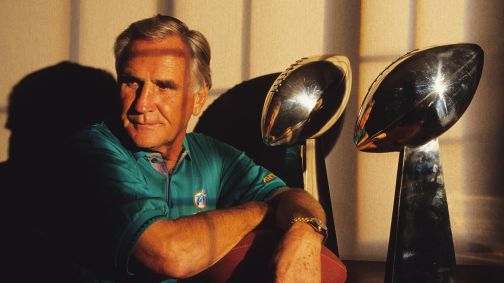
Yet if we flashed you back to the early 1980’s the San Diego Chargers had the most prolific offense in the history of the NFL. The legend of “Air Coryell” had taken flight with Coach Don coming over from St Louis and took full advantage of the liberal passing rule changes of 1978.

Beginning in 1979 Dan Fouts set the NFL ablaze becoming the first QB since Joe Namath in ’68 to throw for more than 4,000 yards in a season. His 4,082 yards in ’79, 4,715 in ’80, and finally 4,802 in ’81 were all NFL records as the Chargers chased a championship. Fouts had the league’s best arsenal in acrobatic receiver John Jefferson, route running Charlie Joiner, and the aforementioned Winslow. This was the original “Greatest Show on Turf” as Charger games became all the rage to watch for their ability to score from anywhere at any time. The league struggled to defend them as:

  • The ’79 Chargers were 1st team since the ’70 merger to pass more than run (541 att/481 rush)
  • In ’79, Jefferson (61 rec/ 1,090 yds 10 TDs) & Joiner (72 rec /1,008 yds 4 TDs) became 1st set of 1,000 yd seasons in NFL history. Both made Pro Bowl
  • On 10/19/80 the Chargers were 1st team in history to have both WR and TEs over 100 yds in 44-7 win over NY
  • In ’80 became the 1st team in history with 3- 1,000 yard receivers (Jefferson 1,340 yds, Winslow 1,290, Joiner 1,132) All 3 were Pro Bowl & All Pro…also 1st in NFL history.
  • Chuck Muncie in 1981 set an NFL record with 19 TDs rushing.

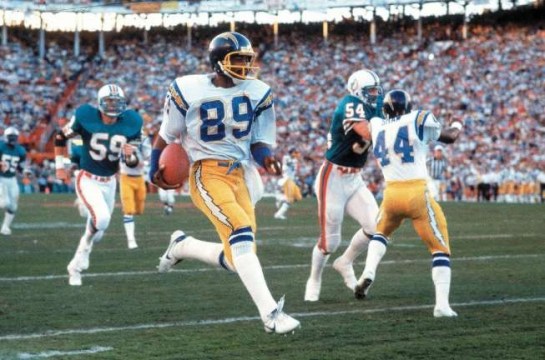
Wes Chandler raced 56 yards for a score with a first quarter punt return. The score was 10-0 (SD)
Heinz Kluetmeier

Despite all the records the Chargers couldn’t win in the postseason. They fashioned a 12-4 record in ’79 which included a 35-7 pounding of the eventual champion Steelers. Only to lose 17-14 in one of the biggest upsets in NFL history to a depleted Oiler team. Vernon Perry intercepted Fouts a playoff record 4 times.

The Chargers bounced back in ’80 with an 11-5 record and homefield advantage where they bested Buffalo 20-14. Then fell at home in the AFC Championship 34-27 to the eventual champion Oakland Raiders.

Having fallen to the Super Bowl champion Raiders the year before and feeling they matched up to Pittsburgh in ’79, the Chargers were on the doorstep although the clock was ticking. Their championship window was closing and once the front office traded All Pro WR John Jefferson to Green Bay and Pro Bowl DE Fred Dean to San Francisco, it appeared shut.

Down in Miami, Don Shula had rebuilt the Miami Dolphins from the smash mouth back to back champions that won Super Bowls VII & VIII. Up until 1980 he still had Hall of Fame QB Bob Griese to lead his offense as a new “No Name Defense” emerged.

The Dolphins made the playoffs in ’78 behind Delvin Williams spectacular 1,258 yard season running the football. In that year Griese was injured for an extended period and the Dolphins won with backup Don Strock. He had a record of 5-2 while outperforming the vet tossing 12 TDs to only 6 interceptions. Griese had a more efficient season when it came to completion percentage and this hurt Strock.
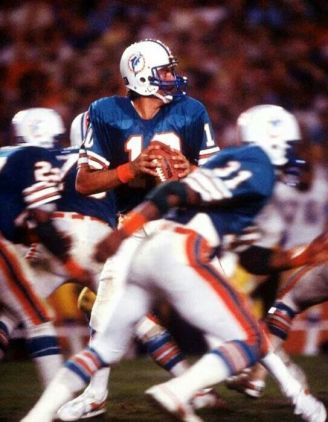
He was hot & cold yet showed enough flash to get on the field but didn’t engender enough confidence to turn the offense over to him. When Griese returned from injury in ’78 and ’79 he always got his job back.

Then in 1980 Griese’s career ended with a shoulder injury early in the season. Shula worked in rookie QB David Woodley along with Strock as he searched for that perfect chemistry on offense. By this time Delvin Williams had moved on as Shula raised Larry Csonka from the dead and paired the two in the backfield to mixed results.

Somehow in ’81 Shula willed the Dolphins to an AFC East title with “Woodstrock” and the combination of rookie FB Andra Franklin and solid RB Tony Nathan each rushing for 700 yards. This was a team of “no names” as Miami fielded only 1 Pro Bowl player on their entire roster in NT Bob Baumhower #73. Who were these guys??
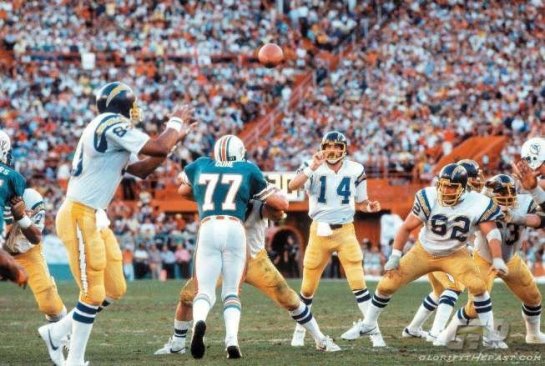
This hodge podge group ranked 16th on offense and 15th overall on defense. It was a testament to Shula’s coaching they were even winning. Somehow they went 11-4-1 & made it into the playoffs for the 3rd straight year. Hosting a playoff game for the 1st time since 1978.

Their opponent would be the Chargers who were falling from the elite when they pulled a coup and traded for electrifying wideout Wes Chandler. On the strength of Dan Fouts’ record 4,802 yard season, the Chargers limped to a 10-6 record.

Limped?? Well yes their defense never recovered from the Fred Dean trade. In ’79 the Chargers were 5th overall in defense then were ranked 6th in ’80 while leading the NFL in sacks. Without their prime time pass rusher the Charger’s defense plummeted to a ranking of 27th. Consequently San Francisco, where Dean was traded to, rose to 2nd overall…yet I digress

Dean’s absence had an affect on both the Chargers defense in ’81 and what was about to happen as these two teams staggered into the ’81 AFC Divisional playoff…

A playoff game that nearly went to 6 quarters at 75* in high humidity that had everything. Multiple blocked field goals, a dramatic comeback from the home team after falling down 24-0 early. The Chargers fighting to stave off a valiant comeback only to have to make a dramatic drive themselves to tie it 38-38 just to go into overtime.

Fouts 433 yds passing was a playoff record until Bernie Kosar threw for 489 yards in an ’86 double overtime epic against the New York Jets.
Kellen Winslow’s 13 receptions established another as he went for 166 rec yards, 1 TD and the blocked kick to send the game into overtime. He left the game several times due to injury where he was suffering from cramps and dehydration.

Each team left it out on the field in one of the greatest games in NFL history. The toll it took on the Chargers having traveled cross country was immense. The following week they had to play in a 140 degree variance when they played the AFC Championship in Cincinnati at -59* wind chill. A game known as The Freezer Bowl. The coldest game in NFL history.

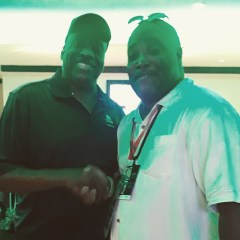
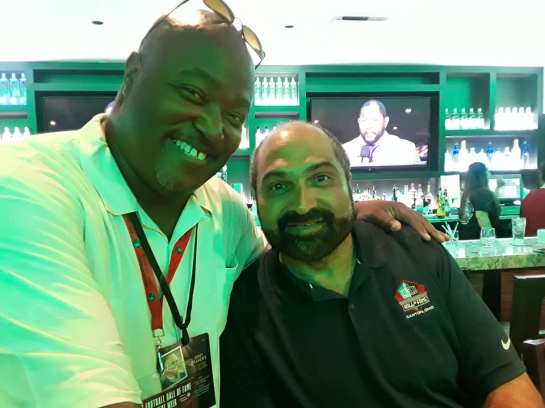
Hall of Fame Member Fred Dean & The Chancellor at the PFHoF in ’18. Ironically behind us was Dan Fouts & Kellen Winslow at a table.

The no name Dolphins had proven their mettle and would go on as one of the elite teams in the AFC, playing in 2 of the next 3 Super Bowls. As for the Chargers, the loss of Fred Dean had caused a season long collapse of their defense culminating in allowing Miami a season high of 478 total yards. It marked the 8th time San Diego’s defense allowed their competitors over 400 total yards in a game over the ’81 campaign.

Ultimately this spectacular game became the crowning jewel in the career of Coach Don Coryell and Air Coryell’s legacy. Having lost the ’80 and ’81 AFC Championship Games they fell back to the pack as other teams would rise to elite status. However this team was reincarnated as The Greatest Show on Turf resurrected their playbook winning Super Bowl XXXIV while becoming one of history’s greatest offenses two football generations later.

Yet this was The Epic in Miami… one of the great games in NFL history.

Dedicated to the memories of Don Coryell, Chuck Muncie, David Woodley, and Larry Gordon, Steve Sabol, and narrator Harry Kalas.

Thanks for reading and please share the article.

SUPER BOWL XIII RUNNER UP 1978 DALLAS COWBOYS

In the “Battle of Champions”,  XIII on January 21, 1979 the defending Super Bowl champion Cowboys took on the Steelers in deciding who was to be the team of the decade. There have only been a few occasions where a Super Bowl champion came back better the following season. The 1978 Dallas Cowboys were one of those teams.

16568_lg

Of all the teams coached by Tom Landry built by Tex Schramm and Gil Brandt, this was the apex of their work. In 1977 they finished #1 on both offense and defense. Rookies Tony Dorsett (1007 yds) and Tony Hill were just learning the offense and fighting for playing time. 1978 saw them each explode onto the scene as Pro Bowl performers with Dorsett flashing for 1,325 yards and 7 TDs. Hill supplanted Golden Richards, teaming with ’77 Pro Bowler Drew Pearson, gathering in 46 balls for 823 yards and 6 TDs. So they were much more explosive.

Finishing #2 in defense in 1978, nothing really changed from the season before. Pro Bowlers Randy White, Harvey Martin, Charlie Waters, and Cliff Harris were joined by 1st timer “Hollywood” Henderson. Whose athleticism had lethal impact on the Cowboys’ nickle packages. Although the NFL extended the regular season to 16 games in ’78, the Cowboys gave up fewer points (208) than they had as league champion the season before (212).

Did you know the ’78 Cowboys were .5 yards per game from being #1 on offense and 8 yards per game from being#1 on defense for a second straight year?? So when they vanquished the Los Angeles Rams and their #1 ranked defense, on the road 28-0 for the NFC Championship, their trip to Super Bowl XIII was for more than winning a title. They had a chance to finish as a dynasty and arguably the best in history.

The best Super Bowl of the first 25 had the Steelers scoring 1st then the Cowboys answering on the last play of the 1st quarter.

The Doomsday Defense II forced a fumble by league MVP and Super Bowl MVP Terry Bradshaw as the first quarter wore on. Just when the Steeler offense seemed to get it together, Doomsday struck again near midfield to take a 14-7 lead. Courtesy of Hollywood Henderson who taunted Bradshaw in the week preceding Super Bowl XIII.

The Steelers struck back with 2 scores to take a 21-14 halftime lead. Bradshaw had answered with several scoring drives and finished with 253 yards passing. A Super Bowl record… Dallas wasn’t living up to their defensive billing. After the first initial offensive drives, the Steelers had held Staubach and company in check.

Although the game had gone back and forth, the Steelers had outgained Dallas 271 to 102 yards. The teams had combined for 5 turnovers. However 1 aspect of the game had gone in Dallas’ favor, the Steelers trapping running game had been smothered. That trend continued in the second half as the Cowboy offense found it’s bearings. Down 21-14 late in the 3rd, Staubach drove the Cowboys to the Steelers 11 yard line. Poised to tie the game, the fickle hands of fate  interceded…

Having to settle for a 21-17 deficit, the momentum lost affected the Cowboys until late in the 4th quarter. In actuality neither team could move the ball for the balance of the second half. Only a pass interference that had impact beyond this Super Bowl gave the Steelers momentum.

The Steelers scored a few plays later to make it 28-17 on Franco Harris’ 22 yard trap up the middle. Another fickle bounce of the ball happened when kicker Roy Gerela slipped kicking off. It went right to DT Randy White. With a casted hand tried to handle the ball on a return when he fumbled it. The Steelers scored on the next play and viola…they were up 35-17 with 6:41 to go. The Cowboys were undone on a bad pass interference and two strange bounces of the football.

The Cowboys didn’t go quietly into the night.

Staubach led the Cowboys to back to back touchdown drives to cut the score to 35-31. They couldn’t get a second onside kick and the Steelers ran out the clock. The Steel Curtain finished the game on fumes. Dallas couldn’t be stopped on those last 2 drives. Comparing both defenses:

  • Steelers allowed 330 yards, 5 sacks, 2 forced fumbles, 1 int.
  • Cowboys allowed 357 yards, 4 sacks, 3 forced fumble, 1 int and 1 fumble recovery for a TD

sbxiiinew2Not bad when you compare two great defenses. However writers have gunned down hyperbole in the history books as Steeler strength vs Dallas finesse. When in fact the Cowboys were ranked 2nd and the Steelers 3rd on defense. The 86 yards gained by Pittsburgh in the 2nd half was the fewest by a Super Bowl winner. Well at least until XXX when the Steelers held the Cowboys to 61 in their loss.

super-bowl-logo-1978Even though the Steelers had bested Dallas in SuperBowl X, this  could have made things even at 3 wins a piece.  Anyway…to the victor went too many spoils when it comes to Hall of Fame inductions off these teams.  No Harvey Martin, no Drew Pearson?  really…Pittsburgh was better…but not 10 inductions to 3 better!  No chance.

Who knew this would be Tom Landry 's last Super Bowl team.

Who knew this would be Tom Landry ‘s last Super Bowl team.

Thanks for reading and please share the article.

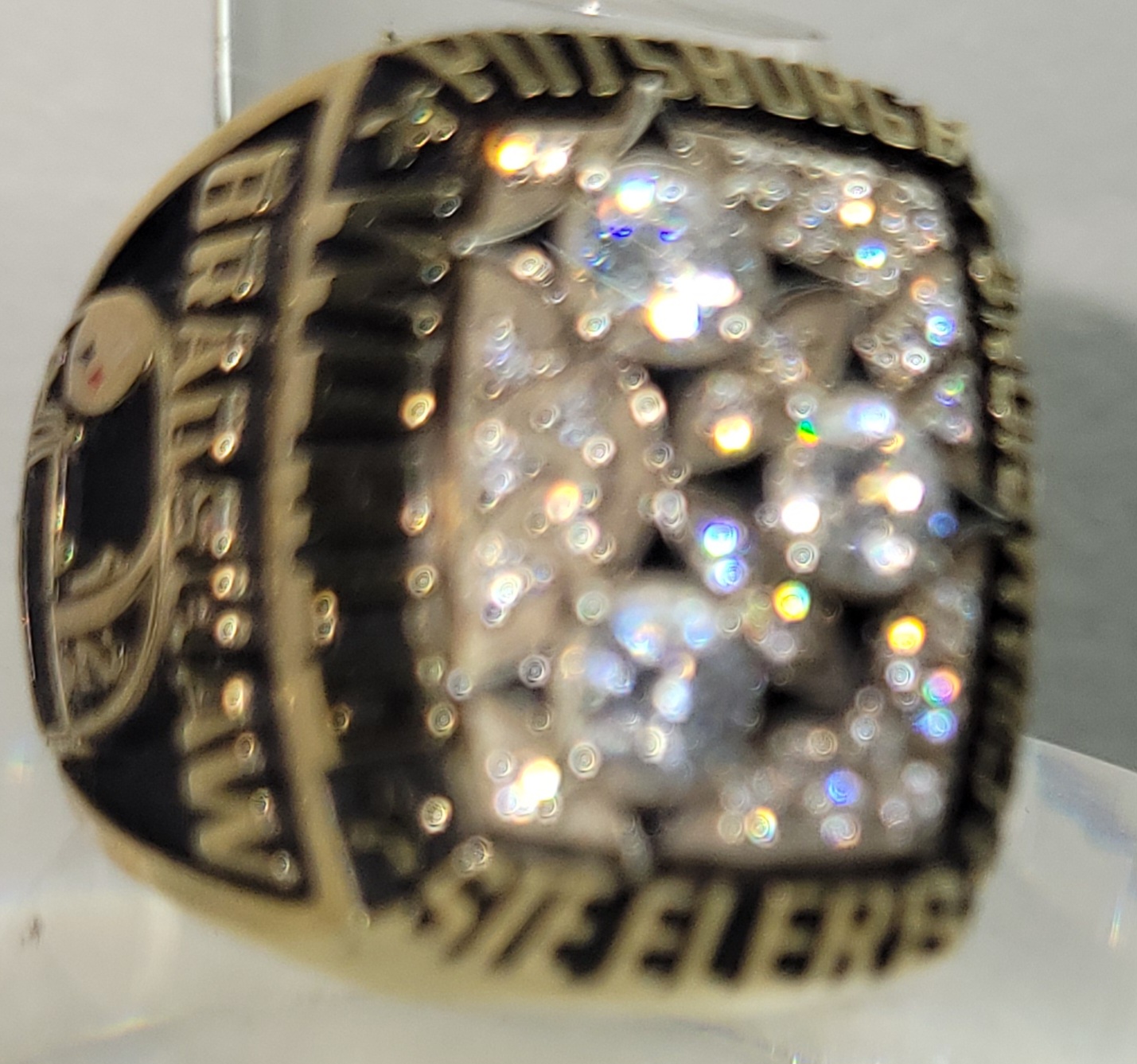
SUPER BOWL XIII CHAMPION 1978 PITTSBURGH STEELERS

In the “Battle of Champions”, Super Bowl XIII on January 21, 1979 the defending champion Cowboys took on the Steelers in deciding who was to be the team of the decade. The first Super Bowl with a kickoff pushed back so that it would conclude in front of a primetime audience.

xiiipsThis was arguably one of the best Super Bowls of the first 25 that were played. Even though the Steelers had bested Dallas in Super Bowl X, this could make things even.  The discrepancy of 10 Steelers in the Hall of Fame vs. 3 for Dallas is beyond ridiculous considering Pittsburgh barely won 35-31.  Of course Cowboy fans point to a bogus “incidental contact” pass interference call between Benny Barnes and Lynn Swann, then you have the Jackie Smith dropped pass…nevertheless referee Fred Sweringen blew that interference call…it’s important because John Stallworth was out for the second half and the Steelers couldn’t move the ball.

Let’s take a trip back in time. Aside from Oakland and Miami, the Steelers and Cowboys were viewed as the best teams of the 1970’s.  The Steelers had won it all in 1974 and returned to the Super Bowl as a powerful defending champion. Pittsburgh repeated as champions and established themselves as a dynasty.  They dropped off the championship mantle for ’76 and ’77 yet were poised to return in 1978.

xiiips2In their absence the Dallas Cowboys had retooled themselves and ascended to the Super Bowl XII championship with Heisman Trophy winner Tony Dorsett added to the mix. The young players that joined the Cowboys in 1975 like Thomas “Hollywood” Henderson, and Randy White were now starters and superstars.  Now they were set to do what Pittsburgh had done and repeat as Super Bowl champions.  So for the second time they’d meet in a Super Bowl with one team coming in as a defending champion.

In 1978, the NFL saw rule changes that allowed receivers to only be chucked within 5 yards of the line of scrimmage. This “Mel Blount rule” along with a rule allowing pass blockers to extend their arms liberalized the passing game. Terry Bradshaw and the Steelers became a new team as he led the league with 28 TDs thrown. The Steel Curtain wasn’t as stout as it had been in the mid 70’s yet they allowed the fewest points in the first 16 game season with 195 allowed. Franco Harris was still a 1,000 yard rusher at this time.

So this powerful 14-2 challenger went down to Miami’s Orange Bowl to take on the defending champion Cowboys who finished 12-4. For only the second time in the 13 year history of the Super Bowl, we would have two teams facing that each previously had won the game before. The first was the Steelers meeting the Cowboys in X, so everyone anticipated a great game for XIII. Two prime champions faced off and an epic battle ensued.
The Steelers opened up the scoring 7-0 with a Bradshaw to John Stallworth pass from 28 yards out.

After the Cowboys came back and tied the game with a Staubach to Tony Hill pass, Dallas “Doomsday Defense” struck. “Hollywood” Henderson and Mike Hegman sacked Bradshaw with Hegman stealing the ball and scoring with it. The Steelers were down 14-7 when a few plays later…

Each team’s defense forced multiple turnovers during the first half. The majority of the 2nd quarter had the teams deadlocked at 14 when the Steelers sustained a drive just before halftime. With seconds to go, Bradshaw connected on his 3rd TD of the half with this pass to Rocky Bleier.

Terry finished the first half with 253 yards with his 3 touchdowns and would become the first QB to throw for over 300 in a Super Bowl. Keep in mind this was the same quarterback that had nearly played his way out of a job in 1974. All the footage of his mistake prone ways as a young player were being extinguished in the mind as he put on this bravura performance in the 1st half.

Up 21-14, the Steel Curtain started to crack as Staubach started to move the ball in the 3rd quarter. Right when they were going to tie the game at 21, Jackie Smith dropped a sure touchdown on a 3rd down forcing them to settle for a field goal and a 21-17 deficit. Dallas, demoralized by the turn of events lost momentum for most of the second half.

After the most questionable pass interference in NFL history put the Steelers on the Cowboys 22, Franco scored on this trap to make it 28-17. We were getting late in the 4th quarter also.

Following an accidental squib kick, DT Randy White mishandled the football and fumbled as he was hit by Tony Dungy. Now the Steelers were poised for the kill at the Dallas 18 yard line.

It was not all over… Although the Steelers led 35-17 with a little more than  6 minutes left in the game, Staubach’s championship mettle shone through. The crack in the Steel Curtain became s fissure as the Cowboys scored twice from 90 and 48 yards out respectively. Yet Pittsburgh held on to win 35-31 and unseated the Cowboys as champions.

super-bowl-logo-1978Super Bowl XIII was a celebration with the two best teams facing off in the big game.  Rarely does that happen. Great games like that to climax the season leave you wanting more but you have to wait until next season to get that fix. To think the NFL’s #2 (Cowboys) and #3 (Steelers) ranked defenses were shredded by 35 and 31 points respectively. No one saw that coming.

chancellor.franco

Bradshaw was the runaway MVP as he passed for a Super Bowl records for yardage (318) and touchdown passes (4). Much like Ben Roethlisberger today, it was the defense and the running game that carried the QB to his first Super Bowl win. Terry had a good game in his second, Super Bowl X, but it was this one that validated his career and sent him to the Hall of Fame.

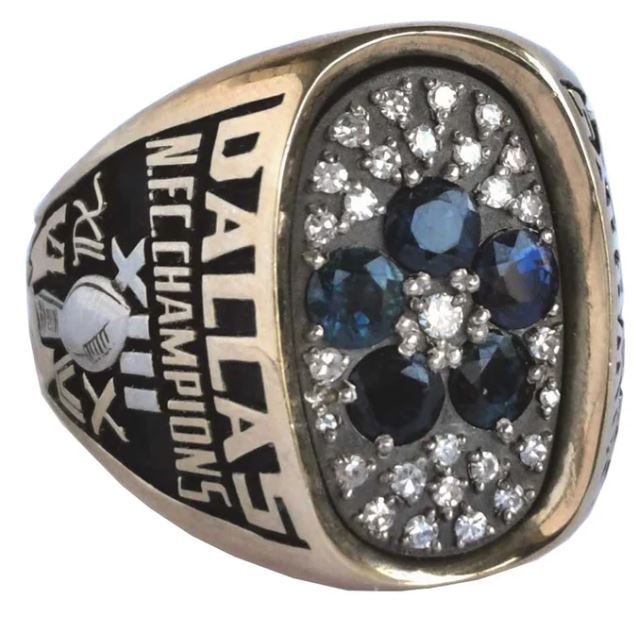
It’s impossible to see this championship ring and not think of the Super Bowl game first.

Thanks for reading and please share the article.

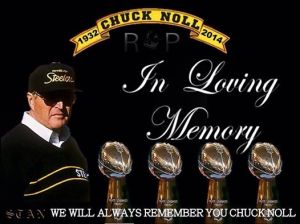
RIP Coach Noll

RIP Coach Noll

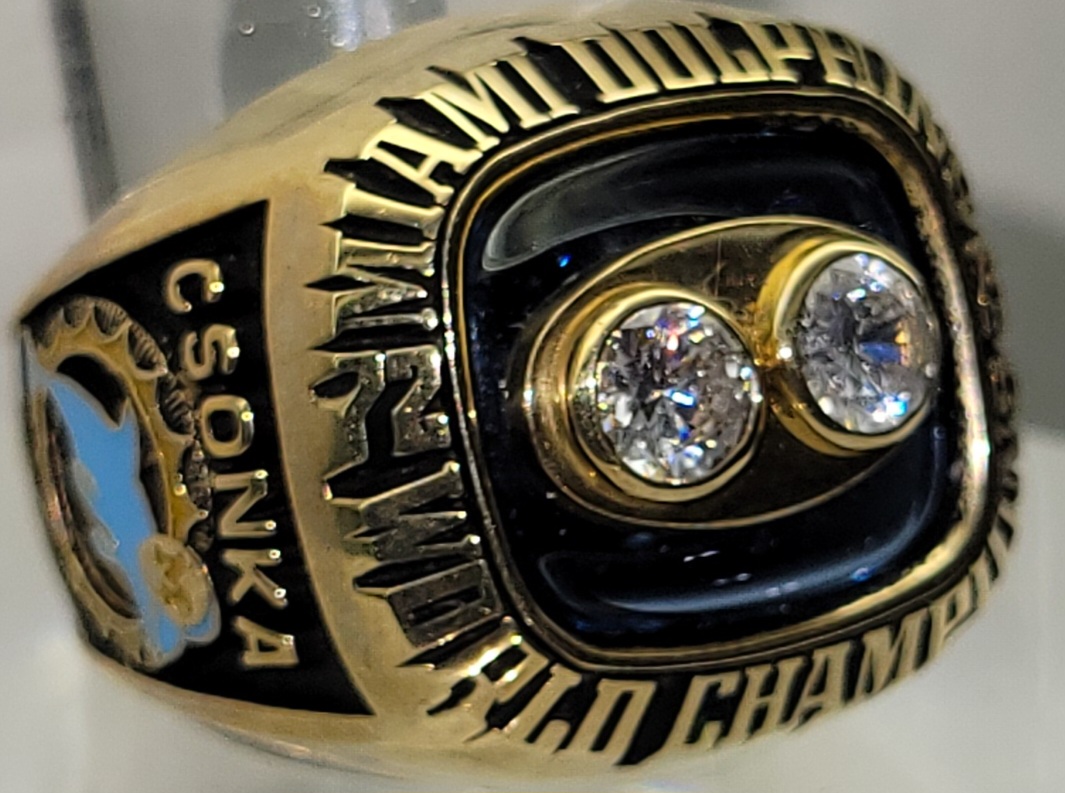
SUPER BOWL VIII CHAMPION 1973 MIAMI DOLPHINS

The NFL’s first dynasty after Vince Lombardi’s Packers was Don Shula’s Miami Dolphins. The only dynasty we never got to see reach its conclusion on the field. After compiling a 32-2 record including two Super Bowls, RBs Larry Csonka, Jim Kiick, and WR Paul Warfield signed contracts with the rogue WFL. It brought the end to an era where Shula’s ground game and “No Name Defense” ruled the NFL.

The most dominant team of 1972 & 1973 would be broken up losing two Hall of Famers in Csonka and Warfield. However their WFL contracts wouldn’t take effect until 1975 meaning the team would be intact for one final season.
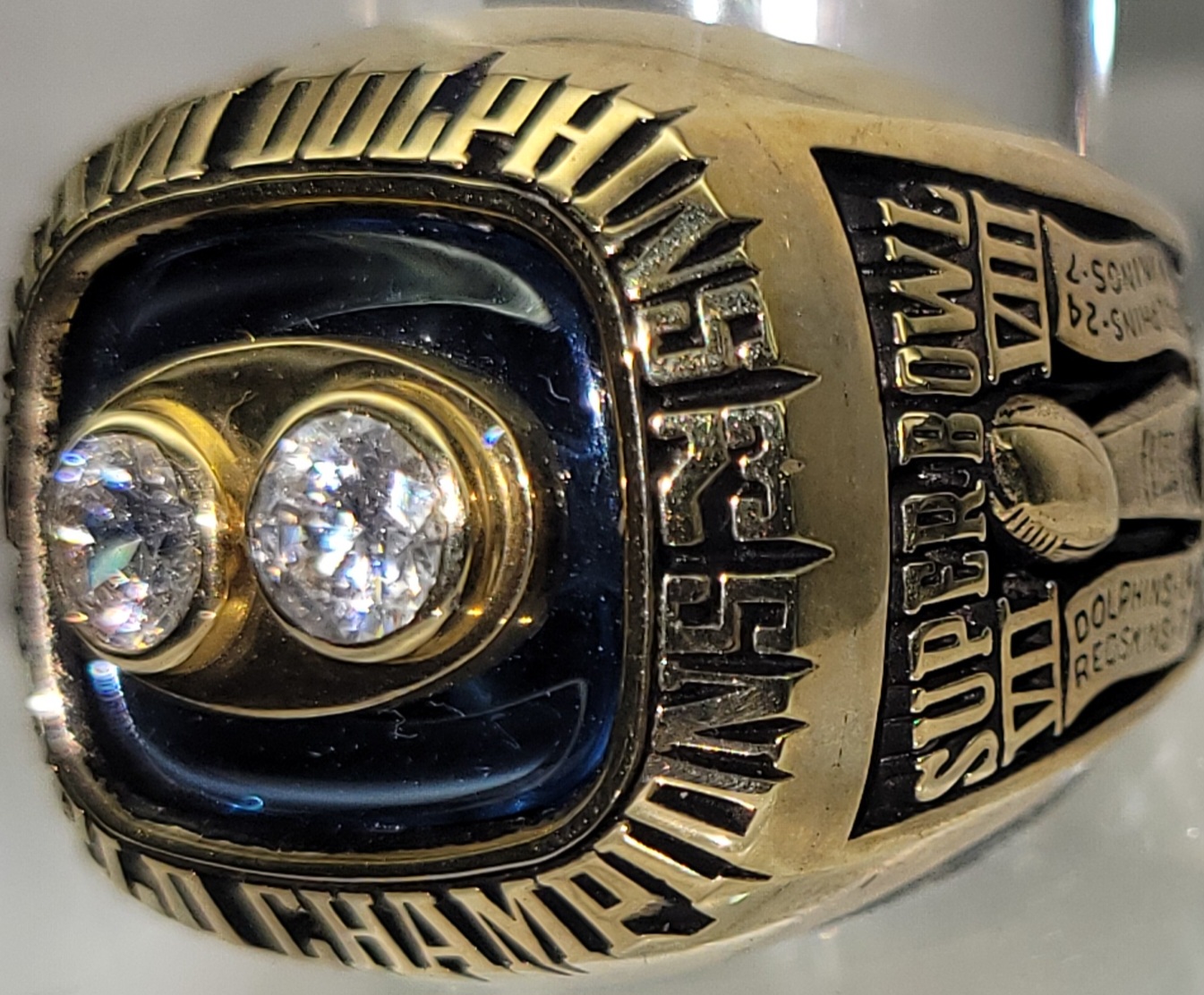
The heartbeat of the Dolphin dynasty was its ground game. In the perfect season of ’72, Larry Csonka and Mercury Morris became the first backfield tandem to each rush for 1,000 yards in the same season. They nearly repeated that feat in ’73 when Morris rushed for 954 to Csonka’s 1,003.

With the team being breaking up an inevitability, Miami had a threepeat in their sight in ’74. After an 11-3 record there was a feeling the Dolphins were vulnerable. Several defensive starters were out due to injury. Six of their wins were by 7 points or less. Where in ’73, all 12 wins were by more than a touchdown. The wear and tear of upholding that championship mantle had brought them back to the pack.
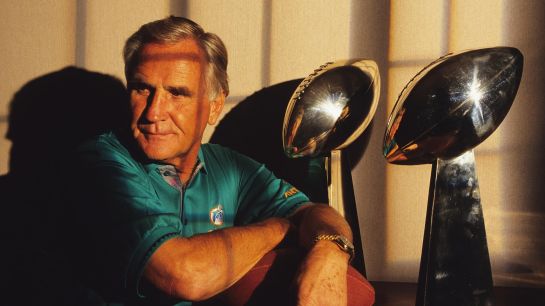
super-bowl-logo-1973The divisional playoff game would be in Oakland against the revenge minded Raiders. Although Miami defeated them in the AFC Championship Game at home in ’73, the Raiders beat them in the regular season in Berkeley. That win halted the Dolphins 18 game winning streak which was an NFL record at the time. So into the Oakland Coliseum they went…

The game became known as “The Sea of Hands” one of the most famous games in NFL history. The Dolphin dynasty came to an end with Kiick, Warfield, and Csonka jumping to the new league the following season. No one knew Don Shula would go on to be the winningest coach in NFL history. Even more surprising, he would coach through the 1995 season and would not win another Super Bowl.

For the coach on the losing end of Super Bowl III, to the coach who drove his team to the NFL’s only undefeated season, to the man that led his team to 3 of the next 5 title games, culminating with this ring. The second NFL championship ring that crowned a dynasty. Don Shula had taken his place among the greatest coaches in NFL history.

Thanks for reading and please share the article.

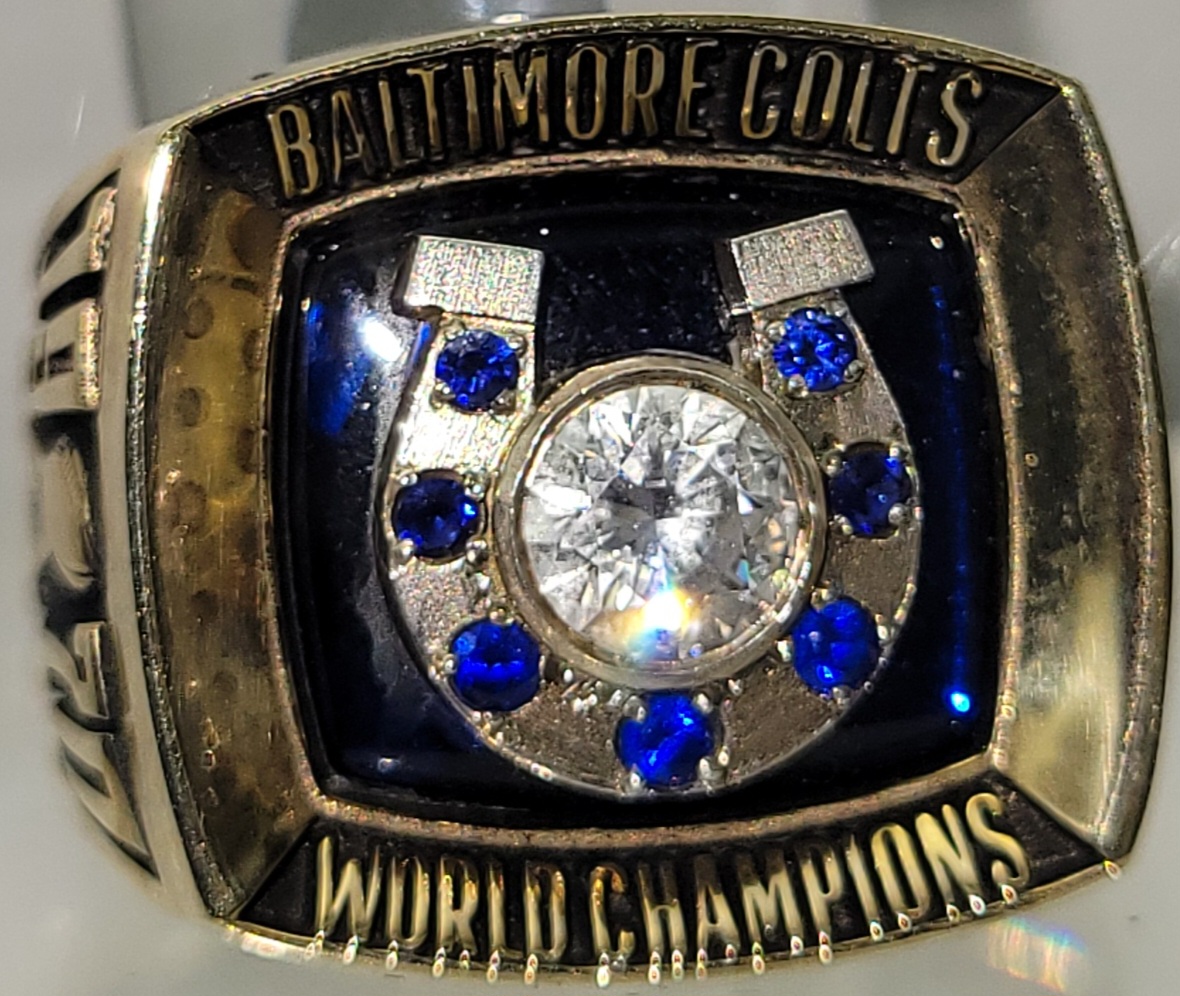
SUPER BOWL V CHAMPION 1970 BALTIMORE COLTS

When you think of the old Baltimore Colts, the first flashback that comes to mind are the black and white films with Johnny Unitas leading the team in the 1950’s. Then another thought stirs up images of Bert Jones, Lydell Mitchell and the mid 1970’s version with Head Coach Ted Marchibroda. You follow-up that thought with the green and yellow Mayflower trucks moving the team to Indianapolis in the middle of the night in 1984. Yet sandwiched between the first and second of these events is the most forgotten champion in modern football history. The 1970 Baltimore Colts.

There are varied reasons why this team is so overlooked when you think of this franchise.  Did you know this is the only Super Bowl winner where the franchise was sold just one year later?? Before the 1972 season, Robert Irsay (Los Angeles Rams) and Carroll Rosenbloom swapped franchises.
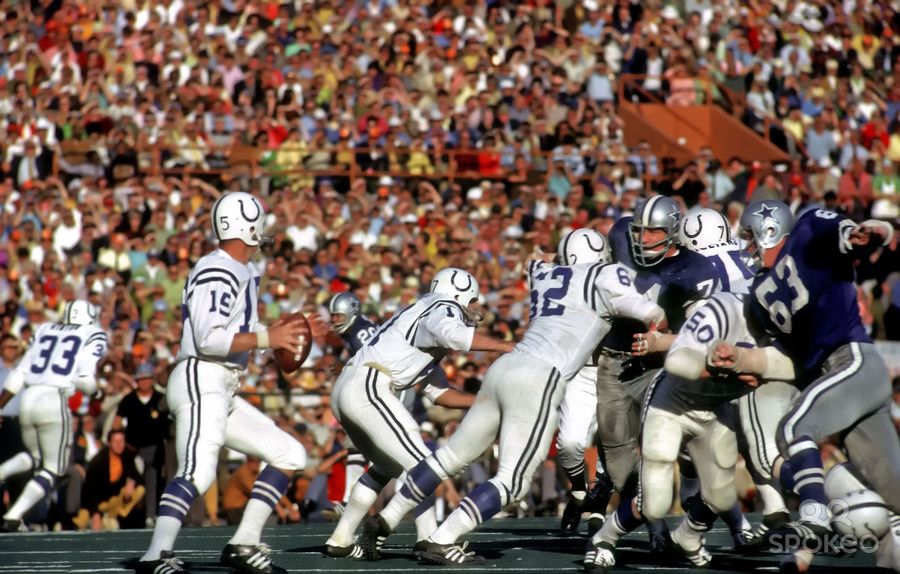
Morrall came in for an injured Unitas and did just enough for the Colts to win.

Carroll had one of the most successful tenures as an owner in NFL history. Yet after losing Super Bowl III, one of the landmark games in league history, he lost Head Coach Don Shula to the Miami Dolphins after the 1969 season.

So is it ironic or part of the story that his last game as Colts owner, was a 21-0 loss to Shula’s Miami Dolphins in the 1971 AFC Championship Game?? Another twist was it was played in the Orange Bowl which had been the site of Super Bowl III.

The last ring won by John Constantine Unitas and Carroll Rosenbloom.

The last ring won by John Constantine Unitas and Carroll Rosenbloom.

Another reason this champion wasn’t remembered is there wasn’t a main powerful character. Yes the Colts had an aging fading John Unitas at quarterback. In 1970, he finished with a career low 51.7% completion percentage, and was the only qb to win the Super Bowl in a year he threw more interceptions (18-14) than touchdowns. He was 3 seasons removed from 11 straight Pro Bowl seasons and 5 player of the year awards.

By this time he was getting by on inspiration and finding the touch at the right time. As was the case in the first ever AFC Championship Game. Clinging to a 20-17 lead late in the 4th,Unitas had reserve WR Ray Perkins motion from the backfield and lofted a perfect sideline floater just past Raider CB Nemiah Wilson for the decisive touchdown. It was the only touchdown he threw in the game as he went 11 of 30 for 245 yards.

Super Bowl V was the first NFL championship game not played on natural grass.

Super Bowl V was the first NFL championship game not played on natural grass.

It was echoed in Super Bowl V as he went 3 for 9 for 88 yards with 2 interceptions and 1 TD before being knocked out of the game. The lone touchdown was the bizarre 75 yarder to John Mackey where the ball bounced from Colt Eddie Hinton and Cowboy Mel Renfro first. So the late Earl Morrall had to come off the bench to save the Colts season just as Unitas tried to in Super Bowl III.

The game was played at a frantic pace with 11 total turnovers in what was nicknamed The Blunder Bowl. The Colts outlasted the Dallas Cowboys, they didn’t beat them. A last second interception by Mike Curtis put them in position for Jim O’Brien to win it with a field goal 16-13.

Another reason they weren’t remembered were they were coached by the late Don McCafferty. He was the hand picked successor once Don Shula departed for Miami having been the long time Offensive Coordinator. By the time we make it to 1972 the Colts were winless in their first five games. General Manager Joe Thomas wanted Unitas benched. When McCafferty refused he was fired.

super-bowl-logo-1970Less than 1 1/2 years after winning Super Bowl V, Carroll Rosenblom was no longer the owner, John Unitas was no longer the quarterback, Don McCafferty was no longer the coach, and the magic was gone from 33rd Street in Baltimore. The romantic era starting with the 1958 NFL Championship Game win over the Giants, ended with the 1971 AFC Championship loss in Miami.

In many ways the Super Bowl V championship had a lifetime achievement feel more than a best of the league feel. Would they have won Super Bowl VI had they rematched with the Cowboys?? How different would Don McCafferty’s legacy been had they won it? As a matter of fact, the Dolphins split their games with the Colts in 1970 and 1971. Would the Colts even make it to Super Bowl V had the Dolphins been able to get past Oakland in the ’70 playoff game??

Epilogue: Carroll Rosenbloom’s Rams won the NFC West 5 times from 1973-1978 but lost the NFC Championship 4 times. He died from a heart attack and drowned before the 1979 season when the Rams did make it to Super Bowl XIV. Which left the team to his wife…. Georgia Rosenbloom who later remarried. Georgia Rosenbloom-Frontiere.

Don McCafferty died of a heart attack in 1974 after he coached the Detroit Lions for one season.

John Unitas remains one of the greatest players in NFL history and was the first to throw for more than 40,000 yards. A staple at Baltimore Ravens games well into the 2000s. Unitas passed away on Sept 11th, 2002.

Bubba Smith, the giant Defensive End  passed away in August 2011. Smith played the majority of his career in Baltimore and stated in 2007 “Super Bowl III, I still haven’t gotten over it.”

Earl Morrrall, the journeyman quarterback who was player of the year in 1968 with Unitas out. Was with the team when they lost Super Bowl III. Afterward he would duplicate his 1968 with a great performance leading the Dolphins to the undefeated season in Bob Griese’s absence. He won 2 more Super Bowls (VII & VIII) with Don Shula’s Miami Dolphins. Morrall died last month on April 25, 2014.

To these men I dedicate this article… they were a champion. NFL champions for 1970.

Thanks for reading and please share the article.