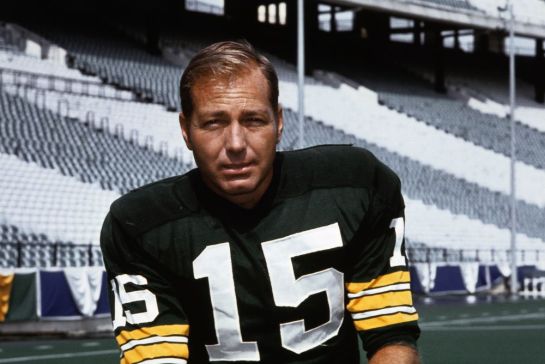
Why is it when great quarterbacks of the past comes up, few name Bart Starr?? Of course when talk of the 1960’s Green Bay Packers comes up, first we think of Vince Lombardi. Then we think of their signature play in the power sweep and their ferocious defense. Yet the glue that not only held everything together but made big play after big play in championship competition was quarterback Bart Starr.
The MVP of Super Bowl I and II and we never hear him among the NFL’s greatest quarterbacks is insane. The Packers were more than running to daylight as this video attests.
He carved up the Dallas Cowboys in the ’66 NFL Title Game with 4 TD passes which was 1 off the championship record of Sid Luckman in 1943. We wouldn’t see it equaled in a Super Bowl for another 13 years.
While Starr studied Johnny Unitas in his quest to become a better QB, Starr certainly mimicked Johnny U’s last minute 1958 NFL Title drive with his Ice Bowl drive in ’67. Starr mainly hit his backs Chuck Mercein and Donny Anderson to move the Packers before scoring the winning TD himself.
Yet once you think about it Starr’s drive in The Ice Bowl looks a lot like Joe Montana‘s to end Super Bowl XXIII when he kept throwing underneath to Roger Craig.
Bart Starr, at the time, was the only quarterback to take his team to 5 NFL championships. Amazingly it took another 49 years to get to Tom Brady winning his 5th in Super Bowl LI.
What’s interesting is we’re only talking about all time greats measuring up to Starr. He was one of the all time greats and needs to be remembered as one of the great quarterbacks in NFL history.
As we’re winding down this series of greatest single season defenses, the first question asked was where did the ’13 Seahawks belong in this group??
The Legion of Boom reigns supreme after 2013.
Do you realize Super Bowl MVP Malcolm Smith not only wasn’t a week 1 starter, but isn’t guaranteed to be one at Outside Linebacker for 2014?? He replaced KJ Wright #50 who had been injured. Its the depth and lack of drop off in production that makes this group great. They ranked #1 and were led by The Legion of Boom secondary which boasts 3 Pro Bowl Players.
Starting with defending Taylor Blitz Times Defensive Player of the Year Richard Sherman, who led the NFL with 8 interceptions. He returned those for 158 yards and a significant week 4 touchdown. He also was 7th on the team in tackles with 48, defensed 17 passes and recovered 2 fumbles.
Kam Chancellor’s thunderous hit on Vernon Davis a year ago is still the defense’s seminal moment in becoming the NFl’s most feared defense.
By the time you add Pro Bowl FS Earl Thomas (105 tackles/ 5 ints/ 11 pass defensed/ 2 forced fumbles) & the thunderous shots by Pro Bowl SS Kam Chancellor (99 tackles / 3 ints/ 12 passes defensed/ 1 forced fumble) you have one of the best secondaries in history. That’s what a championship can elevate you to. Three of four in the secondary made the Pro Bowl.
This group was #1 overall (273.6 ypg.) while finishing #1 against the pass allowing 172 yards per game. Those stats were 28 and 22 ypg. better than the defenses ranked 2nd. Quarterbacks finished with a 63.4 rating in a modern game where the rules have been altered to favor the pass. How does that rank against other great defenses??
2013 Seahawks passer rating allowed 63.4
1985 Chicago Bears passer rating allowed 51.2
1991 Philadelphia Eagles passer rating allowed 52.1
2000 Baltimore Ravens passer rating allowed 62.5
Chancellor brings the intimidation factor. At 232 lbs. he hits with the force of a linebacker.
For the season they held 7 opponents to 10 points or less and one of those was the 4th best offense in football, the New Orleans Saints. An 8th team held to less than 10 was the record setting #1 offense of the Broncos in the Super Bowl when they could only muster 8 points. The highest scoring team in history with 606 points averaging 37.8 per game, was held scoreless until the last play of the 3rd quarter. By then they were down 36-0.
Avril terrorized quarterbacks rushing them from the front side.
Before their 43-8 destruction of Denver, they bested Brees and the Saints in the playoffs were they held them to 15 points as well. They did lose to one Pro Bowl quarterback in Andrew Luck but that is offset by shutting down the 5,477 yards and 55 TD record setting Peyton Manning in Super Bowl XLVIII. So 3-1 against Pro Bowl QBs and holding 2 of them to less than 10 points is strong defensive football. Keep in mind the defense was missing CB Brandon Browner (suspension) and LB KJ Wright (injury) or the Broncos may have been shut out.
By the time we get to the pass rush of Cliff Avril (8.5 sacks) and Michael Bennett(8 sacks) rushing side by side from the strong side, this group plays front 7 by committee. Utilizing blitzes they garnered 44 sacks while surrendering an NFL best 231 points. In contrast the 1971 Dallas Cowboys who won Super Bowl VI or the Doomsday Defense gave up 222 in 14 games.
So yes The Legion of Boom belongs on this list. To do it in the modern NFL where if you sneeze near a receiver it’s a penalty, they gave a world class performance. One of the best in history and #3 on The Chancellor of Football’s list.
Slaton celebrated all night with a dazzling rushing performance.
Then along came Rich Rodriguez and his West Virginia Mountaineers. He took the spread offense to a complete zenith with what you could do with a 53 1/3 yard wide field and implemented a power rushing attack from a spread formation. First he recruited Pat White from Alabama. At 6’0 (being generous) and 185 lbs. he was short for a quarterback and had a decent arm, yet it was his 4.28 40 yard dash that made it nearly impossible for interior linebackers to read blocking patterns, than get to the flank to defend against his options or pitch to Steve Slaton.
Slaton was brought down from Pennsylvania and one of the nation’s fastest running backs coming out of high school in 2005. He had committed to Maryland who had offered him a scholarship then retracted their offer. He took his 4.3 speed to West Virginia to team with Pat White, Owen Schmitt, recievers Darius Reynaud #82 and Brandon Miles#7 and a powerhouse was born. They spread from a traditional set and some 3 receivers yet ran what they call a speed option that most MLBs didnt have the lateral quickness to stay with. The result?? First we have to set the table for you.
Pat White became the first QB in history to win 4 New Years Bowl Games.
My Miami Hurricanes and Boston College had just fled the Big East to join the ACC. Many felt that the Big East was no longer a top flight conference with two of their heavyweight schools having departed. Yet the Mountaineers started a redshirt freshman in Pat White, and a freshman tailback in Steve Slaton and a new offense took the country by storm.
They improved as the season went on and Slaton finished the season with 1,128 yards and 17 TDs, while White finished with 952 yds rushing and 7 TDs to go along with moderate passing to keep defenses honest.
Once they ran out to a 10-1 record, their Big East championship gave them an automatic bid to the BCS Sugar Bowl where they would take on Georgia. The Bulldogs that year were 10-2 and only a close loss in SEC play had kept them from appearing in the National Championship Game and were ranked 3rd.
Experts scoffed that West Virginia’s offense couldn’t perform that well against a superior defense from a superior conference. Yes experts were treating the Big East as a second tier conference with the remaining teams. So the battle lines were drawn and since the Sugar Bowl had to be moved from New Orleans to Atlanta’s Georgia Dome, because of Hurricane Katrina, this would be a home crowd for the Bulldogs too. No way the Mountaineers could stay on the field with an SEC team……………….right??
The Mountaineers had humiliated the Georgia defense rushing for 382 yards. They were within 53 yards of the Sugar Bowl record of 439 that had stood for 35 years. A record was set with Steve Slaton’s 204 yards on 26 carries and 3 scores. West Virginia embarrassed the entire SEC into recognizing the spread offense in front of millions. Since the game recieved a 9.0 Nielsen rating, somewhere around 14 million viewers watched Georgia’s defense give chase but never catch Pat White and Steve Slaton.
The entire SEC Conference moved their offensive approach to the spread from this point on. Take a look at Urban Meyer’s first Florida national champion to Auburn and Cam Newton’s 2010 championship. They were all in spread read option offensive attacks where just 6 years before they had been laughing at the approach.
So the landscape has changed, first through the proliferation of cable television stations allowing players to play in far away places and still be seen back home. This changed the way colleges could approach players when they weren’t the clear cut favorite to land a particular recruit. Players weren’t forced to switch positions to go to a particular name school when there were other alternatives. This happened simultaneously with the NCAA limiting the amount of scholarships teams which spread talent all over the collegiate landscape.
Steve Slaton killed Georgia with 202 yards and 3 touchdowns.
Then in an effort to find the great equalizer, coaching innovations leveled the playing field even more with better tactics while landing a better athlete on their campus than ever before. Couple these factors with the natural chip on the shoulder that most underdogs play with and college football has turned into “On any given Saturday…” Making college football an even greater game than before.
The following year Rodriuguez’s team charged into the season ranked 3rd and were in a dead sprint to play for the National Championship for 2007. Ranked #2 in the country going into the final weekend they were upset 13-7 in “The Backyard Brawl” to their rival Pitt. The nation was introduced to Sean “Shady” McCoy who ran for 148 yds and the difference making touchdown.
They were “this close” to playing for it all! They did rout Okalhoma 48-28 in the Fiesta Bowl to finish the season ranked 3rd.
Yet it was this Sugar Bowl played in prime-time the year before that changed the attitudes of coaches and pundits of the power conferences. From coast to coast teams were using the uptempo spread offense to run as well as pass. Teams could outflank those they couldn’t physically go toe to toe with. Forcing their opponent to field a different set of defenders and players who play better in space. This game was Rich Rodriguez’s masterpiece and changed the way college football is being played today.
A recurring theme that seems to be running through these greatest defenses were they had to carry anemic, inefficient offenses through the season. One such incident took place when the Philadelphia Eagles lost the 1990 NFL MVP Runner Up Randall Cunningham in the first week 1991. All appeared to be lost as they attempted to go on without their #1 weapon. This defense turned in one of the last truly great performances finishing #1 against the run, #1 against the pass, and obviously #1 overall.
When you carry a team that played five quarterbacks during the season, you’ve done something. We’re sure you remember that renowned NFL quarterback Brad Goebel or Pat Ryan, right?? Who?? Brad Goebel not Stan Gable…that’s a fictitious character from Revenge Of the Nerds.
As for real quarterbacks they had two games against the Redskins Mark Rypien, that year’s Super Bowl MVP. Two more against Hall of Famer Troy Aikman then one against Steve Young and Warren Moon. Also Hall of Fame members. All but Young made the Pro Bowl in 1991. They went 3-3 against them and held Young’s 49ers (#3 offensively) and Aikman’s Cowboys (#9 offensively) to less than 100 yards passing in two complete games that year.
Remember, Aikman and Young went on to face each other in 3 consecutive NFC Championships starting the following year and won the next four Super Bowls.
They faced 6 top 10 offenses going 3-3 against them. Defensively they held 6 opponents to 10 points or fewer. Two of those games were against top ten offenses as we mentioned earlier. Counting match-ups with divisional foes as individual games, 8 times they held their opposition to their lowest offensive output for the season.
1991 Pro Bowl members of the Eagles defense.
Half the defense made the Pro Bowl starting with the late Reggie White, the late Jerome Brown, and Clyde Simmons from the defensive line. These three accounted for 37 of the Eagle’s 55 sacks. Those 3 alone had just 7 sacks fewer than the 2013 NFL champion Seahawks had as a team. OLB Seth Joyner (110 tck / 6.5 sacks / 6 ff /3 ints) and CB Eric Allen who picked off 5.
The only reason SS Andre Waters didn’t make the Pro Bowl was his reputation.
Amazingly the late SS Andre Waters didn’t make the Pro Bowl even though he had 156 tackles. It was he and FS Wes Hopkins that sent the early message in their signature game against the Oilers. Did you know starting the very next week, when others used their 13-6 destruction against Houston as a blueprint, stats diminished for the Run & Shoot?? This historic performance was the impetus for the abolition of the Run & Shoot as a complete offensive approach in the NFL.
In winning 7 of their last 8 attempting to make the playoffs, the quarterback rating allowed was around 40.0. For the season, 206 of 467 (44.1%) for 2,807 yards 16 TDs and 26 interceptions would get a quarterback cut and ripped by NFL Network or ESPN shows. Well this was the passing given up by the 91′ Eagles all year.
Or think of it like this: Look at the ’91 Eagles performance against 6 top 10 offenses and 4 HOF QBs. Compare those stats to Geno Smith who was the worst rated starting QB last year. Yes 32nd!!:
’13 Geno Smith – 247 of 443 (55.8%) 3,046 yds 12tds 21 ints
’91 Eagles – 206 of 467 (44.1%) for 2,807 yards 16 TDs and 26 interceptions
One of the best in history and #5 on The Chancellor of Football’s list..
Dedicated to the memories of: Reggie White, Jerome Brown, Andre Waters, Wes Hopkins, Mike Pitts, Buddy Ryan, and Bud Carson.
One of the greatest defensive performances in NFL history happened in 1971. The defending Super Bowl champion Colts had the #1 defense and drug a struggling offense to the AFC Championship Game. They allowed the 2nd fewest yards per game mark in the NFL since 1970 with 203.7 yards. With only 140 points allowed, it would have been an NFL record had the ’69 Vikings not broken the ’68 Colts old scoring record of 144 with 133.
Bubba smith coming off the ball.
One interesting aspect of the ’71 Colts was how anemic their once great passing offense had become. The 38 year old Unitas completed just 52.3% of his passes for 3 TDs and 9 interceptions. Earl Morrall, who was 37, fared no better with an even lower 50.3% with 7 TDs to 12 ints. They were 21st in passing offense and 12th overall making the defense work harder.
During the ’71 season the defense held 7 of their 14 opponents to 10 points or less. Including 5 of their first 6. Baltimore’s D recorded 3 shutouts and held their first playoff opponent to 3 points. In facing 5 top ten offenses that year, they were 4-1 and held two of those to 10 points or less. Yet why aren’t they remembered??
Now the media anoints others of that era and obscures this team…lets compare a few:
1971 Baltimore Colts – #1 overall / 203.7 yds all. / 140 points given up / 28 int
1971 Dallas Cowboys – #3 overall / 243.3 yds all. / 222 points given up / 26 int
1972 Miami Dolphins – #1 overall / 235.5 yds all. / 171 points given up / 26 int
1970 Minnesota Vikings – #1 overall / 200.2 yds all. / 143 points given up / 28 int
1975 Pittsburgh Steelers – #4 overall / 261.5 yds all. / 162 points given up / 27 ints
Right now fans of the Doomsday Defense, The No Name Defense, and the Steel Curtain are saying to themselves ‘Its not all about stats”. Which is true until you realize this was a defending Super Bowl champion that made it back to the AFC Championship Game despite its offense. Had they won against Miami, they would have taken on the Dallas Cowboys in Super Bowl VI. Well that is who they beat in Super Bowl V to become champions in the first place.
Mike Curtis tackling Cliff Branch.
Led by Pro Bowlers DE Bubba Smith, MLB Mike Curtis, LB Ted Hendricks, SS Jerry Logan, and FS Rick Volk, its amazing only Hendricks is in the Hall of Fame. Curtis definitely should be but when you think of Hendricks making the Hall that is primarily from his work with the Raiders.
This was the last hurrah for the Colts as everything came apart starting in 1972. That was the year owner Carroll Rosenbloom swapped franchises with Robert Irsay. Head Coach Don McCafferty fired, John Unitas sent to the bench and the run as an NFL elite team ended.
Yet a tremendous performance by the defense in 1971 allowed them to hang on for one more season.
Dedicated to the memories of Don McCafferty, Bubba Smith, & Carroll Rosenbloom
For all the talk of the Gritz Blitz and the Orange Crush Defense in 1977, it was the year of The Doomsday Defense II. They faced off with the Denver Broncos down in New Orleans in Super Bowl XII and the better defense won. They carried their season statistical domination into that game and forced a then Super Bowl record 8 turnovers. This was the last NFL champion to finish #1 on defense and #1 on offense. In giving up just 229.5 yards per game, most don’t realize that was better than the 1978 champion Pittsburgh Steelers (260.5) or even the great ’76 version (237.5).
After Craig Morton was benched, Hollywood Henderson and Doomsday treated Norris Weese to a rough outing. In Super Bowl XII
Unofficially that year was the little known fact that DE Harvey Martin recorded 26 sacks. The league didn’t start keeping that statistic until 1981 or that would still be a record. It was arguably his best season as he was named All Pro and made the Pro Bowl. Surprisingly he was only joined by SS Charlie Waters, OLB Hollywood Henderson, FS Cliff Harris, and DT Randy White.
Yet this group does have some knocks against it. They only faced 3 top ten offenses that year and gave up 212 points for the season. The highest of our top ten. However they were 2-1 in those games and were the first Super Bowl champion to face their eventual Super Bowl opponent during the season. Winning the finale 14-6.
Supe Bowl XII Co-MVPs Randy White and the late Harvey Martin.
So why are they in the top ten??
The number one reason this group is here is this was the height of The Flex Defense. Their dominance was felt in a season long display. They held 7 of their 14 opponents to 10 points or less then became the first team since the merger to hold their 3 postseason opponents to 10 points or less. One of those was the #3 ranked offense of the Chicago Bears and NFL rushing champion Walter Payton. He was held to 60 yards on 19 carries in a 37-7 win in the divisional round.
The havoc they raised in Super Bowl XII with 4 sacks, countless hurries that led to 4 interceptions on the biggest stage didn’t hurt. When half your line, DT Randy White and DE the late Harvey Martin, become the first defensive linemen to win Super Bowl MVP, that puts on an exclamation point on the season.
Other talents such as Ed “Too Tall” Jones, Thomas “Hollywood” Henderson who made his 1st Pro Bowl, made names for themselves as well. They would defend their championship in the following Super Bowl with the Pittsburgh Steelers where they ranked #2 in defense to the Steelers ranked third. That’s another story for a different time.
Epilogue: This was the crowning jewel in the late Tom Landry’s coaching career. Where he engineered a majority of the tactics to bring the 4-3 to be the modern staple of defense in the NFL. It was his ability to innovate that defense and come up with the Flex Defense to read and react as well as keep the Middle Linebacker (Bob Breunig) free of potential blockers.
Dedicated in the memory of both Tom Landry and Harvey Martin.
You must be logged in to post a comment.