Hail Mary: Dallas Cowboys 1975 Miracle Finish

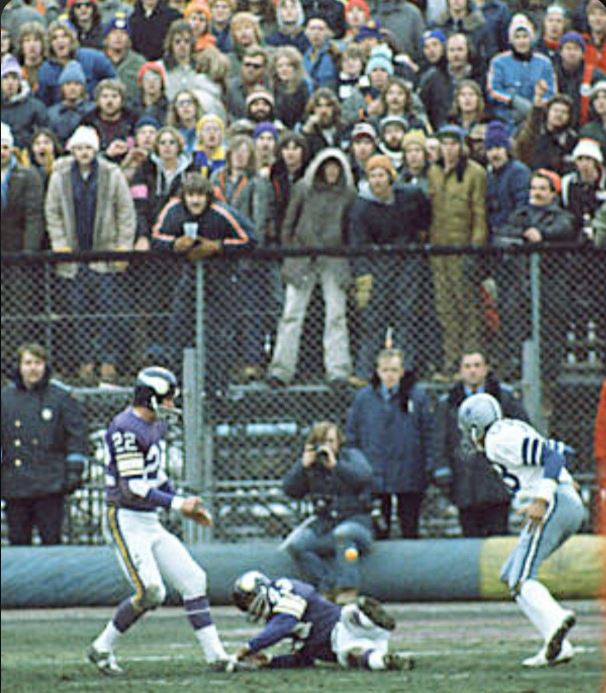
Roger Staubach lets fly against the Minnesota Vikings in the 1975 Hail Mary Game

There are some NFL games that last in the memory longer than others, especially when it comes to playoff games.  None holds true more than the miracle finish that won the 1975 NFC Playoff game for the Dallas Cowboys over the Minnesota Vikings 17-14. Minnesota was trying to equal the feat of the Dolphins in terms of reaching their 3rd straight Super Bowl. Yet they had to get by the rebuilding Cinderella Cowboys who were in the midst of a rebuilding year. The window was closing for this great team to win that elusive Super Bowl.

After the upset loss to the Kansas City Chiefs in Super Bowl IV, the Purple People Eater defense had stayed among the league’s best while the offense had to be revamped. After going a few seasons without having adequately replaced Joe Kapp, the Vikings reacquired Fran Tarkenton in 1972 to add leadership and a grade A quarterback to the offense.  Also in 1972, they acquired John Gilliam who became the first deep threat ever for the Vikings. In that first year, Gilliam teamed with Tarkenton to become the first Viking in team history to top 1000 yards in receiving.

They finally had some offense but needed one more element and got that boost in the 1973 draft.  Chuck Foreman gave the Vikings their first great running back. Combining his skills with Gilliam and Tarkenton and the Vikings made it to the top of the NFC.  However back to back Super Bowl losses to Miami and Pittsburgh dulled some of the luster to the 1973 and ’74 seasons. Yet they were seasoned and primed to win it all in 1975. Just have to get past a youthful Dallas Cowboys team that made the playoffs as a wildcard. Easy money….right??

After missing the playoffs in 1974 while transitioning in 14 new players, the Cowboys had said goodbye to familiar faces like Bob Lilly, George Andrie, Chuck Howley, Calvin Hill, and Walt Garrison.  Players that had epitomized the era of the “Next Year’s Champion” Cowboys through their ultimate triumph in Super Bowl VI.  From 1966-1972 this team was among the league’s elite playing for multiple championships. Yet as we make it into the mid 70s, those aging great players started to retire and a new breed of Cowboys started to infuse the roster. An Ed “Too Tall” Jones in place of a George Andrie, a D.D. Lewis to replace a Chuck Howley. Understand this team had plenty of veterans to lead this young team into this playoff game. MLB Lee Roy Jordan, OLB Dave Edwards, DT Jethro Pugh, and CB Mel Renfro were among the mainstays on defense.

On offense Roger Staubach had developed into a complete NFL quarterback. His ability to move within the pocket was enhanced with the installation of the “Shotgun” formation. Coach Landry had re-introduced a formation that was the birth-child of the early 1960s San Francisco 49ers and Coach “Red” Hickey.  This hodge podge set of Cowboys made the pilgrimmage to Minnesota’s Metropolitan Stadium for an NFC Playoff Game.  The ’75 Cowboys didn’t even win their division, they came in with a 10-4 record and seemed to go as far as their talent could take them…right??

To borrow a line from Chris Berman “That’s why they play the games!!”

Drew Pearson scoring on the “Hail Mary” with :18

Epilogue: It was this game that launched the mid to late 70’s Dallas Cowboys. Roger Staubach had already performed a great come from behind playoff game against the 49ers in the 30-28 epic1973 NFC Divisional Game out in Candlestick. Yet it was this second one that spread the belief in his team psychologically that they were never out of a ball game with Roger at the controls.

This was also the game that ushered in Drew Pearson as a playmaker that would be a scourge for many a Cowboy foe over the next decade or so in the playoffs. They would go on to win the NFC Championship in an upset blowout of the Los Angeles Rams in the LA Coliseum 37-7 before falling to the Pittsburgh Steelers, 21-17,  in Super Bowl X.

As for the Minnesota Vikings a window was narrowing shut on their championship chances.  The great line of Hall of Famer Carl Eller, Hall of Famer Alan Page, Jim Marshall, and Doug Sutherland was aging and wasn’t as dominant as in years past. In the 1976 season, Buddy Ryan was hired to coax one more good year out of this group. They got it even though they wore down toward the end of the season. They made it to their 3rd Super Bowl in 4 years, and 4th  Super Bowl in 8 years total yet they lost to the Oakland Raiders 32-14 in the 11th edition.

The latter part of the 1970s saw the great play of the Vikings diminish as their stars retired or were phased out. Fran Tarkenton would go on to retire with more passing yards than any quarterback in  NFL history with 47,003 yards. The day of the “Hail Mary” game dealt Tarkenton a more severe blow when he learned his father had died of a heart attack while watching the game in Georgia.  He was standing in a CBS truck when he learned of his father’s passing.

Yet there is one lingering question from the “Hail Mary” game… Did Drew Pearson interfere with CB Nate Wright or did Nate Wright simply overrun the play?? While it can be noted that if you look at the play before the touchdown, you can see Preston Pearson lose his footing. So it doesn’t seem implausible…. Did he push off??

Death Becomes the Run & Shoot on a Monday Night

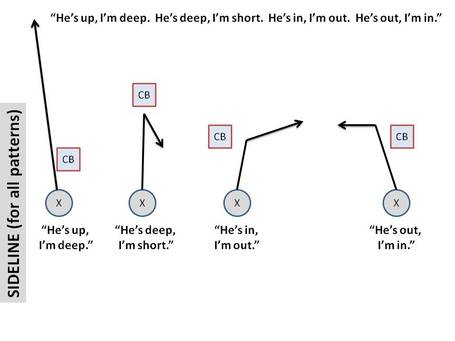
Single outside receiver site adjustments from the Run and Shoot

Whatever happened to the Run & Shoot as a pro offense?? You remember in the early 90s, when several downtrodden franchises looked to this offense to gain a tactical advantage on the competition.  Atlanta, Detroit, Houston, and Seattle deployed 4 receivers who ran their routes according to how defenses were playing them.  Borrowing on a concept from Bill Walsh’s offense, it was up to both the receiver and quarterback to read the defense, then adjust the route accordingly.

The truth of the matter is for each team with 4 receivers; the 3rd and 4th receivers were better than the opposing 3rd and 4th defensive backs that were normally platooned to cover them.  These teams started racking up yards by the bushel and along with Buffalo’s “K Gun offense”, the zenith of the Run & Shoot was 1991 when each team, except Seattle. who abandoned the offense in 1990, made the playoffs.  The Bills set offensive records for TDs scored and 33TD passes in a season by Jim Kelly.  In fact Thurman Thomas was NFL MVP with over 2,100 combined yards from scrimmage.

Everyone thought of the Bills “No Huddle” offense as an offshoot of the Run & Shoot because of option routes run by Andre Reed in the slot and Thurman Thomas out of the backfield.  Teams had a hard time adjusting and no matter how your corner played any of these receivers, the receiver would change his route and use the corner’s position against him.

For instance if the corner played outside position in a cover 3 zone, the adjustment would be a seam route by the slot receiver, or a skinny post for the outside receiver.  That same corner came up in press one on one, the receiver would try for an outside release and run a fly pattern.   In a cover 2 where the corner was off, he would adjust and run a hook with the underneath receiver running a down and out underneath his pattern, as the outside receiver occupied the corner.  What could a defense do to combat an offense that used your very choices against you?

Enter the NFC East.  This was the division that each team fielded twin 200 lbs. safeties receivers were funneled to. Whether it was Myron Guyton / Greg Williams with the New York Giants, Danny Copeland / Brad Edwards of the Washington Redskins, or the more punishing Andre Waters / Wes Hopkins duo that was on patrol in Philadelphia’s Veteran Stadium.

Where most teams were employing mainly dime defenses that were off the receiver, these teams started fielding nickel and dime defenses with cover two over the top and bludgeoned smaller  run and shoot receivers.  Many pundits look back to the Giants 1990 Super Bowl XXV defeat of the Buffalo Bills and their use of a 2 man line nickle and dime variations to slow down Buffalo’s no huddle / run and shoot tactics.

However thats misleading…the Giants conceded the run to the Bills (see Thurman Thomas’ 135 yards rushing) to set the tone punishing receivers with hits from the linebackers and safeties.  It was more of a victory based on the strong time of possession difference from the methodical Giants offense more than defensive tactics. A 40:31 to 19:29 possession time difference as a matter of fact.  Although Super Bowl XXV, at the end of the 1990 season, did set the blueprint for playing physical defense against this speed type offense.  So when and where was the run and shoot conquered as an offense??

The signature game that signaled the death of the Run & Shoot as an offense, came in week 14 of the 1991 season.  A Monday night matchup where the Houston Oilers hosted the Philadelphia Eagles.  The Eagles as a defense had come to full fruition as a unit originally put together by Buddy Ryan and now run by defensive coordinator Bud Carson.  They had high hopes that 1991 would be their year: they returned ’90 NFL MVP Randall Cunningham and an improving defense, yet torn ligaments to Cunningham’s knee courtesy of Bryce Paup in the season opener, sent the Eagles season spiraling.  Not quite…

A defense that ranked near the bottom in ’88, Buddy Ryan helped their esprit de corp when he drafted only four players in 1989 citing he liked his guys.  The team grew defensively into a giant by 1991 although Ryan was no longer with them.  The defense kept them in games week after week and they came into this matchup 7-5.  Could they best the #1 passing offense in the league? Could they do it on the road?

The Houston Oilers were the vanguard of the run n shoot teams and with Warren Moon had put up the most prolific numbers. In 1990 Moon passed the Oilers to the playoffs with 4,689 yards and 33 TDs.  The most since Dan Marino’s record setting 1984 and he missed 1 full game and time in 2 others.  Along the way he passed for 514 yards against the playoff bound Chief’s #6 ranked defense. Coming within 41 yards of Norm Van Brocklin’s 50 year old record of 554. Alas Moon suffered a broken thumb and missed the Oiler’s playoff loss to Cincinnati.

Going into 1991, Moon was on a near record setting pace again and some thought this, and not Buffalo was the strongest AFC team.  The Redskins were 8-0 and the Oilers 7-1 when they met in a week 8 slugfest with the eventual world champion Redskins. The game was won  by Washington 20-17 in RFK, yet they showed they indeed were ready to stand toe to toe with the best the NFC offered. Going into the Monday Night tilt against the beat up Philadelphia Eagles at home, many thought the Oilers juggernaut offense would roll in this game too.

What took place over the next three hours was one defensive masterpiece that many defensive affecionados remember reverently to this day. The Eagles employed a 4-2-5 nickel variation with OLB Seth Joyner and MLB Byron Evans, who was lanky for a middle backer yet had great range, for most of the night.

Occasionally they’d bring in the dime defense (6 defensive backs) yet what they did differently was press the receivers and blitz off short corners. The hitting was vicious with Wes Hopkins and Andre Waters leading the way.  They knocked out both Ernest Givins and Drew Hill out of the game twice each. The first vicious shot was a dirty elbow from Wes Hopkins that broke Givins nose, yet set the tone for the night.

Joyner played his way to the Pro Bowl and almost the Hall of Fame that night with 2 sacks, a forced fumble and a fumble recovery to keep the game close.  Reggie White, Jerome Brown (The U), Mike Golic, and Clyde Simmons swallowed Allen Pinkett’s attempts to run holding the Oilers to a paltry 21 yards rushing for the game.  They also provided a serious rush that they supplemented with the occasional blitz that beat Houston into total submission before a stunned audience of millions. When dime back Otis Smith’s thunderous hit on Drew Hill, on an outside swirl route, forced Houston’s fifth fumble of the night. The rest of the league were on their second tablet from taking notes. The Eagles won 13-6 in front of a shocked audience.

Early 90s pic of Eagles L-R: Clyde Simmons, Eric Allen, Jerome Brown, Seth Joyner, and Reggie White

The beating was so decisive it ruined the Oilers season and this game was the complete blueprint on how to stop the run and shoot. Going into the game the Oilers were averaging 307 yards passing, just off pace needed to break Marino’s passing record, yet staggered away from this game only averaging 232 the rest of the season. The 226 they gained through the air against the Eagles was their season low.

The average was also down for the Falcons and Lions over the last 4 weeks of the season as well. The Oilers went down in the divisional round of the ’91 playoffs 26-24 to Denver, and the lone run n shoot playoff winner was Detroit who went on to whip Dallas 38-6. In fact the Cowboys had lost 4 games to run n shoot teams in 1991. The next year the Cowboys drafted a rangy MLB Robert Jones, in a Byron Evans mold, and brought in CB Kevin Smith, SS and former rangy college linebacker Darren Woodson, to stop those offenses the next year. The first of their 3 Super Bowl wins in the 90s and it started with that 1992 draft to mimick what the Eagles fielded in 1991.

As for the run n shoot, its effectiveness was diminished and the race for the record book was over.  In 1991 Houston passed for 4,621 yards where in 1992 that number dropped to 4,029. In ’92 neither the Lions or the Falcons came within 3 games of the playoffs and the Lions and Bills started to alter their offensive approach. The Oilers along with the Falcons ran the offense until 1993, yet the Falcons never returned to the playoffs…and the Oilers?? Well they went into the 1992 wildcard and took a 28-3 halftime lead on Buffalo who was playing with 6 & 7 DBs on the field.  Warren Moon at the half was 19 of 22 for almost 300 yards and 4 TDs and ballooned the lead to 35-3.

In the 3rd quarter, the Bills decided to play it the same way the Eagles had in ’91 inserting rangy MLB Carlton Bailey #54 and Darryl Talley #56 and they shut Houston down in the second half enroute to the greatest comeback in NFL history winning 41-38 in OT. Couple these landmark events with the system’s inability to score in the red zone and the run n shoot’s fate was sealed.  Even now the run n shoot receiving principles of WR route running based on options lives on in playbooks, just not in a 4 receiver set, nor as an entire offensive approach.

As for the Philadelphia Eagles defense that was the architect of the run n shoot’s demise? They went on to become the last great defense to finish #1 against the run, #1 against the pass, and #1 overall.  A distinction the ’85 Bears, ’86 Giants, ’76 Steelers, ’78 Steelers, ’08 Steelers, nor ’00 Ravens could match.  They finished the season winning 7 of 8 games and finished 10-6 and narrowly missed the playoffs.

The combined quarterback rating for their final 6 QBs was less than 40.0, and their principle line rushers R. White, Jerome Brown(The U), and Clyde Simmons combined for 37 sacks (which if they played last year would rank 11th in the NFL by themselves), and all 3 were Pro Bowlers and 1st team All Pro. Seth Joyner and Eric Allen earned Pro Bowl distinctions in 1991 as well.  They don’t receive the recognition of those other great defenses because they didn’t win the Super Bowl. Who would have operating with 5 different starting quarterbacks? They were one of the best defenses in NFL History.  Had Randall Cunningham not been injured…

Prologue: The impact of the players of this era in Eagle history were felt throughout the decade…
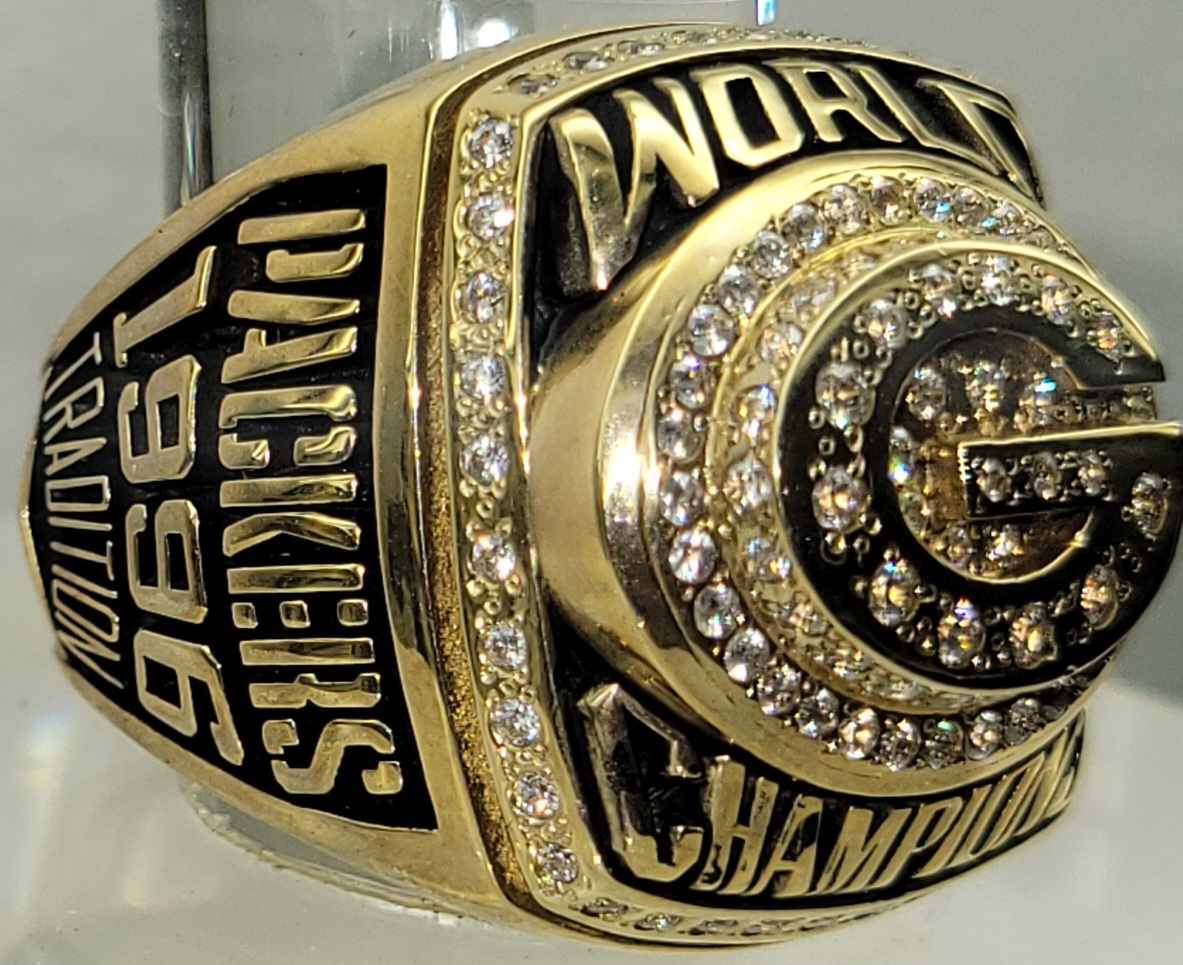
Reggie White-Became the main prize in 1993’s free agent derby, signed with Green Bay and went on to become the NFL’s all time sack leader. Recorded 3 sacks in Super Bowl XXXI when he became a champion with Green Bay along with former Eagle TE Keith Jackson. They bested the New England Patriots who had former Eagle RB Keith Byars and CB Otis Smith on the team. White passed on the week of Christmas 2004 which cast a pall over the playoffs that year. He was inducted into the Hall of Fame posthumosly in 2006. RIP Reggie White.
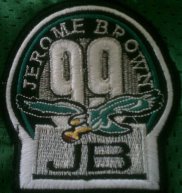
Commemorative patch worn by the 1992 Philadelphia Eagles in Jerome Brown’s memory.

Jerome Brown– An all pro talent who passed away the following June. He’s still one of the most beloved Miami Hurricanes and missed by Hurricane fans everywhere. The 1992 Eagles dedicated their season to his memory and wore this commemorative patch on their jerseys the entire season. They also kept an equipped locker for him throughout the season and set it up on road trips also. His locker was with the ’92 Eagles in the Superdome as they won their first playoff game in 15 years.

Brown was the predecessor to fellow Hurricanes DTs Cortez Kennedy Russell Maryland, and Warren Sapp. Kennedy, who changed his number to 99 in honor of Jerome and went on to win NFL Defensive Player of the Year in his honor in 1992 while playing for the Seahawks. Every Hurricane playing in the NFL during 1992 wore a black #98 on their helmet that year including several that played for the Dallas Cowboys. The next time you watch Super Bowl XXVII where Dallas beats Buffalo you’ll see the black #98 on the back of many helmets. Jerome was alos the inspiration and reason former Hurricane Warren Sapp wore #99 during his entire NFL career. R.I.P Jerome Brown

Seth Joyner & Clyde Simmons– Were twin free agent prizes that signed with Buddy Ryan and the Cardinals in 1994. I wrote the Buffalo Bills organization and suggested we grab Simmons and Joyner to join Bruce Smith and Cornelius Bennett to fortify our defense to get to our fifth Super Bowl…yet I digress Joyner went on to join White with the Packers (1997) in their bid to repeat as champions yet they lost to Denver in Super Bowl XXXII.

Well if you can’t beat ’em, join ’em, and when Denver (1998) went on to become back to back champions a year later. Seth Joyner was a Bronco and guess what number he wore?? Number 99. He is a motivational speaker in Arizona now http://sethjoyner.com/ runs youth football clinics and is a coach himself. Just launched his show and podcast “The Seth Joyner Show” where you can hear his commentary along with a host of former Eagles.


Eric Allen– Played on through the 2001 season finishing with the Raiders. A popular notion is he should have been 1993’s NFL Defensive Player of the Year for his 64 tackles 6 interception performance in which returned 4 of them for touchdowns.  The most famous being a 91 yard interception against the Jets. After weaving his way into the endzone, he handed the ball to teammate Randall Cunningham who was on crutches having been injured earlier in the game. His last game as a player was the famous “Tuck Game” in New England in the 2001 playoffs. Former teammate Otis Smith was a Patriot CB. He’s currently an ESPN analyst.

Byron Evans-Played 8 years with the Eagles through the ’94 season and was an underrated talent. Has an internet radio show he does with former teammate CB Mark McMillan on the Voice of America Network. http://www.voiceamerica.com/show/1475/hard-hittin-radio

Andre Waters– The hard hitting safety went on to join Simmons and Joyner in Arizona for the ’94 and ’95 seasons. He had gone into coaching yet passed away in 2006 R.I.P. Andre Waters

Otis Smith-Was an Eagle dimeback in ’91. He went on to be the wily CB for a veteran laden Patriot team that lost Super Bowl XXXI to Green Bay. Yet was a Patriot 5 years later man handling Tory Holt and Isaac Bruce to stop the Greatest Show on Turf as he became a champion in Super Bowl XXXVI.

Mike Golic– finished his career with Miami and is half of the popular duo Mike and Mike on ESPN television and radio in the morning.

Taylor Blitz Times new logo!!

Taylor Blitz Times new logo!!

2011 Dallas Cowboys Preview

For the Dallas Cowboys, 2009 began with the optimistic view of becoming the first team in NFL history to play in the Super Bowl on their own home field. The reality was that their roster wasn’t dynamic enough to fulfill these expectations and they hadn’t adequately replaced Flozell Adams who had departed at Left Tackle.  Subsequently Tony Romo ran for his life until an injury finished his season. Although the Cowboys won 5 of 8 games to finish the season, it makes you wonder how close are they really?  Are they a few players away as Jerry Jones and company would like to make us think?  Was the improvement shown toward the end of the season a product of Jason Garrett’s coaching or from the fire lit under everyone’s ass when they learned they were all expendable??

Tony Romo

Quarterback: Going into his fifth season as the starter, the Cowboys have a good quarterback in Tony Romo.  So much is made of what he does off the field that many Cowboys fans don’t recognize he owns all the significant passing records in team history. He’s thrown for twice as many 300 yard passing games as Troy Aikman.  Get this: In 2009 he threw for 4,483 yards and 29 TDs, had he not thrown for 36TDs in 2007, those would have both been Cowboy records as well.  He has a good arm and can deliver the football from the pocket or on the run.  His dropback is fluid and he moves effortlessly when he escapes the pocket.  Also he needs to show more daring, when its 3rd and 10, throw to the second level and get the first down and not some 3 yard dump off that achieves nothing. Physically he has the tools to be a great quarterback.

Psychologically, Romo hasn’t shown to be the inspirational leader that the Cowboys hoped he’d be once they released Terrell Owens.  He hasn’t dropped his “aw shucks” persona and taken on that of a field general. The type of generalship that Jon “Cockroach” Kitna showed in those last 8 games. You saw him pleading, cajoling and getting in teammates faces, especially after dumb penalties, and played ball from his gut. Last year he completed 209 of 318 passes for 2,365 yards, 16 touchdowns and 12 interceptions. Kitna’s 65.7% completion rating was the best of his 14 year career.  Project those numbers over a year and thats a Pro Bowl season. The best he’s ever played and a solid backup.

The best way to get to Romo is to come with delayed blitzes. When he senses the outside rush coming, he’s quick to step up through the gaps looking for space to run or throw. In self scouting you can see the Cowboys are aware of this and they run a lot of draws and delays to the running backs to make it all look the same.  Keep defensive ends from coming up the field too quick and opening those gaps between themselves and the inside rushers. Another thing is to keep putting hits on him, there are times Romo will look down at the rush if hit or sacked early. Its yet to be seen if his game changes any coming back from a broken clavicle. Will he be willing to take those hits??However, Dallas is very good at quarterback.

Offensive Backfield: Dallas has the best set of 3rd down backs in the league in Tashard Choice and Felix Jones. The problem is what to do on 1st and 2nd down. Early last year an astute Cowboy fan, Gary Bumgarner, suggested that Marion Barber had really slowed down.  The eyeball test didn’t lie. Amazingly over the last 3 years Barber has only averaged over 4.0 yards per rush (league avg.) in only one season. Last season he ran for a paltry 374 yards while scoring 4 TDs.  Surprisingly he has not run for more than 1,000 yards at any point of his career.  He has run hard, with heart and great determination, but he seems to be this generations Wilbert Montgomery and has beaten the ability from his body early.  Along with his high salary and the drafting of DeMarco Murray, we at Taylor Blitz Times think he will be cut before the season.

Felix Jones had his best season while taking over for Barber.  He rushed for 800 yards on 185 carries but only scored 1 touchdown.  His average per carry was good (4.3 yrd avg) but his touchdown total tells the story.  He and Choice are space players, neither have the heft to knuckle up and get that 3rd and 2 or power in from the two like Barber could.  Since Felix Jones is supposed to be a homerun hitter, he should have been able to break an arm tackle and take it the distance 4 or 5 times last year wouldn’t you think? Or at least in space, right? Well, out of the backfield Jones had 48 rec. for 450 yards and again only 1 TD.  Thats 233 touches of the football and only 2 TDs for a breakaway threat?

Choice seemed like the odd man out last year, carrying the ball only 66 times for 243 yards and 3 TDs. At 5’11 and 212 lbs, Choice should be the starter with Jones as the 3rd down back. Can Choice take the pounding? He did run for 100 yards in a week 13 win over the Colts in a 38-35 overtime thriller. Yet between Choice, Jones or 3rd round pick DeMarco Murray none seem to thrive running between the tackles. So if Marion “The Barbarian” gets released who is going to run the football in goal line and closing situations? Running back is below average for the Cowboys until someone emerges and the pick of Murray was a puzzling one for us.

Receivers: This is where the Cowboys are in the best shape of any unit. Once the Cowboys were out of contention they started to put Dez Bryant in different situations to see what he could do. Bryant came in as a rookie and played with fire and flair, who knew at 6’2 225lbs he would be a good kick returner? He averaged 24.4 yards on 12 kickoff returns and a whopping 14.3 on punt returns, taking 2 back for touchdowns on only 15 attempts. Do you realize projected over a complete season those would be NFL leading numbers in both categories? Throw in his 45 receptions for 561 yards and 6 touchdowns and what do you have? The bench for a certain Roy E. Williams. Look some players just have the it factor and this kid is it.  He plays like he wants it and if I were Jason Garrett I’d sick him on defenses 15 times per game. He’s tall, muscular, fast and can jump. The first of many Pro Bowls should come this year with his first 1,000 yard season. Don’t be surprised if he goes over 80 catches for 1,300 yards and 12-15TDs. Terrell Owens has finally been replaced.

How can we be so high on Bryant? Well the first part of that equation is his skill set and the second is he’s teamed with Pro Bowlers Jason Witten (94 rec. 1,002 yds 9 TDs), and Miles Austin (69 rec. 1,041 yds 7TDs). Yikes! This is not going to be easy for anybody to defend. Witten is the best tight end in football. A solid blocker who at TE has the heft to muscle safeties and the speed to get over back pedaling linebackers.  Thats two straight years with 94 receptions and with another season like that will have crossed 715 receptions in his career. Guess what? The all time reception record for tight ends is within reach. He was a Pro Bowler for the 7th time and was first team All Pro for the second.

Which brings us to little Miles Austin. Of course we’re kidding here but at 6’3, 215lbs. he is the smallest of the two receivers. So coming up and jamming these guys is going to be difficult. Austin didn’t have quite the year he had in his breakout 2009 campaign but he had to deal with teams really game planning and paying attention to him and had to work with backup Jon Kitna at quarterback. Still he crossed 1,000 yards and made the Pro Bowl a second time. Reminds me of Andre Reed the way he runs after the catch and unlike many receivers you can’t arm tackle him. With Austin, the hope is he keeps playing with that chip on his shoulder. The practice squad guy who finally made good and not fall into that celebrity dating nonsense to get his mind off of football.

What? Oh Roy Williams with an “E” could work out as a really good third receiver to help stretch for first downs.  Are you seeing what we’re seeing? This is shaping up to be one of the best receiving corps since the 2007 Patriots. We already told you the Cowboys have a good quarterback who owns the 2 highest touchdown marks passing in Cowboys history at 36 and 29. If Romo comes back healthy… Lets just say that at WR & TE, this is a Super Bowl caliber group.

Offensive Line: Where the Cowboys did their best work on draft day.  They brought in T Tyron Smith out of USC with their 1st round selection, then snagged G David Arkin of Missouri St. This offensive line did benefit early on with Tony Romo scrambling. That kept the sack totals down yet they did surrender 31 which was 11th best.  It was the 73 hits, 17th allowed, that is unacceptable and sidelined their quarterback for the year. Although they were 16th in rushing with a 1,786 yards in 2010, the Cowboys struggled to push when they needed to.  Critical 3rd and 2 power plays saw the marginal success of 59  1st downs up the middle and only 44 times to the strong side which ranked 23rd and 25th respectively. Terrible.  What is surprising is that C Andre Gurode was a Pro Bowl selection in 2010.

The Cowboys drafted Smith #1 for him to go into the lineup. They may have finally replaced Flozell Adams if he can beat out incumbent Doug Free at LT. Arkin or 7th round pick  C Bill Nagy should push to make both guard spots. Too much improvement is needed at the guard spot for at least one of these rookies to get into the starting lineup. Most likely would be Larkin.  By addressing their offensive line in the draft and watching the Packers win the Super Bowl with several young linemen, they should be influenced to go young and live with the consequences.  They worked their way up to average with a chance to be good on the offensive front.

Defensive Line: This team needs to pick up a few free agents to solidify themselves on the defensive front. Defensive ends Igor Olshansky, Marcus Spears, and Stephen Bowen combined for 1.5 sacks in 2010. Before you say ‘well they are there to tie up blockers and not give ground in the Cowboy 3-4’, they were 12th in the NFL against the run and gave up over 4.3 yards per rush, which ranked 17th.  Thank goodness Jay Ratliff had a Pro Bowl year by not giving up too much ground in the middle or this defense could have finished dead last in all of football. Seriously. Ratliff provided the only push from this unit recording 3.5 sacks where opposing lines could concentrate on him. He needs help. Not signing any defensive help yet, we have tho give the Cowboys a below average grade here.

All Pro OLB DeMarcus Ware

Linebacker: This defense begins and ends with DeMarcus Ware, NFL sack champion for 2010.  His 15.5 sacks was the only consistent element on the defensive side of the football for the Cowboys. He’s simply a beast and its imperative that they get some pressure generated elsewhere and he may have a shot at the single season sack record.  However at times it seems that he can disappear in games yet its a misnomer. Teams game plan for him and are sometimes successful.  Imagine what he could do with a bookend to relieve him of some of the double and triple teams? With all this attention he still has been the All Pro (3 times) and Pro Bowl (5 times) performer out of Troy that Bill Parcells envisioned. He’s the best outside linebacker in the NFC.

Toward the end of the season Anthony Spencer started making some plays and was the most improved defender on the team. He amassed 63 total tackles, had 5 sacks and forced 2 fumbles. Bradie James and Keith Brooking  manned the inside linebacking spots. James led the Cowboys with 118 tackles, had 2 forced fumbles and 1 interception. A solid performance.  Brooking has proven to be the team’s inspirational leader and was second on the team with 97 tackles and had 1 interception. A player that made a splash in 2010 was linebacker Sean Lee, especially against the Colts and Peyton Manning.  He picked him off twice and had a pick six in that game while making several splash plays against the pass and the run.  He finished the season with 25 total tackles in a relief role and those 2 interceptions with 1 forced fumble.  If James or Brooking go down during the season this kid can fill in without a drop off. The linebacker play in Dallas is well above average.  They need the line to keep blockers off of them better.

Secondary: At first glance you want to lambast this secondary for the dismal 26th ranking against the pass yet this is a two fold issue. If the secondary was so bad why did they snatch 17 of the team’s 20 interceptions?? Sure there is some improvement needed at the corner position where Mike Jenkins has regressed from his play a few seasons back and tallied only1 interception. He has to improve, no make that he better improve http://bleacherreport.com/articles/686084-dallas-cowboys-2011-draft-report-card-grades-for-all-eight-draft-picks has high regard for 5th round draft pick Josh Thomas from the University of Buffalo. He will push both Jenkins and Newman (whom Cowboy fans have wanted replaced for 100 years now) for a starting spot.  We say that because its going to be hard to move Orlando Scandrick.  He was very effective as a blitzer and a nickel back.  He made 2.5 sacks, 45 total tackles with 8 passes defensed, nearly matching  Jenkins production of 55 tackles, 9 passes defensed with a single interception.

At safety Gerald Sensabaugh led the team with 5 interceptions, tied with Newman for the team lead.  He seems a little stiff in his backpedal but that is normally the case with most strong safeties.  Free safety is where we and other pundits feel the Cowboys can improve their secondary’s skill set.  Watch out for possibly a Darren Sharper signing to put more moxie into their secondary if he comes available.  Incumbent starter Alan Ball only defensed 4 passes and had just 1 interception.  He had plenty of opportunities while team’s racked up 3,894 yards passing last year.  A little more pass rush and this secondary would be decent.  Without it and we have to say slightly below average.  If Ball starts playing with instinct and can be more of a factor against the pass they can rate as good.  Right now have to stay with the present ranking.

Overall: Upon further review, the Cowboys don’t really want to run. Not in the traditional sense and the drafting of another space back is evidence of this.  They are going to throw the football and run off of draws and screens. What rugged NFC East?? With the New York Giants and definitely with the Philadelphia Eagles taking more to the air, Dallas is going to be throwing out of 3 receiver sets heavily.  Expect every passing record in team history to fall in Dallas this year.

Romo should throw for nearly 40 TDs this year if they stay as they are with the running back personnel. The problem is: Did they do enough on defense to improve on their overall ranking of 17th??  Taylor Blitz Times doesn’t think so and Dallas is going to be involved in shootouts and will win most of them.  The best they can expect is a 10-6 season where they will be fighting for a wildcard playoff berth.

They are too deficient on the defensive line to improve dramatically against the run and in goal line. Garrett is going to take to the air and Jerry World will look like the Transworld Dome of the Rams in ’99. Ask yourself this one fundamental question… You are the defensive co-ordinator facing Dallas on a 3rd and 7. They come out with a three receiver set: an explosive Antonio Bryant, a Pro Bowl Miles Austin who excels after the catch, an All Pro TE in Witten, with a 6’4 Roy E. Williams next to him, and Choice in the backfield. Who are you going to gear toward??  Points will ring up in Dallas…count on it.  Playoffs?? Hmmmm??

2011 Seattle Seahawks Preview

What a strange and goofy odyssey the Seahawks took their fans on last year.  They became the first team in NFL History to make the playoffs with a losing record going 7-9.  This is a team that could look completely listless as they were in a Halloween loss to the Raiders 33-3, yet look like a world beater like they did in their 41-36 wildcard victory over defending champion New Orleans.  Get this…the Seahawks gave up 97 more points than they scored in 2010 (310 for / 407 opp.) while posting the 28th best offense and 27th ranked defense. Which makes one ask the question; Who in the hell are they? Are they a division champion or a team that was just the best of an NFC West that was just terrible?? In their first year under Pete Carroll few new what to expect from this team.  Now with a season under our belt, we’re going to take a shot at it…maybe

Hasselbeck throwing the rock

Quarterback: If you were to ask me this question before last year’s playoff tilt against the Saints, I’d say it might be time to see what the Seahawks have in Charlie Whitehead.  Lets face it for much of last season Hasselbeck looked uninspired. He seemed to be an aging quarterback on a fading team and out of nowhere came this masterful playoff performance. Against the Saints he threw for 272 yards, 4TDs and only 1 interception.  He was even better in the loss to Chicago where after a mediocre first half, he wouldn’t let his team quit.  His 258 yards and 3TDs withstanding, it was his leadership and inspirational play that rallied the Seahawks to finish with a flair.  What happened?? Who was the guy wearing #8 for them in the regular season??  You know the guy who threw for 3001 yards, 12 TDs with 17 interceptions and a dismal 73 quarterback rating. Lets see if we have this right…14 regular season games 12TDs v. 2 playoff games and 7TDs. Tell him they’re all playoff games and Hasselbeck may throw for over 50TDs this season.

Obviously that isn’t going to happen but there was a button pushed psychologically for Hasselbeck going into those playoffs and it might have been the way the Seahawks were being mocked by the media. If he plays like that with his back against the wall Carroll may want to keep that fire lit with a spirited competition for the starting quarterback role with Hasselbeck and Whitehurst. In the two games that Whitehurst started, he went 57 of 99 for 2TDs and 3 interceptions.  If Hasselbeck were to go down again the season won’t be lost. However they have to plan for the future and next year may need to draft a quarterback.  When the Seahawks passed on local college star Jake Locker and didnt draft a quarterback this year, we know he thinks he can get one more good year out of ole #8.  Quarterback is average in the Emerald City

Offensive Backfield: Well here we are with the University of Cal Golden Bears backfield of 2007 with Marshawn Lynch starting and Justin Forsett backing him up.  Oddly enough Forsett had slightly better numbers when he was in the lineup with a 4.4 yards per carry average.  As with the case with Hasselbeck, Lynch didn’t seem inspired until the post season.  With that thunderous 67 yard run in last year’s playoff win over the Saints, he showcased what he can do and what he possibly could be.  That has been the problem, he showed a flash here and there in Buffalo yet would slip back into an easy to tackle, marginal running back. Last year Lynch rushed for 573 yards on 165 carries for a 3.5 yard average and that has to improve for this team to return to the playoffs.

Forsett is better suited as a 3rd down back.  He shows burst, just not the bulk you want in a runner when its time for the 10 play 75 yard clock killing 4th quarter drive. Evidence of this is he only scored twice rushing the football to Lynch’s six.  He plays better in space when a defense isn’t keying on him.  He rushed for 523 yards and caught 33 passes for another 252 yards out of the backfield.  Decent but not spectacular.  At running back the Seahawks are below average.  This group just doesn’t pass the eyeball test and when focused upon is easily stopped.  As a team, they only had 6 games where the Seahawks ran for more than 100 yards.  Thats an indictment of their line but also their backs who rarely make plays in space.  Maybe thats why the roar of the crowd was so loud on that playoff run by Lynch.  This team should have drafted a running back.

Receivers: This was a position in flux over the entirety of 2010.  First they released T.J. Houshmandzadeh before the season.  They traded Deion Branch back to the New England Patriots and shuffled their receivers to the tune of 5 different starters over the course of the season. Former USC WR Mike Williams resurrected his career and was fairly productive between the 20s catching 65 passes for 721 yards yet he only scored 2 times.  Then in the draft the Seahawks draft the same type of receiver in Kris Durham who is 6’5 and 215 lbs, another possession type receiver with not much burst. Why would you need two of the same type of receiver when you lack playmakers?? Puzzling selection to say the least.

The Seahawks did have 2 younger receivers come to the forefront in Deon Butler and Ben Obomanu, who could be the match set of receivers for this team in the near future.  Butler caught 36 for 385 yards, while Obomanu caught 30 for 496 yards, and they each scored four times.  Golden Tate out of Notre Dame rounds out this group and is trying to learn the pro game at receiver after switching to receiver from running back in college.  He did grab 21 receptions for 227 yards yet showed nervous hands which is understandable for a young receiver.  He is suited to the slot receiver role in a 3 receiver set where he can come out of cuts quickly and get up field after the catch. Unless one of these receivers has a breakout year, this group is slightly below average and doesn’t pack a punch.

Offensive Line: Aha, we found the source of the offense’s problems.  Do you realize this team was 31st in rushing yards, 30th in rushing average as a team (3.7 yds per carry) and was 16th in allowing their quarterback sacked 35 times?? Come on you have to be good at one of them don’t you?? This team could only power the football for the first down 54% of the time up the middle and 57% of the time on 3rd and 2 or shorter.  When push came to shove this line didn’t get enough push. Now here are some well spent draft picks. First they took James Carpenter in the 1st round, a 6’4, 321lbs. mountain of a man who was a blocker for 2009 Heisman winner Mark Ingram at Alabama. Will he be a guard or a tackle? Hmm.. They spent their 2nd selection on Wisconsin G John Moffitt, who at 6’4 319lbs can come off the ball and punish linebackers if  he gets to the 2nd line of defense.  Hopefully this team will run the football with more regularity this season keeping pressure off these rookies when it comes to pass protection.

One of the reasons the sack total was higher than anticipated was rookie T Russell Okung settling into his LT spot.  If he meshes with the two young studs they drafted this group could come off the ball and really improve the Seahawks ability to run. The question is will the coaching staff call those running plays as often as they should? They didn’t draft these guys this high to sit the bench.  The Seahawks never adequately replaced Steve Hutchinson from a few years back.  They may have finally done so.  We’ll give the offensive line a grade of average for now until we see these guys take the field.  If they return with the regulars from last year,  completely below average.

Defensive Line: Surprisingly the Seahawks had a decent pass rush that produced 37 sacks in 2010.  Not a bad total for the league’s 27th defense.  That total was high enough to rank 13th in the NFL for rushing the passer.  Chris Clemons swo0ped in for 11 sacks, while former Colt and current pass rush specialist Raheem Brock came in for 9 sacks as well. This was the bulk of the Seahawk pass rush with several rushers coming on for 1 sack a piece.  DT Brandon Mebane teamed with Junior Savii for not only 2 sacks from the defensive tackle’s sacks they combined for 43 tackles. That isn’t enough and they need to get enough inside push to offset the pass rushing from the outside. The Seahawks were a dismal 21st against the run and couldn’t stop their opponents when they needed to.  They could use a boost here.  They did draft Levingston Lazarious in the 7th round from LSU, but at 6-4 292lbs, he seems suited to play end more than tackle.  This defensive line is below average and am surprised they didn’t make more of an attempt to address this in the draft.

Linebackers: The strength of this defense can be found in this linebacking corps. Lofa Tatupu, David Hawthorne, and Aaron Curry started all 16 games and made plays all over the field. It was OLB Hawthorne who led the team in tackles with 105 tackles, he forced 2 fumbles and did have one interception last year. Yet it looks like the brass is trying to replace him.  They used two draft picks on outside linebackers K.J. Wright in the 4th and Malcolm Smith in the 7th from Pete Carroll’s USC tree.  This could push him to have an even more spectacular 2011 campaign.  Lofa Tatupu is a solid MLB, but I expected him to make more splash plays than he does.  He’s instinctive and solid diagnosing the play but if a lineman gets on him he doesn’t shed blocks that well. He did shed enough blocks to make 88 total tackles and had 1 sack, an interception and forced one fumble. Just a little more out of Tatupu and ….

Which brings us to #1 draft pick Aaron Curry out of Wake Forest. At 6’4, 250 lbs., this is a linebacker that can really run.  He made 70 tackles, forced 2 fumbles and had 3.5 sacks when he did blitz.  His 3rd year should be a breakout year for him now that he is used to the pro game. He can get to the flank and defend against the pass and should intercept a few passes this year as well.  Last year you could see plays where he was a half step off in recognizing specific plays, with his athleticism and study those will be turnovers this year.  He should make his first pro bowl in 2010.  Watch this kid… Linebackers are good with a chance to be great if Lofa could just….

Secondary: This was an active secondary. SS Lawyer Milloy had a real good year logging 89 tackles and 4 sacks on blitzes.  He also forced two fumbles yet I can’t remember the last time I saw him intercept a pass. He has always been beatable when you can get him to cover man to man. See last year’s TD play by Greg Olsen (The U) in the playoff loss to the Bears.  He’s muscular and hips don’t swivel that well yet in a zone or phonebooth (near the line of scrimmage) he is as solid as they come.  Age is a concern though and at 38 he could age in a hurry during the season. Earl Thomas had a good year at FS leading the team with 5 interceptions and had 71 tackles which was 5th best on the team.

Corner play was up and down with Marcus Trufant and Kelly Jennings (The U). Jennings play picked up when he returned to the lineup from injury.  Although he missed 2 games he led the Seahawks with 13 passes defensed and may be rounding into a solid NFL corner. Trufant often got his nose dirty making 80 tackles which was 4th on the team. So where is the down side?  As a tandem, they only had two interceptions which prompted them to draft CB Richard Sherman from Stanford and CB Byron Maxwell from Clemson. One way or another they should get more active corner play.  It looks like they will move Marcus Trufant to SS to replace Milloy since he is willing to tackle and is 8 years younger.  The Seahawks are slightly above average and are the beneficiary of a weak front that doesn’t put teams in obvious passing situations. However they were exposed in the playoffs by Jay Cutler and Drew Brees and looked tired at the end of the season.  They need help from the defensive front.

Forsett

Overall: After all this research we still don’t know who the Seahawks are.  If they can get the return they expect from their top two picks on the offensive line this can be a much improved team. Lynch will have a 1,000 yard season and they could win 10 games.  Still can’t make since of their picking two linebackers when one led the team in tackles and the other is on the verge of stardom.  Why not pick up defensive line help? Puzzling… This team is puzzling and we have to wait and see which Matt Hasselbeck comes into the new season. Will they make it back to the playoffs? Still unclear however they have to watch out for the Rams.

The AFL: A True American Success Story

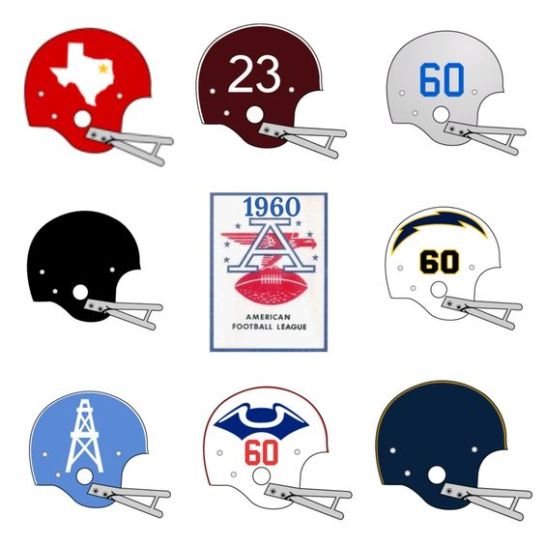
Unlike other leagues that popped up and died, the American Football League lives on in the American Football Conference of the modern NFL.  With a burgeoning economy after World War II, Americans turned their attention to a life of leisure during the 1950s. Sports became the outlet for most of America.
There was a clamor by many who felt slighted when it came to big league sports.  The furthest point west on the map where major professional sports was played, was Wisconsin & St Louis Missouri. Then something happened to change the landscape.  The AAFC football league folded and the San Francisco 49ers joined the NFL in 1950, along with the champion Cleveland Browns and Baltimore Colts.

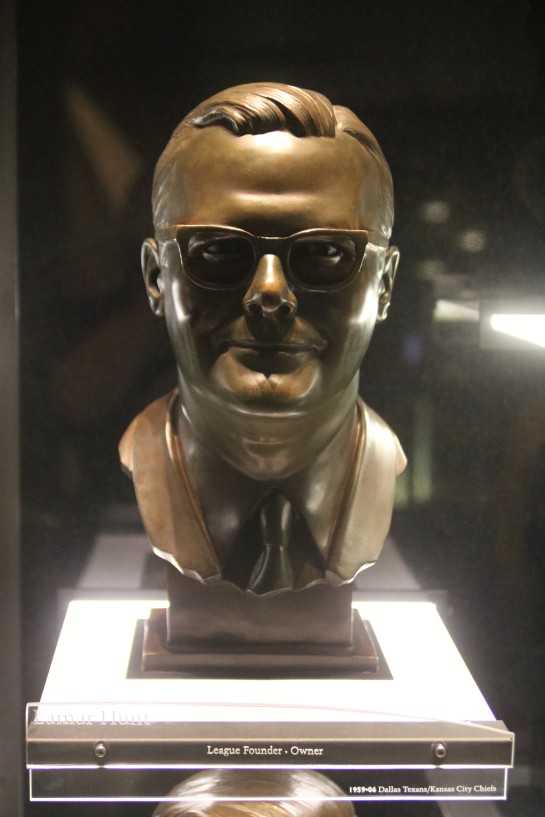
This event helped propel the Cleveland Rams west to Los Angeles, where they joined San Francisco to be the first pro teams in California. Now other western cities wanted in on the action and all the other sports started to broaden their minds toward relocation.  Soon moves were made by an L.A. Councilwoman who massaged the beginnings of what came to be the Brooklyn Dodgers and New York Giants move to California in 1957.  Expansion was on soon with the Lakers in 1960 moving from Minneapolis.  Now Texans wanted an NFL team and had the money to gain an NFL franchise or so Lamar Hunt thought.

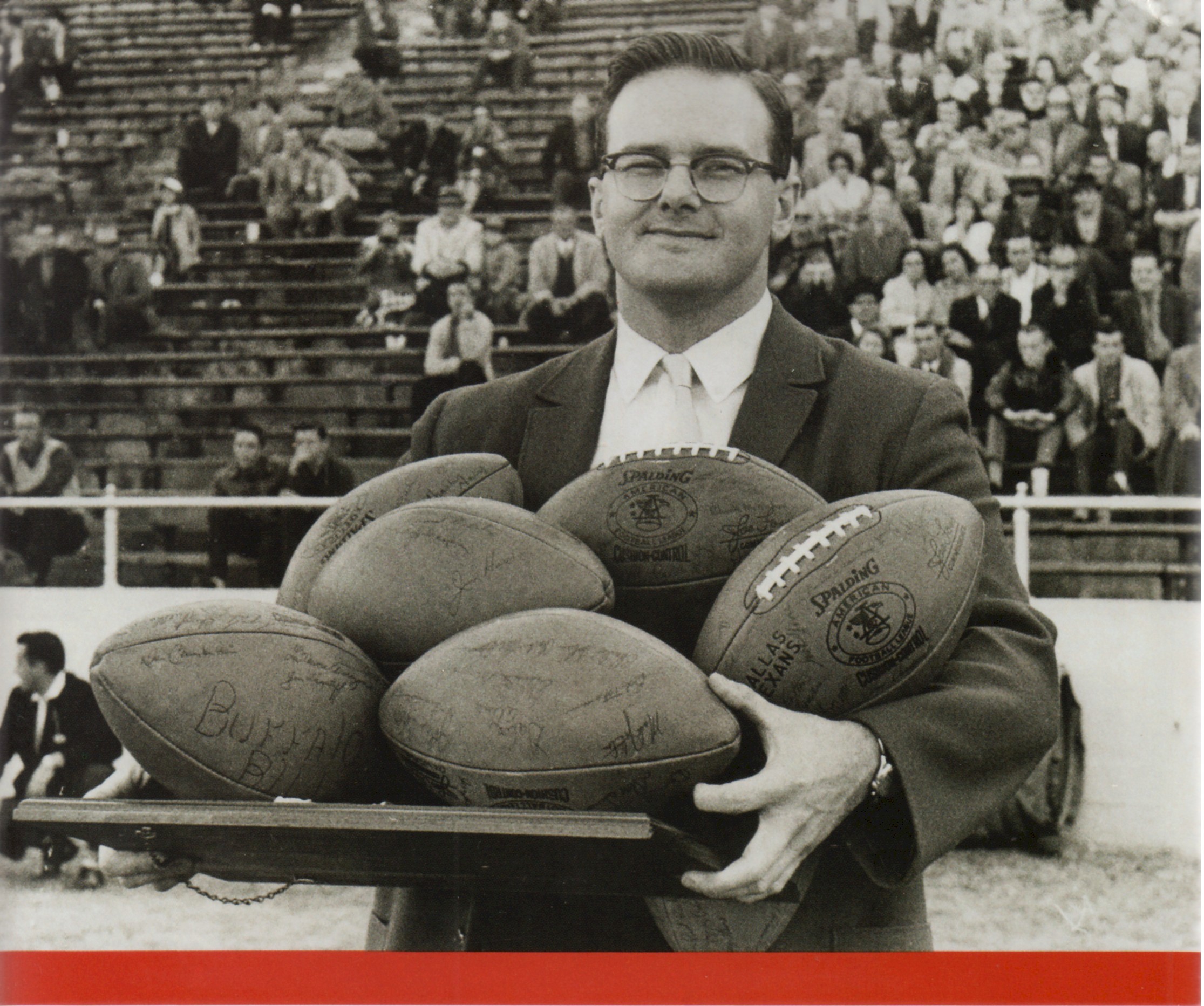
AFL and Kansas City Chief founder Lamar Hunt holding a platter of AFL footballs.

AFL and Kansas City Chief founder Lamar Hunt holding a platter of AFL footballs.

Then the NFL had the landmark 1958 NFL Championship overtime game between the New York Giants and Baltimore Colts that transformed the spark of interest into a flame. Hunt and principles moved quickly to form the American Football League since the NFL had thwarted their attempts to bring football to Texas. Now you have to understand who we’re talking about here for a second.  Lamar Hunt was son of H.L. Hunt of Hunt Brothers Oil! We’re talking seriously deep pockets here. The NFL in its arrogance thought they would outlast a fledgling league like the AAFC just a decade before….damn were they wrong.

Once the idea of the AFL gained momentum, the NFL turned to espionage and tricky double dealing to sink the new league.  The eight cities that Hunt and the other AFL owners decided on were Dallas, Houston, Denver, Boston, New York, Los Angeles, Minneapolis, and Buffalo. However the NFL bent the ear of the Minnesota ownership group, and told them they would give them an NFL franchise if they would decieve their brethren, by defecting to the NFL at the last minute. It almost worked but the AFL scrambled to move the eighth team to its new home in Oakland. Meanwhile the NFL put a team in Dallas to compete with Hunt’s Dallas Texans, they were called the Cowboys.

The AFL had some seriously rich men that wanted to see it succeed in Bud Adams, Ralph Wilson, Lamar Hunt, and Barron Hilton yet there were other ownership groups that struggled to make ends meet as the league got off the ground in 1960. Many teams were losing money at record rates, some to the tune of a million dollars or more.

It was former Boston Patriot owner Billy Sullivan who coined the phrase “The Foolish Club” when listening to his colleagues joke about revenues lost.  However John Madden recalled a reporter asking Lamar’s father H.L. Hunt “What did he think of his son losing $1 million  a year??” Hunt’s answer was cryptic to the NFL and the sporting establishment’s ears when he replied “Well, he’ll be ok. At that rate he’ll only be able to go on for another 150 years.” Damn!!  On 1960’s dollars??  Yikes!!

Although the NFL had been around forever, for the first time they were up against wealthy men who gained their fortunes as titans of industry outside of football. NFL owners George Halas, Carroll Rosenbloom, Tim and Wellington Mara, George Preston Marshall, and Art Modell were primarily football men and knew their asses were in trouble.  If it came down to the AFL’s pockets they would be in for a battle they couldn’t win.

The first few years had the established sporting press scoffing at the league’s style of play, uniforms, retread players and coaches, you name it. This is an era where if you went against the establishment, you had more than an uphill battle just for acceptance….I mean the radical 60’s were not yet underway. Yet here they were continuing the plan on expanding professional football to more points within the United States.

One of the first items the AFL did was secure a television contract to assist the teams that had financial problems like the Titans and Raiders.  The Raiders had also come to a point of folding when they contacted their fellow teams and said they couldn’t sustain operation financially.  Buffalo’s Ralph Wilson stepped in and lent the Raiders $450,000 to stay afloat because the league couldn’t operate with only 7 teams. As for the Titans and Harry Wismer, the Jets needed an ownership group that had the pockets and vision to rival that of the New York Giants. Enter Sonny Werblin.

Werblin spearheaded a group that purchased the bankrupt New York Titans, renamed them the Jets and helped negotiate the most lucrative television contract to date with NBC.  Over $1.8 million dollars went to each team in 1965 and with all of their teams solvent for future operation, new stadiums went up in San Diego (Los Angeles), Oakland, & Denver. Now the next move Werblin spearheaded was to draft Joe Namath and pay him a ridiculous $427,000 contract to be the star in New York. Uh oh…this single shot turned the draft into a who is going to pay the most for a players services between the two leagues.  Talk about impact.

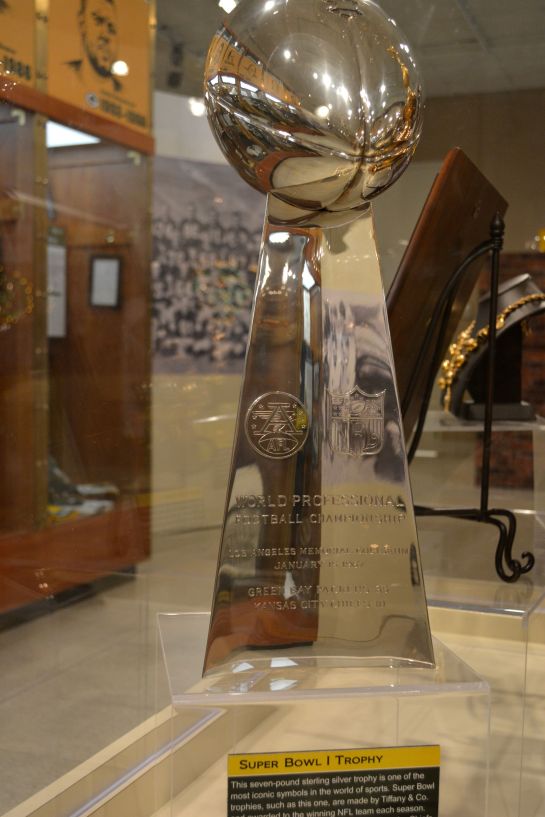
Super Bowl I trophy with both logos (Katie Marie Packers Hall of Fame)

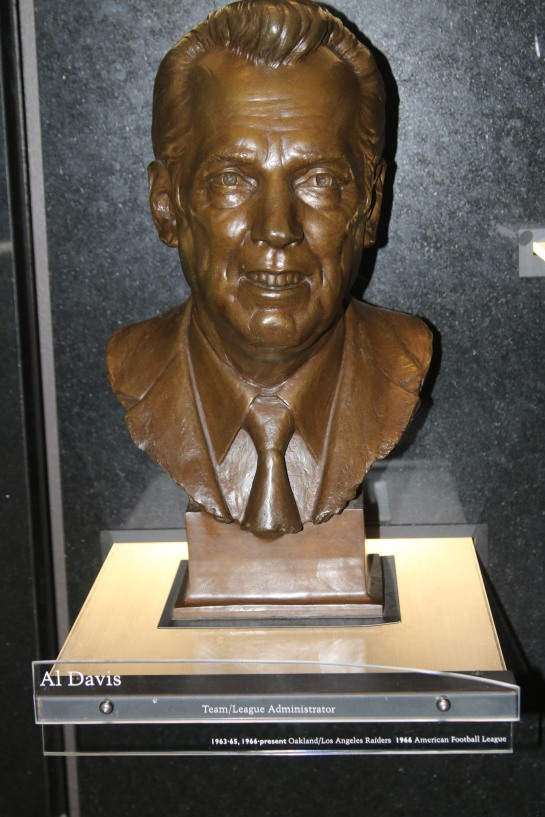
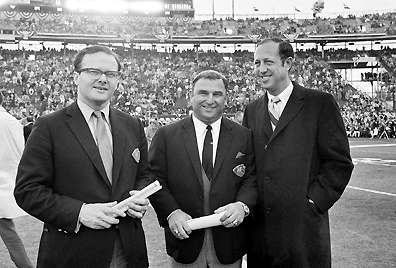
An unwritten agreement existed between the two leagues to not sign each others current players.  Yet the NFL went underhanded, yet again, when the New York Giants signed kicker Pete Gogolak from the two time AFL Champion Buffalo Bills.  The AFL retaliated big time. It was recounted by Lamar Hunt, the founder of the Texans who had moved his team to Kansas City and renamed them the Chiefs, to meet Tex Schramm and discuss a possible merger. Hunt still lived in Dallas. They met at Love Field under the Texas Ranger statue and when the meeting was over, Hunt flew to Houston to elect Al Davis AFL Commissioner.  Joe Foss had been a good commissioner but now they needed a “war time President”.  Al Davis quickly helped teams realize they could bring the NFL to its knees if they created a bidding war by signing away their superstars.

The moves of signing away San Francisco quarterback John Brodie, Los Angeles’ Roman Gabriel, and Chicago’s Mike Ditka were the straw that broke the camel’s back.  The bidding for player’s talents had driven contracts up dramatically and the NFL grudgingly came to the table.  Al Davis was away about to sign another player when Hunt told him that they were going to meet the next day about a merger and they didn’t need the headlines. *Pay attention because this is the birthplace of the Chiefs / Raiders rivalry and the Al Davis against the world mentality takes place*  Davis signs the player which angers Hunt.

In the subsequent negotiations, the leagues agree to a merger with the two league’s champions playing in a new championship game, the Super Bowl, for the first four years and realignment into one all inclusive league in 1970.  Pete Rozelle remained commissioner over all of football, there was a common draft starting in 1966… and Al Davis….?? They left him out in the cold sort of..

al-davis-bustThis is where he received his dubious ownership distinction and awkward title President of the Managing General Partner for the Raiders.  He had only been a coach before, yet one of the  items that seemed spineless is the NFL made the AFL’s teams pay $3 million in reparation damages each and had Al Davis been there would never have acquiesced to such a demand.  Not when they had the NFL crawling to the table.  It was this animosity toward Pete Rozelle, Bud Adams and especially the Kansas City Chiefs and Lamar Hunt that raged on for many years. *This is where the animosity between Davis and Rozelle fostered…remember the court battles of the 1980s between the Oakland Raiders v the NFL??*
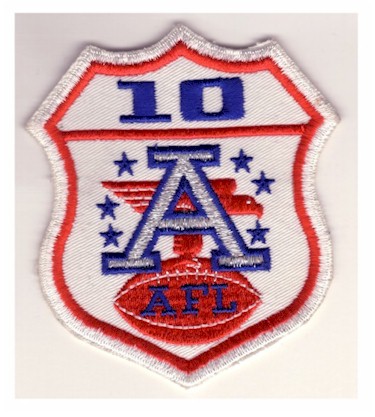
The patch worn by the Kansas City Chiefs on January 11, 1970 for Super Bowl IV. The final game of the AFL

In the first two Super Bowls Green Bay bested Kansas City and Oakland respectively.  The landmark win came when the Jets upset Baltimore to show that the AFL was on a par in Super Bowl III.  Then with a twist of fate, the ownership group who traitorously tried to sink the AFL by defecting, came into Super Bowl IV against the Kansas City Chiefs and AFL founder Lamar Hunt.  In the last game ever for the AFL, Kansas City buried the Minnesota Vikings 23-7 to bring not only the Super Bowl record to 2-2 between the two leagues, but able to have the satisfaction of kicking Judas’ ass in the process.

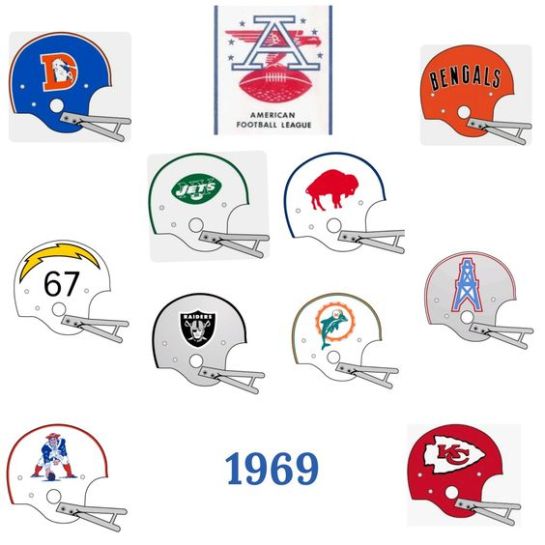
In conclusion: It was wrong to not include Davis and to me is the one of the few black eyes in this success story.  The AFL was swallowed into the monolith that is the NFL after expanding the AFL to 10 teams with Cincinnati, and Miami emerging.  These 10 teams were joined by the Pittsburgh Steelers, Cleveland Browns, and Baltimore Colts, yes the Baltimore Colts who gave the NFL a black eye with that first loss. They didn’t go empty handed, each club was paid $3 million to move to the new AFC.  Yet AFL loyalists such as Davis wished the two leagues stay separate, and he truly believed they would have eventually folded the NFL.
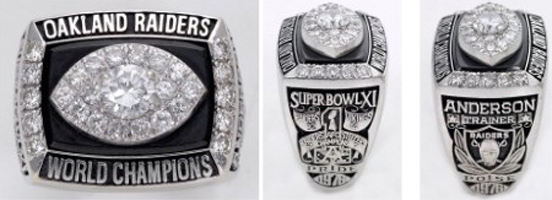
This is the ring for the Raiders triumph in Super Bowl XI. Look at the middle pic of the side of the ring. There you’ll see the AFL Block “A” along with the AFL logo and not the bold modified AFC “A”.

In fact in the 3 Super Bowls the Raiders won in the post merger NFL, Davis always used the Block “A” of the AFL and not the bold modified block “A” of the AFC on their Super Bowl rings.  He didn’t relent until the 2002 AFC championship ring where he finally used the AFC “A”.

hof-lamar-huntThere you have it…how the AFL changed the sporting landscape after the first shot was fired by the folding of their predecessors, the AAFC.  San Francisco’s entering the NFL doesn’t get the impact that it should because so much focus was on champion Cleveland coming over.  The western expansion of American Football owes a debt of gratitude to the 49ers yet even more to those original owners.

Thanks for reading and please share the article.

2011 Philadelphia Eagles Preview

That Andy Reid can come out smelling like a rose can’t he? First he exiled the franchise’s best ever quarterback for the heir apparent in Kevin Kolb.  Kolb proved ineffective during the preseason and was replaced after injury by a rejuvenated Michael Vick who played some of the most electrifying football seen in years.  Fast forward one year later and Vick wins the NFL’s Comeback Player of the Year in a landslide and Kevin Kolb is being dangled as trade bait after the 2010 season.

The Eagles fell to the eventual Super Bowl champion Green Bay Packers in the playoffs yet seemed poised to terrorize the NFC East with maybe the division’s most explosive offense ever.  With the Redskins and Cowboys foundering on rocky waters, all that remains is the enigmatic Giants to keep them from reclaiming their division crown.  The question for the Giants is: ” Have they sought help for the nightmares from DeSean Jackson’s punt return that flipped their season on it’s ear?”  So a little over a year removed from rumors that Reid may step down, followed by a press conference and possible wife induced decision to stay on, he comes into the 2011 season retooled and loaded for bear.

Quarterback: The “Michael Vick Experience” hit the City of Brotherly Love like a storm last year.  It was the perfect elixir for an underachieving Kevin Kolb who was outplayed by both Vick and rookie Mike Kafka from Northwestern in the preseason.  With the release of Donovan McNabb, the keys to the kingdom were turned over to Kolb.  So once conventional wisdom had Kolb start the season, with new contract in tow,  his play was marginal and then he went down with an injury.  Enter Michael Vick, who went on to have the best season of his career.  He ranked 4th with a passer rating (100.2), while throwing for 3,018 yards, and the best touchdown to interception ratio of his career 21 to 6.

His ability to supplement the running game with 676 yards and 9 touchdowns, made the Eagle offense the scourge of the league at the midseason point.  His feet have improved as a quarterback, he’s constantly on balance and ready to throw.  He showed a penchant to keep his head up and find receivers when he was evading the rush, and not always running it. Yet its this threat to do so that causes defenses to approach with a caution that is borderline fear.  As showcased when he danced through the New York Giants while leading the miraculous 4th quarter comeback that doomed the Giants season in game 14.  That 38-31 win kept Vick in the hunt for the NFL MVP Award, however it was his transcendent performance against Washington in a 58-29 blowout that started it.  That night was one of the greatest offensive performances ever and was exactly what Vick followers expected him to mature into.

Kevin Kolb came back and played well once Vick came off the field due to injury, yet his fate was sealed. He threw for 1,197  yards, 7 TDs, and 7 ints. which was not the best but he did respond once his job was threatened.  Andy Reid has a quarterback to trade and should get a number one and a second round for him.  He figured it would be Vick until the season began and now they have a quarterback in Kolb who could start for at least 10 other teams.  At quarterback the Eagles are Super Bowl quality at the moment…they have to keep Vick healthy.  Could use a draft pick here to prepare for the imminent departure of Kolb who should be traded by the regular season.

Offensive Backfield: Now statistics show you the Eagles have a strong rushing attack.  They ran 428 times for 2, 324 yards and 18 TDs which ranked 5th in the league for rushing totals. These numbers are skewed because of the Michael Vick factor.  Although he didn’t run as frequent as in year’s past he accounted for half of the teams rushing touchdowns with 9 and his 6.8 yards per attempt on 100 carries swelled the Eagles stat as a team to 5.4 per rush.

In fact Vick was second on the team in rushing for 38 first downs to McCoy’s 48.  Yet they can run the ball effectively with LeSean McCoy who accounted for 1080 yds and 7 touchdowns.  Without Vick to contain teams honestly, bootlegs away from the flow of the play, McCoy doesn’t gain that type of  yardage.  Its like the Brian Westbrook saga all over again.  He can catch and run but can only do so in space without resorting to gimmicky plays like shovel passes, draws, and sprint draw plays out of 3 and 4 receiver sets.  Yet he was the Eagle’s leading receiver with 78 receptions for another 592 yards.  Many of which were plays where Vick began to scramble and found him on scat routes once the defense squared up to attack the QB.

This teams goal line offense is bootleg pass options with Vick. The Eagles would do themselves a service if they drafted another half back to provide some power between the tackles at times.  It would prove fruitful in the long run for both the Eagles ability to convert on short yardage and goal line, but also minimize the wear and tear on McCoy over a long season. At running back average at best yet superior totals adding Vick’s ad-libs.

Receiver: These guys are growing by leaps and bounds and should be better with a full pre-season to get accustomed to Vick as the starter.  This will be the Greatest Show on Turf East, with so many explosive weapons on the flank.

DeSean Jackson, going into his 4th season, has emerged as one of the best deep threats in the league.  Once out in the open forget catching this lightning bolt from behind.  His 47 catches for 1,056 yards and 6 touchdowns were enough to make the Pro Bowl despite missing a game and a half due to a concussion.

In fact he became the first player in NFL history to earn his way onto a Pro Bowl roster at two different positions in the same year.  He made it as a receiver,and punt returner, while causing 80,000 in the New Meadowlands anguish with a punt return touchdown with no time on the clock.  Over his 3 years in Philadelphia,  Jackson has averaged over 47 yards on 26 career touchdowns including 14 from over 50 yards.  If he gets on top of your safety forget it.  The Redskins found this out on a Monday Night when he scored on a 91 TD on the Eagles first offensive play.  Going to be a deep threat for many years to come.

On the other side is Jeremy Maclin, who provides a similar skill set yet has the bigger body (6’0 and 198 yards) to go over the middle for the intermediate catches. He had 70 receptions for 964 yards and led the Eagles with 10 TDs.  Brent Celek is an emerging tight end who chimed in with 47 receptions.  By the time we put in Jason Avant from Michigan and his 51 receptions, this gives the Eagles 5 receivers with 40 or more receptions.  Who do you game plan for in stopping this passing game?  We feel this is the year that teams over play Jackson’s deep ball and Maclin has his breakout season with a 1,200 yard season and his first Pro Bowl berth.  Receiver is pro bowl caliber in Philadelphia and they should terrorize the NFC East this year as well.  All are in their prime and getting better…just dangerous.

Offensive Line: Hmmm, kind of mixed reviews here and hard to gauge this line in terms of their affectiveness.  Although this team is running a west coast offense where the staple is to get the ball out of the quarterback’s hands quickly, Eagle quarterbacks were hammered all year.  You do remember they got Kevin Kolb knocked out of game 1 which got Vick on the field in the first place, right? Even with Vick’s elusiveness, only 3 teams gave up more sacks than the 49 this Eagle line gave up last year….yikes! Couple that with a twin ranking of 29th in Philly QBs being hit 95 times and you see why Vick missed time last year as well as Kevin Kolb.  No wonder this team called a lot of half rolls off play action fakes.  They needed to slow down the opposing defense.

The numbers are better for this unit in the running game but again this comes with an asterisk.  The final stats show the Eagles ranked fifth with 2,324 yards rushing and 18 TDs which is ranked 4th.  Terrific, until you dissect this a little further.  Take away the 676 yards and 9TDs that came from Vick scrambles and the output plummets to  1,648 yards and only 9 TDs which would have ranked 20th and 24th respectively.  The lone offensive lineman that performed with distinction in 2010 was LT Jason Peters who made the Pro Bowl.

It wouldn’t be surprising if the Eagles put a few draft picks here to light fires under several of their lineman.  Another season like this and they could get their quarterback hurt and derail their 2011 season.  With that…this team is below average and needs to have better push on running plays.  They play too upright and need to get their knuckles in the dirt and fire off the ball.  This comes back to the coaches spending 80% of their practice time in passive pass blocking stances.  It shows on 3rd and 2 when you can’t power off tackle with regularity and the Eagles just don’t pass the eyeball test when it comes to running the football traditionally.

Defensive Line: One of the most enigmatic groups among the elite teams in all of football.  You here every NFL coach start off every press conference with stopping the run.  This group can be pushed off the ball and ranked 15th against the run giving up 1,766 yards and over 4.2 yards per carry.  Yet this front finished with 23 of the team’s overall 31 sacks which included 19 from the defensive end position.  Trent Cole accounted for 81 tackles and 10 sacks from the weakside, but can be run on and is smallish at 6’3 , 270lbs by today’s NFL standards.  Lets be honest, these DTs, Mike Patterson, Antonio Dixon, and Broderick Bunkley have to play more stout and quit getting shoved in the face of their linebackers.  They need to come off those blocks better as well…

This team relies on the offense getting a lead and allowing this defensive line to tee off on the opposing quarterback.  If they have to “sit in” and play honest against both the run and the pass this team can be overpowered.  They rely on exotic blitzes to force turnovers and missed blocks to mask their line deficiencies.  The Eagles should grab a DT or two in the draft and free agency since they are below average in holding their ground.  Teams will run at them to keep them off the field.

Linebackers: The Eagles starters are Ernie Sims, Stewart Bradley, and Moise Fokou who are marginal at best. They accounted for 4 sacks and only 1 interception.  Sims is an athletic defender who sometimes lacks instinct and gets gobbled up by blockers once he’s diagnosed the play.  An original 1st round draft pick by the Detroit Lions finished with 68 tackles and 5 passes defensed.  His play has slipped since his 1st two seasons with Detroit where he had 82 and 96 tackles.   Stewart Bradley was second on the team with 88 tackles yet made too many 5 yards down field. The linebackers suffer from the D-Line not holding up.  However this linebacking group is functional and not really instinctive. The Eagles would serve themselves well with a free agent pickup and or a few draft picks here.  The fact that they were running blitzes similar to those of the late Jim Johnson, this crew should have made more splash plays.

Secondary: This is one of the better secondaries in football.  These guys take chances yet have to stay solid with the defense sending blitzes in many situations.  The signing of Asante Samuel at corner has paid off handsomely.   The all time playoff interception TD return leader in NFL history has made several plays since his arrival from New England.  In 2010, he went to his 4th straight Pro Bowl after leading the NFC with 7 interceptions with 8 passes defensed.  Some have been critical of his not being a solid tackler in the running game and he only had 28 tackles….eh there could be something to that.  Yet this guy is a ballhawk and leads the league in interceptions since 2006 with 36 interceptions, which is what the Eagles really signed him for.

The other star in this secondary is S Quentin Mikell from Boise St.  Yes Melinda and Ray that same Boise St.  One of the Eagles that should have made the Pro Bowl after the 2010 season.  In fact he made the Pro Bowl in 2009, and last year still garnered 2nd team All Pro distinction with his play for a 3rd straight year.  Last year he led the Eagles with 111 tackles, defensed 14 passes while intercepting 3 passes.  This is the force member of the secondary on running plays along with the other cornerback in Dimitri Patterson who recorded 55 tackles and 4 interceptions.  Yet this is a solid tackling group.  Secondary is excellent however if we ran an opposing offense:  run sweeps and bubble screens on Samuel and force him to tackle more.  Try to get behind him with double moves afterward for he will gamble on intermediate (10-15 yard) routes where he jumps passes and gets most of his interceptions. The key is to get hits on his legs and make it easy to pass on him later.

Overall: In facing this team the first thing to remember is this team can definitely be run on and they will give up points.  Astoundingly this Eagle team isn’t as strong as defenses in recent years during the Andy Reid era.  Last year they gave up 377 points which ranked 21st in the league which was 3rd from the bottom of all playoff teams.  Although the Colts were missing Bob Sanders and linebacker Gary Brackett, their best players, and the 7-9 Seattle Seahawks who shouldn’t have been there.  This team  almost wins inspite of their statistics whether we look at the offensive line, defensive line, linebackers or defense as a whole which ranked 12th in yardage given up.  Stay to the ground as the Vikings did in defeating them in game 15; 24-14, feeding them Adrian Peterson for over 100 yards.

The key to playing them is to not become impatient and fast-break with them.  Run on this defense and keep Vick and that offense sitting on their hands and take them out of rhythm.  Even in the Giants game where they came from behind to win in the Meadowlands, they were cold for much of the game.  The Giants became deer in the headlights once Vick got going.  If the Eagles get into a rhythm on offense you could be dead in the water.  Keep your rushing attempts high and force a low scoring game and avoid the “Michael Vick Experience”.  How did he not get a single vote for league MVP?  Sigh…another subject for another day.  This team should repeat as NFC East division champion.

Next Up: Indiannapolis Colts