Corey Dillon Belongs In The Hall of Fame

There are many NFL fans who miss true talents around the league and just focus on their team. That narrow focus can keep one from seeing a Hall of Fame talent at work. That doesn’t mean an overlooked player should miss the call to the hall if he doesn’t garner great media attention. It’s about what they accomplished on the field and how well their peers respected their exploits.
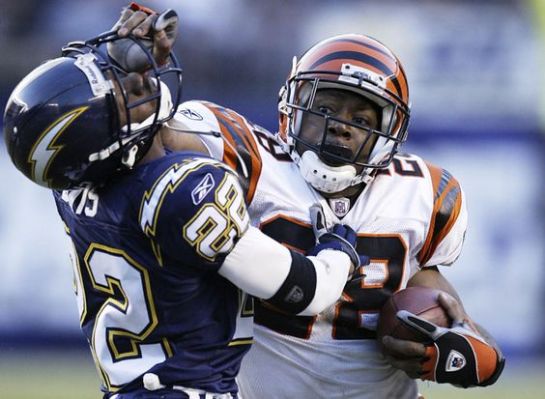
Did you know that at one point Corey Dillon owned the greatest single game rushing performance and the #6 performance in NFL history?? Not Emmitt Smith, Barry Sanders, Eric Dickerson, LaDanian Tomlinson, nor Adrian Peterson or any great back you’ve ever watched accomplished that . Well, you have to be in your mid fifties at least to say you saw someone perform to that high a level. That was when OJ Simpson held sway in the NFL. You’d have to be in your fifties!!

Not only that, his 6th place (at the time) performance stood as the NFL’s rookie rushing record at 247 yards in a 1997 game against the Tennessee Oilers. That record Dillon broke had been Jim Brown’s. Each of these have since been broken but it was the manner in which they were set that sets them apart.

Unlike the shifty make ’em miss running style of most halfbacks, Dillon struck like the hammer of Thor. He was a passionate violent runner that thrived on contact. Once he positioned a defender to one side, he’d forearm, stiff-arm, or shoulder right through them. He made a joke of arm tackles and if you wanted to tackle him, your heart had better be in it.

For years media pundits painted him with the broad brush of that of a malcontent. Yet let me ask: If you were one of the best talents in the league, how frustrated would you be with a team that couldn’t get you any help?? In 1999 Inside The NFL broadcast their show from Cincinnati asking “Why can’t the Bengals tun it around?? Were they the JV of the NFL??” They interviewed player after player and the only one whose eyes burned fire with frustration were Dillon’s.
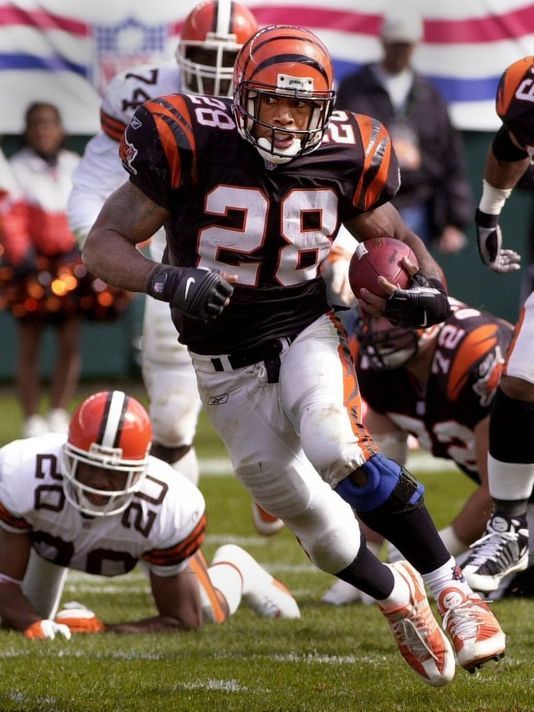
For an instant you could peer into his soul and you understood him completely. For all the hard work to make it to the NFL, then play for a franchise that couldn’t field a better team. He was toiling in anonymity loss after loss. All those childhood dreams of playing in a Super Bowl were dying an agonizing death.

It looked like 2000 would be no different as the Bengals started out 0-6. The optimism of having their 1st season in Paul Brown Stadium was fading fast. They had only scored 34 points while being shut out 3 times when the Denver Broncos, just two years removed from back to back championships, came to town. At the time the Broncos had the NFL’s 2nd ranked run defense.

The heavens opened up and the football god’s touched Dillon, allowing his fury to be unleashed in the greatest rushing display in NFL history.

Inside The NFL Perspective:

Did The Chancellor of Football say the greatest rushing display in the history of pro football?? Absolutely!! Listen, on a day when the Bengals completed just 4 passes, Dillon got off on a defense focused squarely on him. As for the record of 278 yards being broken twice by Jamal Lewis and Adrian Peterson, we will put them side by side in a minute. You have to remember the football world was still reeling from Walter Payton’s death. We were just 1 week short of the 1 year anniversary of his passing. As for the record comparison:

  • 2000 Corey Dillon 22 car. 278 yds 2TDs
  • 1977 Walter Payton 40 car. 275 yds 1 TD
  • 2003 Jamal Lewis 30 car. 295 yds 3TDs
  • 2007 Adrian Peterson 30 car. 296 yds 3TDs

However a closer look and Corey lost 6 yds on 6 of his carries. So in essence he ran for 284 yards in 16 carries or 17.75 yards per rush!!! Yikes!!! Best in history by a wide margin… It was Corey who wiped Jim Brown and Walter Payton from the record book, proving to a generation those records weren’t unbreakable. Payton’s record had stood for 23 years.

Dillon finished the 2000 season with a team record 1,435 yards rushing. Don’t forget he had two games against the  record setting Super Bowl champion Raven’s defense that ranked #2, and two more vs. Tennessee’s ranked at #1. What would he have done had he played in a less stout division defense-wise??

What would he have done behind a line like the Dallas wall with Larry Allen??

In 7 years he only played once with a Pro Bowl lineman.  That was T Willie Anderson in 2003. By then he was splitting time with Rudi Johnson. In that same year Chad Johnson (Ocho Cinco) made the Pro Bowl. Other than that he played with NO Pro Bowl players during his Cincinnati years. In those circumstances he ran for 1,000 yards in 6 of 7 seasons. In stark contrast Emmitt Smith’s line had 16 Pro Bowl Linemen and TEs between 1991-1995 alone. But alas he was traded to the New England Patriots for a second round pick when he failed to rush for 1,000 in 2003.

What did the Patriots get??
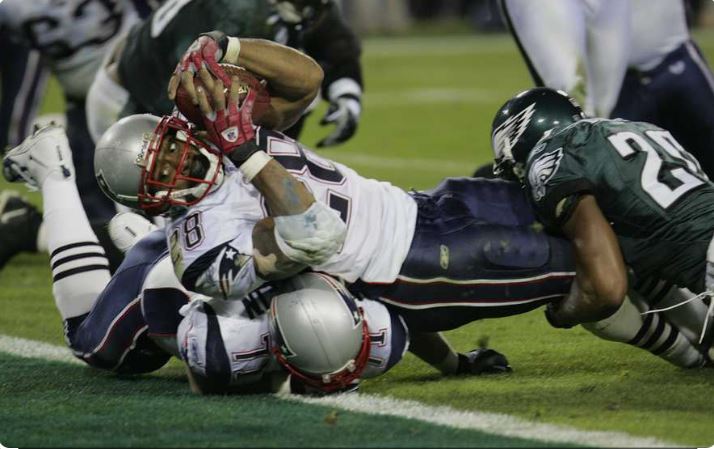
Try the driving force for their back to back championship season of 2004. He wasn’t just a member of that team. Dillon ran for a Patriots team record 1,635 yards and 13TDs & was the closer for the best of the three champions in their dynasty. He had 9 100 yard performances that year and the playoff clinching win came against Cincinnati. Where he received the game ball from Bill Belichick.

The Patriots went on to win Super Bowl XXXIX 24-21 which validated the career of Corey Dillon. Overall he rushed for 11,241 yards and 82 TDs. Dillon is one of a select few to set the franchise single season rushing record for two different teams.

As the argument heats up about the candidacy of other power runners like Eddie George and Jerome Bettis, neither showed the exhibition of power and speed Dillon displayed. Not to record breaking levels. He had 7 1,000 yard seasons and was a world champion. What could have become of Dillon’s career had he more talent around him??
Please lend your thoughts as well by writing in to the Pro Football Hall of Fame to the address below. Be respectful and positively lend your voice:

Please write & nominate Corey Dillon
Send letters to:
Pro Football Hall of Fame
Attention Hall of Fame Selection Committee
2121 George Halas Dr NW, Canton, 
OH 44708

There is also a fan vote here on the PFHOF website

For induction into the Pro Football Hall of Fame, I present to you Corey Dillon.


Roger Craig Should Be In Pro Football Hall of Fame

When you think back to Bill Walsh’s great 49er teams, who are the first players you think of?? Right there with the Joe Montanas, the Jerry Rices, and Ronnie Lotts it only takes a fraction of a second to think of Roger Craig. His high knee running style brought a physicality to the San Francisco offense that was seen as a finesse group up until his arrival. In fact he came to San Francisco as a fullback when they drafted him from Nebraska before the 1983 season.
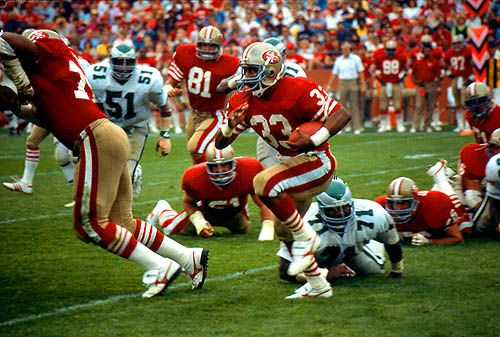
In college he had been primarily a blocking back in the Cornhuskers wishbone offense. Normally he paved the way for Jarvis Redwine and then Mike Rozier. Yet when Bill Walsh decided to revamp San Francisco’s dismal backfield after a 3-6 season in 1982, he drafted Craig in the second round.

Although the 49ers had won it all in 1981, it had become apparent Bill Ring, Amos Lawrence, Walt Easley, and Earl Cooper just wasn’t cutting it in the backfield. To raise the stakes in the NFC for 1983, Craig and newly acquired Wendell Tyler would form a more potent backfield.

After posting the worst yards per carry average (3.4) and yardage (742) in 1982, the new backfield duo of Craig and Tyler turned that around completely. The much improved ground game of 1983 ranked 8th with 2,257 yards rushing and a gaudy 4.4 yard average. Ironically just ahead of the Los Angeles Rams, who had traded Tyler to San Francisco so they could draft Eric Dickerson.

You had to give the nod to Craig who ran for 783 yards a team leading 8 TDs, while catching 42 passes for 427 yards and another 4 scores. This more dynamic backfield, along with Joe Montana, powered San Francisco to the NFC Championship Game. A 24-21 loss to the Washington Redskins was shrouded in controversy, thanks to some questionable calls, yet Walsh had the backfield he envisioned. Craig had reinvented himself from a collegiate player who rarely touched the football to a dual threat pro.

The 1984 49ers were a juggernaut becoming the first team to go 15-1 during the regular season. Everyone of the 49 man roster played their role so no one had outstanding stats. However once the 49ers moved past the New York Giants and Chicago Bears during the playoffs, the stage was set for a coming out party in Super Bowl XIX. With all eyes on Joe Montana’s possible second Super Bowl trophy and the electrifying record setting Dan Marino, Craig’s name didn’t even make the marquee.


Roger Craig graces the cover of Sports Illustrated after his record breaking performance in Super Bowl XIX.

Roger Craig graces the cover of Sports Illustrated after his record breaking performance in Super Bowl XIX.

It was his 1985 that set Craig apart as he amassed his 1,000/ 1,000 yard seasons both rushing and receiving. The first player in league history to do so. Some 27 years later, only Hall of Famer Marshall Faulk shares that accomplishment when he did it in 1999. How dominating was his performance?? Well his 1,050 yards rushing doesn’t jump out at you until you realize he only ran 214 times for a whopping 4.9 yards per carry. The league average is always around 4.0.

Oh by the way, he led the NFL in receiving that year with 92, which set a record for running backs, that amassed 1,016 more yards. His 15 total touchdowns was second to Joe Morris and was 1 better than NFL MVP Marcus Allen. In fact many pundits, including our CEO believes Craig should have been the MVP in 1985 with that dominating performance.

Now buoy his 1985 record setting season not culminating with the league MVP, on the backdrop of a Super Bowl record 3 TDs yet not winning that MVP and you’ll see where we’re going in a minute. Don’t forget he did this on a 10-6 San Francisco team that was a defending champion with Jerry Rice being a rookie that didn’t have 1,000 yards receiving and only 3 touchdowns. Craig quite simply fueled that offense.

Once the 49ers won Super Bowl XIX, they were forced to retool and become a bigger physical team. In 1985, the Chicago Bears emerged with one of the most imposing defenses in NFL history. The Giants followed suit with an overwhelming defense that featured 4 linebackers in the 250 lbs category. When Bill Walsh and his 49ers were dominated 49-3 in the 1986 NFC Divisional Playoffs by the Giants something had to be done.

These were teams the 49ers had beaten on their way to the ’84 championship, now they had taken the game to a new level of brute force. In reinventing the offense from a size perspective, it was Craig who was switched from fullback to halfback to allow for the insertion of Tom Rathman at fullback. The entire offensive line was overhauled.

You have to keep in mind the average career for a runner in pro football is less than 4 years. Yet here Craig was making the switch in year 5 to a position that called for him to be quicker. This at a time where he should have been slowing down from a physical standpoint. Yet he, Jerry Rice and Joe Montana spearheaded one of history’s most accomplished runs. From 1987-1990 the 49ers went 51-12 in the regular season, winning back to back Super Bowls in ’88 & ’89 and were the prohibitive favorites to win it all in 1987 as well as 1990. They finished #1 in offense in ’87 and ’89 and #2 in ’88 and ’90. In each year they made it to at least the divisional round of the playoffs and 3 straight NFC Championship Games as they were trying to threepeat.

Playing in only 12 games due to the ’87 strike, Craig ran for 815 yards which projects out to 1,086 over a full season. The 13-2 Niners were poised to become the greatest team of the modern era yet were upset by the Vikings in the playoffs. They were #1 in both offense and defense yet proved fallible in the playoff loss. Craig went on to his greatest performance in the 1988 campaign. In rushing for a career high and club record 1,502 yards, he also caught 76 passes for an additional 534  yards for his second season with over 2,000 yards from scrimmage. More important, he powered San Francisco to another Super Bowl championship with a win over Cincinnati in the XXIII’d edition.

Roger Craig was a hard nosed runner.

Roger Craig was a hard nosed runner.

Yet go back to 1988 being his second season with more than 2,000 yards from scrimmage. Keep in mind this was no sleek, make ’em miss halfback. He brought a punishing style to his position where he bludgeoned the opposition. As you’re reading this you can picture his high knee running style like when he trampled through the Rams on his most famous run in 1988.

Yet did you know that Emmitt Smith, Thurman Thomas, and Barry Sanders only had 2 different seasons amassing 2,000 yards from scrimmage also?? Did you also know that Marcus Allen and Adrian Peterson have only had one?? Only Edgerrin James, Marshall Faulk, Ladainian Tomlinson, and Eric Dickerson had more. What do all of these runners have in common?? Peterson and Tomlinson will be in the Hall of Fame and all the others are in. Roger Craig is right there with them.

Now going into the Hall of Fame is based on impact on the game. By the time we bring up the 1989 team that won Super Bowl XXIV, Craig was a driving force behind the team of the decade. Again he was a 1,000 yard rusher as the team won their fourth Super Bowl and Roger had his 3rd ring. When he left the game in 1993, his 566 career receptions was #1 among running backs all time and still remains 7th.

He is in the linear line of great NFL running backs when it comes to catching the football and is a part of the game’s evolution. He took the mantle from Chuck Foreman and propelled it forward. Since then, only a handful of every down running backs have provided that type of versatility. Now everyone has a receiving running back who comes in on 3rd downs where Roger was in every play.

It was Craig’s play that allowed a young Jerry Rice to flourish as teams concentrated their efforts to stop him. If Craig’s move to halfback in 1987 hadn’t panned out, what would have been the legacy of Bill Walsh’s “West Coast Offense”?? It was the run from 1987-1990 that made the offense spread it’s wings throughout the National Football League. During this time is when it proved it could take on the big bad Chicago Bears defense (see 41-0 1987 Monday Night shutout) and 28-3 NFC Championship win in Soldier Field in ’88. Then you add the rivalry with the New York Giants.

From Mike Holmgren to Denny Green to Mike White to Jon Gruden ( who had just begun coaching on the 1990 SF coaching staff) and George Seifert succeeding Bill Walsh. They all could attribute their Head Coaching jobs to some extent to Craig’s performance along with Montana and Rice. Yet the foundation of that offense running and receiving along with goal line and short yardage was #33.

By the way, when did Roger Craig become the the first running back to have a 100 yard receiving game in a Super Bowl?? You guessed it… Super Bowl XXIII against Cincinnati and not his record setting performance against Miami. Now had he won the Super Bowl XIX MVP, or the 1985 NFL MVP, would that have propelled him to winning the NFL MVP in 1988?? Give it some thought.

For induction into the Pro Football Hall of Fame, I present to you…Roger Craig

Legendary Days: Rookie Earl Campbell Rushes For 199 Yards on Monday Night

One of the biggest travesties that has taken place over the last ten years was the move of Monday Night Football to cable television. In fact it’s only trumped by the proliferation of too many channels carrying NFL football. When you go back to the last generation of us fans, many of our seasons were remembered by tremendous performances on Monday Night.

One great performance there and you were a made man in the eyes of all NFL fans, for every single one of them were watching the same exploits.  ABC was accessible to the rich and the poor, the young and the old, which allowed generations of fans to watch the same game as well.

The "Luv Ya' Blue" Houston Oilers of the late 1970's was a team that almost won it all.

The “Luv Ya’ Blue” Houston Oilers of the late 1970’s was a team that almost won it all.

Well on one memorable Monday Night in 1978, every NFL fan watching witnessed one of the transcendent games of the 1970’s. The Houston Oilers were 7-4 and hosting the 8-3 Miami Dolphins in the marquee game of the week.

You have to understand the Oilers had been one of the NFL’s bottom feeders their entire existence up to that point. They had only appeared in 1 postseason game in their entire 19 year existence. A 40-7 loss in the 1967 AFL Championship Game. So even that hadn’t gone so well….

Enter Earl Campbell

Every year the NFL has it’s share of rookies who are supposed to live up to press clippings. The “Tyler Rose” stepped onto the field with the Oilers from day one and showed he belonged. Having won the Heisman Trophy his senior season at Texas, he came in as a marked man. Although he had lifted the lowly Oilers into playoff contention, the majority of America had only read of his exploits in newspapers. This Monday Night matchup would become the showcase where the Oilers proved they belonged with the NFL’s elite. Also it would solidify Earl Campbell’s chances to win rookie of the year honors. After all he came into this week 12 contest with 944 yards rushing.

Just as the late Bum Phillips recalled in the clip above, it was one where the crowd noise helped carry the game past a good game into one of great remembrance. Campbell, being cheered on by a raucous crowd, put on a performance for the ages that trumpeted his arrival as well as the Oilers as a force to be reckoned with. It was a back and forth game Houston won 35-30.

This may not have been one of Don Shula’s Super Bowl teams from half a decade before but they were an 11-5 AFC East Wild Card participant that year.  In fact, the Oilers would defeat them again 13-7 down in the Orange Bowl for Houston’s first ever postseason win. Who was the AFC East Champion that year?? The New England Patriots who were rocked 31-14 as Campbell powered the Cinderella Oilers to the AFC Championship Game.

Campbell leapfrogging Patriot cornerback Raymond Clayborn in the '78 playoffs.

Campbell leapfrogging Patriot cornerback Raymond Clayborn in the ’78 playoffs.

Alas they fell to the Steelers in the championship game and would do so again in 1979. Yet it was this performance that put Earl Campbell on the map for good in the eyes of all football fans, not just the NFL. You have to realize the majority of America was down to just NBC, CBS, and ABC when it came to college football and most hadn’t seen him play at the collegiate level. Campbell wound up rushing for 1,450 yards to lead the league in rushing. It was the first time a rookie had done so since Jim Brown in 1957.

Of course he would go on to the collegiate and Pro Football Hall of Fames and ushered in the era of the big super back. George Rogers, Herschel Walker, Bo Jackson, and Keith Byars would follow from college to pro. However none captured the imagination of the football world the way Earl Campbell did that November Monday Night.

As their careers are forever attached, Campbell and Phillips exit Three Rivers Stadium after the 1979 AFC Championship Game.

As their careers are forever attached, Campbell and Phillips exit Three Rivers Stadium after the 1979 AFC Championship Game.

This article is dedicated to the memory of former Houston Oiler Head Coach Bum Phillips (September 29, 1923 – October 18, 2013) A coach who nearly made it to legendary status yet is remembered for the family atmosphere he fostered on those teams. He was the quintessential Texas gentleman that called games for the Oilers for years on radio as well. NFL fans everywhere will miss him.

Thanks for reading and please share the article.

The Soul Of The Game: Randy White

Randy White... easily a Hall of Fame player.

Randy White… easily a Hall of Fame player.

When it comes to great hitting in the NFL, much of it takes place on the line of scrimmage, away from the camera following the football. However there are players who deliver those hits on quarterbacks, running backs and those same offensive linemen. Randy White was one of those players. An intense desire burned in him if you ever watched him play.

In fact it was that desire which helped him turn in probably the NFL’s greatest defensive play in our CEO’s estimation. In the 1980 season finale, Dallas needed to beat the Eagles by 25 points to win the NFC East. The Eagles were near midfield when they completed a slant to wide receiver Scott Fitzkee, who took off for the goal line. White, who had seen the pass whiz by turned and chased down Fitzkee tackling him at the 5 yard line. Ask yourself when was the last time you saw a defensive lineman chase down a receiver after a 49 yard gain??

Of course that wasn’t a great hit but it showed unbelievable heart. When you thought of the Dallas Cowboys during the late 1970’s and thought of toughness, he was the one that came to mind. He wasn’t that big either and thrived on his quickness to get into the “A” gap of opposing offenses.

One aspect of his play that is unusual is his size for a defensive tackle. The Cowboys had him listed at 6’4″ 257 lbs but that was a smokescreen. He looks like he’s about 6’1 or 6’2 and played at a weight where most of his contemporaries were pushing 275-280 lbs. We have yet to see in any film where White was bigger than a player trying to block him.

Randy White was a flat out beast for the Dallas Cowboys.

Randy White was a flat out beast for the Dallas Cowboys.

Over his 14 year career he made the Pro Bowl 9 times and was voted All Pro in 8 of them.  He was the impetus to the Doomsday Defense II that followed the original unit Bob Lilly, Lee Roy Jordan, Dave Edwards, and Chuck Howley played on. In fact along with Howley, White shares the distinction of being named Super Bowl MVP while wearing #54 for the Cowboys. Howley did so as the only player from a losing team, to nab that distinction in Super Bowl V.

As for White, he was the co-winner along with the late Harvey Martin for chasing Craig Morton all over the Super Dome in game number XII. In that contest he and the defensive line hounded Denver quarterbacks into 4 interceptions on 8 of 25 passing for 61 yards. In a Super Bowl?? Yikes. For his career he finished with 9 Pro Bowls and 7 – 1st team All Pro selections. A sure Hall of Fame performer which raises an interesting question: Who was the Dallas Cowboys all time greatest defensive tackle?? Bob “Mr. Cowboy” Lilly or Randy “Manster” White??

Thanks for reading and please share the article.

NEXT: Andre Reed Belongs In The Pro Football Hall of Fame

Andre Reed Belongs In The Pro Football Hall of Fame

Andre Reed was a very dangerous receiver with the Buffalo Bills in the late 80s and early 90s.

Andre Reed was a very dangerous receiver with the Buffalo Bills in the late 80s and early 90s.

As many of the NFL’s best ever gather for the Pro Football Hall of Fame enshrinement ceremony, Andre Reed, who has been a finalist 7 times, remains on the outside looking in. Many forget how dangerous Andre Reed was with the football when the Buffalo Bills rose to prominence back in the late 80’s. He was a budding superstar before the Bills brought in James Lofton during the 1989 season.

Essentially and unselfishly he sacrificed personal glory as a slot receiver where he spent most of his time getting hit by linebackers and running away from safeties as he perfected the run after the catch. He could have been a prima donna and cried through the media for more passes, but he didn’t. He sacrificed for the good of the Buffalo Bills and it could be those lack of numbers now keeping him out of the Hall. So lets take a closer look.

During the early 1980’s, the Buffalo Bills were a downtrodden franchise with little direction. The Bills had stumbled in the standings from 1982-1984. going 14-27. The area was economically depressed and morale was low on a football team that was literally Siberia in NFL circles. However that changed in 1985 with the first overall draft selection of future Hall of Famer DE Bruce Smith and spent a fourth round pick on a little known receiver out of Kutztown St. Who?? Exactly. This was the draft where the pre-draft talk was on Jerry “World” Rice of Mississippi Valley State, and Al Toon out of Wisconsin. However there was talk brimming on a little known receiver shuffling off to Buffalo.

Reed as a rookie showed promise as he caught a modest 46 passes for 637 yards and 4 touchdowns. He and Smith were the first cogs in a rebuilding project that would include QB Jim Kelly in 1986, Shane Conlan, Cornelius Bennett in 1987, and Thurman Thomas in 1988. The Bills became a defensive minded team that ran the ball with a combination of Ronnie Harmon, Thomas, and Robb Riddick. It was the 1988 season, Reed’s fourth, where the team took off racing to an 11-1 record and became the first team to win their division by Thanksgiving. Reed made the Pro Bowl for the first time that season catching 71 passes for 968 yards and 7 touchdowns. Despite missing two games to injury. The Bills dropped the Houston Oilers 17-10 in the divisional round before falling to Cincinnati in the AFC Championship Game 21-10.

However it was the 1989 season where Andre Reed and the Bills offense hit full stride. For the record, he had become the NFL’s most dangerous receiver after the catch. In a year where the Bills found themselves in shootouts they opened up the offense with a no-huddle reminiscent of Kelly’s run & shoot USFL days. Reed burst into the nation’s consciousness when he had a 5 catch 135 yard 2 TD performance in a wild 47-41 overtime win against Houston. It was the game of the year and in spectacular fashion, Reed took a routine 5 yard pass and turned it into a winning 28 yard score. He juked the initial defender covering him, ran through an attempted arm tackle and took it down the sideline. Ballgame!! Reed finished with 88 receptions for a career best 1,312 yards and 9 touchdown (#2 in NFL /receptions) and became one of the league’s game breakers.

As the 9-7 Bills limped into the playoffs, they faced the aging Cleveland Browns in a divisional playoff.  With his team down 3-0, Kelly 0 for 5, and needing some offense, it was Reed who struck with a game breaking 72 yard touchdown to get the Bills into the game 7-3.

Reed went on to catch 6 for 115 yards and a touchdown as he was matched up against All Pro Cornerback Frank Minnifield all day. The 34-30 loss was one of the greatest games in NFL history and the nation’s first glimpse of what was to come. By 1990, with James Lofton now entrenched as a starter on the outside, the Bills ran their 3 receiver no huddle offense from the outset of the season and not as a 2 minute offense.  At the time, they made a then unheard of decision to have Reed play in the slot instead of the “Z” receiver. This isn’t like now where defenders aren’t allowed to really tee off on receivers running inside routes. He was never going to be the receiver running under picture perfect bombs again. He had to fight for yards the tough way….after the catch in the middle of defenses. As for the Bills offense??

Andre Reed tries to avoid Mark Collins in Super Bowl XXV.

Andre Reed tries to avoid Mark Collins in Super Bowl XXV.

Over the next five years, the Bills finished #1 in offense 3 times as the team went on to 4 Super Bowl appearances. During that time Reed amassed 288 receptions for 5,128 yards and 35 touchdowns on one of the offensive juggernauts in NFL history. While teammates Jim Kelly and Thurman Thomas won several offensive player of the year awards and an NFL MVP in 1991, it was Reed who was the only Pro Bowler in all five of those seasons. The attention defenses afforded Reed on the inside is why Lofton reemerged as one of the league’s deep threats. Thanks to 2, 1,000 yard seasons, Lofton retired after 1992 as the NFL’s yardage reception leader with 14,—- yards. The last few years of his career propelled him to Canton as a Hall of Famer thanks to Reed’s sacrifice within the team’s offensive structure.

One of the greatest aspects of Reed’s career was his performance in the postseason. We already alluded to the great game he had against the Browns in 1989. In ’90 the Bills had homefield throughout the playoffs yet Jim Kelly had missed the last three regular season games. Experts weren’t sure they could pick up where they had left off, until Reed caught a shallow crossing route, broke two tackles turning it into a 40 yard touchdown. 7-0 and the Dolphins were hanging on for dear life. In a 44-34 triumph, Reed scored the clinching touchdown on a similar play from 26 yards out. On the day he caught 4 passes for 122 yards and a pair of scores.

In 1992, Reed was the Bills only top shelf performer in the AFC Wild Card tilt with the Houston Oilers. After spotting the Oilers a 35-3 third quarter lead, Buffalo roared back to win 41-38 in the greatest comeback in NFL history. Both Hall of Fame quarterback Jim Kelly and Hall of Fame running back, Thurman Thomas didn’t play that day. All Reed did was team with Frank Reich, gather 8 receptions for 136 yards and 3 second half touchdowns including the one that tied it at 38 to force overtime. Although the Bills were beaten soundly in Super Bowl XXVII, Reed had another spectacular performance with 8 receptions for 152 yards, breaking two catches for over 35 yards in the second quarter to keep the game close. At halftime the Cowboys jumped his routes on their way to a blow out win. He was that much a factor early….but Dallas pulled away 52-17.

The ultimate reason Reed is a Hall of Famer is the way he played. Without being the size of a linebacker like Brandon Marshall, Terrell Owens, and this huge new breed of receiver, Reed only stood 6’2 and 190 lbs, yet he didn’t catch short passes and slide to the ground waiting to get touched down. He stiff armed defenders and ran through arm tackles for most of his touchdowns. He was the greatest ever receiver when it came to yardage after the catch. As you saw in the latest film, he caught passes over the middle and only when the Bills caught teams in a blitz did he sight adjust to a longer pattern. Otherwise he ran through defensive backs with ease. Over his 16 year career, he gathered in 951 receptions for 13,151 yards and 87 touchdowns. He ranks 10th all time in receptions and his 27 receptions in Super Bowl competition is 2nd only to Jerry Rice.

Had Andre Reed not sacrificed for the good of the Bills offense, would James Lofton have made the Pro Football Hall of Fame?? Would Jim Kelly and Thurman Thomas?? For a period, Kelly and Reed held the record for most touchdowns by a combination in NFL history. They wrested that mantle from Johnny Unitas and Raymond Berry, which has since been broken by Peyton Manning and Marvin Harrison. The closest duo in the 1990’s was Steve Young and Jerry Rice. All of these players are either in the Pro Football Hall of Fame or a shoo-in to get there as the count down for Manning will start this February. Only Marvin Harrison and Andre Reed are on the outside looking in. Reed deserves to be in the Hall of Fame for his fearless play.

For induction into the Pro Football Hall of Fame, I present Andre Reed

Thanks for reading and please share the article.

NEXT: 2013 Washington Redskins Preview

The Soul Of The Game: Pat Fischer

In the long history of the NFL there have been players who defined their positions because of their physicality. Men like Dick Butkus, Dick “Night Train” Lane, and Lawrence Taylor were freaks at their position. They were bigger than what other teams were geared to deal with normally. Yet there are those that stand out as hitters first although their size would suggest something different. Enter Pat Fischer.

Standing only 5’9, and 170 lbs (that can’t be right) Smith played in an era where the NFL was a running league. Unlike today’s game where he could play out in space chasing an X, Z, or slot receiver, Fischer had to come up and tackle in an era where everyone was emulating Green Bay’s power sweep. He had to take on pulling guards,  some fullbacks along with his coverage responsibilities. Yet he only missed 10 games in his first 16 years.

Pat Fisher played cornerback for 17 NFL seasons.

Pat Fisher played cornerback for 17 NFL seasons.

His physical play belied his diminutive size as he played as a pint sized intimidator. Lionel “Train” James loves to say “It’s not the size of the dog in the fight, it’s the size of the fight in the dog.” Never was this more true than of Pat Fisher. Even in the Super Bowl VII highlight, NFL Films had John Facenda narrate how much a nemesis he was against the run and the pass. Let’s face it, a cornerback his size now is primarily a special team guy who is platooned only against multiple receiver sets. They rarely tackle players other than small slot receivers. Take a look at how Fisher played…

In the NFL of the 1960’s there was a concentration of talent that stayed with the same teams and systems for many years. Fischer was caught in this vice where Hall of Fame cornerbacks Dick “Night Train” Lane, Herb Adderley, Jimmy Johnson, and Lem Barney were playing. He was an overlooked player for awhile and some of it could have been other players not leaving behind on-field animosity when voting for fellow players.

There has to be some truth to it or Fischer wouldn’t have had one of his 3 Pro Bowl seasons in 1969 when he had just 2 interceptions. Now his first, in 1964, where he picked off 10 returning them for 164 yards and 2 touchdowns couldn’t be ignored. That was 1 TD short of the all time record. Yet other years he was overshadowed by these other players.

mel-gray-05893042

Pat Fischer played well into the 70’s and here he is going against Mel Gray in the mid ’70s.

One could also make the argument Fischer’s 1969 Pro Bowl and All Pro season came because of the higher visibility Vince Lombardi brought to the team in his only year coaching there.

Whatever the reason, Fischer played from 1961-1977 and retired having played in more games at cornerback in NFL history. If you think about that time frame, he came in 9 years before the AFL / NFL merger and played through the 12th Super Bowl. This is before the modern athlete could have arthroscopic surgery between seasons to prolong their careers. Does he belong in the Hall of Fame??

Thanks for reading and please share the article.