Everson Walls Belongs In the Hall of Fame

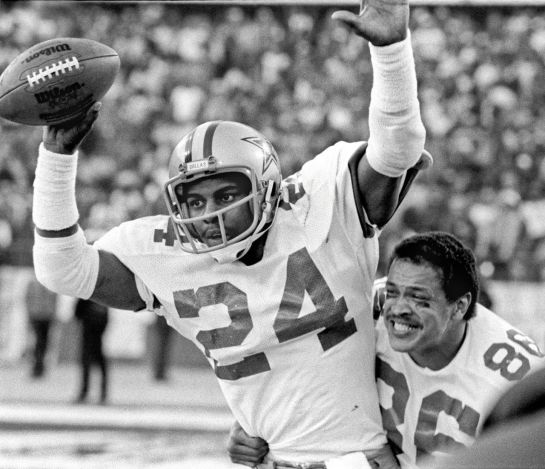
Butch Johnson and Everson celebrate Walls 4th quarter redzone interception in the ’81 NFC Championship Game. Yes, same quarter as The Catch

In the history of football, one of the hardest positions to judge or gauge performance is cornerback. Many times they’re overlooked when we speak of their careers as a whole because they rarely have a lot of tackles or hard hits.  So we tend to think of defenisve linemen or linebackers first. However after the NFL instituted rule changes that favored the passing game in 1978.  A more fluid athlete was needed to turn and run with receivers who could no longer be hit beyond 5 yards of the scrimmage line. The day of the super physical Mel Blount type cornerback was over and a new type of player would emerge.

The Dallas Cowboys of 1980 saw a secondary in flux with many of their great ’70s players aging, and teams piled points on ’em  after years of abuse. They gave up 311 points or nearly 20 a game. Mel Renfro had retired a few years back and Cliff Harris’ left after the 1979 season and the secondary was having epic breakdowns.

Even in Roger Staubach’s famous come from behind victory over the Redskins in the 1979 finale, the defense had given up 34 points at home in that game. So losing an All Decade performer in Cliff Harris and injuries to Randy Hughes magnified Cowboys problems.  By the time the 1980 playoffs began, the Cowboys couldn’t cover a child with a blanket. Cornerback Aaron Mitchell got lit up by Alfred Jenkins ( 4 rec. 155 yds, 1 TD) of the Atlanta Falcons in a playoff game known for being Danny White’s first great comeback. They prevailed 30-27 but a defensive back upgrade was top priority in the 1981 NFL Draft.

Enter Everson Walls, a lanky fast cornerback the Dallas Cowboys drafted out of Grambling in 1981.  He was a clearly brought in to be a cover man first and run supporter second.  He burst onto the scene in his rookie year when he led the NFL in interceptions with 11 while making the Pro Bowl as a rookie. Coming a year after Lester Hayes breakout 1980 campaign when he totaled 13 interceptions, Walls season was somewhat overlooked. While pundits duked it out over which cornerback was the best of the new breed, Walls interception totals didn’t drop over the ensuing years as Hayes did once stickum was outlawed.

After the strike shortened year of 1982 in which the NFL only played 9 regular season games, Walls led the NFL again in interceptions with 7.  Teams were avoiding throwing in his area and he gambled his way to a better season than his first.  Projected over a 16 game season, he would have equaled the 13 that Lester Hayes had in his near record breaking campaign in 1980.  After having 11 the year before?? Now that is an encore.

Everson Walls battling a rookie Jerry Rice in 1985

One of the reasons that Walls gets overlooked is he played for the Dallas Cowboys after their Super Bowl appearances of the late 70s.  This was the era in which the Dallas Cowboys lost three consecutive NFC Championship games, so the stars of this time weren’t lionized by NFL pundits like their 70’s counterparts. Much of this can be attributed to the 1981 NFC Championship Game in which Dwight Clark soared high to make “The Catch” and Walls was falsely treated as a goat for allowing it.

Yet many of those same pundits forget that earlier in the game Walls had made several key plays which included 2 interceptions to halt 49er drives. One of which occurred at the goal line.  He had played an exceptional game even in that defeat.

The Cowboys were a playoff team in 1983 yet teams threw away from Everson Walls at all costs.  However in 1985 he re-emerged to lead the NFL again with 9 interceptions. By doing so he became the only player in league history to lead 3 times in interceptions. It was at this point there had to be a reason for this gambler from Grambling picking off so many passes.

In John Madden’s second book “One Knee Equals Two Feet”, John cited the reason for Walls high totals a byproduct for teams having to throw over 6 foot 9, Ed “Too Tall” Jones. Jones was the defensive end on Walls side but that isn’t true. If you look at the 1977 and 1978 seasons, the Doomsday Defense II and “Too Tall” were at their zenith. In ’77 the Cowboys were the last team to win the Super Bowl with a team that was #1 on offense and defense yet the highest interception total was 5 by Benny Barnes. In the ’78 season in which they returned to the Super Bowl the highest cornerback total was 3. Walls with 11, 7 (projected 13), and 9 interception totals dwarf those with an aging Jones in front of him.

What are we saying?  Its time to give credit where credit is due. When you think of impact at cornerback you think of interceptions and the ability to battle the league’s best. Walls faced Roy Green, Hall of Famer Art Monk, and Mike Quick who were the NFC’s best and came out on top in many battles. Walls would go on to finish with 57 interceptions over his 12 year career.  He was a 4 time Pro Bowler yet was a first team All Pro just once. How does that happen when he led the league in interceptions 3 times?? Sportswriters are at fault for the All Pro snub and none pushed for him since he wasn’t a high round draft pick the beat writers would advocate for.

The Cowboys were penalized after losing the Battle of Champions to the Pittsburgh Steelers in Super Bowl XIII, and the fallout includes the early 80s Cowboys when it comes to Hall of Fame consideration. While most short sighted columnists would remind you that his Dallas Cowboys never won a Super Bowl as reason for the snub.

Yet one of the most important roles in his career was when he teamed with Mark Collins, and Perry Williams to give the New York Giants 3 excellent corners to shut down the Buffalo Bills 3 receivers in Super Bowl XXV. Early in that game it was Walls who caught James Lofton after a deflected pass gained Buffalo 61 yards and into Giant territory.  Three plays later on a crucial 3rd down it was Walls who broke up a pass for Thurman Thomas that forced the Bills to settle for a field goal. Had he not caught Lofton or stopped the Bills from gaining a first and goal, how could that have affected a game in which the Giants won just 20-19??   So he was a Super Bowl champion, so scratch that off the list of why he doesn’t belong.

He was forever immortalized on the cover of Sports Illustrated after that game.
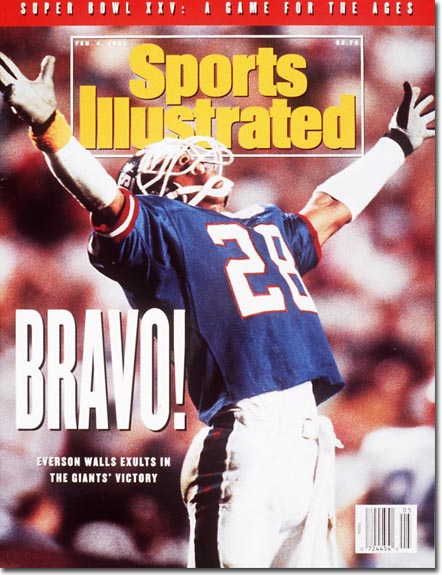
Super Bowl XXV Cover Pic of Everson Walls

Two weeks ago, Everson Walls was inducted into the Grambling Hall of Fame.  In recent years this consummate teammate made headlines by donating a kidney to former Cowboy Ron Springs in a gesture that says more about the man than his playing ability. He is an excellent ambassador to the game of football, signing autographs and constantly meets and communicates with fans through social media and Cowboys engagements. However it was his exploits as one of “Thurman’s Thieves” that made it all possible.

Please lend your thoughts as well by writing in to the Pro Football Hall of Fame at the address below. Please be respectful and positively lend your voice:

Please write & nominate #24 Everson Walls
Send letters to:
Pro Football Hall of Fame
Attention Senior Selection Committee
2121 George Halas Dr NW, Canton, 
OH 44708

For induction into the Pro Football Hall of Fame, I present to you Everson Walls

Coaches and players from the past advocated for on Taylor Blitz Times in order:

Robert Brazile 2011 (inducted 2018)
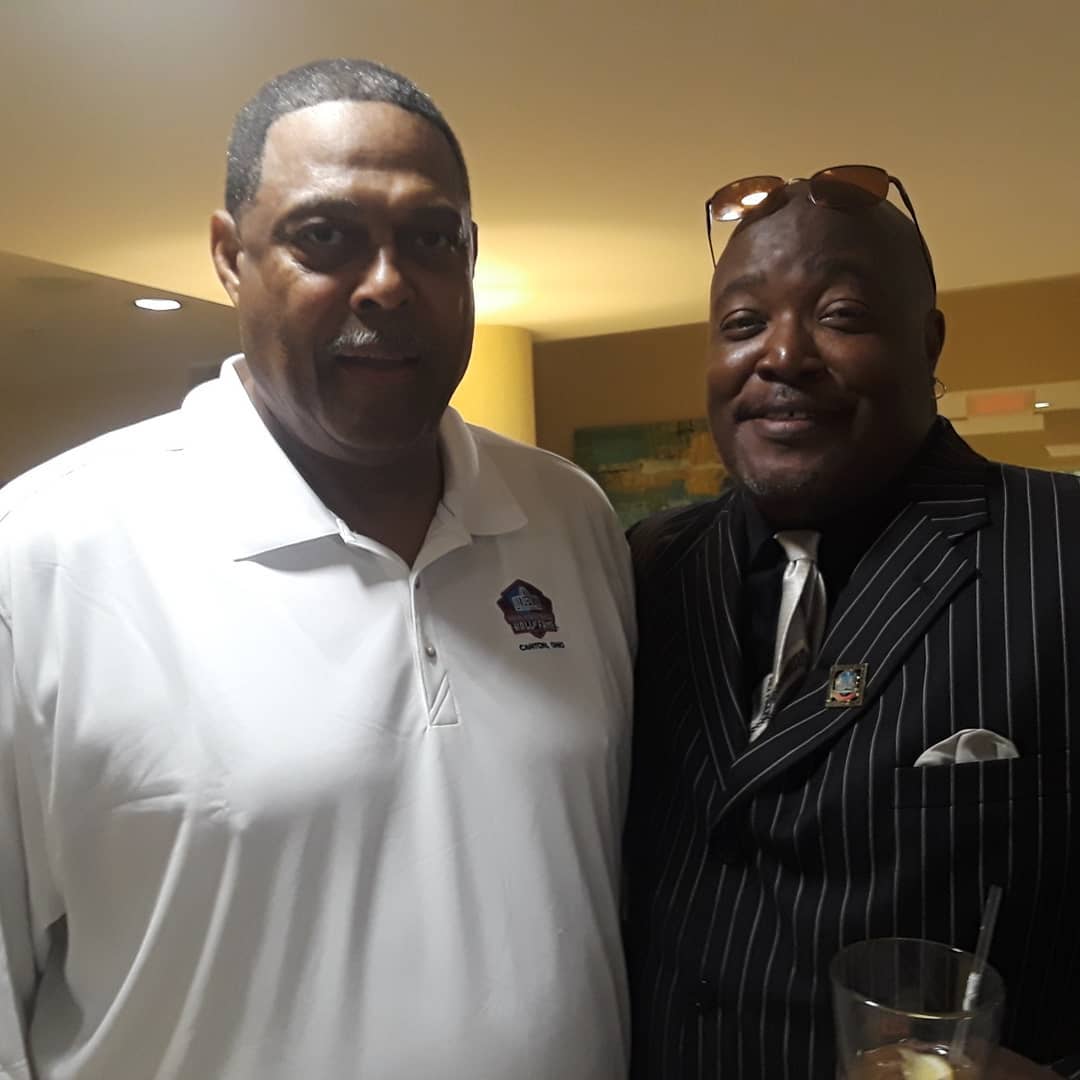
Ran into Robert Brazile after the Gold Jacket Dinner. Great time.


Kevin Greene 2011 (inducted 2016)
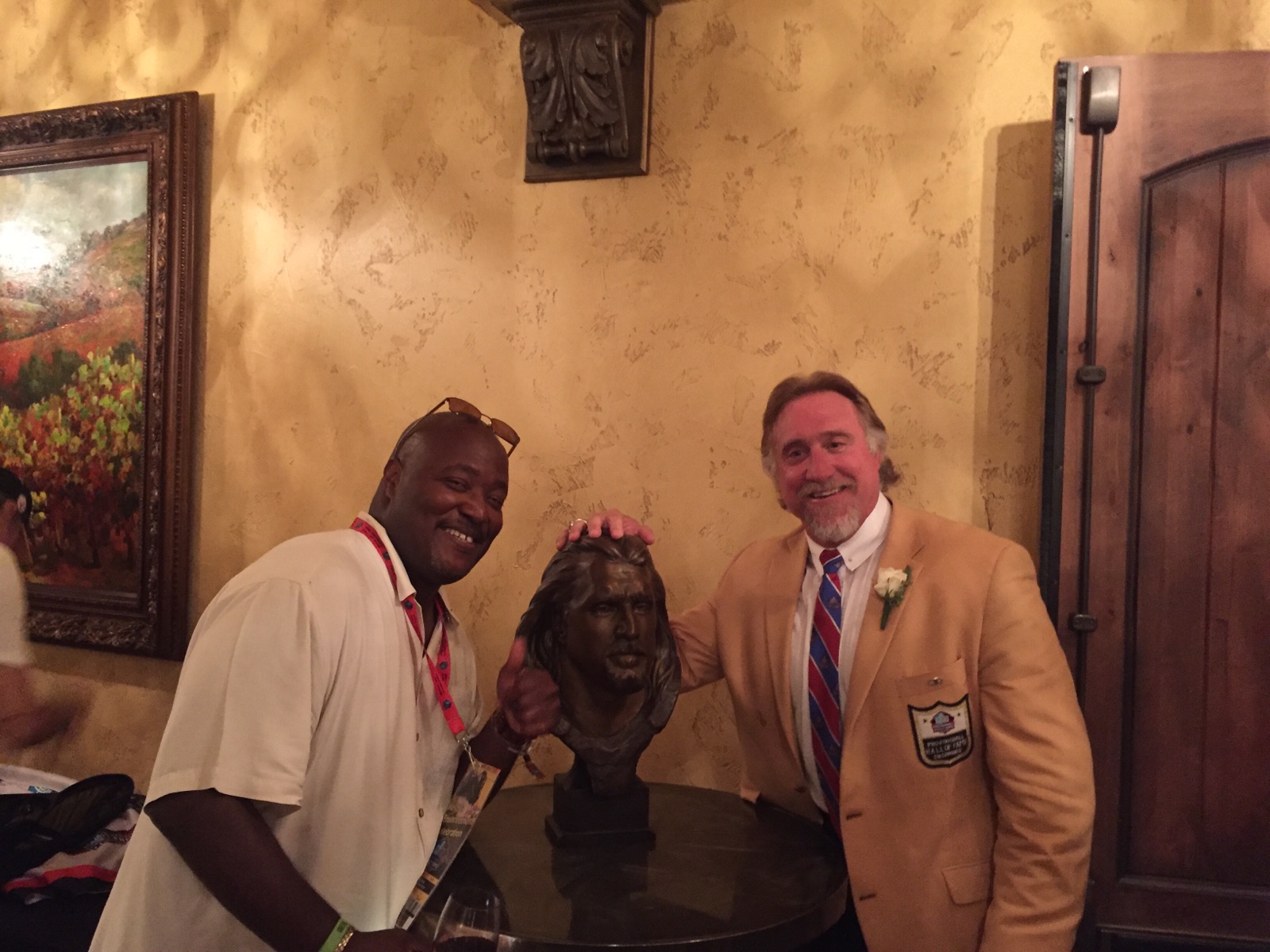
With Kevin Greene after the Induction ceremony.


Sterling Sharpe 2011 (induction Aug. 2025

Terrell Davis 2011 (inducted 2017)

Jerry Kramer 2011 (inducted 2018)
“Hey big guy!” The laughs at the Hall of Fame party were priceless.


Everson Walls 2011

Randy Moss 2011 (inducted 2018)

Cris Carter 2011 (inducted 2013)

Tom Flores 2012 (inducted 2021)

Lester Hayes 2012

Chuck Foreman 2012

Edgerrin James 2013 (inducted 2020)

Andre Reed 2013 (inducted 2014) 

Roger Craig 2013

Corey Dillon 2014

Ken Riley 2015 (inducted 2023)

Ken Stabler 2015 (inducted 2016)
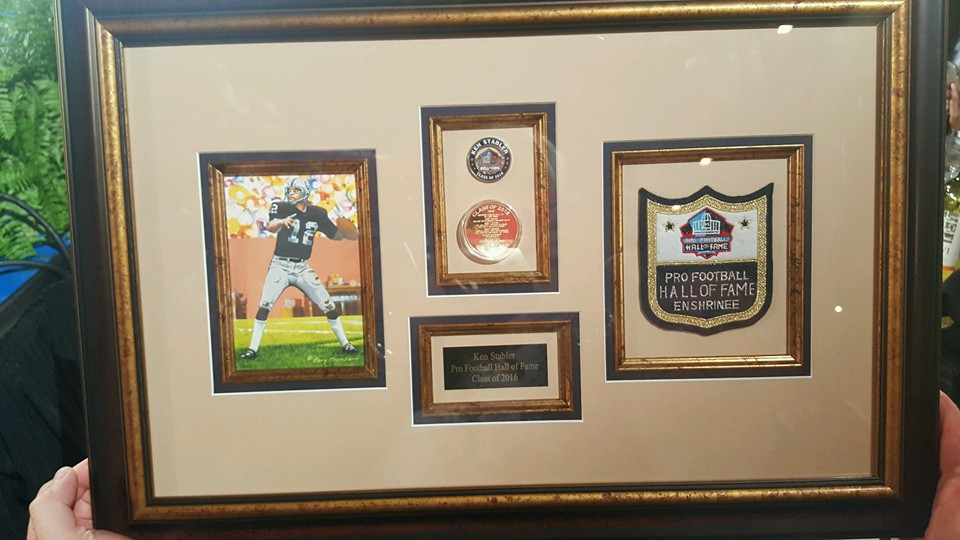
Drew Pearson 2016 (inducted 2021) 

Cliff Branch 2016 (inducted 2022)

Todd Christensen 2017

Hardy Nickerson 2020

Wilber Marshall 2024

Terrell Davis Belongs In The Hall of Fame


Terrell Davis in Super Bowl XXXII

When you think back to the Denver Broncos of the late 90s, Terrell Davis is usually the first player you think of.  He brought an NFC toughness to the AFC in terms of running the football.

You have to remember that the NFC was in the midst of a 13 game winning streak before the Broncos broke through with their win in Super Bowl XXXII.  The AFC had been filled with primarily scat backs and finesse runners when Davis was drafted in the 6th round of the 1995 draft.  He ran with power between the tackles and had the speed to pull away once he made his upfield cut.

For four years he was one of the best runners in football. An all time great until a knee injury in ’99 derailed a promising career.  Just like Gale Sayers he was a whirlwind of production before that injury so why should he be denied Hall of Fame consideration??

In 1995, Davis became the lowest draft pick ever to rush for 1,000 yards when he bolted for 1,117 on a Denver team that was retooling itself. Coach Shanahan had just come over from the World Champion 49ers and combined a single back set and merged it with a version of the “west coast” offense. Davis was an affective runner in that system but it was once the team moved to an offset I formation with the addition of FB Howard Griffith in ’96 did Davis’ production reach the stratosphere.

It was the ’96 season that Davis wrested the mantle of best power back from a fading Emmitt Smith with a 1,538 yard, 13TD rushing performance. If we add in his receiving totals he had 1848 all purpose yards and 15 total touchdowns. Yet despite the 13-3 record, his ’96 Broncos were upset in the divisional round of the playoffs by Jacksonville 30-27.

Davis in the ’97 AFC Divisional Playoff win over KC 13-10

Davis’ numbers would have been higher for the ’96 season yet Shanahan rested he and most of the starters after jumping out to an 11-1 start.  The team rusted before the playoffs and Davis lost 3 second halves where he could have piled up more yards and should have been an 1,800 yard rusher.

The ’97 season saw the Broncos move to a 12-4 record yet were cast in the roll of wildcard by virtue of Kansas City’s 13-3 record. Again Davis was the driving force running for 1,750 yards and 15TDs leading the AFC in rushing and the NFL in touchdowns. He then ran for over 100 yards against the Jaguars, Chiefs, and Steelers enroute to Super Bowl XXXII. Now their physical running game would be put to the test against the defending Super Bowl champion Green Bay Packers and their mammoth defensive line.

In one of the best performances in Super Bowl history, Davis ran for 157 yards and a Super Bowl record 3 touchdowns propelling the Broncos to a 31-24  upset win.  Davis had a superb performance and may have broken Tim Smith’s record of 204 yards had he not missed the 2nd quarter with a migraine headache. In the game he punished the Green Bay defense with physical, tackle breaking runs that broke the former world champions down. He was MVP of the NFL’s signature game in his own hometown what more could be on the horizon??

One year after the sporting press celebrated Barry Sanders rushing for 2,053 yards in ’97, there was speculation that Terrell Davis could repeat that feat in 1998. Terrell Davis and his Broncos ran out to a 13-0 record and threatened the ’72 Dolphins unbeaten streak but an upset by the Giants then the Dolphins relegated the AFC West champions to a 14-2 record.  Davis ran for over 170 yards in the final game of the season to finish with 2,008 yards, 23 TDs and he was voted NFL Most Valuable Player in the process.

His total was even more impressive than Eric Dickerson’s, Barry Sanders or O.J. Simpson’s total for one reason: his 2,000 yard season came with his sitting out over 8 quarters in blowout wins. With his average per game divided out over a 14 game season his numbers project out to 2,294 yards and 26 TDs. Had that happened he would have broken Emmitt Smith’s record of 25 TDs and Marshall Faulk never would have had the record in 2000. Keep in mind he attained all this while playing for a defending Super Bowl champion with a bullseye on their back for the entire season. Something the other 2,000 yard rushers didn’t have to contend with.

After leading the Broncos to another Super Bowl triumph in the XXXIIIrd edition, a 34-19 win over the Falcons. Davis was on pace for a record setting career yet in the 3rd game of the ’99 season he tore ligaments in his knee making a tackle against the Jets and was never the same player after a year and a half off to recover. He retired after the 2001 season with 7,607 yards rushing and 60TDs in 7 seasons.

Now it’s at this point where you have to realize the greatness of Davis. At the current rate he was running the ball at the time of his injury, he was on pace to gain 12,824 yards in only EIGHT years! Only comparison to that  is Jim Brown who ran for 12,312 in 9 years. This was a north south runner who didn’t rely on moves to gain his yards so its very likely that he could have maintained his pace. His 56 touchdown total swells out past 110 given he would have made it injury free for those same 8 years. Thats production..

Here is another talent who didn’t play for a long career but as a comet burned bright as any ever seen in the football heavens. He was the power and impetus for a two time league champion, a celebrated 2,000 yard rusher, a Super Bowl MVP, and NFL MVP. What more could he have done? Those 3 years (96-98) he was an All Pro and Pro Bowl performer.

Just like Gale Sayers his career was cut short and he was never the same yet Davis deserves the same Hall of Fame distinction. He wasn’t as flashy as Sayers but he was more productive with a bullseye on his back and powered a league champion. That has to be worth something more than distinction. He was a great player and ambassador of the game. Never an off field issue uttered with his name and came off as an affable likeable player and person. He has to be considered the top Bronco running back of all time and that includes Hall of Famer Floyd Little who came three decades earlier.

Yet thats another debate for a different day…For induction into the Pro Football Hall of Fame I present to you: Terrell Davis

New York Giants Powerful 1990 Champion Stronger Than 1986

New York Giants Super Bowl XXV Ring

In NFL History, there are some stories of some of football’s champions yet some are overshadowed by more romanticized teams. Yet if it’s true that the measure of a team is in who they beat to obtain a championship, where does that put the 1990 New York Giants??

They stopped the San Francisco 49ers bid for a three-peat. Then stopped the best of the Buffalo Bills 4 straight AFC Championship teams. They weren’t given their due by the sporting press in our estimation and their Super Bowl victory hinged on Scott Norwood missing a 47 yard field goal as time expired.  We say “So what?”

Its like this: Super Bowl XXIV had the widest margin of victory in Jan. 1990, when San Francisco defeated the Denver Broncos 55-10. The following year, these New York Giants won by the closest margin defeating the Buffalo Bills in the aforementioned Silver Anniversary 25th edition 20-19. What was the difference?? Nothing.  The Giants received the same amount of money and ring expense as the 49ers the year before.

However when the 80’s Giants are remembered this team is always thought of as the weaker of their 2 championship teams during that era. There is an air of romanticism around the ’86 team becoming Super Bowl Champions, but we at Taylor Blitz Times, believe the teams defeated give a legitimate case for the ’90 version being the stronger team.

In 1986 the Chicago Bears set the record for fewest points in a season with 187. They were the #1 defense in all of pro football and the Giants were #2. In the ’85 playoffs, the Giants were shut out 21-0 by the Bears and by luck (Charles Martin slamming Jim McMahon) didn’t play them in ’86. Then for the first time ever Pete Rozelle came up with the first Monday Night series where the Bears (’85 Champions) took on the Giants (’86 Champions).

The Bears blew them out 34-19 and the Giants only scored once on offense in that game. So it’s a legitimate debate that had they played the Bears in the ’86  playoffs they would have lost. Yet the ’90 version had to march through TWO champions to get their ring. Take a look

SUPER BOWL XXV CHAMPION 1990 NEW YORK GIANTS borrowed from upcoming book: Ring of Champions

1964 NFL Champion Cleveland Browns

64 Bowns ringDid you know that the NFL had a rotating trophy in the years before the Super Bowl? How do we know this? Well in 1995 when it was determined that Cleveland was to keep the Browns team colors, records, etc., there was no championship trophy for 1964. In fact, in more ways than one, they left it in Green Bay following a loss in the 1965 NFL Championship Game. Following the 1965 season we started the Super Bowl series where teams kept a trophy to commemorate the accomplishment…but there were rings.

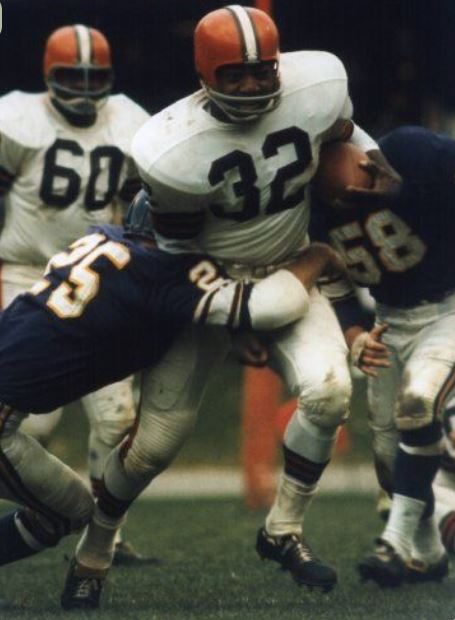
Jim Brown about to collide with Lenny Lyles during the '64 NFL Title Game.

Jim Brown about to collide with Lenny Lyles during the ’64 NFL Title Game.

Yet the year before the Cleveland Browns hosted the heavily favored Baltimore Colts in the 1964 NFL Title Game. With the Baltimore Colts defense keying on Jim Brown, Frank Ryan hit surprise MVP Gary Collins #86 with 3 TD passes in a 27-0 upset. Collins 3TD receptions in a title game went unmatched until Jerry Rice had 3 in Super Bowl XXIV some 26 years later. OK that isn’t entirely true since today they use the NFC Championship Game as an equivalent to the old NFL Championship Game we have to include Preston Pearson’s 3TDs in the 1975 NFC Championship Game when Dallas beat the Rams 37-7….yet I digress

This was the last championship won by the lake. So yes Jim Brown did play for an NFL Champion during his career. The team was quarterbacked by Frank Ryan who went on to be a college professor and designed the first electronic voting system for either US Congress or the House of Representatives…the memory escapes me. A uniquely forgotten team amidst the slew of Green Bay Packers championship teams throughout the decade.

Ironically, the team that bears the name of Paul Brown, won this championship without him. In a power struggle he was removed by new majority owner Art Modell. They were coached by Blanton Collier. More irony can be found in the fact that in Cleveland 4 years later, the Colts got revenge shutting out the Browns 34-0 in the NFL Championship Game on their way to Super Bowl III. Then the obvious irony of losing not only their last NFL Championship appearance to Baltimore, but then lost their original incarnation of the Browns to Baltimore when Art Modell moved them there following the 1995 season.

Gary Collins snares one of his three TD receptions in the '64 NFL Title Game.

Gary Collins snares one of his three TD receptions in the ’64 NFL Title Game.

However in 1964 they were league champions and went on to defend that title in 1965 against Green Bay Packers. This was also the team of the 1950s and is the only team in league history to win an NFL title in their first year in the league.

Further food for thought: What was first IRRESPONSIBLY taught to the masses as the “west coast offense” was the 1950s playbook of Paul Brown’s from Cleveland and taught to Bill Walsh in Cincinnati. In fact the most famous play in “west coast offense” history, the pass to Dwight Clark from Joe Montana in the ’81 NFC Championship Game, was an old Cleveland Brown play called Q-8 option and NOT sprint right option. It started in Ohio….NOT in San Francisco. Know your history kids… Class dismissed

The Ed Thorpe NFL Championship Trophy for 1965 as won by Green Bay as the rotating trophy the Browns took to defend their 64 Title was lost. Trophy stayed

’88 Cincinnati Bengals: What Is A Champion?? What Does One Look Like??

1988 AFC Championship Ring: Bengals 21-10 over Buffalo

Are you a champion only because you won the championship over your competition? Can there be another definition for one?? Are you to tell me that before 1985, Walter Payton wasn’t a champion? I remember Aeneas Williams firing up his Arizona Cardinals sometime around 1999, when he gathered his team and said “Champions aren’t born in the ring, they’re (only) recognized there”.  Why do I ask these questions, I think there are other definitions of a champion.  To show a champion’s will to win.  To not concede to the onslaught of another team even when you’re hopelessly behind. The greatest efforts of championship teams gone by weren’t games they won they were games that they lost.

On multiple occasions I heard Michael Irvin, Troy Aikman, and Emmitt Smith speak with the most pride on how they handled the ’94 NFC Championship Game.  They fell behind 21-0 in the last game before trying for the elusive Super Bowl 3-peat. Against the 1993 Pro Bowl defense (6 defensive signees) geared to stop them they fought on and came within a controversial call of coming back in that game, losing 38-28.

Jack Lambert and the Late Art Rooney Sr. spoke reverently of their beloved 1976 Steelers who did not win the Super Bowl.  This defense was the reason that the rule changes of ’78 took place to open the passing game. In an 8 game stretch to finish the ’76 season, the Steelers gave up only 28 points and shut out 5 of their last 8 opponents to catch the Bengals and make the playoffs. They lost in the AFC Championship Game to the Oakland Raiders 24-7 because BOTH Franco Harris and Rocky Bleier, who each rushed for 1,000 yards in ’76, missed the championship game. Many including the Steelers themselves hold this team with a greater degree of pride than the 4 teams that did win it.

What are we getting at here? A champion is defined by the magnificence of their effort no matter the odds.  Our society loses sight of this from time to time.  Please don’t misunderstand this as though winning it all isn’t the ultimate, just saying that there are even greater stories of those who put in a monumental effort only to come up a tad short.  Yet they maximized all they could give…which is what we all teach to kids all over. Give all you can and that is all you can do… so without further adieu we bring you a story of one of those great champions in the 1988 Cincinnati Bengals.

SUPER BOWL XXIII RUNNER UP 1988 CINCINNATI BENGALS <————-CLICK LINK (Word 2007 Document)

This story is from an upcoming book.

Thanks for reading,

**TOMORROW’S ARTICLE: 2011 Minnesota Vikings preview**

Death Becomes the Run & Shoot on a Monday Night

Single outside receiver site adjustments from the Run and Shoot

Whatever happened to the Run & Shoot as a pro offense?? You remember in the early 90s, when several downtrodden franchises looked to this offense to gain a tactical advantage on the competition.  Atlanta, Detroit, Houston, and Seattle deployed 4 receivers who ran their routes according to how defenses were playing them.  Borrowing on a concept from Bill Walsh’s offense, it was up to both the receiver and quarterback to read the defense, then adjust the route accordingly.

The truth of the matter is for each team with 4 receivers; the 3rd and 4th receivers were better than the opposing 3rd and 4th defensive backs that were normally platooned to cover them.  These teams started racking up yards by the bushel and along with Buffalo’s “K Gun offense”, the zenith of the Run & Shoot was 1991 when each team, except Seattle. who abandoned the offense in 1990, made the playoffs.  The Bills set offensive records for TDs scored and 33TD passes in a season by Jim Kelly.  In fact Thurman Thomas was NFL MVP with over 2,100 combined yards from scrimmage.

Everyone thought of the Bills “No Huddle” offense as an offshoot of the Run & Shoot because of option routes run by Andre Reed in the slot and Thurman Thomas out of the backfield.  Teams had a hard time adjusting and no matter how your corner played any of these receivers, the receiver would change his route and use the corner’s position against him.

For instance if the corner played outside position in a cover 3 zone, the adjustment would be a seam route by the slot receiver, or a skinny post for the outside receiver.  That same corner came up in press one on one, the receiver would try for an outside release and run a fly pattern.   In a cover 2 where the corner was off, he would adjust and run a hook with the underneath receiver running a down and out underneath his pattern, as the outside receiver occupied the corner.  What could a defense do to combat an offense that used your very choices against you?

Enter the NFC East.  This was the division that each team fielded twin 200 lbs. safeties receivers were funneled to. Whether it was Myron Guyton / Greg Williams with the New York Giants, Danny Copeland / Brad Edwards of the Washington Redskins, or the more punishing Andre Waters / Wes Hopkins duo that was on patrol in Philadelphia’s Veteran Stadium.

Where most teams were employing mainly dime defenses that were off the receiver, these teams started fielding nickel and dime defenses with cover two over the top and bludgeoned smaller  run and shoot receivers.  Many pundits look back to the Giants 1990 Super Bowl XXV defeat of the Buffalo Bills and their use of a 2 man line nickle and dime variations to slow down Buffalo’s no huddle / run and shoot tactics.

However thats misleading…the Giants conceded the run to the Bills (see Thurman Thomas’ 135 yards rushing) to set the tone punishing receivers with hits from the linebackers and safeties.  It was more of a victory based on the strong time of possession difference from the methodical Giants offense more than defensive tactics. A 40:31 to 19:29 possession time difference as a matter of fact.  Although Super Bowl XXV, at the end of the 1990 season, did set the blueprint for playing physical defense against this speed type offense.  So when and where was the run and shoot conquered as an offense??

The signature game that signaled the death of the Run & Shoot as an offense, came in week 14 of the 1991 season.  A Monday night matchup where the Houston Oilers hosted the Philadelphia Eagles.  The Eagles as a defense had come to full fruition as a unit originally put together by Buddy Ryan and now run by defensive coordinator Bud Carson.  They had high hopes that 1991 would be their year: they returned ’90 NFL MVP Randall Cunningham and an improving defense, yet torn ligaments to Cunningham’s knee courtesy of Bryce Paup in the season opener, sent the Eagles season spiraling.  Not quite…

A defense that ranked near the bottom in ’88, Buddy Ryan helped their esprit de corp when he drafted only four players in 1989 citing he liked his guys.  The team grew defensively into a giant by 1991 although Ryan was no longer with them.  The defense kept them in games week after week and they came into this matchup 7-5.  Could they best the #1 passing offense in the league? Could they do it on the road?

The Houston Oilers were the vanguard of the run n shoot teams and with Warren Moon had put up the most prolific numbers. In 1990 Moon passed the Oilers to the playoffs with 4,689 yards and 33 TDs.  The most since Dan Marino’s record setting 1984 and he missed 1 full game and time in 2 others.  Along the way he passed for 514 yards against the playoff bound Chief’s #6 ranked defense. Coming within 41 yards of Norm Van Brocklin’s 50 year old record of 554. Alas Moon suffered a broken thumb and missed the Oiler’s playoff loss to Cincinnati.

Going into 1991, Moon was on a near record setting pace again and some thought this, and not Buffalo was the strongest AFC team.  The Redskins were 8-0 and the Oilers 7-1 when they met in a week 8 slugfest with the eventual world champion Redskins. The game was won  by Washington 20-17 in RFK, yet they showed they indeed were ready to stand toe to toe with the best the NFC offered. Going into the Monday Night tilt against the beat up Philadelphia Eagles at home, many thought the Oilers juggernaut offense would roll in this game too.

What took place over the next three hours was one defensive masterpiece that many defensive affecionados remember reverently to this day. The Eagles employed a 4-2-5 nickel variation with OLB Seth Joyner and MLB Byron Evans, who was lanky for a middle backer yet had great range, for most of the night.

Occasionally they’d bring in the dime defense (6 defensive backs) yet what they did differently was press the receivers and blitz off short corners. The hitting was vicious with Wes Hopkins and Andre Waters leading the way.  They knocked out both Ernest Givins and Drew Hill out of the game twice each. The first vicious shot was a dirty elbow from Wes Hopkins that broke Givins nose, yet set the tone for the night.

Joyner played his way to the Pro Bowl and almost the Hall of Fame that night with 2 sacks, a forced fumble and a fumble recovery to keep the game close.  Reggie White, Jerome Brown (The U), Mike Golic, and Clyde Simmons swallowed Allen Pinkett’s attempts to run holding the Oilers to a paltry 21 yards rushing for the game.  They also provided a serious rush that they supplemented with the occasional blitz that beat Houston into total submission before a stunned audience of millions. When dime back Otis Smith’s thunderous hit on Drew Hill, on an outside swirl route, forced Houston’s fifth fumble of the night. The rest of the league were on their second tablet from taking notes. The Eagles won 13-6 in front of a shocked audience.

Early 90s pic of Eagles L-R: Clyde Simmons, Eric Allen, Jerome Brown, Seth Joyner, and Reggie White

The beating was so decisive it ruined the Oilers season and this game was the complete blueprint on how to stop the run and shoot. Going into the game the Oilers were averaging 307 yards passing, just off pace needed to break Marino’s passing record, yet staggered away from this game only averaging 232 the rest of the season. The 226 they gained through the air against the Eagles was their season low.

The average was also down for the Falcons and Lions over the last 4 weeks of the season as well. The Oilers went down in the divisional round of the ’91 playoffs 26-24 to Denver, and the lone run n shoot playoff winner was Detroit who went on to whip Dallas 38-6. In fact the Cowboys had lost 4 games to run n shoot teams in 1991. The next year the Cowboys drafted a rangy MLB Robert Jones, in a Byron Evans mold, and brought in CB Kevin Smith, SS and former rangy college linebacker Darren Woodson, to stop those offenses the next year. The first of their 3 Super Bowl wins in the 90s and it started with that 1992 draft to mimick what the Eagles fielded in 1991.

As for the run n shoot, its effectiveness was diminished and the race for the record book was over.  In 1991 Houston passed for 4,621 yards where in 1992 that number dropped to 4,029. In ’92 neither the Lions or the Falcons came within 3 games of the playoffs and the Lions and Bills started to alter their offensive approach. The Oilers along with the Falcons ran the offense until 1993, yet the Falcons never returned to the playoffs…and the Oilers?? Well they went into the 1992 wildcard and took a 28-3 halftime lead on Buffalo who was playing with 6 & 7 DBs on the field.  Warren Moon at the half was 19 of 22 for almost 300 yards and 4 TDs and ballooned the lead to 35-3.

In the 3rd quarter, the Bills decided to play it the same way the Eagles had in ’91 inserting rangy MLB Carlton Bailey #54 and Darryl Talley #56 and they shut Houston down in the second half enroute to the greatest comeback in NFL history winning 41-38 in OT. Couple these landmark events with the system’s inability to score in the red zone and the run n shoot’s fate was sealed.  Even now the run n shoot receiving principles of WR route running based on options lives on in playbooks, just not in a 4 receiver set, nor as an entire offensive approach.

As for the Philadelphia Eagles defense that was the architect of the run n shoot’s demise? They went on to become the last great defense to finish #1 against the run, #1 against the pass, and #1 overall.  A distinction the ’85 Bears, ’86 Giants, ’76 Steelers, ’78 Steelers, ’08 Steelers, nor ’00 Ravens could match.  They finished the season winning 7 of 8 games and finished 10-6 and narrowly missed the playoffs.

The combined quarterback rating for their final 6 QBs was less than 40.0, and their principle line rushers R. White, Jerome Brown(The U), and Clyde Simmons combined for 37 sacks (which if they played last year would rank 11th in the NFL by themselves), and all 3 were Pro Bowlers and 1st team All Pro. Seth Joyner and Eric Allen earned Pro Bowl distinctions in 1991 as well.  They don’t receive the recognition of those other great defenses because they didn’t win the Super Bowl. Who would have operating with 5 different starting quarterbacks? They were one of the best defenses in NFL History.  Had Randall Cunningham not been injured…

Prologue: The impact of the players of this era in Eagle history were felt throughout the decade…

Reggie White-Became the main prize in 1993’s free agent derby, signed with Green Bay and went on to become the NFL’s all time sack leader. Recorded 3 sacks in Super Bowl XXXI when he became a champion with Green Bay along with former Eagle TE Keith Jackson. They bested the New England Patriots who had former Eagle RB Keith Byars and CB Otis Smith on the team. White passed on the week of Christmas 2004 which cast a pall over the playoffs that year. He was inducted into the Hall of Fame posthumosly in 2006. RIP Reggie White.
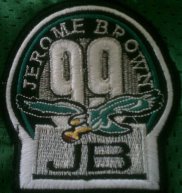
Commemorative patch worn by the 1992 Philadelphia Eagles in Jerome Brown’s memory.

Jerome Brown– An all pro talent who passed away the following June. He’s still one of the most beloved Miami Hurricanes and missed by Hurricane fans everywhere. The 1992 Eagles dedicated their season to his memory and wore this commemorative patch on their jerseys the entire season. They also kept an equipped locker for him throughout the season and set it up on road trips also. His locker was with the ’92 Eagles in the Superdome as they won their first playoff game in 15 years.

Brown was the predecessor to fellow Hurricanes DTs Cortez Kennedy Russell Maryland, and Warren Sapp. Kennedy, who changed his number to 99 in honor of Jerome and went on to win NFL Defensive Player of the Year in his honor in 1992 while playing for the Seahawks. Every Hurricane playing in the NFL during 1992 wore a black #98 on their helmet that year including several that played for the Dallas Cowboys. The next time you watch Super Bowl XXVII where Dallas beats Buffalo you’ll see the black #98 on the back of many helmets. Jerome was alos the inspiration and reason former Hurricane Warren Sapp wore #99 during his entire NFL career. R.I.P Jerome Brown

Seth Joyner & Clyde Simmons– Were twin free agent prizes that signed with Buddy Ryan and the Cardinals in 1994. I wrote the Buffalo Bills organization and suggested we grab Simmons and Joyner to join Bruce Smith and Cornelius Bennett to fortify our defense to get to our fifth Super Bowl…yet I digress Joyner went on to join White with the Packers (1997) in their bid to repeat as champions yet they lost to Denver in Super Bowl XXXII.

Well if you can’t beat ’em, join ’em, and when Denver (1998) went on to become back to back champions a year later. Seth Joyner was a Bronco and guess what number he wore?? Number 99. He is a motivational speaker in Arizona now http://sethjoyner.com/ runs youth football clinics and is a coach himself. Just launched his show and podcast “The Seth Joyner Show” where you can hear his commentary along with a host of former Eagles.


Eric Allen– Played on through the 2001 season finishing with the Raiders. A popular notion is he should have been 1993’s NFL Defensive Player of the Year for his 64 tackles 6 interception performance in which returned 4 of them for touchdowns.  The most famous being a 91 yard interception against the Jets. After weaving his way into the endzone, he handed the ball to teammate Randall Cunningham who was on crutches having been injured earlier in the game. His last game as a player was the famous “Tuck Game” in New England in the 2001 playoffs. Former teammate Otis Smith was a Patriot CB. He’s currently an ESPN analyst.

Byron Evans-Played 8 years with the Eagles through the ’94 season and was an underrated talent. Has an internet radio show he does with former teammate CB Mark McMillan on the Voice of America Network. http://www.voiceamerica.com/show/1475/hard-hittin-radio

Andre Waters– The hard hitting safety went on to join Simmons and Joyner in Arizona for the ’94 and ’95 seasons. He had gone into coaching yet passed away in 2006 R.I.P. Andre Waters

Otis Smith-Was an Eagle dimeback in ’91. He went on to be the wily CB for a veteran laden Patriot team that lost Super Bowl XXXI to Green Bay. Yet was a Patriot 5 years later man handling Tory Holt and Isaac Bruce to stop the Greatest Show on Turf as he became a champion in Super Bowl XXXVI.

Mike Golic– finished his career with Miami and is half of the popular duo Mike and Mike on ESPN television and radio in the morning.

Taylor Blitz Times new logo!!

Taylor Blitz Times new logo!!