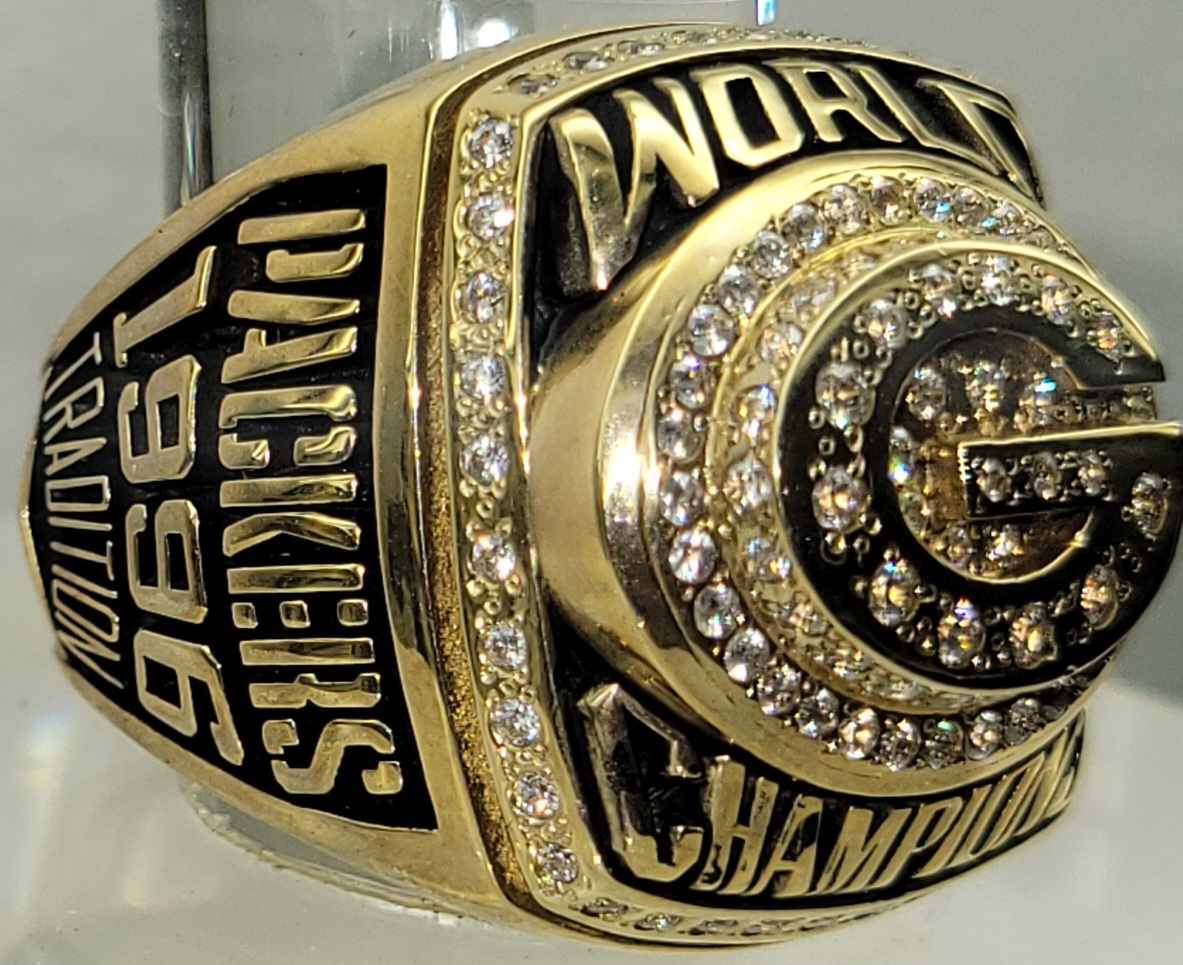
Missing Rings: 1993 Houston Oilers

Everyone can tell you when an era ends but when was its zenith?? The truly great teams burn bright for some time while winning championships. Others burn almost as bright for a long time but memory fades on those that don’t bring home Super Bowl rings. When it comes to the case of the Houston Oilers between 1987-1993, the zenith came at the end and the fall was so dramatic it killed the franchise.
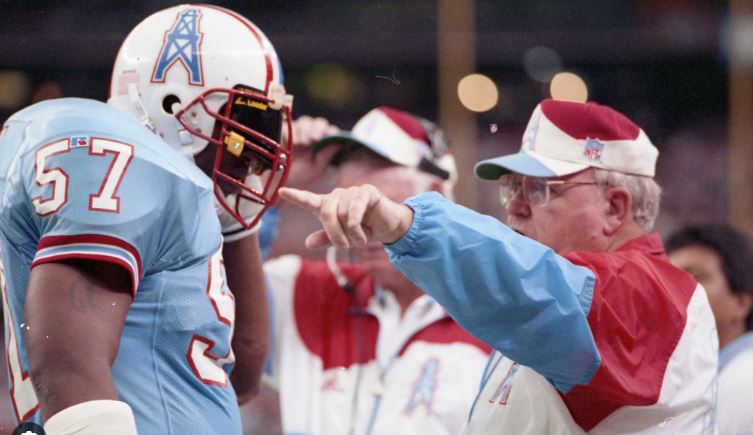
Yet as we look back at the Houston Oilers of 1993, you have to stretch back a little further and remember what happened during the playoffs of 1991 and 1992.

The Oilers had become one of the most talented teams in football. They were the vanguard of the teams that ran the Run & Shoot offense. Their trigger man, Warren Moon had made it into the upper echelon of NFL quarterbacks. He had orchestrated the league’s #1 offense in 1990 and 1992. in 1991 they dropped to second in the league behind the K Gun of the Buffalo Bills.

Warren Moon was building his Hall of Fame resume with Pro Bowl performances 8 straight years.

Moon was starting at a time when black quarterbacks were just getting their start in the NFL on a league wide basis. Yet despite those pressures he approached Dan Marino’s passing records with 4,689 yards in 1990, and 4,690 yards in 1991. However his team coming up short in the playoffs was starting to become an issue. Similar to what was once a concern of Peyton Manning and continues to dog Tony Romo, Moon had only won 1 playoff game between 1987-1990. In reality, the Oilers were expected to ascend to be the best team in the AFC as they stockpiled talent around him. Make no mistake Moon was playing to erase the stigma that a black quarterback could lead his team to a championship. It hadn’t been done since Doug Williams in 1987.

He had diminutive and quick receivers in Ernest Givins, the late Drew Hill, Curtis Duncan, and a tall wideout in Haywood Jeffires. In 1991, 4 yards kept Moon from having 3 – 1,000 yard receivers as the Oilers opened 7-1 and looked like the AFC’s best rival to knock off the defending champion Bills.  However they ran into John Elway and the Denver Broncos in the AFC Divisional Playoff. On a mission they ran out to a 21-6 lead in Mile High Stadium. However Elway rallied his team back to a last second 26-24 win that sent the Oilers home after a total collapse. A team with 7 Pro Bowlers and 3 All Pros was sent home by a hodgepodge rebuilding Denver team that hadn’t made the playoffs in 1990 and wouldn’t in 1992.

Andre Reed scores the go ahead touchdown in the greatest comeback in NFL history.

Andre Reed scores the go ahead touchdown in the greatest comeback in NFL history.

The team was still in it’s prime as they approached 1992. Age was becoming a factor as the 36 year old Moon missed 6 games during the middle of the year. Houston entered the playoffs with a 10-6 record courtesy of a 27-3 win over Buffalo in a Sunday night finale. It set up a rubber match at Rich Stadium in a wild card game against the two time defending AFC Champion.

Not only were the Bills without future Hall of Fame quarterback Jim Kelly, they would be without Pro Bowlers Cornelius Bennett and Thurman Thomas as well. Moon had a first half for the ages as he went 18 of 22 for over 220 yards and 4 touchdowns in the first half. At an 81% completion rate, broadcasters Charlie Jones and Todd Christensen waxed philosophical about the possibility of breaking the record of 88% Phil Simms had accomplished in Super Bowl XXI. Houston was up 28-7 at the half and then SS Bubba McDowell returned an interception to give the Oilers a 35-3 lead in the 3rd quarter.  They had outscored the Bills 62-6 in 6 quarters in less than a week. They were hitting on all 8 cylinders.

Then came the greatest collapse in the history of the NFL. A 32 point lead was washed away as Buffalo just put on a performance for the ages in a 41-38 win. Once the Bills took the momentum from the shell-shocked Oilers the game was almost inevitable. Moon’s crispness in the first half, where he led the Oilers to touchdowns on all four of their drives, went 3 and out on the first four of the second half. Also completely befuddled was defensive coordinator Jim Eddy, who never changed the nickle package or calls for the entire second half of that game. Bills receivers and backup QB Frank Reich knew exactly which plays would work and kept waiting for adjustments that didn’t come.

If the Oilers would have won a Super Bowl between 1987-1993, would Ray Childress be in the Pro Football Hall of Fame??

If the Oilers would have won a Super Bowl between 1987-1993, would Ray Childress be in the Pro Football Hall of Fame??

Psychologically, the jury was in on the Houston Oilers of that era for many pundits. They just couldn’t win the big game despite the talent they had on the field. Pro Bowl defenders Ray Childress, Al Smith were possibly tarnishing Hall of Fame careers at this point. Former Pro Bowl talents such as CB Cris Dishman, DE Willam Fuller, and DE Sean Jones were all on the field in Buffalo and none could make a play to turn that game around. Just as they hadn’t in Denver the year before.

Owner Bud Adams had seen enough and decided the defense was the reason for the collapse and hired Buddy Ryan. That’s right the same Defensive Coordinator of the 1985 Bears and former Head Coach of the Philadelphia Eagles. Adams did this and forced him onto then Head Coach Jack Pardee. Ryan had total autonomy just as he had in Chicago. In fact he was able to hire his own assistants and player requests. In came former Ryan disciple Wilber Marshall, a fiery linebacker that was one of the unsung performers on that ’85 Bears team.

Ryan also forced the team to draft a MLB in Miami Hurricane Michael Barrow and draft a tight end in John Heny Mills. With a defense that had 6 former pro bowlers on it and a soon to be Pro Bowler Lamar Lathon at that point, this was going to be a sight to behold. Ryan resurrected the 46 defense deep in the heart of Texas yet how much of the leadership of that team was stripped of Pardee?? 1993 looked like the last year for the Oilers to make it to the Super Bowl or the team would be broken up. All or nothing.

When Buddy Ryan brought in former All Pro Wilber Marshall, the defense took on a totally different tone.

When Buddy Ryan brought in former All Pro Wilber Marshall, the defense took on a totally different tone.

The preseason began with Ryan firing off comments about Offensive Coordinator Kevin Gilbride and the Run & Shoot offense. The “Chuck & Duck” Ryan scoffed at the high penchant for passing and not running the football and prone to turnovers.

The team however sputtered out of the gate as the defense had some growing pains and the offense started slow.

In fact, a 1-4 start to the 1993 season looked similar to the Houston Texans of this year. A lot of talent, although a little old and they should be able to turn it around. That fourth loss came in a return trip to Buffalo. With Warren Moon’s benching, it looked to all the world this era of Oilers football was about to come to a crashing end.

However the defense not only grew into it’s shoes, it became the scourge of the league. Gone was the passive 4 man rushes of the Jim Eddy defense and in was the confusing blitz packages Ryan had made famous in Chicago. His Philadelphia Eagles didn’t use as many packages as he did in Houston. Over the next eight games they had 35 sacks, 30 takeaways and had knocked 5 quarterbacks from the game. A defense full of star quality talent left opponents without a focal point to game plan against. The league hadn’t seen heavy focus on the 46 defense in over 5 years. They also hadn’t played against this personnel in these new positions. Teams were thoroughly over matched as the last 11 opponents never scored beyond 20 points.

As the defense helped turn the season around Warren Moon came off the bench when his backup Cody Carlson was injured in week 6. His play was more efficient than it was spectacular as defenses had caught up to the Run & Shoot by ’93. However the Oilers were running the ball more and inserted a bigger back to try and wear down defenses. Former special teamer Gary Brown took over due to injuries and rushed for 1,002 yards on 195 carries. He was the first player in league history to rush for 1,000 yards while only starting half the season. Gone was the scat back presence of Lorenzo White and Allen Pinkett and a bruiser was now running the football in the Run & Shoot. Now teams couldn’t go with pass specialists at linebacker with a hammer in the backfield.

However all wasn’t rosey.

The team operated in the awkward vacuum of two camps within a football squad. Buddy Ryan had complete autonomy with his players and coaches. The season long tension was always there as Ryan said what he wanted to at press conferences, even if it wasn’t supportive of the offensive side of the ball or the team as a whole. Head Coach Jack Pardee and Offensive Coordinator Kevin Gilbride acquiesced some of their game planning to accomodate Ryan. Think not?? Brown in half of the ’93 season carried the ball nearly 200 times where in 1991, Allen Pinkett started all 16 games and only ran it 171 times.

What bothered Ryan the most was the offense continuing to pass the football at the end of halves when they should have run the clock out and gone into the locker room. This resulted in two of his starting defensive backs being lost for the season on meaningless plays right before halftime. So when starting FS Marcus Robertson was injured with just seconds left before the half in the last game, Ryan exploded and threw a punch at Gilbride. Now heading into the NFL playoffs he would be missing 3 of his 4 starters in the secondary.
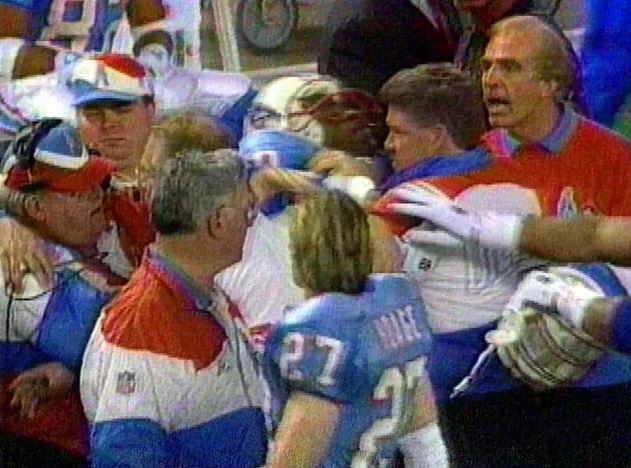
The Oilers of 1993 were a lab experiment about how a team with such disjointed chemistry could actually band together to be the tough minded team no one thought of them as. They survived “Baby-gate” when OT David Williams missed a game early in the season to witness the birth of a child. Media scrutiny was less intense and more forgiving when DT Jeff Alm committed suicide before their week 14 match-up with the Pittsburgh Steelers. Dedicating the game ball to his parents and their fallen teammates memory, they went on the road and whipped the Steelers 26-17 to capture the AFC Central.  Ten months after a collapse branded this team as one of the psychologically weak teams in modern history, they had forged an identity tougher than any could remember.

Houston concluded the regular season 12-4, finishing on an 11 game winning streak. Which had only been equaled by the ’72 Dolphins, the ’69 Minnesota Vikings, and the 1934 Chicago Bears in all of NFL history. No question did they look across state and see a possible match-up with the defending champion Cowboys. When they went out and hit Steve Young so often in a 10-7 win out in Candlestick on Christmas Day, league wide fear of this team only grew. This was not going to be the same team that wilted under playoff pressure come playoff time in 1993.
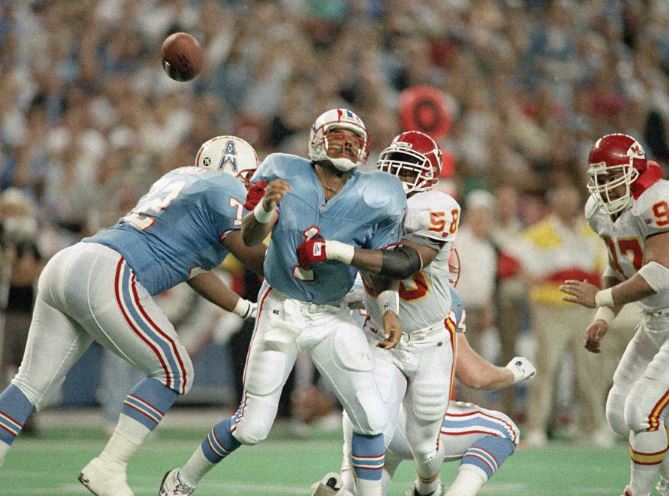
Everyone feared this group except one team, the Kansas City Chiefs. The Oilers had run over the Chiefs 30-0 early in the season and had talked a big game while doing it. As the AFC Divisional slate put these two together again, talk of knocking out Chief quarterback Joe Montana drew the ire of Chief defenders. The late Derrick Thomas and Neil Smith talked about their knocking Moon out if Montana left the game simiarly. What hadn’t been thought of was beating the bully at their own game.

The Chiefs came into the game as a team that didn’t blitz a lot. They stayed with bookend pass rush All Pros Smith and Thomas and played coverage behind them…or so the Oilers thought. The Chiefs threw blitzes at Warren Moon tying an NFL playoff record with 9 sacks and knocking the offense out of continuity from the very start. They held the Oilers to only 277 yards of offense. Their season low?? 246 yards ironically against the Chiefs in their 30-0 loss to the Oilers at the beginning of the season.

It was Joe Montana and moving on half rollouts away from the blitz that kept him upright in this game. A veteran of 20 previous playoff games, with a 15-5 record that featured 4 Super Bowl championships, he may have played his best game at 37 years of age. He completed 22 of 38 passes for 299 yards 3 TDs and 2 interceptions. Once he adjusted to the Oilers and their fleet of second string people in the secondary, he and Marcus Allen kept the ball away from Moon in the second half. The 28-20 win by the Chiefs came at great delight to both Buffalo and Dallas who no longer had to think of facing this monster team from Houston. They would go on to play each other in a second straight Super Bowl once Buffalo DID knock Montana from the AFC Championship Game.
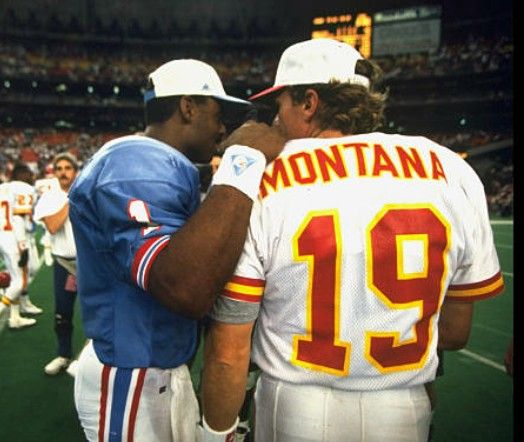
As for the Oilers, they were broken up after 1993. Gone was Warren Moon who went on to sign with the Minnesota Vikings. Buddy Ryan received another Head Coaching position in Arizona taking Wilber Marshall with him. The defense was turned over to Ryan disciple Jeff Fisher, who would succeed Jack Pardee once he was fired in week 10 of 1994. Present Titans coach Mike Munchak played his last game for the Oilers in that 93 playoff loss and began his coaching career that same year. Former Offensive Coordinator Kevin Gilbride was let go once Pardee was dismissed. They had been the men responsible for bringing the Run & Shoot to Houston and it left with them.

Ironically the offense that didn’t win it all as a complete scheme lived on in offenses around the league. It was Gilbride teaching some of the Run & Shoot principles to New York Giant receivers as they have won Super Bowls XLII and XLVI. Even the team of the 2000’s, the New England Patriots run variations of offensive principles that were a staple of Gilbride’s down in Houston. Especially the screen plays that Gilbride designed. Below is a copy of one of the pages from the Patriots Super Bowl playbook of 2003 and you can clearly read “Run and Shoot screen”. 

RunAndShootScreen

The largest fall had been with the fan base that was there from the Luv ya Blue days through this era of Oiler football. The heart of the fan base drained drastically as the team fell to 2-14 in 1994. Within two years, Bud Adams moved the team to Tennessee and renamed the franchise the Titans. It was a sad and sudden end to the Oiler franchise but it came off the heels of promise that was the best team in Oiler history that didn’t make it to the Super Bowl.

Thanks for reading and please share the article.
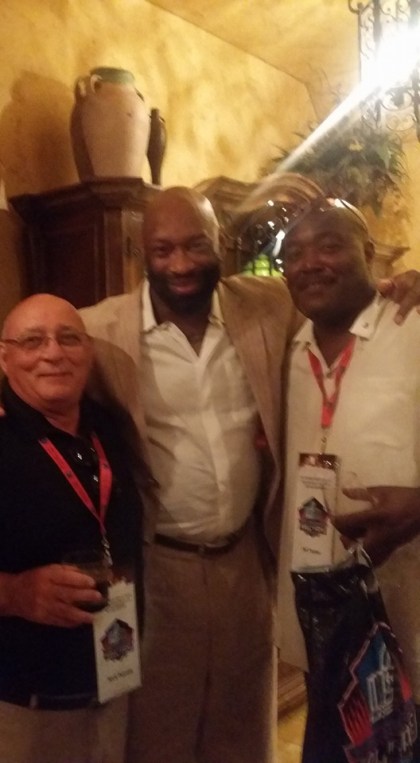
CoachP.LLathonandChancellor

Met Lamar Lathon with Coach Petrillo at 2016 HoF party for KG

Roger Craig Should Be In Pro Football Hall of Fame

When you think back to Bill Walsh’s great 49er teams, who are the first players you think of?? Right there with the Joe Montanas, the Jerry Rices, and Ronnie Lotts it only takes a fraction of a second to think of Roger Craig. His high knee running style brought a physicality to the San Francisco offense that was seen as a finesse group up until his arrival. In fact he came to San Francisco as a fullback when they drafted him from Nebraska before the 1983 season.
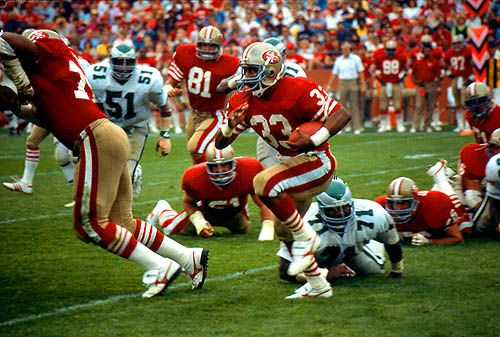
In college he had been primarily a blocking back in the Cornhuskers wishbone offense. Normally he paved the way for Jarvis Redwine and then Mike Rozier. Yet when Bill Walsh decided to revamp San Francisco’s dismal backfield after a 3-6 season in 1982, he drafted Craig in the second round.

Although the 49ers had won it all in 1981, it had become apparent Bill Ring, Amos Lawrence, Walt Easley, and Earl Cooper just wasn’t cutting it in the backfield. To raise the stakes in the NFC for 1983, Craig and newly acquired Wendell Tyler would form a more potent backfield.

After posting the worst yards per carry average (3.4) and yardage (742) in 1982, the new backfield duo of Craig and Tyler turned that around completely. The much improved ground game of 1983 ranked 8th with 2,257 yards rushing and a gaudy 4.4 yard average. Ironically just ahead of the Los Angeles Rams, who had traded Tyler to San Francisco so they could draft Eric Dickerson.

You had to give the nod to Craig who ran for 783 yards a team leading 8 TDs, while catching 42 passes for 427 yards and another 4 scores. This more dynamic backfield, along with Joe Montana, powered San Francisco to the NFC Championship Game. A 24-21 loss to the Washington Redskins was shrouded in controversy, thanks to some questionable calls, yet Walsh had the backfield he envisioned. Craig had reinvented himself from a collegiate player who rarely touched the football to a dual threat pro.

The 1984 49ers were a juggernaut becoming the first team to go 15-1 during the regular season. Everyone of the 49 man roster played their role so no one had outstanding stats. However once the 49ers moved past the New York Giants and Chicago Bears during the playoffs, the stage was set for a coming out party in Super Bowl XIX. With all eyes on Joe Montana’s possible second Super Bowl trophy and the electrifying record setting Dan Marino, Craig’s name didn’t even make the marquee.


Roger Craig graces the cover of Sports Illustrated after his record breaking performance in Super Bowl XIX.

Roger Craig graces the cover of Sports Illustrated after his record breaking performance in Super Bowl XIX.

It was his 1985 that set Craig apart as he amassed his 1,000/ 1,000 yard seasons both rushing and receiving. The first player in league history to do so. Some 27 years later, only Hall of Famer Marshall Faulk shares that accomplishment when he did it in 1999. How dominating was his performance?? Well his 1,050 yards rushing doesn’t jump out at you until you realize he only ran 214 times for a whopping 4.9 yards per carry. The league average is always around 4.0.

Oh by the way, he led the NFL in receiving that year with 92, which set a record for running backs, that amassed 1,016 more yards. His 15 total touchdowns was second to Joe Morris and was 1 better than NFL MVP Marcus Allen. In fact many pundits, including our CEO believes Craig should have been the MVP in 1985 with that dominating performance.

Now buoy his 1985 record setting season not culminating with the league MVP, on the backdrop of a Super Bowl record 3 TDs yet not winning that MVP and you’ll see where we’re going in a minute. Don’t forget he did this on a 10-6 San Francisco team that was a defending champion with Jerry Rice being a rookie that didn’t have 1,000 yards receiving and only 3 touchdowns. Craig quite simply fueled that offense.

Once the 49ers won Super Bowl XIX, they were forced to retool and become a bigger physical team. In 1985, the Chicago Bears emerged with one of the most imposing defenses in NFL history. The Giants followed suit with an overwhelming defense that featured 4 linebackers in the 250 lbs category. When Bill Walsh and his 49ers were dominated 49-3 in the 1986 NFC Divisional Playoffs by the Giants something had to be done.

These were teams the 49ers had beaten on their way to the ’84 championship, now they had taken the game to a new level of brute force. In reinventing the offense from a size perspective, it was Craig who was switched from fullback to halfback to allow for the insertion of Tom Rathman at fullback. The entire offensive line was overhauled.

You have to keep in mind the average career for a runner in pro football is less than 4 years. Yet here Craig was making the switch in year 5 to a position that called for him to be quicker. This at a time where he should have been slowing down from a physical standpoint. Yet he, Jerry Rice and Joe Montana spearheaded one of history’s most accomplished runs. From 1987-1990 the 49ers went 51-12 in the regular season, winning back to back Super Bowls in ’88 & ’89 and were the prohibitive favorites to win it all in 1987 as well as 1990. They finished #1 in offense in ’87 and ’89 and #2 in ’88 and ’90. In each year they made it to at least the divisional round of the playoffs and 3 straight NFC Championship Games as they were trying to threepeat.

Playing in only 12 games due to the ’87 strike, Craig ran for 815 yards which projects out to 1,086 over a full season. The 13-2 Niners were poised to become the greatest team of the modern era yet were upset by the Vikings in the playoffs. They were #1 in both offense and defense yet proved fallible in the playoff loss. Craig went on to his greatest performance in the 1988 campaign. In rushing for a career high and club record 1,502 yards, he also caught 76 passes for an additional 534  yards for his second season with over 2,000 yards from scrimmage. More important, he powered San Francisco to another Super Bowl championship with a win over Cincinnati in the XXIII’d edition.

Roger Craig was a hard nosed runner.

Roger Craig was a hard nosed runner.

Yet go back to 1988 being his second season with more than 2,000 yards from scrimmage. Keep in mind this was no sleek, make ’em miss halfback. He brought a punishing style to his position where he bludgeoned the opposition. As you’re reading this you can picture his high knee running style like when he trampled through the Rams on his most famous run in 1988.

Yet did you know that Emmitt Smith, Thurman Thomas, and Barry Sanders only had 2 different seasons amassing 2,000 yards from scrimmage also?? Did you also know that Marcus Allen and Adrian Peterson have only had one?? Only Edgerrin James, Marshall Faulk, Ladainian Tomlinson, and Eric Dickerson had more. What do all of these runners have in common?? Peterson and Tomlinson will be in the Hall of Fame and all the others are in. Roger Craig is right there with them.

Now going into the Hall of Fame is based on impact on the game. By the time we bring up the 1989 team that won Super Bowl XXIV, Craig was a driving force behind the team of the decade. Again he was a 1,000 yard rusher as the team won their fourth Super Bowl and Roger had his 3rd ring. When he left the game in 1993, his 566 career receptions was #1 among running backs all time and still remains 7th.

He is in the linear line of great NFL running backs when it comes to catching the football and is a part of the game’s evolution. He took the mantle from Chuck Foreman and propelled it forward. Since then, only a handful of every down running backs have provided that type of versatility. Now everyone has a receiving running back who comes in on 3rd downs where Roger was in every play.

It was Craig’s play that allowed a young Jerry Rice to flourish as teams concentrated their efforts to stop him. If Craig’s move to halfback in 1987 hadn’t panned out, what would have been the legacy of Bill Walsh’s “West Coast Offense”?? It was the run from 1987-1990 that made the offense spread it’s wings throughout the National Football League. During this time is when it proved it could take on the big bad Chicago Bears defense (see 41-0 1987 Monday Night shutout) and 28-3 NFC Championship win in Soldier Field in ’88. Then you add the rivalry with the New York Giants.

From Mike Holmgren to Denny Green to Mike White to Jon Gruden ( who had just begun coaching on the 1990 SF coaching staff) and George Seifert succeeding Bill Walsh. They all could attribute their Head Coaching jobs to some extent to Craig’s performance along with Montana and Rice. Yet the foundation of that offense running and receiving along with goal line and short yardage was #33.

By the way, when did Roger Craig become the the first running back to have a 100 yard receiving game in a Super Bowl?? You guessed it… Super Bowl XXIII against Cincinnati and not his record setting performance against Miami. Now had he won the Super Bowl XIX MVP, or the 1985 NFL MVP, would that have propelled him to winning the NFL MVP in 1988?? Give it some thought.

For induction into the Pro Football Hall of Fame, I present to you…Roger Craig

Everson Walls Belongs In the Hall of Fame

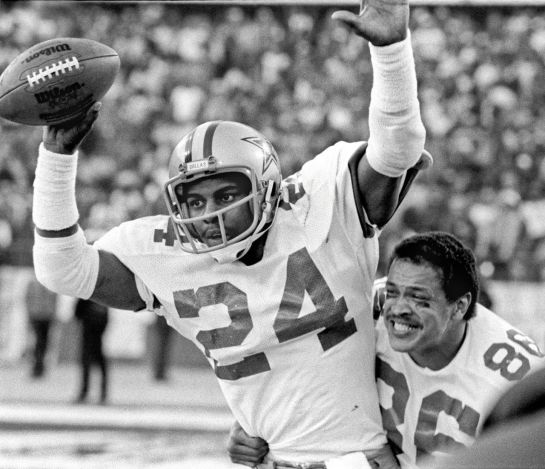
Butch Johnson and Everson celebrate Walls 4th quarter redzone interception in the ’81 NFC Championship Game. Yes, same quarter as The Catch

In the history of football, one of the hardest positions to judge or gauge performance is cornerback. Many times they’re overlooked when we speak of their careers as a whole because they rarely have a lot of tackles or hard hits.  So we tend to think of defenisve linemen or linebackers first. However after the NFL instituted rule changes that favored the passing game in 1978.  A more fluid athlete was needed to turn and run with receivers who could no longer be hit beyond 5 yards of the scrimmage line. The day of the super physical Mel Blount type cornerback was over and a new type of player would emerge.

The Dallas Cowboys of 1980 saw a secondary in flux with many of their great ’70s players aging, and teams piled points on ’em  after years of abuse. They gave up 311 points or nearly 20 a game. Mel Renfro had retired a few years back and Cliff Harris’ left after the 1979 season and the secondary was having epic breakdowns.

Even in Roger Staubach’s famous come from behind victory over the Redskins in the 1979 finale, the defense had given up 34 points at home in that game. So losing an All Decade performer in Cliff Harris and injuries to Randy Hughes magnified Cowboys problems.  By the time the 1980 playoffs began, the Cowboys couldn’t cover a child with a blanket. Cornerback Aaron Mitchell got lit up by Alfred Jenkins ( 4 rec. 155 yds, 1 TD) of the Atlanta Falcons in a playoff game known for being Danny White’s first great comeback. They prevailed 30-27 but a defensive back upgrade was top priority in the 1981 NFL Draft.

Enter Everson Walls, a lanky fast cornerback the Dallas Cowboys drafted out of Grambling in 1981.  He was a clearly brought in to be a cover man first and run supporter second.  He burst onto the scene in his rookie year when he led the NFL in interceptions with 11 while making the Pro Bowl as a rookie. Coming a year after Lester Hayes breakout 1980 campaign when he totaled 13 interceptions, Walls season was somewhat overlooked. While pundits duked it out over which cornerback was the best of the new breed, Walls interception totals didn’t drop over the ensuing years as Hayes did once stickum was outlawed.

After the strike shortened year of 1982 in which the NFL only played 9 regular season games, Walls led the NFL again in interceptions with 7.  Teams were avoiding throwing in his area and he gambled his way to a better season than his first.  Projected over a 16 game season, he would have equaled the 13 that Lester Hayes had in his near record breaking campaign in 1980.  After having 11 the year before?? Now that is an encore.

Everson Walls battling a rookie Jerry Rice in 1985

One of the reasons that Walls gets overlooked is he played for the Dallas Cowboys after their Super Bowl appearances of the late 70s.  This was the era in which the Dallas Cowboys lost three consecutive NFC Championship games, so the stars of this time weren’t lionized by NFL pundits like their 70’s counterparts. Much of this can be attributed to the 1981 NFC Championship Game in which Dwight Clark soared high to make “The Catch” and Walls was falsely treated as a goat for allowing it.

Yet many of those same pundits forget that earlier in the game Walls had made several key plays which included 2 interceptions to halt 49er drives. One of which occurred at the goal line.  He had played an exceptional game even in that defeat.

The Cowboys were a playoff team in 1983 yet teams threw away from Everson Walls at all costs.  However in 1985 he re-emerged to lead the NFL again with 9 interceptions. By doing so he became the only player in league history to lead 3 times in interceptions. It was at this point there had to be a reason for this gambler from Grambling picking off so many passes.

In John Madden’s second book “One Knee Equals Two Feet”, John cited the reason for Walls high totals a byproduct for teams having to throw over 6 foot 9, Ed “Too Tall” Jones. Jones was the defensive end on Walls side but that isn’t true. If you look at the 1977 and 1978 seasons, the Doomsday Defense II and “Too Tall” were at their zenith. In ’77 the Cowboys were the last team to win the Super Bowl with a team that was #1 on offense and defense yet the highest interception total was 5 by Benny Barnes. In the ’78 season in which they returned to the Super Bowl the highest cornerback total was 3. Walls with 11, 7 (projected 13), and 9 interception totals dwarf those with an aging Jones in front of him.

What are we saying?  Its time to give credit where credit is due. When you think of impact at cornerback you think of interceptions and the ability to battle the league’s best. Walls faced Roy Green, Hall of Famer Art Monk, and Mike Quick who were the NFC’s best and came out on top in many battles. Walls would go on to finish with 57 interceptions over his 12 year career.  He was a 4 time Pro Bowler yet was a first team All Pro just once. How does that happen when he led the league in interceptions 3 times?? Sportswriters are at fault for the All Pro snub and none pushed for him since he wasn’t a high round draft pick the beat writers would advocate for.

The Cowboys were penalized after losing the Battle of Champions to the Pittsburgh Steelers in Super Bowl XIII, and the fallout includes the early 80s Cowboys when it comes to Hall of Fame consideration. While most short sighted columnists would remind you that his Dallas Cowboys never won a Super Bowl as reason for the snub.

Yet one of the most important roles in his career was when he teamed with Mark Collins, and Perry Williams to give the New York Giants 3 excellent corners to shut down the Buffalo Bills 3 receivers in Super Bowl XXV. Early in that game it was Walls who caught James Lofton after a deflected pass gained Buffalo 61 yards and into Giant territory.  Three plays later on a crucial 3rd down it was Walls who broke up a pass for Thurman Thomas that forced the Bills to settle for a field goal. Had he not caught Lofton or stopped the Bills from gaining a first and goal, how could that have affected a game in which the Giants won just 20-19??   So he was a Super Bowl champion, so scratch that off the list of why he doesn’t belong.

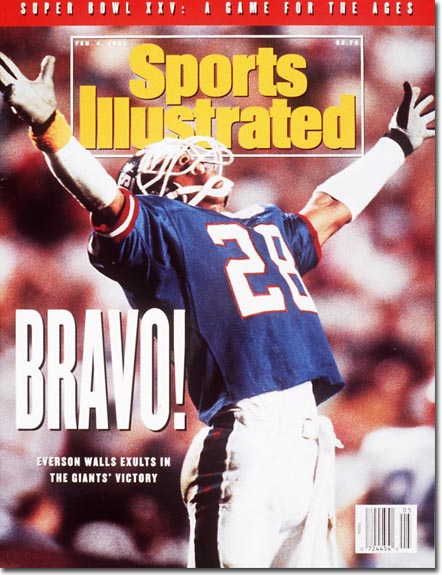
He was forever immortalized on the cover of Sports Illustrated after that game.

Super Bowl XXV Cover Pic of Everson Walls

Two weeks ago, Everson Walls was inducted into the Grambling Hall of Fame.  In recent years this consummate teammate made headlines by donating a kidney to former Cowboy Ron Springs in a gesture that says more about the man than his playing ability. He is an excellent ambassador to the game of football, signing autographs and constantly meets and communicates with fans through social media and Cowboys engagements. However it was his exploits as one of “Thurman’s Thieves” that made it all possible.

Please lend your thoughts as well by writing in to the Pro Football Hall of Fame at the address below. Please be respectful and positively lend your voice:

Please write & nominate #24 Everson Walls
Send letters to:
Pro Football Hall of Fame
Attention Senior Selection Committee
2121 George Halas Dr NW, Canton, 
OH 44708

For induction into the Pro Football Hall of Fame, I present to you Everson Walls

Coaches and players from the past advocated for on Taylor Blitz Times in order:

Robert Brazile 2011 (inducted 2018)

Ran into Robert Brazile after the Gold Jacket Dinner. Great time.


Kevin Greene 2011 (inducted 2016)

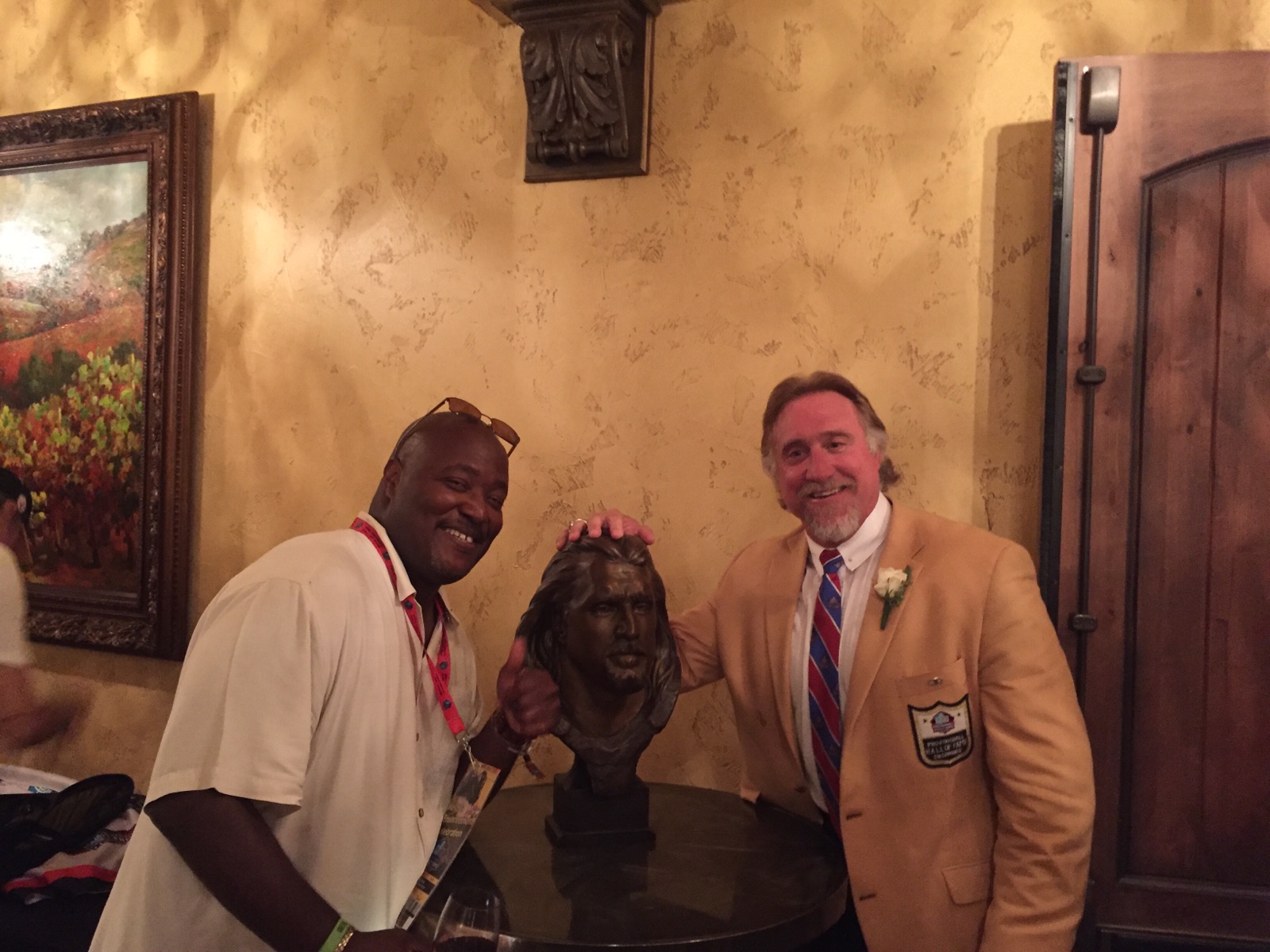
With Kevin Greene after the Induction ceremony.


Sterling Sharpe 2011 (induction Aug. 2025

Terrell Davis 2011 (inducted 2017)

Jerry Kramer 2011 (inducted 2018)

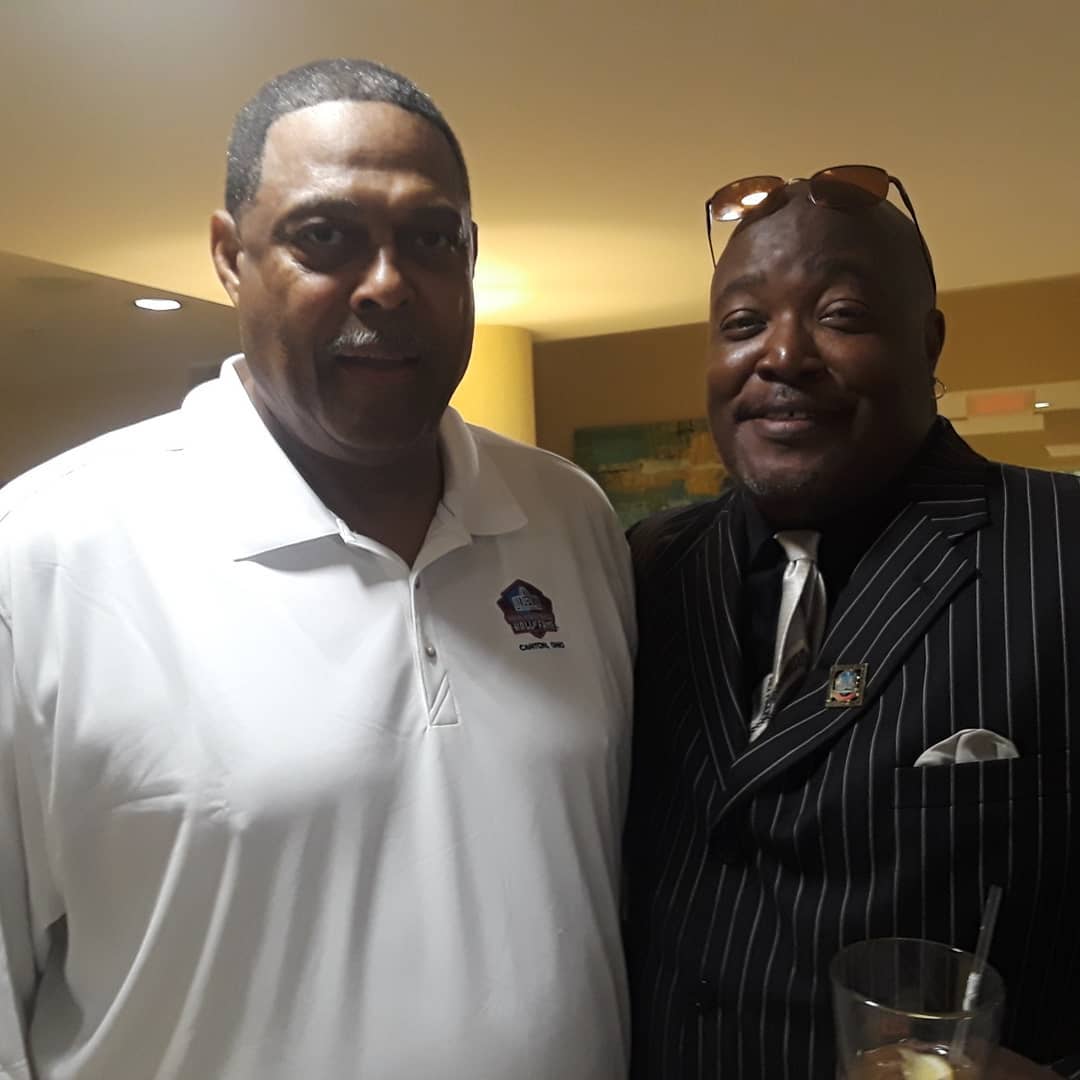
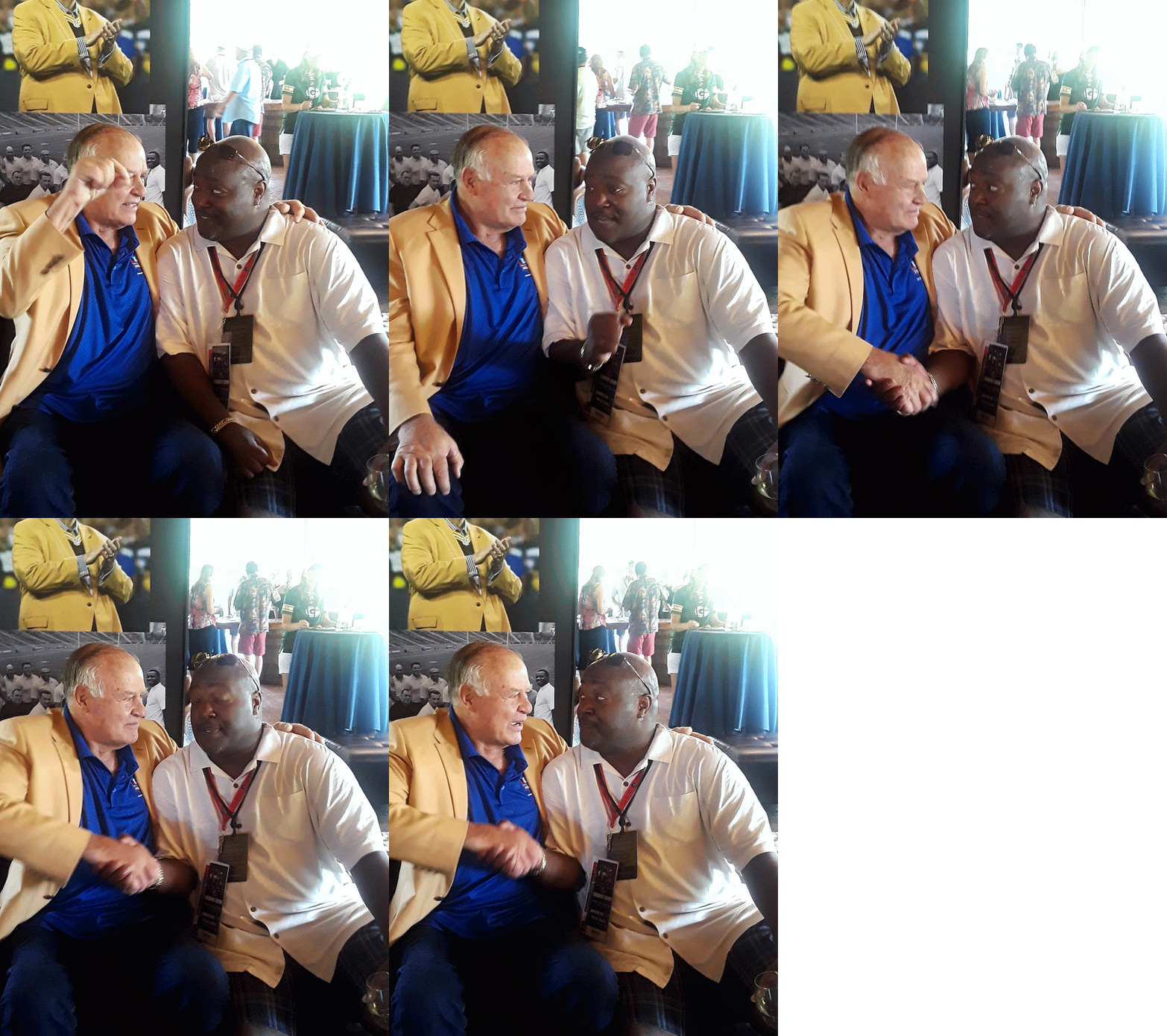
“Hey big guy!” The laughs at the Hall of Fame party were priceless.


Everson Walls 2011

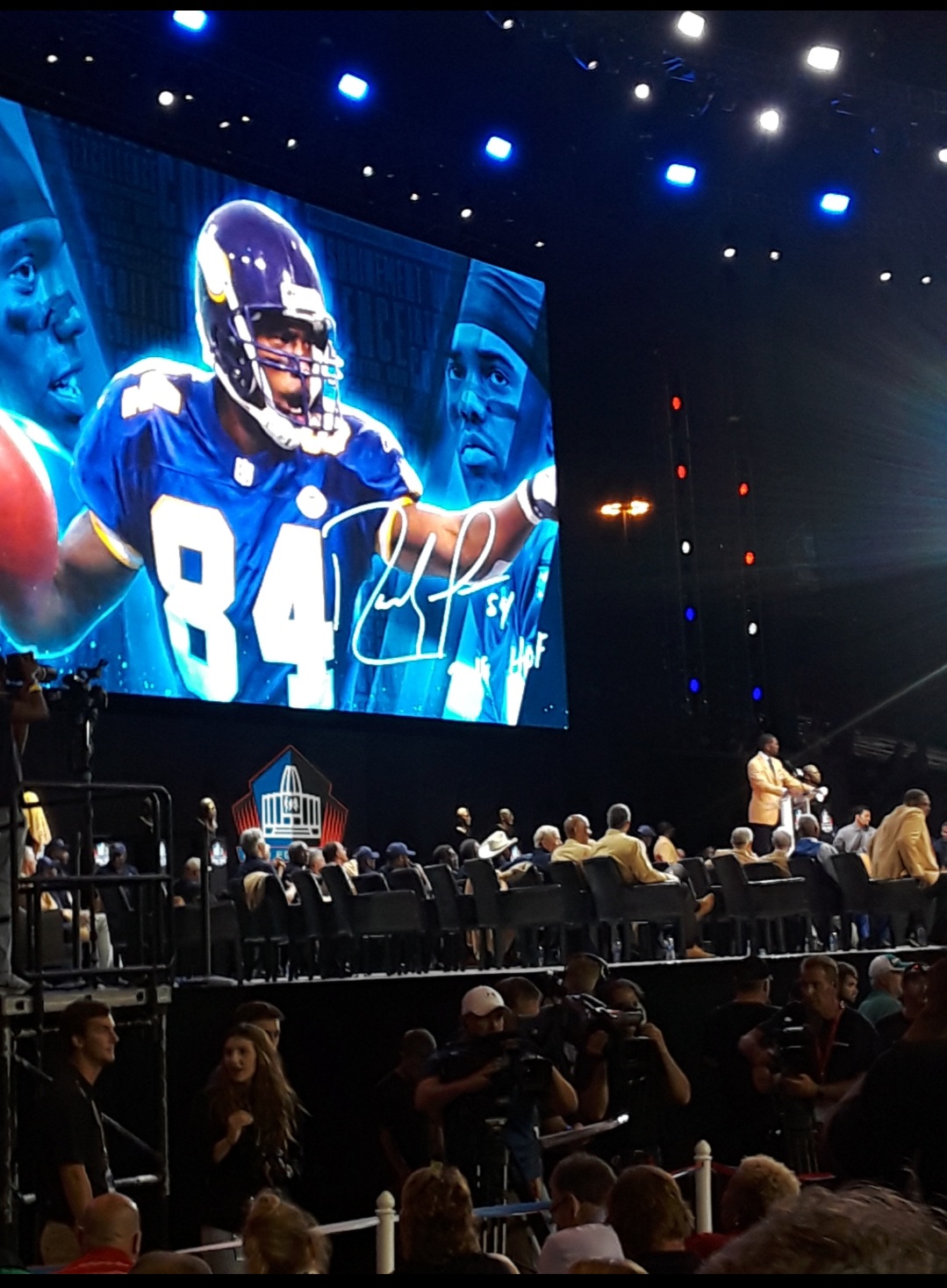
Randy Moss 2011 (inducted 2018)

Cris Carter 2011 (inducted 2013)

Tom Flores 2012 (inducted 2021)

Lester Hayes 2012

Chuck Foreman 2012

Edgerrin James 2013 (inducted 2020)

Andre Reed 2013 (inducted 2014) 

Roger Craig 2013

Corey Dillon 2014

Ken Riley 2015 (inducted 2023)

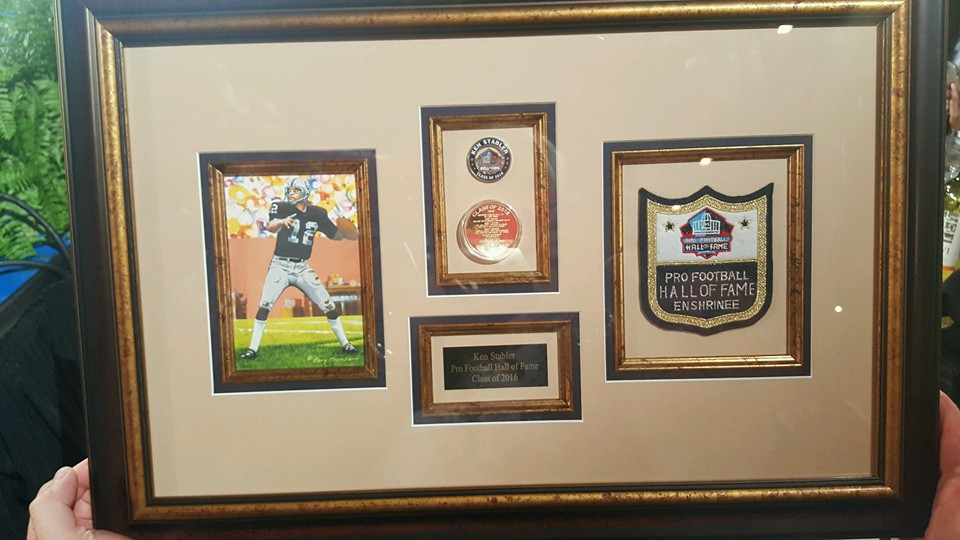
Ken Stabler 2015 (inducted 2016)

Drew Pearson 2016 (inducted 2021) 

Cliff Branch 2016 (inducted 2022)

Todd Christensen 2017

Hardy Nickerson 2020

Wilber Marshall 2024

2011 San Diego Chargers Preview

The San Diego Chargers took their fans on a weird football odyssey last year. In 2010, NFL had some strange twists but do you realize that the Chargers finished #1 in offense AND defense yet finished 9-7 and missed the playoffs?? The last two times we at Taylor Blitz Times can remember that happening was in 1977 when the 12-2 Dallas Cowboys won it all, and the ’87 San Francisco 49ers who were 13-2 and should have won it.

When a team plays up and down to the level of their competition its suffering from a lack of leadership. Direct reflection of Norv Turner who should have been let go for having that much talent & not make the playoffs. Its evident that they played to the level of their competition and weren’t motivated to do away with the lesser teams.

How do you improve on having the best offense and defense in the NFL? How does a team with the second rated passer in Phillip Rivers sit at home in January? The Chargers were the 2nd highest scoring team and gave up the 10th fewest points in the NFL. These numbers and rankings just aren’t adding up.  There has to be a change in the culture of this football team for its psyche is a little off, yet where would you tinker as to not upset the production of the team? Norv Turner is definitely on the hot seat this year and throughout his head coaching career his leadership qualities have always been in question.  He’s shed some of that over the last few years with a trip to the ’07 AFC Championship Game but the team has had enigmatic season endings ever since. So those allegations are resurfacing.

Phillip Rivers handing off to rookie Ryan Matthews

Quarterback: Its sometimes strange in how media covers certain players or why fans don’t readily accept them. Phillip Rivers is on the flip side of the great trade for Eli Manning and is best known for his verbal skirmishes with Jay Cutler when he was a Denver Bronco. From time to time you see him in the face of a defender if he feels he was hit late and gets into it with opponents verbally. To us thats moxie, hutzpah, the type of fire from within that Dallas Cowboy fans would like to see from Tony Romo.  So why is it that Rivers public persona takes a hit for this side of his personality??

When they talk of the NFL’s best quarterbacks his name rarely comes up. Take a look at what he did last year; 357 of 541 for 4,710 yards and 30TDs with 13 int. Yikes folks those are Dan Fouts numbers!! He was the 2nd highest rated quarterback, led the NFL in passing yards and his touchdown total ranked 5th.  Do you realize he also led the NFL with 65 pass plays last year that gained over 20 yards??  He was named to his 3rd Pro Bowl, this time as a starter so maybe perceptions are starting to change. Entering his 8th season Rivers is in his prime and playing some great football.  He’s averaged nearly 31 touchdowns over the last three seasons and seems to be getting better with age.

The natural tendency is to gauge his success with that of his 2004 draft counterparts Eli Manning and Ben Roethlisberger. Now each of them have Super Bowl rings, so that has become the measuring stick for him to be graded by.  As a quarterback he has performed better than the both of his counterparts but without the hardware, he has to get his ring before he’s going to get his due.  May not be fair but perception is reality. He earned his courage badge forever when he limped one legged through the playoffs to the AFC Championship with a torn knee ligament in 2007.  It might be high time for Rivers to take on more of a leadership role yet what he has to have his team avoid falling behind and having to try and rally the Chargers in every game. He is a Super Bowl quality quarterback who might be just one year away from winning his.

Matthews in a 2010 pre season game against Chicago

Offensive Backfield: It took a year for everything to roll over but the Chargers learned that there is life after Ladainian Tomlinson.  After a year in which the Chargers found out the hard way that Darren Sproles was only a 3rd down back, they drafted Ryan Matthews from Fresno State. Last year he teamed with 243lb. butterball ex fullback Mike Tolbert, to form a formidable rushing attack. Tolbert led the team with 735 yards rushing with 11 TDs, while Matthews ran for 678 yards and 7 TDs despite missing 4 games. This year look for Matthews to go over 1,000 yards for the first time in his career.  He runs with power yet has more wiggle than Tolbert and can turn vicious shots into glancing blows.  We expect him to take on the featured role and have Tolbert’s carries diminish in 2011.  Now do we expect Matthews to duplicate the 1400 yards and 18 touchdowns that he and Tolbert combined for?? He’s going to come close. We expect a 1,200 yard 13 TD season this year.

Out of the backfield on 3rd down is where Darren Sproles was best utilized. Last year he gathered in 59 receptions for 520 yards and 2TDs.  Matthews and Tolbert combined for 47 receptions and another 361 yards out of the backfield.  By the time we put in FB Jacob Hester, this team can run out of any formation with either power or speed and should try some Power-I formations to cut down on penalties and  take control of the line of scrimmage early in ball games. They have 3rd down speed to get after linebackers and cause the mismatches that Sproles can turn into first downs. This team is set at running back and Tolbert can take over when Matthews needs a rest or is injured.  Both are young with Matthews in his 2nd year and Tolbert entering his 4th.  They also drafted Jordan Todman out of UConn for insurance.  At running back this team is playoff caliber as a committee. They have the breakout year from Matthews that we’re expecting and they could be Super Bowl quality.

Receivers: When you stop to think that between Vincent Jackson and Antonio Gates, there were a combined 17 games missed in 2010. Despite that the Chargers still finished with over 4,700 yards through the air?? Yikes! Even though he missed 6 games, Gates still made the Pro Bowl after a 50 catch season & scoring 10 TDs.  Once again his yards per reception average ranked up there with those of an outside receiver at 15.6.  However at 30, has he hit the wall when it comes to completing a full 16 game season?

He has been durable in the past in not missing games but he has been on the injury report a bunch with turf toe and ankle sprains over the last 3 years. After 8 seasons as the main “go to guy”, the last 7 with Pro Bowl distinction, has the pounding started to take its toll on Gates?? Keep an eye on this.

Receiving by committee was what the Chargers went through without their best wideout in Vincent Jackson. Emerging from the pack was Malcolm Floyd, who snagged 37 catches for 717 yards and 6 TDs. With Jackson healthy, maybe the Chargers don’t need that other big time receiver as many pundits think they do.  However they took a flyer on hometown product Vincent Brown, a 5-11, 187 lbs. with a 3rd round pick. He is shiftier than the taller, more stiff receivers in Nanee and Floyd who are straight line route runners.  If Brown comes in and contributes this could reduce playing time for former Cowboy Patrick Crayton.  In 2011 Crayton was 4th on the team with 28 catches for 514 yards yet only produced 1 TD. The Chargers need just a little more explosion out of the slot position and Brown could be that guy.

Vincent Jackson’s return is important to the Chargers maintaining mismatches in the passing game. At 6’5, 241 lbs. Jackson is a huge receiver who can muscle most corners. Add to that a 6’5, Floyd and a 6’3 Legedu Naanee and you have a receiving corp that causes serious physical mismatches in speed against linebackers in the nickle or smaller DBs to cover them. Along with Gates this is a near Super Bowl caliber group.

Offensive Line: An individual source of issues can be seen with this offensive line. Although they were number one in total offense, some deficiencies show up here.  However we have to remember San Diego is a passing team or at least they’re perceived to be since they were always scrambling from behind last year. The Chargers were 15th in NFL rushing with 1,810 yards and their 18 TDs ranked 4th.  In 2010, the offensive line did have 12 missed starts mainly at LT and RG due to injury yet the offensive line at RT was manned all season by Jeromey Clary. They drafted Steve Schilling , a guard from Michigan to compete for the RG spot. However when this team ran the football to the strong side, they only produced 22 rushing first downs and on 3rd and shorts/goal line were only successful 45 times. These numbers ranked 30th and 24th respectively. That has to get better so this team can run out the clock and win more games.

Consider the fact that the Chargers dropped back 578 times last year, they weren’t that bad when it came to protection. Rivers was sacked 38 time last year and hit another 68 times. Some of this can be attributed to Rivers penchant for holding on to the ball a little too long. San Diego’s protection ranked 21st in sacks allowed yet only 13th in hits on the quarterback so the protection breakdowns are infrequent. Once they get the right side of the line fortified this group can make it up to average

Defensive Line: Where everyone has been talking about the defenses in Pittsburgh and Green Bay yet this was the number one defense in all of football. This line was the impetus for the Chargers being 4th in the NFL against the run, allowing opponents  only 3.7 yards per carry.  Add to that the very first pick was on DT/DE Corey Liuget from Illinois, whom “Bolts From The Blue” believes will replace Jacques Cesaire at LDE.http://www.boltsfromtheblue.com/2011/4/30/2145940/2011-nfl-draft-san-diego-chargers-selections That may have been true before the lockout but if Liuget starts slow he’ll at least provide some serious depth. Aside from a lack of consistency in his pass rushing (1.5 sacks) we would have a hard time replacing him unless he was clearly outplayed in the pre season.

RE Luis Castillo and NT Antonio Garay hold ground against the run as well as Keisel and Hampton in Pittsburgh. Garay also pitched in with 5.5 sacks which is hard to do facing double and triple teams on the point. On paper this is another above average unit the Chargers field. If they can produce a few more sacks lookout.

Charger linebackers getting fired up!!

Linebacker: Shaun Phillips again went to the Pro Bowl after a solid season. His 55 total tackles was low but his impact was felt elsewhere with his 11 sacks, 7 passes defensed and 1 interception. Almost 20 times forcing a turnover or a punt is tremendous from one defender. The surprise campaign was turned in by inside ‘backer Kevin Burnett formerly of Dallas. He may have been robbed of a Pro Bowl season after a 95 tackle, 6 sack, 2 interception performance. Both Burnett and Phillips returned an interception for a touchdown in 2010. Each are primed to duplicate those performances the first issue is to retain Burnett’s services since he’s a free agent.

As for Stephen Cooper at the other inside linebacker spot, he will be challenged by Jonas Mouton out of Michigan who was selected in the second round.  What is surprising is that there was actually someone on the Michigan football team that could tackle last year?? We didn’t see it but we didn’t watch every game either. Our apologies this was an insurance move that was necessary but we see it playing out that Cooper will start early and then be replaced if Mouton can pick up the defensive sets and calls.  Last year Cooper accounted for 44 tackles in 12 games with 1 sack and an interception. Since he will turn 32 this year his production doesn’t merit what his tenure says he should be paid under the current collective bargaining agreement.

This team is still reeling from the loss of Shawne Merriman. He was their spiritual leader as much as a vocal one and his replacement Antwan Applewhite is serviceable but not the playmaker Merriman was. Alright we’re a little harsh but he did record 46 tackles and 3 sacks in the 13 games he replaced Merriman. At times he could be fooled but you have to attribute that to a lack of experience and he should be less stiff in his play this year. At 26 years of age Applewhite should be in his prime, the question is will they call for him to make the plays they used to ask of Merriman?  Linebacker on this team is slightly above average with a chance to be really good if Mouton shows up ready to play and Applewhite improves with his play recognition.

Antoine Cason making a solid tackle

Secondary: How is this team going to play at the corner with the loss of Cromartie? Remember that question before last season? Quite well thank you. His replacement Antoine Cason had 67 tackles, 17 passes defensed and 4 interceptions along with a forced fumble in a solid all around performance. He outperformed his counterpart Quentin Jammer who had 45 tackles, 11 passes defensed with 2 interceptions.  Understand that this team was #1 against the pass and was the only NFL team to allow less than 3,000 yards passing for the season. These corners are beyond solid.

By the time we make it back to the safeties, Eric Weddle (FS) and Paul Oliver (SS) you have two guys are who are willing to tackle. Weddle was second on the team with 95 tackles.  On a team that produced 47 sacks and a lot of pressure you’d think that the safeties would have more interceptions than the 2 Weddle produced and 1 for Oliver. Yet being the last line of defense they will step up and hit you that much we do know. As a secondary this is a near Super Bowl caliber secondary based on the corners. This might be the best corner tandem in football, rivaling that of Revis and Cromartie in New York.

Overall: Something is missing from this football team and it starts at the top when it comes to motivation.  This team starts too many games slow and then come roaring back only to fall short. In losses last year to the Patriots, Raiders, Bengals, and Rams it was the same thing over and over. The Chargers either didn’t score in the first quarter or first half and then scored in a mad scramble at the end of the game. This team lacks urgency and reminds us of the situation in Tampa right before Gruden took over. We think Norv Turner has taken this team as far as he could take it and the next coach may put them in the Super Bowl.

There is just no way Turner can survive not making the playoffs again with this much talent on the roster. This team might want to take a page from the Buffalo Bills in 1989 to squash their slow starts.  Since they’re so proficient at the hurry up offense, start the game with it to put their opponents on their heels a bit. If this team can get a lead they’re super dangerous. In 8 of their 9 wins, this team scored over 30 points averaging 34 points per game.  This is a Super Bowl champion in waiting. 2012 may be their year the question is will Norv Turner still be there.  This is the best team in the AFC on paper but they will frustrate their fans again this year.

Death Becomes the Run & Shoot on a Monday Night

Single outside receiver site adjustments from the Run and Shoot

Whatever happened to the Run & Shoot as a pro offense?? You remember in the early 90s, when several downtrodden franchises looked to this offense to gain a tactical advantage on the competition.  Atlanta, Detroit, Houston, and Seattle deployed 4 receivers who ran their routes according to how defenses were playing them.  Borrowing on a concept from Bill Walsh’s offense, it was up to both the receiver and quarterback to read the defense, then adjust the route accordingly.

The truth of the matter is for each team with 4 receivers; the 3rd and 4th receivers were better than the opposing 3rd and 4th defensive backs that were normally platooned to cover them.  These teams started racking up yards by the bushel and along with Buffalo’s “K Gun offense”, the zenith of the Run & Shoot was 1991 when each team, except Seattle. who abandoned the offense in 1990, made the playoffs.  The Bills set offensive records for TDs scored and 33TD passes in a season by Jim Kelly.  In fact Thurman Thomas was NFL MVP with over 2,100 combined yards from scrimmage.

Everyone thought of the Bills “No Huddle” offense as an offshoot of the Run & Shoot because of option routes run by Andre Reed in the slot and Thurman Thomas out of the backfield.  Teams had a hard time adjusting and no matter how your corner played any of these receivers, the receiver would change his route and use the corner’s position against him.

For instance if the corner played outside position in a cover 3 zone, the adjustment would be a seam route by the slot receiver, or a skinny post for the outside receiver.  That same corner came up in press one on one, the receiver would try for an outside release and run a fly pattern.   In a cover 2 where the corner was off, he would adjust and run a hook with the underneath receiver running a down and out underneath his pattern, as the outside receiver occupied the corner.  What could a defense do to combat an offense that used your very choices against you?

Enter the NFC East.  This was the division that each team fielded twin 200 lbs. safeties receivers were funneled to. Whether it was Myron Guyton / Greg Williams with the New York Giants, Danny Copeland / Brad Edwards of the Washington Redskins, or the more punishing Andre Waters / Wes Hopkins duo that was on patrol in Philadelphia’s Veteran Stadium.

Where most teams were employing mainly dime defenses that were off the receiver, these teams started fielding nickel and dime defenses with cover two over the top and bludgeoned smaller  run and shoot receivers.  Many pundits look back to the Giants 1990 Super Bowl XXV defeat of the Buffalo Bills and their use of a 2 man line nickle and dime variations to slow down Buffalo’s no huddle / run and shoot tactics.

However thats misleading…the Giants conceded the run to the Bills (see Thurman Thomas’ 135 yards rushing) to set the tone punishing receivers with hits from the linebackers and safeties.  It was more of a victory based on the strong time of possession difference from the methodical Giants offense more than defensive tactics. A 40:31 to 19:29 possession time difference as a matter of fact.  Although Super Bowl XXV, at the end of the 1990 season, did set the blueprint for playing physical defense against this speed type offense.  So when and where was the run and shoot conquered as an offense??

The signature game that signaled the death of the Run & Shoot as an offense, came in week 14 of the 1991 season.  A Monday night matchup where the Houston Oilers hosted the Philadelphia Eagles.  The Eagles as a defense had come to full fruition as a unit originally put together by Buddy Ryan and now run by defensive coordinator Bud Carson.  They had high hopes that 1991 would be their year: they returned ’90 NFL MVP Randall Cunningham and an improving defense, yet torn ligaments to Cunningham’s knee courtesy of Bryce Paup in the season opener, sent the Eagles season spiraling.  Not quite…

A defense that ranked near the bottom in ’88, Buddy Ryan helped their esprit de corp when he drafted only four players in 1989 citing he liked his guys.  The team grew defensively into a giant by 1991 although Ryan was no longer with them.  The defense kept them in games week after week and they came into this matchup 7-5.  Could they best the #1 passing offense in the league? Could they do it on the road?

The Houston Oilers were the vanguard of the run n shoot teams and with Warren Moon had put up the most prolific numbers. In 1990 Moon passed the Oilers to the playoffs with 4,689 yards and 33 TDs.  The most since Dan Marino’s record setting 1984 and he missed 1 full game and time in 2 others.  Along the way he passed for 514 yards against the playoff bound Chief’s #6 ranked defense. Coming within 41 yards of Norm Van Brocklin’s 50 year old record of 554. Alas Moon suffered a broken thumb and missed the Oiler’s playoff loss to Cincinnati.

Going into 1991, Moon was on a near record setting pace again and some thought this, and not Buffalo was the strongest AFC team.  The Redskins were 8-0 and the Oilers 7-1 when they met in a week 8 slugfest with the eventual world champion Redskins. The game was won  by Washington 20-17 in RFK, yet they showed they indeed were ready to stand toe to toe with the best the NFC offered. Going into the Monday Night tilt against the beat up Philadelphia Eagles at home, many thought the Oilers juggernaut offense would roll in this game too.

What took place over the next three hours was one defensive masterpiece that many defensive affecionados remember reverently to this day. The Eagles employed a 4-2-5 nickel variation with OLB Seth Joyner and MLB Byron Evans, who was lanky for a middle backer yet had great range, for most of the night.

Occasionally they’d bring in the dime defense (6 defensive backs) yet what they did differently was press the receivers and blitz off short corners. The hitting was vicious with Wes Hopkins and Andre Waters leading the way.  They knocked out both Ernest Givins and Drew Hill out of the game twice each. The first vicious shot was a dirty elbow from Wes Hopkins that broke Givins nose, yet set the tone for the night.

Joyner played his way to the Pro Bowl and almost the Hall of Fame that night with 2 sacks, a forced fumble and a fumble recovery to keep the game close.  Reggie White, Jerome Brown (The U), Mike Golic, and Clyde Simmons swallowed Allen Pinkett’s attempts to run holding the Oilers to a paltry 21 yards rushing for the game.  They also provided a serious rush that they supplemented with the occasional blitz that beat Houston into total submission before a stunned audience of millions. When dime back Otis Smith’s thunderous hit on Drew Hill, on an outside swirl route, forced Houston’s fifth fumble of the night. The rest of the league were on their second tablet from taking notes. The Eagles won 13-6 in front of a shocked audience.

Early 90s pic of Eagles L-R: Clyde Simmons, Eric Allen, Jerome Brown, Seth Joyner, and Reggie White

The beating was so decisive it ruined the Oilers season and this game was the complete blueprint on how to stop the run and shoot. Going into the game the Oilers were averaging 307 yards passing, just off pace needed to break Marino’s passing record, yet staggered away from this game only averaging 232 the rest of the season. The 226 they gained through the air against the Eagles was their season low.

The average was also down for the Falcons and Lions over the last 4 weeks of the season as well. The Oilers went down in the divisional round of the ’91 playoffs 26-24 to Denver, and the lone run n shoot playoff winner was Detroit who went on to whip Dallas 38-6. In fact the Cowboys had lost 4 games to run n shoot teams in 1991. The next year the Cowboys drafted a rangy MLB Robert Jones, in a Byron Evans mold, and brought in CB Kevin Smith, SS and former rangy college linebacker Darren Woodson, to stop those offenses the next year. The first of their 3 Super Bowl wins in the 90s and it started with that 1992 draft to mimick what the Eagles fielded in 1991.

As for the run n shoot, its effectiveness was diminished and the race for the record book was over.  In 1991 Houston passed for 4,621 yards where in 1992 that number dropped to 4,029. In ’92 neither the Lions or the Falcons came within 3 games of the playoffs and the Lions and Bills started to alter their offensive approach. The Oilers along with the Falcons ran the offense until 1993, yet the Falcons never returned to the playoffs…and the Oilers?? Well they went into the 1992 wildcard and took a 28-3 halftime lead on Buffalo who was playing with 6 & 7 DBs on the field.  Warren Moon at the half was 19 of 22 for almost 300 yards and 4 TDs and ballooned the lead to 35-3.

In the 3rd quarter, the Bills decided to play it the same way the Eagles had in ’91 inserting rangy MLB Carlton Bailey #54 and Darryl Talley #56 and they shut Houston down in the second half enroute to the greatest comeback in NFL history winning 41-38 in OT. Couple these landmark events with the system’s inability to score in the red zone and the run n shoot’s fate was sealed.  Even now the run n shoot receiving principles of WR route running based on options lives on in playbooks, just not in a 4 receiver set, nor as an entire offensive approach.

As for the Philadelphia Eagles defense that was the architect of the run n shoot’s demise? They went on to become the last great defense to finish #1 against the run, #1 against the pass, and #1 overall.  A distinction the ’85 Bears, ’86 Giants, ’76 Steelers, ’78 Steelers, ’08 Steelers, nor ’00 Ravens could match.  They finished the season winning 7 of 8 games and finished 10-6 and narrowly missed the playoffs.

The combined quarterback rating for their final 6 QBs was less than 40.0, and their principle line rushers R. White, Jerome Brown(The U), and Clyde Simmons combined for 37 sacks (which if they played last year would rank 11th in the NFL by themselves), and all 3 were Pro Bowlers and 1st team All Pro. Seth Joyner and Eric Allen earned Pro Bowl distinctions in 1991 as well.  They don’t receive the recognition of those other great defenses because they didn’t win the Super Bowl. Who would have operating with 5 different starting quarterbacks? They were one of the best defenses in NFL History.  Had Randall Cunningham not been injured…

Prologue: The impact of the players of this era in Eagle history were felt throughout the decade…

Reggie White-Became the main prize in 1993’s free agent derby, signed with Green Bay and went on to become the NFL’s all time sack leader. Recorded 3 sacks in Super Bowl XXXI when he became a champion with Green Bay along with former Eagle TE Keith Jackson. They bested the New England Patriots who had former Eagle RB Keith Byars and CB Otis Smith on the team. White passed on the week of Christmas 2004 which cast a pall over the playoffs that year. He was inducted into the Hall of Fame posthumosly in 2006. RIP Reggie White.
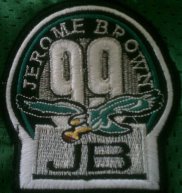
Commemorative patch worn by the 1992 Philadelphia Eagles in Jerome Brown’s memory.

Jerome Brown– An all pro talent who passed away the following June. He’s still one of the most beloved Miami Hurricanes and missed by Hurricane fans everywhere. The 1992 Eagles dedicated their season to his memory and wore this commemorative patch on their jerseys the entire season. They also kept an equipped locker for him throughout the season and set it up on road trips also. His locker was with the ’92 Eagles in the Superdome as they won their first playoff game in 15 years.

Brown was the predecessor to fellow Hurricanes DTs Cortez Kennedy Russell Maryland, and Warren Sapp. Kennedy, who changed his number to 99 in honor of Jerome and went on to win NFL Defensive Player of the Year in his honor in 1992 while playing for the Seahawks. Every Hurricane playing in the NFL during 1992 wore a black #98 on their helmet that year including several that played for the Dallas Cowboys. The next time you watch Super Bowl XXVII where Dallas beats Buffalo you’ll see the black #98 on the back of many helmets. Jerome was alos the inspiration and reason former Hurricane Warren Sapp wore #99 during his entire NFL career. R.I.P Jerome Brown

Seth Joyner & Clyde Simmons– Were twin free agent prizes that signed with Buddy Ryan and the Cardinals in 1994. I wrote the Buffalo Bills organization and suggested we grab Simmons and Joyner to join Bruce Smith and Cornelius Bennett to fortify our defense to get to our fifth Super Bowl…yet I digress Joyner went on to join White with the Packers (1997) in their bid to repeat as champions yet they lost to Denver in Super Bowl XXXII.

Well if you can’t beat ’em, join ’em, and when Denver (1998) went on to become back to back champions a year later. Seth Joyner was a Bronco and guess what number he wore?? Number 99. He is a motivational speaker in Arizona now http://sethjoyner.com/ runs youth football clinics and is a coach himself. Just launched his show and podcast “The Seth Joyner Show” where you can hear his commentary along with a host of former Eagles.


Eric Allen– Played on through the 2001 season finishing with the Raiders. A popular notion is he should have been 1993’s NFL Defensive Player of the Year for his 64 tackles 6 interception performance in which returned 4 of them for touchdowns.  The most famous being a 91 yard interception against the Jets. After weaving his way into the endzone, he handed the ball to teammate Randall Cunningham who was on crutches having been injured earlier in the game. His last game as a player was the famous “Tuck Game” in New England in the 2001 playoffs. Former teammate Otis Smith was a Patriot CB. He’s currently an ESPN analyst.

Byron Evans-Played 8 years with the Eagles through the ’94 season and was an underrated talent. Has an internet radio show he does with former teammate CB Mark McMillan on the Voice of America Network. http://www.voiceamerica.com/show/1475/hard-hittin-radio

Andre Waters– The hard hitting safety went on to join Simmons and Joyner in Arizona for the ’94 and ’95 seasons. He had gone into coaching yet passed away in 2006 R.I.P. Andre Waters

Otis Smith-Was an Eagle dimeback in ’91. He went on to be the wily CB for a veteran laden Patriot team that lost Super Bowl XXXI to Green Bay. Yet was a Patriot 5 years later man handling Tory Holt and Isaac Bruce to stop the Greatest Show on Turf as he became a champion in Super Bowl XXXVI.

Mike Golic– finished his career with Miami and is half of the popular duo Mike and Mike on ESPN television and radio in the morning.

Taylor Blitz Times new logo!!

Taylor Blitz Times new logo!!

2011 Dallas Cowboys Preview

For the Dallas Cowboys, 2009 began with the optimistic view of becoming the first team in NFL history to play in the Super Bowl on their own home field. The reality was that their roster wasn’t dynamic enough to fulfill these expectations and they hadn’t adequately replaced Flozell Adams who had departed at Left Tackle.  Subsequently Tony Romo ran for his life until an injury finished his season. Although the Cowboys won 5 of 8 games to finish the season, it makes you wonder how close are they really?  Are they a few players away as Jerry Jones and company would like to make us think?  Was the improvement shown toward the end of the season a product of Jason Garrett’s coaching or from the fire lit under everyone’s ass when they learned they were all expendable??

Tony Romo

Quarterback: Going into his fifth season as the starter, the Cowboys have a good quarterback in Tony Romo.  So much is made of what he does off the field that many Cowboys fans don’t recognize he owns all the significant passing records in team history. He’s thrown for twice as many 300 yard passing games as Troy Aikman.  Get this: In 2009 he threw for 4,483 yards and 29 TDs, had he not thrown for 36TDs in 2007, those would have both been Cowboy records as well.  He has a good arm and can deliver the football from the pocket or on the run.  His dropback is fluid and he moves effortlessly when he escapes the pocket.  Also he needs to show more daring, when its 3rd and 10, throw to the second level and get the first down and not some 3 yard dump off that achieves nothing. Physically he has the tools to be a great quarterback.

Psychologically, Romo hasn’t shown to be the inspirational leader that the Cowboys hoped he’d be once they released Terrell Owens.  He hasn’t dropped his “aw shucks” persona and taken on that of a field general. The type of generalship that Jon “Cockroach” Kitna showed in those last 8 games. You saw him pleading, cajoling and getting in teammates faces, especially after dumb penalties, and played ball from his gut. Last year he completed 209 of 318 passes for 2,365 yards, 16 touchdowns and 12 interceptions. Kitna’s 65.7% completion rating was the best of his 14 year career.  Project those numbers over a year and thats a Pro Bowl season. The best he’s ever played and a solid backup.

The best way to get to Romo is to come with delayed blitzes. When he senses the outside rush coming, he’s quick to step up through the gaps looking for space to run or throw. In self scouting you can see the Cowboys are aware of this and they run a lot of draws and delays to the running backs to make it all look the same.  Keep defensive ends from coming up the field too quick and opening those gaps between themselves and the inside rushers. Another thing is to keep putting hits on him, there are times Romo will look down at the rush if hit or sacked early. Its yet to be seen if his game changes any coming back from a broken clavicle. Will he be willing to take those hits??However, Dallas is very good at quarterback.

Offensive Backfield: Dallas has the best set of 3rd down backs in the league in Tashard Choice and Felix Jones. The problem is what to do on 1st and 2nd down. Early last year an astute Cowboy fan, Gary Bumgarner, suggested that Marion Barber had really slowed down.  The eyeball test didn’t lie. Amazingly over the last 3 years Barber has only averaged over 4.0 yards per rush (league avg.) in only one season. Last season he ran for a paltry 374 yards while scoring 4 TDs.  Surprisingly he has not run for more than 1,000 yards at any point of his career.  He has run hard, with heart and great determination, but he seems to be this generations Wilbert Montgomery and has beaten the ability from his body early.  Along with his high salary and the drafting of DeMarco Murray, we at Taylor Blitz Times think he will be cut before the season.

Felix Jones had his best season while taking over for Barber.  He rushed for 800 yards on 185 carries but only scored 1 touchdown.  His average per carry was good (4.3 yrd avg) but his touchdown total tells the story.  He and Choice are space players, neither have the heft to knuckle up and get that 3rd and 2 or power in from the two like Barber could.  Since Felix Jones is supposed to be a homerun hitter, he should have been able to break an arm tackle and take it the distance 4 or 5 times last year wouldn’t you think? Or at least in space, right? Well, out of the backfield Jones had 48 rec. for 450 yards and again only 1 TD.  Thats 233 touches of the football and only 2 TDs for a breakaway threat?

Choice seemed like the odd man out last year, carrying the ball only 66 times for 243 yards and 3 TDs. At 5’11 and 212 lbs, Choice should be the starter with Jones as the 3rd down back. Can Choice take the pounding? He did run for 100 yards in a week 13 win over the Colts in a 38-35 overtime thriller. Yet between Choice, Jones or 3rd round pick DeMarco Murray none seem to thrive running between the tackles. So if Marion “The Barbarian” gets released who is going to run the football in goal line and closing situations? Running back is below average for the Cowboys until someone emerges and the pick of Murray was a puzzling one for us.

Receivers: This is where the Cowboys are in the best shape of any unit. Once the Cowboys were out of contention they started to put Dez Bryant in different situations to see what he could do. Bryant came in as a rookie and played with fire and flair, who knew at 6’2 225lbs he would be a good kick returner? He averaged 24.4 yards on 12 kickoff returns and a whopping 14.3 on punt returns, taking 2 back for touchdowns on only 15 attempts. Do you realize projected over a complete season those would be NFL leading numbers in both categories? Throw in his 45 receptions for 561 yards and 6 touchdowns and what do you have? The bench for a certain Roy E. Williams. Look some players just have the it factor and this kid is it.  He plays like he wants it and if I were Jason Garrett I’d sick him on defenses 15 times per game. He’s tall, muscular, fast and can jump. The first of many Pro Bowls should come this year with his first 1,000 yard season. Don’t be surprised if he goes over 80 catches for 1,300 yards and 12-15TDs. Terrell Owens has finally been replaced.

How can we be so high on Bryant? Well the first part of that equation is his skill set and the second is he’s teamed with Pro Bowlers Jason Witten (94 rec. 1,002 yds 9 TDs), and Miles Austin (69 rec. 1,041 yds 7TDs). Yikes! This is not going to be easy for anybody to defend. Witten is the best tight end in football. A solid blocker who at TE has the heft to muscle safeties and the speed to get over back pedaling linebackers.  Thats two straight years with 94 receptions and with another season like that will have crossed 715 receptions in his career. Guess what? The all time reception record for tight ends is within reach. He was a Pro Bowler for the 7th time and was first team All Pro for the second.

Which brings us to little Miles Austin. Of course we’re kidding here but at 6’3, 215lbs. he is the smallest of the two receivers. So coming up and jamming these guys is going to be difficult. Austin didn’t have quite the year he had in his breakout 2009 campaign but he had to deal with teams really game planning and paying attention to him and had to work with backup Jon Kitna at quarterback. Still he crossed 1,000 yards and made the Pro Bowl a second time. Reminds me of Andre Reed the way he runs after the catch and unlike many receivers you can’t arm tackle him. With Austin, the hope is he keeps playing with that chip on his shoulder. The practice squad guy who finally made good and not fall into that celebrity dating nonsense to get his mind off of football.

What? Oh Roy Williams with an “E” could work out as a really good third receiver to help stretch for first downs.  Are you seeing what we’re seeing? This is shaping up to be one of the best receiving corps since the 2007 Patriots. We already told you the Cowboys have a good quarterback who owns the 2 highest touchdown marks passing in Cowboys history at 36 and 29. If Romo comes back healthy… Lets just say that at WR & TE, this is a Super Bowl caliber group.

Offensive Line: Where the Cowboys did their best work on draft day.  They brought in T Tyron Smith out of USC with their 1st round selection, then snagged G David Arkin of Missouri St. This offensive line did benefit early on with Tony Romo scrambling. That kept the sack totals down yet they did surrender 31 which was 11th best.  It was the 73 hits, 17th allowed, that is unacceptable and sidelined their quarterback for the year. Although they were 16th in rushing with a 1,786 yards in 2010, the Cowboys struggled to push when they needed to.  Critical 3rd and 2 power plays saw the marginal success of 59  1st downs up the middle and only 44 times to the strong side which ranked 23rd and 25th respectively. Terrible.  What is surprising is that C Andre Gurode was a Pro Bowl selection in 2010.

The Cowboys drafted Smith #1 for him to go into the lineup. They may have finally replaced Flozell Adams if he can beat out incumbent Doug Free at LT. Arkin or 7th round pick  C Bill Nagy should push to make both guard spots. Too much improvement is needed at the guard spot for at least one of these rookies to get into the starting lineup. Most likely would be Larkin.  By addressing their offensive line in the draft and watching the Packers win the Super Bowl with several young linemen, they should be influenced to go young and live with the consequences.  They worked their way up to average with a chance to be good on the offensive front.

Defensive Line: This team needs to pick up a few free agents to solidify themselves on the defensive front. Defensive ends Igor Olshansky, Marcus Spears, and Stephen Bowen combined for 1.5 sacks in 2010. Before you say ‘well they are there to tie up blockers and not give ground in the Cowboy 3-4’, they were 12th in the NFL against the run and gave up over 4.3 yards per rush, which ranked 17th.  Thank goodness Jay Ratliff had a Pro Bowl year by not giving up too much ground in the middle or this defense could have finished dead last in all of football. Seriously. Ratliff provided the only push from this unit recording 3.5 sacks where opposing lines could concentrate on him. He needs help. Not signing any defensive help yet, we have tho give the Cowboys a below average grade here.

All Pro OLB DeMarcus Ware

Linebacker: This defense begins and ends with DeMarcus Ware, NFL sack champion for 2010.  His 15.5 sacks was the only consistent element on the defensive side of the football for the Cowboys. He’s simply a beast and its imperative that they get some pressure generated elsewhere and he may have a shot at the single season sack record.  However at times it seems that he can disappear in games yet its a misnomer. Teams game plan for him and are sometimes successful.  Imagine what he could do with a bookend to relieve him of some of the double and triple teams? With all this attention he still has been the All Pro (3 times) and Pro Bowl (5 times) performer out of Troy that Bill Parcells envisioned. He’s the best outside linebacker in the NFC.

Toward the end of the season Anthony Spencer started making some plays and was the most improved defender on the team. He amassed 63 total tackles, had 5 sacks and forced 2 fumbles. Bradie James and Keith Brooking  manned the inside linebacking spots. James led the Cowboys with 118 tackles, had 2 forced fumbles and 1 interception. A solid performance.  Brooking has proven to be the team’s inspirational leader and was second on the team with 97 tackles and had 1 interception. A player that made a splash in 2010 was linebacker Sean Lee, especially against the Colts and Peyton Manning.  He picked him off twice and had a pick six in that game while making several splash plays against the pass and the run.  He finished the season with 25 total tackles in a relief role and those 2 interceptions with 1 forced fumble.  If James or Brooking go down during the season this kid can fill in without a drop off. The linebacker play in Dallas is well above average.  They need the line to keep blockers off of them better.

Secondary: At first glance you want to lambast this secondary for the dismal 26th ranking against the pass yet this is a two fold issue. If the secondary was so bad why did they snatch 17 of the team’s 20 interceptions?? Sure there is some improvement needed at the corner position where Mike Jenkins has regressed from his play a few seasons back and tallied only1 interception. He has to improve, no make that he better improve http://bleacherreport.com/articles/686084-dallas-cowboys-2011-draft-report-card-grades-for-all-eight-draft-picks has high regard for 5th round draft pick Josh Thomas from the University of Buffalo. He will push both Jenkins and Newman (whom Cowboy fans have wanted replaced for 100 years now) for a starting spot.  We say that because its going to be hard to move Orlando Scandrick.  He was very effective as a blitzer and a nickel back.  He made 2.5 sacks, 45 total tackles with 8 passes defensed, nearly matching  Jenkins production of 55 tackles, 9 passes defensed with a single interception.

At safety Gerald Sensabaugh led the team with 5 interceptions, tied with Newman for the team lead.  He seems a little stiff in his backpedal but that is normally the case with most strong safeties.  Free safety is where we and other pundits feel the Cowboys can improve their secondary’s skill set.  Watch out for possibly a Darren Sharper signing to put more moxie into their secondary if he comes available.  Incumbent starter Alan Ball only defensed 4 passes and had just 1 interception.  He had plenty of opportunities while team’s racked up 3,894 yards passing last year.  A little more pass rush and this secondary would be decent.  Without it and we have to say slightly below average.  If Ball starts playing with instinct and can be more of a factor against the pass they can rate as good.  Right now have to stay with the present ranking.

Overall: Upon further review, the Cowboys don’t really want to run. Not in the traditional sense and the drafting of another space back is evidence of this.  They are going to throw the football and run off of draws and screens. What rugged NFC East?? With the New York Giants and definitely with the Philadelphia Eagles taking more to the air, Dallas is going to be throwing out of 3 receiver sets heavily.  Expect every passing record in team history to fall in Dallas this year.

Romo should throw for nearly 40 TDs this year if they stay as they are with the running back personnel. The problem is: Did they do enough on defense to improve on their overall ranking of 17th??  Taylor Blitz Times doesn’t think so and Dallas is going to be involved in shootouts and will win most of them.  The best they can expect is a 10-6 season where they will be fighting for a wildcard playoff berth.

They are too deficient on the defensive line to improve dramatically against the run and in goal line. Garrett is going to take to the air and Jerry World will look like the Transworld Dome of the Rams in ’99. Ask yourself this one fundamental question… You are the defensive co-ordinator facing Dallas on a 3rd and 7. They come out with a three receiver set: an explosive Antonio Bryant, a Pro Bowl Miles Austin who excels after the catch, an All Pro TE in Witten, with a 6’4 Roy E. Williams next to him, and Choice in the backfield. Who are you going to gear toward??  Points will ring up in Dallas…count on it.  Playoffs?? Hmmmm??