Legendary Days: The 1990 NFC Championship Game – The Death of Camelot 35th Anniversary Today!

Leonard Marshall clobbers Joe Montana and knocks him out of the 1990 NFC Championship Game. He doesn’t return to action until the final game of the 1992 season against the Detroit Lions.

Reissue of Original Piece 24, July 2018

There is an old axiom when it comes to boxing when you hear someone say “styles make great fights” meaning opposing styles colliding provide great theater. Never was this more evident when it came to the San Francisco 49ers and the New York Giants of the 1980’s. The identity of the men from Gotham was a blood thirsty defense led by Lawrence Taylor, arguably the greatest defensive player ever. Joe Montana had ascended to legendary status as he led the NFL’s most efficient offense to 4 Super Bowl titles that decade. They would meet in a fitting crescendo that still has ramifications to this day.

If you travel to 1978 the Giants and 49ers met in what was a forgettable season for both. New York won 27-10 out in Candlestick during the season’s 4th week. They only won 3 games the rest of the stanza while San Francisco only won twice. Both began by hiring coaches in 1979 in Bill Walsh and Ray Perkins which set the course as each regime rose to prominence in the decade to come.

The next step was the selection of franchise quarterbacks, first Phil Simms in New York in round one then Joe Montana in the third. Each turned to the draft for the same spark on defense a few years later when the Giants selected LB Lawrence Taylor and Walsh’s selection of FS Ronnie Lott both in the 1st round in 1981. Both would later be enshrined in Canton.
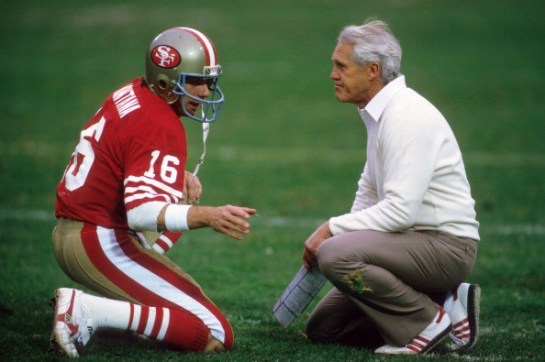
Walsh and company ended an 8 year playoff drought with a 13-3 record and homefield advantage as Montana and company had come of age. New York defeated Dallas 13-10 to earn their first trip to the NFL postseason in 18 years. Then after a 27-21 upset of the defending NFC Champion Eagles in the wildcard round, New York was one step away from the NFC Championship Game and traveled west to face San Fran.

Going into the game the question was could NFL Defensive Player of the year Lawrence Taylor get to Joe Montana?? Could the finesse passing game take down the Giants’ hard rock defense??

Walsh’s team was shattering the NFL paradigm by passing first to set up the run. Contrary to popular belief was the fact it was San Francisco’s defense ranked #2 to the Giants at #3.

Montana was 20 of 31 for 304 yards for 2 TDs in a 38-24 win under the lights in Candlestick. Next came the NFC Championship with Dallas & The Catch, then a Super Bowl XVI victory and all the prestige that came with it. Walsh became the toast of the league and christened with his “genius” label. Joe became one of the faces of the NFL and would be one for the decade of the 1980’s.
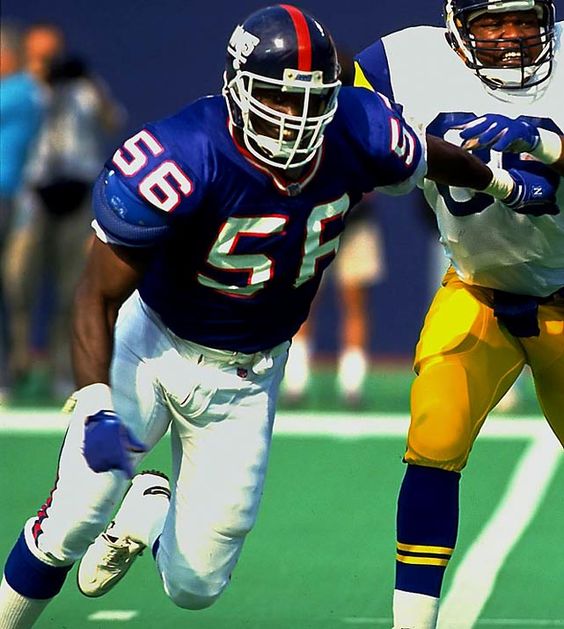
The vanquished?? Well New York Defensive Coordinator Bill Parcell’s unit collapsed giving up a season high 38 points. They had only given up 30 once the entire year up to that point. As is the case when teams come up short in the playoffs, they’re knocked off kilter for a couple of years.

Parcells succeeded Perkins after a 4-5 season in ’82 and was nearly fired after a disastrous 3-12-1 rookie year in ’83. Yet all the while Walsh was one of the NFL’s marquee coaches and his 49ers bounced back and came within a couple penalties from winning the NFC Championship a 2nd time in 3 years. They fell to Washington 24-21 yet the media further spread the moniker they anointed Walsh with….”genius.”

Parcells bristled at the attention Walsh and the 49ers “finesse” approach to the game was getting. It only intensified in ’84 as they went 15-1 and threatened to go undefeated. New York rebounded as Phil Simms finally emerged from the shadows and became a 4,000 yard passer and the Giants returned to the playoffs. Another NFC playoff loss to Joe and the Niners 21-10 relegated the Giants to the NFL’s jr varsity as Walsh and Joe went on to hoist another Lombardi trophy.

However over the years Parcells kept building a team of brute force. Although they had been effective he drafted 6-4 250lb OLB Carl Banks who was a blue chip strong side ‘backer. Brought in 288 lbs DE Leonard Marshall to replace a 259lb Gary Jeter. He kept building upon his defense and relying on a straight forward power rushing attack.

Finally in the 1985 playoffs, the Giants #2 ranked defense held Montana and the 49er offense out of the endzone for the first time in a 17-3 Wildcard win at home. For the first time ever Parcells and the Giants beat the Niners in the 80’s and in the locker room he scoffed “What do you think now about that west coast offense?” In a bit of irony he wound up coining the name Walsh’s offense would come to be known forever.
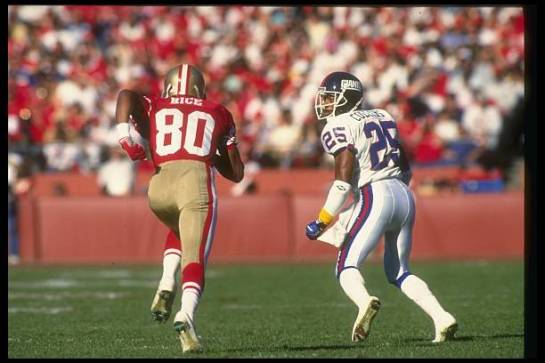
However the Giants were manhandled in Chicago 21-0 to the eventual champion Bears. Both teams were built in the same old school fashion. You win with brute force on the line of scrimmage with a heavy front 7 and a strong offensive line with an offense that relied on the run. Yet the Giants sent alarm bells off all around the NFL when they already had a strong defense yet spent their first 6 picks in the first 3 rounds all on defense.

They fortified their defensive line with 6’4 280 lbs DE Erik Dorsey, NT Eric Howard who stood 6’4 275, 250 lb ILB Pepper Johnson along with crafty CB Mark Collins who was nearly 5-10 200 lbs. Collins turned into one of the Giant defense’s greatest assets as he blanketed Jerry Rice and was the best in history covering him. This gave the Giants a tremendous advantage for years to come.
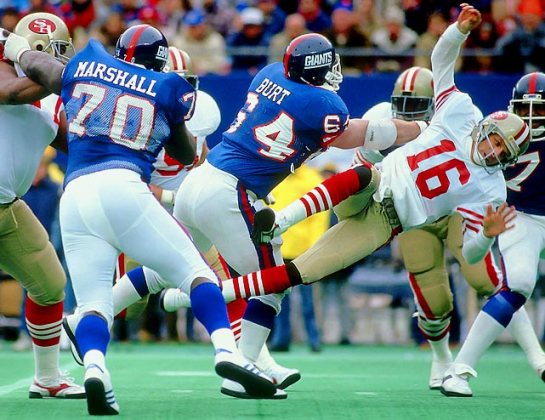
Jim Burt knocking Joe Montana out with a concussion in their 49-3 rout in the ’86 playoffs.

In the ’86 playoffs the Giants defense had come of age and starting with a 49-3 devastation of San Francisco in the NFC Divisional Round, it became clear the pendulum had completely swung. Jim Burt knocked Joe Montana out with seconds to go in the 1st half as Taylor returned an interception 34 yards to balloon the score to 28-3. In an embarrassing fashion Walsh’s squad was hammered into submission. Physically beat down unlike any game they had seen since they became one of the league’s elite a few years before.

This forced the 49ers to finish what they started in the ’85 draft fortifying their lines with bigger players to deal with the Bears and Giants. It came to fruition as the Niners went on to win Super Bowls XXIII and XXIV after the ’88 and ’89 seasons. Walsh had stepped down after the XXIII championship and former DC George Seifert took over head coaching duties. Offensive Coordinator Mike Holmgren began to be recognized as the 49er offense elevated their play to one of near perfection. Walsh’s legend only grew even in his departure for creating the offensive system which allowed his 49ers to become the team of the decade.

Going into 1990 pundits were debating not only were the 49ers the best ever team but was Joe Montana the best ever quarterback?? The same could be said of Jerry Rice as he had assaulted the record books and also had been a Super Bowl MVP. On their way to back to back championships they had set the NFL record with 18 consecutive road wins. Now they had the chance to win 3 straight Super Bowls where it would leave no doubt. They began the season with a 10-0 record and…

Waiting for them who also began 10-0 was the Giant team that had learned how to win from the 49ers and had taken it up a level. Now the more powerful rebuilt 49ers who had a 2-3 record (0-2 in the playoffs since ’85) staring them down. Were they lucky they hadn’t met the Giants in the playoffs in both ’88 and ’89?? Would they even have won back to back had New York had a shot at them??

The Chancellor definitely doesn’t think they would have.. yet I digress

In week 12 each team was 10-1 when they met in San Francisco on a Monday Night. In the 2nd highest watched MNF in history the 49ers beat the Giants 7-3 in a slugfest where the Giants inability to score a touchdown on offense did them in. In 3 shots inside the redzone they could only score 1 field goal. Yet to a man the Giants relished another shot at San Francisco. Finally they would have their chance in the NFC Championship Game. For the decade the playoff record between the two stood at 2-2 and they would meet in the last chance to halt “Camelot’s” greatest procession into history.

In the collective gasp after the Leonard Marshall hit you knew everything had changed. The silence that befell Candlestick Park as Montana writhed in pain for several minutes was palpable. Unlike most games where the network would take a commercial break, a nationwide audience sat glued to the football version of a tragic event. The greatest quarterback whose nimble feet that deftly dodged trouble in and out of the pocket forever in January’s past had been viciously taken down. The Camelot Bill Walsh so eloquently stated of that era ended in that moment.
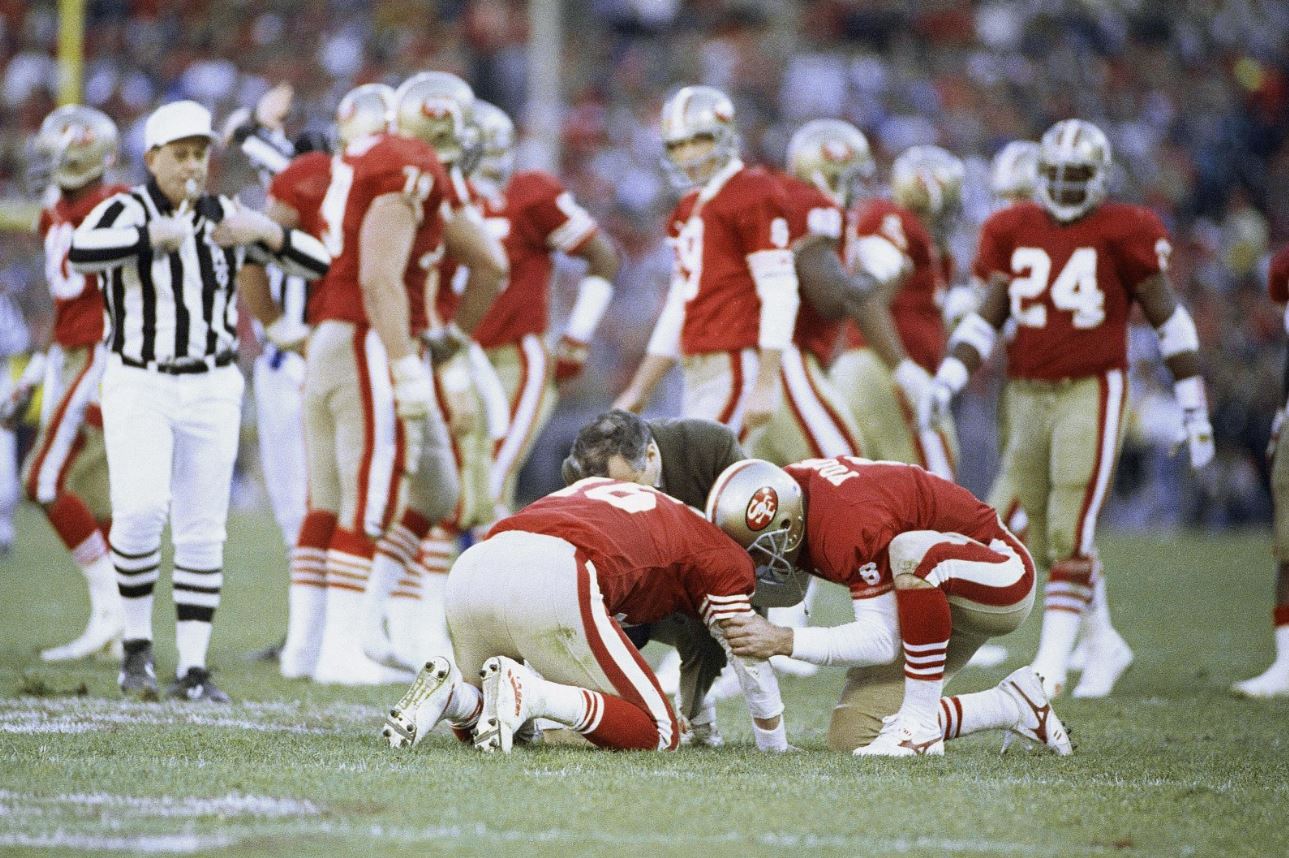
The final kick by Matt Bahr for the 15-13 win was just icing on the cake made by a ferocious defense in one of the greatest games in NFL history.
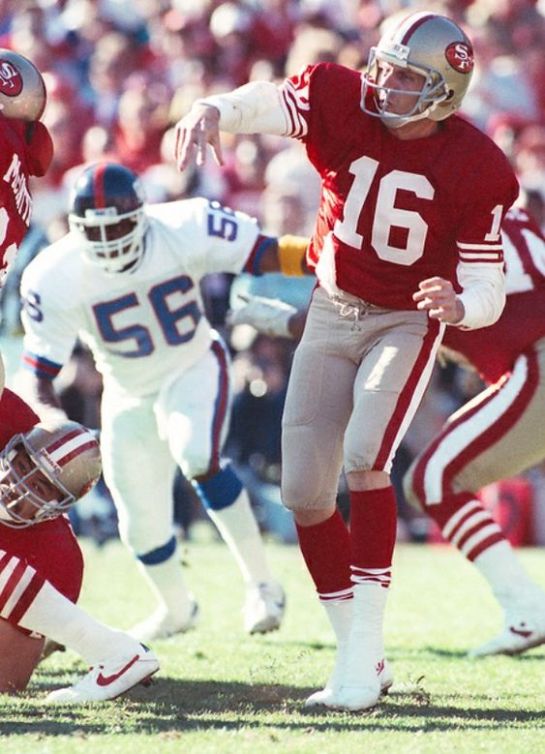
90nfcchmpshp

A more visceral look:

The era closed with the Giants holding a 3-2 edge in postseason games although the Niners were team of the decade. Over the next 27 years coaches from both sides made it to the Super Bowl 15 times with Bill Belichick (9) Tom Coughlin (2) Mike Holmgren (3) and Jon Gruden (1). This doesn’t include Bill Parcells’ 2nd Super Bowl triumph 1 week after this game vs Buffalo in XXV. Much has been made of the Bill Walsh coaching tree but take a look at the one stemming from Parcells’ group. Its second to none and it all started with a championship win over Camelot in 1990.

Looking back each team had elevated the other and by the time the decade concluded they were head and shoulders above other teams. However the two contrasting styles made for great theater and one where most people forget who finished with the upper hand.

Thanks for reading and please share the article.
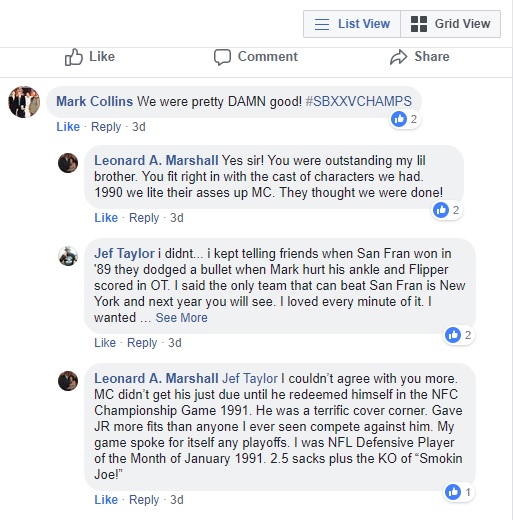
collins.marshall

collins.marshall2

Roger Craig Belongs in the Pro Football Hall of Fame


Those high knees

Reissue of original Article: 13, November 2013

When you think back to Bill Walsh’s great 49er teams, who are the first players you think of?? Right there with the Joe Montanas, the Jerry Rices, and Ronnie Lotts it only takes a fraction of a second to think of Roger Craig. His high knee running style brought a physicality to the San Francisco offense that was seen as a finesse group up until his arrival. In fact he came to San Francisco as a fullback when they drafted him from Nebraska before the 1983 season.

In college he had been primarily a blocking back in the Cornhuskers wishbone offense. Normally he paved the way for Jarvis Redwine and then Mike Rozier. Yet when Bill Walsh decided to revamp San Francisco’s dismal backfield after a 3-6 season in 1982, he drafted Craig in the second round.

Although the 49ers had won it all in 1981, it had become apparent Bill Ring, Amos Lawrence, Walt Easley, and Earl Cooper just wasn’t cutting it in the backfield. To raise the stakes in the NFC for 1983, Craig and newly acquired Wendell Tyler would form a more potent backfield.

After posting the worst yards per carry average (3.4) and yardage (742) in 1982, the new backfield duo of Craig and Tyler turned that around completely. The much improved ground game of 1983 ranked 8th with 2,257 yards rushing and a gaudy 4.4 yard average. Ironically just ahead of the Los Angeles Rams, who had traded Tyler to San Francisco so they could draft Eric Dickerson.

You had to give the nod to Craig who ran for 783 yards a team leading 8 TDs, while catching 42 passes for 427 yards and another 4 scores. This more dynamic backfield, along with Joe Montana, powered San Francisco to the NFC Championship Game. A 24-21 loss to the Washington Redskins was shrouded in controversy, thanks to some questionable calls, yet Walsh had the backfield he envisioned. Craig had reinvented himself from a collegiate player who rarely touched the football to a dual threat pro.

The 1984 49ers were a juggernaut becoming the first team to go 15-1 during the regular season. Everyone of the 49 man roster played their role so no one had outstanding stats. However once the 49ers moved past the New York Giants and Chicago Bears during the playoffs, the stage was set for a coming out party in Super Bowl XIX. With all eyes on Joe Montana’s possible second Super Bowl trophy and the electrifying record setting Dan Marino, Craig’s name didn’t even make the marquee.


Roger Craig graces the cover of Sports Illustrated after his record breaking performance in Super Bowl XIX.

Roger Craig graces the cover of Sports Illustrated after his record breaking performance in Super Bowl XIX.

It was his 1985 that set Craig apart as he amassed his 1,000/ 1,000 yard seasons both rushing and receiving. The first player in league history to do so. Some 27 years later, only Hall of Famer Marshall Faulk shares that accomplishment when he did it in 1999. How dominating was his performance?? Well his 1,050 yards rushing doesn’t jump out at you until you realize he only ran 214 times for a whopping 4.9 yards per carry. The league average is always around 4.0.

Oh by the way, he led the NFL in receiving that year with 92, which set a record for running backs, that amassed 1,016 more yards. His 15 total touchdowns was second to Joe Morris and was 1 better than NFL MVP Marcus Allen. In fact many pundits, including our CEO believes Craig should have been the MVP in 1985 with that dominating performance.

Now buoy his 1985 record setting season not culminating with the league MVP, on the backdrop of a Super Bowl record 3 TDs yet not winning that MVP and you’ll see where we’re going in a minute. Don’t forget he did this on a 10-6 San Francisco team that was a defending champion with Jerry Rice being a rookie that didn’t have 1,000 yards receiving and only 3 touchdowns. Craig quite simply fueled that offense.

Once the 49ers won Super Bowl XIX, they were forced to retool and become a bigger physical team. In 1985, the Chicago Bears emerged with one of the most imposing defenses in NFL history. The Giants followed suit with an overwhelming defense that featured 4 linebackers in the 250 lbs category. When Bill Walsh and his 49ers were dominated 49-3 in the 1986 NFC Divisional Playoffs by the Giants something had to be done.

These were teams the 49ers had beaten on their way to the ’84 championship, now they had taken the game to a new level of brute force. In reinventing the offense from a size perspective, it was Craig who was switched from fullback to halfback to allow for the insertion of Tom Rathman at fullback. The entire offensive line was overhauled.

You have to keep in mind the average career for a runner in pro football is less than 4 years. Yet here Craig was making the switch in year 5 to a position that called for him to be quicker. This at a time where he should have been slowing down from a physical standpoint. Yet he, Jerry Rice and Joe Montana spearheaded one of history’s most accomplished runs. From 1987-1990 the 49ers went 51-12 in the regular season, winning back to back Super Bowls in ’88 & ’89 and were the prohibitive favorites to win it all in 1987 as well as 1990. They finished #1 in offense in ’87 and ’89 and #2 in ’88 and ’90. In each year they made it to at least the divisional round of the playoffs and 3 straight NFC Championship Games as they were trying to threepeat.

Playing in only 12 games due to the ’87 strike, Craig ran for 815 yards which projects out to 1,086 over a full season. The 13-2 Niners were poised to become the greatest team of the modern era yet were upset by the Vikings in the playoffs. They were #1 in both offense and defense yet proved fallible in the playoff loss. Craig went on to his greatest performance in the 1988 campaign. In rushing for a career high and club record 1,502 yards, he also caught 76 passes for an additional 534  yards for his second season with over 2,000 yards from scrimmage. More important, he powered San Francisco to another Super Bowl championship with a win over Cincinnati in the XXIII’d edition.

Roger Craig was a hard nosed runner.

Roger Craig was a hard nosed runner.

Yet go back to 1988 being his second season with more than 2,000 yards from scrimmage. Keep in mind this was no sleek, make ’em miss halfback. He brought a punishing style to his position where he bludgeoned the opposition. As you’re reading this you can picture his high knee running style like when he trampled through the Rams on his most famous run in 1988.

Yet did you know that Emmitt Smith, Thurman Thomas, and Barry Sanders only had 2 different seasons amassing 2,000 yards from scrimmage also?? Did you also know that Marcus Allen and Adrian Peterson have only had one?? Only Edgerrin James, Marshall Faulk, Ladainian Tomlinson, and Eric Dickerson had more. What do all of these runners have in common?? Peterson and Tomlinson will be in the Hall of Fame and all the others are in. Roger Craig is right there with them.

Now going into the Hall of Fame is based on impact on the game. By the time we bring up the 1989 team that won Super Bowl XXIV, Craig was a driving force behind the team of the decade. Again he was a 1,000 yard rusher as the team won their fourth Super Bowl and Roger had his 3rd ring. When he left the game in 1993, his 566 career receptions was #1 among running backs all time and still remains 7th.

He is in the linear line of great NFL running backs when it comes to catching the football and is a part of the game’s evolution. He took the mantle from Chuck Foreman and propelled it forward. Since then, only a handful of every down running backs have provided that type of versatility. Now everyone has a receiving running back who comes in on 3rd downs where Roger was in every play.

It was Craig’s play that allowed a young Jerry Rice to flourish as teams concentrated their efforts to stop him. If Craig’s move to halfback in 1987 hadn’t panned out, what would have been the legacy of Bill Walsh’s “West Coast Offense”?? It was the run from 1987-1990 that made the offense spread it’s wings throughout the National Football League. During this time is when it proved it could take on the big bad Chicago Bears defense (see 41-0 1987 Monday Night shutout) and 28-3 NFC Championship win in Soldier Field in ’88. Then you add the rivalry with the New York Giants.

From Mike Holmgren to Denny Green to Mike White to Jon Gruden ( who had just begun coaching on the 1990 SF coaching staff) and George Seifert succeeding Bill Walsh. They all could attribute their Head Coaching jobs to some extent to Craig’s performance along with Montana and Rice. Yet the foundation of that offense running and receiving along with goal line and short yardage was #33.

By the way, when did Roger Craig become the the first running back to have a 100 yard receiving game in a Super Bowl?? You guessed it… Super Bowl XXIII against Cincinnati and not his record setting performance against Miami. Now had he won the Super Bowl XIX MVP, or the 1985 NFL MVP, would that have propelled him to winning the NFL MVP in 1988?? Give it some thought.

For induction into the Pro Football Hall of Fame, I present to you…Roger Craig

1990’s San Francisco 49ers v. Dallas Cowboys: 49ers Perspective

Originally written May 6, 2015- Reissued July 25, 2025

Former San Francisco 49er Head Coach Bill Walsh referred to the early years of the organization’s coming of age as “Camelot”. After the 1981 Super Bowl championship they would go on to become “Team of the Decade” winning another 3 titles. San Francisco became the NFL’s gold standard in on field achievement and the corporate way they conducted themselves.

watters.94championshipTheir players were revered as Joe Montana, Jerry Rice, and Ronnie Lott took their place among the league’s greatest ever players. They had been the toast of Presidents as the 80’s drew to a close. In 1989 new Dallas Cowboy owner Jerry Jones traveled to San Francisco to learn from Eddie Debartolo how the league’s model franchise did business. This was nothing new as even former Head Coach Bill Walsh had become a favorite on the corporate motivational speaking circuit.

As the 90’s beckoned, the team was transitioning on the field as Steve Young, Ricky Watters and a new wave of 49ers emerged. It started with a team loss in  the 90 NFC Championship to the New York Giants 15-13 ending their chance at a 3-peat. Gone were 80’s holdovers Montana, Roger Craig, and Lott as the new generation took shape in 1991. Montana from a vicious hit that kept him out of football for two years. The others were released as the team looked to get younger to stay competitive.

They finished 10-6 as Steve Young finished his first season as a passing champion. It took awhile for San Fran to find their footing yet they finished on a 6 game winning streak. By 1992 the Niners hit their stride finishing 14-2 and retooled with Ricky Watters rushing for 1,013 yards to join Young, and Rice in the Pro Bowl. Another passing title moved Young into the elite of the sport yet it came crashing down with a loss to the upstart Dallas Cowboys in the NFC Championship 30-20.

Steve Young being sacked during the 1992 NFC Championship Game.

Steve Young being sacked during the 1992 NFC Championship Game.

Yes, those same Dallas Cowboys who had studied the 49er organization some 4 years before. The same Jimmy Johnson and Jerry Jones who had traded for former 49er Charles Haley to help lead the upstart Cowboys and shift the balance of power. Haley had grown up a 49er and battled T Steve Wallace, G Guy McIntyre, and G Harris Barton for 6 years in practice. His experience and spirit settled the nervous young Cowboys in their ’92 NFC Championship triumph.

Going into the game it was a 50/50 split as to who had the upper hand. What really hurt Steve Young is a now healthy Joe Montana watched from the sideline. As San Fran fell behind in the second half, a growing feeling in the stadium loomed. Would George Seifert put Montana in if the game got away from Young. Even though Young was the NFL’s MVP, he still had the legend looking over his shoulder. As the event drew near it felt like a defining NFC Championship was taking shape. The excitement leading into the game reached a crescendo when…

What if Guy McIntyre doesn’t get called for holding on the game’s 3rd play negating Jerry Rice’s 63 yard TD from Young?? It would have changed the complexion of  the game. However Troy Aikman had gone 24 of 34 for 322 yards and 2TDs. Troy Aikman outplayed him and made several signature throws to Alvin Harper while Young threw 2 4th quarter interceptions.Emmitt Smith controlled the clock with 114 yds rushing and 59 yds receiving. They took the measure of San Fran and became the league’s signature team with their Super Bowl XXVII championship.

Going into 1993 the 49ers had traded away Joe Montana making it Young’s team. This added pressure from the fans but their real battle was catching Dallas who was now an established champion. They were brash and played with an in your face bravado that took the 49ers aback. In the locker room following the ’92 Championship, Jimmy Johnson’s boast “How ’bout them Cowboys!?!” reverberated in the CBS cameras & throughout Candlestick Park. It haunted the organization as they set their sights on dethroning the loud, brash Cowboys.

Once they qualified for the NFC Championship rematch in Dallas, it was time to right the ship. Dallas had beat them 26-17 in the regular season to add to their confidence. Then Cowboy coach Jimmy Johnson dropped a bombshell.  He called a Dallas radio station and declared “We will win the game and you can put it in 3 inch headline!” Now they were calling San Fran out and how would they respond??

Called out and humiliated like an after school fight in 6th grade, the 38-21 loss in the ’93 NFC Championship was worse than it looked. Dallas was up 28-7 in the 2nd quarter and was sitting on the ball with 3:27 to go. The defense, which had struggled all year, was completely exposed. The gap was widening and the team needed to make drastic changes if they were going to compete with the younger Cowboys.

Michael Irvin had emerged as one of the best wide outs in the NFL. Emmitt Smith had the last 2 rushing titles and had his 3rd straight 100 yard rushing game against the 49ers. Troy Aikman had yet to throw an interception in 2 NFC Championship games. Alvin Harper was becoming a serious 49er killer as he emerged with the highest yard per catch average in postseason history. Most of it due to huge plays against San Fran.

Carmen Policy and the 49ers brass moved into swift action. Back then the team that lost the conference championship coached the Pro Bowl squad. Free agency had come to the NFL the year before and they used this as a recruiting trip. They signed future Hall of Famers Rickey Jackson, Richard Dent, Deion Sanders off the NFC Pro Bowl squad. Then stole Ken Norton Jr from the Cowboys and DE Charles Mann all fom the ’93 Pro Bowl.

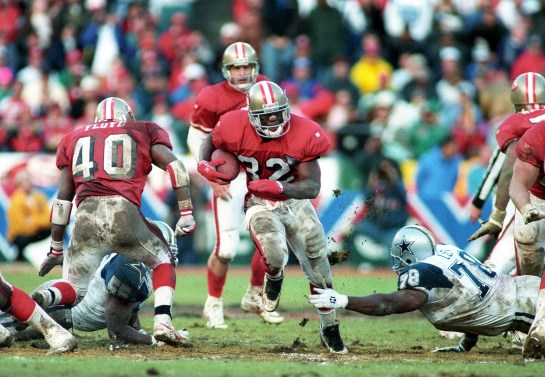
Floyd and Watters celebrate touchdown during their 44-15 demolition of Chicago in the '94 playoffs.

Floyd and Watters celebrate touchdown during their 44-15 demolition of Chicago in the ’94 playoffs.

“If you can come in and give us the defense, we have an offense that can dethrone the Cowboys and get to the Super Bowl.” They also knew they needed a new approach psychologically and embraced a more brash, in your face swaggering persona. Spearheaded by the outgoing personalities of Ricky Watters, Deion Sanders, and rookie FB William Floyd.

Gone was the laced up corporate attitude of the team on the field. This group showed its emotions on the field, celebrated with end zone dancing and Deion highstepping downfield after interceptions. The only thing that made the 49ers recognizable were their helmets. Thanks to the NFL commemorating their 75th season, the Niners elected to play most of the season in their “throwback” uniforms of the 1950s. The 49ers were reborn in 1994.

It worked as the 49ers blew through the regular season 13-3 and scored a team record 505 points. Steve Young was league MVP and Sanders was the NFL’s Defensive Player of the Year. They retooled and had specific match ups ready as they eyed the defending champion Cowboys. They beat them during the season 21-14 to earn the right to homefield advantage for the ’94 NFC Championship. If the Cowboys were going to 3peat, they had to go through the last team that had that same chance just 4 years before.

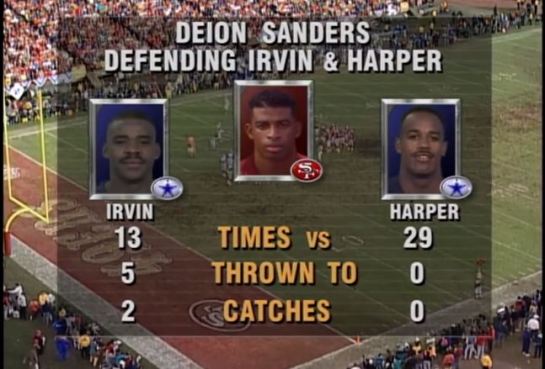
Sanders impact on the Conference Championship Game was immense. While he intercepted Aikman at a critical juncture of the 3rd quarter, it was the strategy to put him on 49er killer Alvin Harper at the start of the game that proved fatal. The first two scores were set up by turnovers as the Cowboys threw away from Sanders on Harper. By the third drive Harper was removed from the game so the Cowboys coaches could get a grasp of how they would deploy Deion in his absence. Harper returned to the game a series later but so decisive was Deion’s coverage you could trace the decline of Harper’s career to this point.

The vanquished became the victors with their 38-28 defeat of the Dallas Cowboys in the ’94 NFC Championship Game. Super Bowl XXIX was an anticlimactic 49-26 win over the San Diego Chargers. Steve Young liberated himself from the ghost of Joe Montana. For 3 straight years these two teams pushed each other to heights they would not have achieved without each other. However the final shot was fired by the 49ers.

Young and Rice celebrate in Super Bowl XXIX.

Young and Rice celebrate in Super Bowl XXIX.

Jerry Jones had become obsessed with overtaking the 49ers who themselves made practical business decisions. They didn’t match Ricky Watters free agent contract with Philadelphia, which was a mistake, and they had to enter a bidding war for Deion Sanders. In ’94 they signed him to $1.1 million for one year where other teams were offering 4 years $17 million. Coming off a Super Bowl triumph and his 1994 NFL Defensive Player of the Year it was time to cash in. San Francisco baited jones and he took it and overspent for Deion at a cost of $35 million.

This crippled Dallas who wouldn’t be a player in free agency the rest of the decade. The Cowboys had all their money tied to Aikman, Smith, Irvin, and Sanders. The 49ers had freed themselves of the Dallas stranglehold and would go on to be an elite team the rest of the decade. They just didn’t see a new foe emerging in Mike Holmgren’s Green Bay Packers.

However there was the 1995 season where the 49ers were more in the spirit of the pre ’94 group. At midseason they took on the revenge minded Cowboys in Texas Stadium. The Cowboys were 8-1, healthy and ready to show with Deion Sanders in tow, they had overtaken San Fran. Going into the game they were missing QB Steve Young, FB William Floyd and staggered into the game with a 5-4 record. Perfect timing for the Cowboys to provide the knock out blow. Nobody believed the 49ers had a chance…

After being upset by the Packers in the 1995 NFC Divisional Playoffs 21-17, they began a new rivalry chapter with them. As for Dallas, they did win Super Bowl XXX to make it 4 wins in 4 years between these two organizations. New teams would emerge before the decade concluded. Most notable was Mike Shanahan’s Denver Broncos. Shanahan was San Francisco’s Offensive Coordinator during the heat of the 49er v Cowboys rivalry.

Thanks for reading and please share the article.
 

The Golden Age of Hating The Dallas Cowboys

Originally Written June 16, 2013 -Reissued July 23, 2025

It was a feeling which manifested sometime during the 1970’s. We can put it on the late George Allen, former coach of the Washington Redskins, who was first to voice a total disdain for everything Dallas Cowboys. It raised the level of rancor between the Redskins and Cowboys elevating the rivalry to the national level.

Below the surface the rivalry began to take shape when the Cowboys became the NFL’s southern most team when they began play in 1960. Prior to this, the Redskins of George Preston Marshall were. It’s one of the reasons they sang “Dixie” at their welcome back luncheon when the team reported to camp. Yet this new team came along and began to eat into their fan base.

Keep in mind the Atlanta Flacons and. New Orleans Saints werent founded for another half decade. With the Falcons beginning play in ’66 and the Saints following in ’67. By then the Cowboys were had grown in stature and had taken the Packers for NFL supremacy.

However the disdain Allen felt during the early 1970’s was more palpable. More real.

A growing resentment felt by many teams and fans. The feeling was the late Tom Landry and his Dallas Cowboys were given too much publicity by the networks and the print media. CBS was constantly covering the Cowboys and the level of success they had in the 1970’s, with 5 Super Bowl visits, seeded hatred in their rivals. Especially within their division. Yet none of them were good enough to challenge them in the NFC East.

By the time NFL Films made the 1978 Dallas Cowboys yearbook and labeled it “America’s Team” hatred was at an all time high. Even jealousy if you will. It was the arrogance and air of supremacy the Cowboys organization painted during those CBS days that fueled two schools of fans.

You had those who thought of themselves as beautiful and carried themselves with a sense of arrogance and identified with the team and their cheerleaders. Then you had the regular meat and potatoes folks who loved when the Pittsburgh Steelers punched them square in the mouth during Super Bowls X and XIII. They were also fans of all other teams. Yet when your team is no longer in it, they cheered for whoever was facing Dallas in the playoffs or Super Bowl.

Ironically, this is where the Steelers gained their nationwide fan base. It had nothing to do with the fact they won 4 Super Bowls in the 1970’s, it was the fact they beat the Cowboys in two of those Super Bowls that made them remain as fans.

As the 1980’s beckoned, many of the teams that Dallas had squashed the last decade began to grow anew. A fresh generation of coaches and players started to internalize the disdain for the bully on the block and began their ascent. It was known that you had to take out Landry’s Cowboys if you really want to be recognized as champions. Although the Redskins were the one with the more acknowledged rivalry, it was the Philadelphia Eagles under Dick Vermeil that got the first crack at the boys from the Lone Star State.

Much of the animosity started at the beginning of the week, when the Eagles were cast as underdogs against Landry’s Cowboys in the 1980 NFC Championship Game. Although they were hosting, the Eagles were made underdogs by Vegas. Right on cue, the Eagles were being treated as bit role players even though they split their games with Dallas that year.

An upset Dick Vermeil made a declaration that ratcheted feelings up when he vowed “Never allow anyone to take you for granted! I get the feeling the Dallas Cowboys are taking us for granted right now. We’re here because we earned the right to be here. If the Dallas Cowboys are going to take us for granted, we’ll whip their ass!”

To further irk Tom Landry, Vermeil opted to play in their white uniforms forcing the Cowboys to play in the blue jerseys, which they felt were jinxed. Dallas complained to the league office yet for once the powers that be didn’t allow Gil Brandt and Tex Schramm to get their way. The crowd at Veteran’s Stadium was unforgiving as the two teams emerged from the tunnel. It was 4* and -17* windchill when on the Eagles second play from scrimmage:

The roar of the crowd during Wilbert Montgomery’s touchdown was the loudest ever at Veteran’s Stadium. Cowboy haters everywhere delighted as the Eagles held the early upper hand on the Cowboys 7-0. As the game wore on and Landry’s charges behind 17-7 late in the fourth quarter, they were able to punt and pin the Eagles to their own 5 yard line. From their own 5 yard line the Eagles ended fading hopes for Dallas when in 3 runs Philadelphia moved the football to the Dallas 25. Montgomery was putting the finishing touches on a signature day when he struck with this 54 yard masterpiece.

The Eagles vanquished the Cowboys 20-7 on their way to Super Bowl XV. Wilbert Montgomery etched his name into Philadelphia lore with a 194 yard performance. They had destroyed the Flex Defence, rushing for 263 yards on 40 carries averaging 6.575 yards a pop!! Cowboy haters everywhere rejoiced in hearing Landry, Danny White and Cowboy apologists have to answer the questions as the defeated football team. In fact many Cowboy haters pulled for the Oakland Raiders in the Super Bowl two weeks later. People weren’t cheering for the Eagles as much as they were for Dallas to lose.

The following year the Cowboys had revamped their secondary & national press covered the exploits of rookies Everson Walls (who should be a Hall of Famer), Michael Downs, and Ron Fellows. Although the publicity was on this group in Big D, they were overshadowing an even greater group in San Francisco. Where Bill Walsh had drafted and started rookie CB Ronnie Lott, CB Eric Wright, and S Carlton Williamson to go along with scrappy veteran S Dwight Hicks. Yet through most of the 1981 season, you didn’t hear about the 49ers. Even after a 45-14 devastation of the Cowboys in week 5 with Ronnie Lott scoring the decisive touchdown.

Did you know the 49ers didn’t make the Monday Night Football highlight package?? Don’t tell our CEO there was no media bias. Nor can you say the coverage of Dallas’ rookie trio of defensive backs didn’t motivate the group by the bay. Was it borne from the Cowboys propaganda and success of the 1970s?? Or was it borne from Tom Landry’s ties to the New York media since his pro coaching career started there??

Did you know the late Pat Summerall who broadcast many of the Cowboys games in that era, was a teammate and friend of Landry back in New York?? So when they didn’t make the ABC Monday Night package it fed into the hating Dallas mantra that much more by the 1981 NFC Championship Game.

There had been a history between the San Francisco 49ers and Dallas. In fact you could say the 49ers were who Dallas had built their reputation on with wins over them in the 1970 and 1971 NFC Championship Games. At that point the Cowboys were called “Next Year’s Champions” for four straight playoff defeats to Vince Lombardi’s Packers and the Cleveland Browns. As a new decade beckoned it was the Niners and the Cowboys who stepped to the fore.

Once Dallas emerged and won Super Bowl VI, their prestige soared where the vanquished 49ers went into a tailspin the rest of the decade. Yet before that happened, there was the 1972 NFC Divisional playoff where a measure of revenge was going to be exacted against Landry’s troops when Roger Staubach led a furious 4th quarter rally. Staubach led Dallas to a 30-28 win after they were behind 28-13 with 5:00 to go in the game. This is when he earned the nickname Captain Comeback.

Fast forward to the 1981 NFC Championship where the resurrected 49er franchise, now under Coach Bill Walsh & owner Eddie DeBartolo, were preparing for the game. Still smarting from the lack of respect afforded his group after the 45-14 win and no media coverage, set the tone of a franchise when talking to a reporter. “They ate it once and they can eat it (defeat) again.” DeBartolo bellowed. Reminiscent of Dick Vermeil the year before, Cowboy haters were all pulling for the 49ers in this game when they took the field.

The final stint came when the Washington Redskins had their turn to climb over Dallas to make it to the summit of pro football. After a strike shortened season where the 8-1 Redskins entered a playoff tournament to make it to Super Bowl XVII, most pundits picked the media darling Cowboys to win the NFC Champoinship citing the Redskins only loss was courtesy of the Cowboys. Our CEO can remember being fired up for the NFC Championship between Washington and Dallas and knew it was going to be a thing of beauty.

It actually started when the Redskins were putting the finishing touches on a 21-7 win over the Vikings to set up the NFC Conference final when the chant “We want Dallas!! We want Dallas!!” resonated from the jam packed crowd at RFK. Just moments before, John Riggins who had rushed for 185 yard was in the midst of a curtain call, turned and gave a bow to the crowd sending them into a frenzy. Those sights and sounds reverberated throughout the stadium and CBS chose instead of showing the final plays of that game, panoramic views of the raucous fans.

As for the rest of the Cowboy haters who gathered to watch this team go down again. Look no further than another bulletin board comment that jump started the festivities. It started with Dexter Manley professing in the paper that he “hated Dallas” that Monday that got the ball rolling. Then back and forth in the newspaper ensued from Danny White of the Cowboys, to Redskin owner Jack Kent Cooke, EVERYONE was stoking the fire. How bad did it get? There was even a heated argument about the game within the House of Representatives the Friday before the game and the late Thomas “Tip” O’Neill adjourned session an hour early. It was on!!!!

Over a football game? Yes over a football game. The hating of Dallas really grew wings in the George Allen era. He preached it, lived it, and over all the treatment America’s Team received as a media darling kept breeding that hatred within rival teams. Real Redskin fans will talk with high regard of the fact that they beat Dallas in the ’72 NFC Championship when the Cowboys were defending champions. So here we were some 10 years later and all that animosity was a thing of the past right? After all new owner, new coach, new quarterback and cast of characters comprised the Redskins roster. Right?

For a more visceral look:

With that we were at an end of an era where other NFL teams were able to get their due as the 1980’s moved on. Media coverage transferred from Dallas to new teams coming from Chicago, the New York Giants, Denver Broncos, of course the 49ers and the Redskins who were dominant the rest of the decade. From this era came the nationwide fan base of the San Francisco 49ers much like the Steelers. The backlash of the “America’s Team” name and favorable coverage brewed hatred from the majority of NFL fans and players.

Notice in these videos, the look in their eye and the description of elation for vanquishing the Dallas Cowboys of that era. In all three cases before the NFC Championship, where decorum was to be quiet, and not give the Cowboys bulletin board material. Coaches and owners in these instances were doing it let alone players. It set the table for things to come and put their organizations on high alert of what was expected of them.

The hatred for everything Dallas began to dissipate at this time. There was some animosity left when the ’85 Bears bloodied them 44-0 in Texas Stadium after 9 straight losses to them. Yet by the time of Tom Landry’s departure, people felt bad about what happened to the Cowboys and watched the dismantling of a franchise with mixed emotions.

You were almost mad that they were 1-15 in 1989, because the villain from Texas was gone. The Jimmy Johnson Cowboys of the 1990’s were an envied team, not a hated one. To be hated you had to be more than a good football team, and in retrospect that was what made hating the Dallas Cowboys worthwhile.

The way they were marketed, branded, and packaged. The way their coach was treated like a God and their quarterback in Roger Staubach was the idol which gave way to Danny White. Well until these NFC Championship losses tarnished White’s legacy.

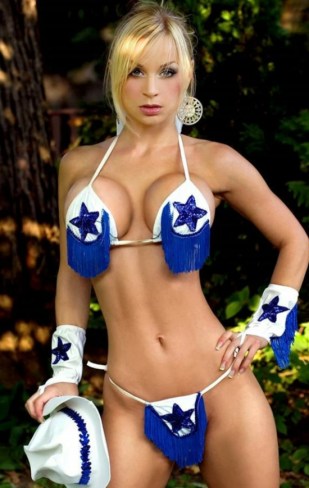
Their cheerleaders were even made famous. They had telvision specials and still do to this very day. All of this tapped into the inferiority complex of many players and fans of other teams. When it came time to beat them for a championship or a game of importance, it was the Holy Grail.

One of Taylor Blitz’s finest Sarah, shrugs it off and has this message “How ’bout them Cowboys?”

Thanks for reading and please share the article.

Mike Holmgren Belongs In The Pro Football Hall of Fame

There are several acccomplishments which set a coach apart where they reach the status as a coaching great. Of course winning a Super Bowl is the ultimate prize however when we look at the legacy of their coahing tree, PFHoF players the coach produces, and the ability to turn around a franchise. Mike Holmgren has soared every hurdle and has turned around 2 franchises.
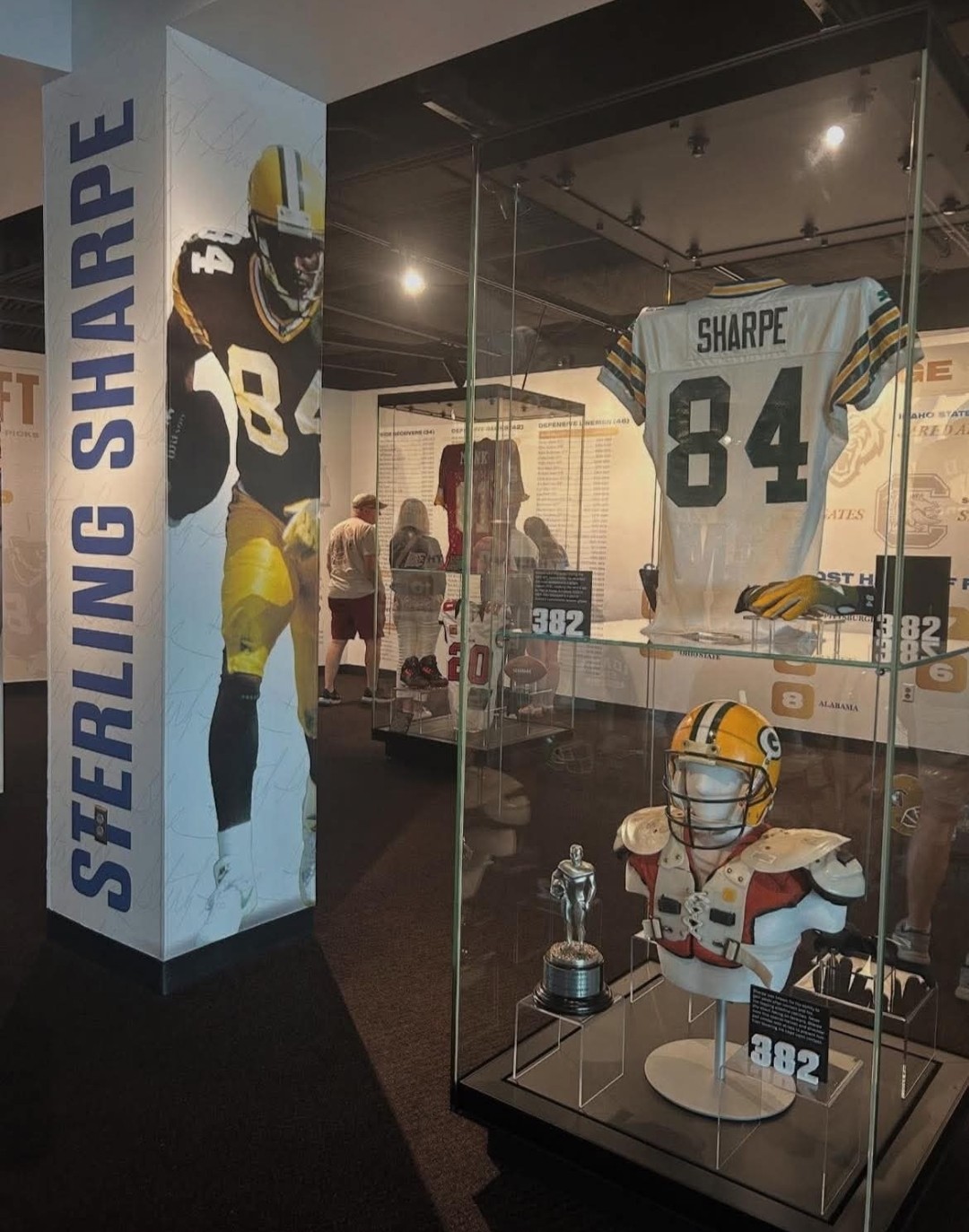
Do you realize when Sterling Sharpe gives his speech this August, he’ll be the 6th player enshrined in Canton that played for Holmgren? That is 1 fewer than Tom Landry who coached Dallas 29 seasons and 2 less than Don Shula who coached for 33. Mike Holmgren was head coach in Green Bay & Seattle for just 17 seasons. The late Reggie White, Brett Favre, LeRoy Butler, T Walter Jones, & G Steve Hutchinson are the others with bronze busts.
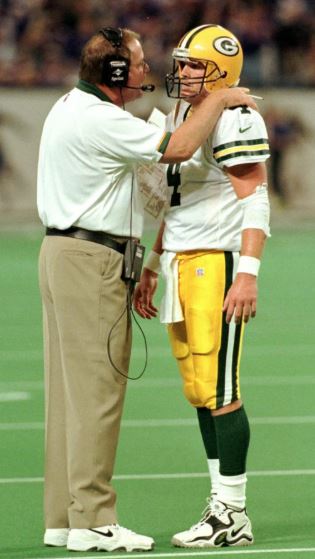
Try this on… The Mike Holmgren coaching tree with branches Andy Reid, Jon Gruden, Steve Mariucci, Jim Mora Jr, & Tom Coughlin have gone on to take their teams to 22 conference championship games! This includes 6 Super Bowl Championships (XXXVII, XLII, XLVI. LIV, LVII, & LVIII) in 9 appearances. In contrast when you compare this to Hall of Fame Coach Bill Walsh, you have to include Holmgren’s 4 conference championship appearances just to make it to 13. You know the reverence Coach Walsh is kept here at Taylor Blitz but that is an astounding measure.

No other coach has had 3 staff members move on to become Super Bowl winning head coaches. Bill Walsh & Bill Parcells each had 2 but that is it. Not Jimmy Johnson, not Chuck Noll, not Bill Belichick, not George Seifert, not even Tom Landry. Keep in mind 5 of these coaches are already enshrined in Canton with Belichick eligible in 3 years.
He was also able to win in different fashions. He developed a young Brett Favre and won with his passing prowess featuring Hall of Fame receiver Sterling Sharpe. Sharpe set back to back NFL records for receptions in a season (1992 -108rec/1993 -112 rec) while Favre went on to be NFL MVP 3 straight years 1995-1997. He set NFC record with TD passes with 38 in ’95 & 39 in ’96. They were a pass first West Coast offense that leaned on the run to close out games.

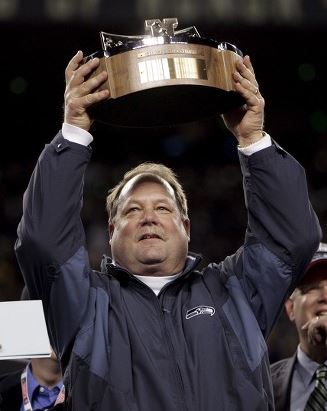
Then in Seattle he leans on a bellcow running back Sean Alexander who wins the 2005 NFL MVP rushing for 1,880 yards with 28 rushing TDs. They made it to Super Bowl XL where several questionable calls kept Holmgren from becoming the 1st coach to win Super Bowls with 2 different franchises. He was “this” close…

2005 NFC Championship Trophy

Of course his most notable stop was resurrecting a Green Bay franchise that had been flat on its back since the Lombardi era in the 1960s. No coach could sustain excellence in what had become a desolate place where other coaches would use the threat of “sending” players off to Green Bay as a banishment. There is an NFL Films clip of the late John McKay saying this on the Buccaneer sideline. This was a team that had been 0-26!

In bringing the team to respectability from a competitive standpoint, his rise came at the advent of free agency at the beginning of the 1993 season. One of the principle arguments that persisted was ‘how could Green Bay attract black free agents?’ He was instrumental in landing the 1st prized free agent in Hall of Fame DE Reggie White. He actually pranked him by leaving a voicemail saying he “was Jesus and he should come to Green Bay.” He won over Reggie White when no pundit thought he had a snowballs chance to sign him.

That move attracted key black free agents TE Keith Jackson, WR Andre Rison, FS Eugene Robinson, DE Sean Jones who spearheaded Holmgren’s Super Bowl XXXI champion. Yes there were other great notable signings in WR Don Beebe, QB Jim McMahon, and FS Mike Prior but in ’92 while the players were suing for free agency Keith Jackson was the #1 free agent. Reggie White’s name was on the lawsuit and he was ’93s prize free agent every team was after. Holmgren charmed them both.

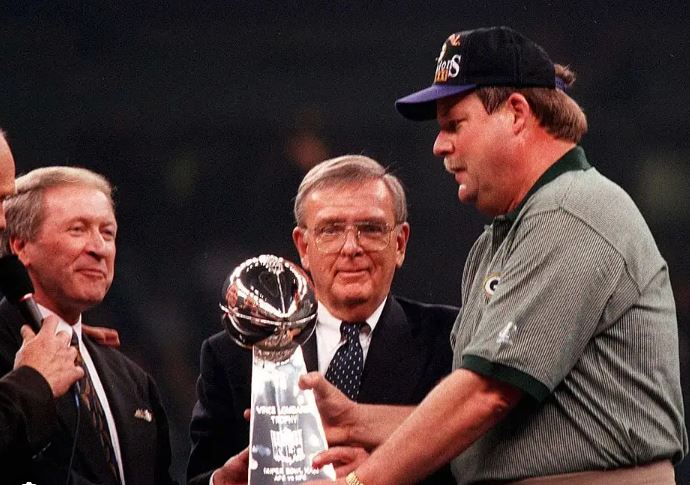
He needed them to get over the top after taking the Packers to 9-7, 9-7, 9-7 and 11-5 records 1992-1995. His 13-3 masterpiece returned the Vince Lombardi Trophy to Green Bay making Holmgren a legend:

His final two years in Green Bay, he was on the precipice of winning back to back Super Bowls when they charged into XXXII as a defending champion. Needless to say Holmgren’s team fell behind and he took the ball out of Dorsey Levens hands chronicled here

In 1998 the Packers entered the playoffs as a wildcard and lost in dramatic fashion to San Francisco 30-27 on a last second TD from Young to Owens. His final game as a Packer. I was disappointed he didnt win in XXXII and believe he would have been in Canton years ago had he gone back to back. Referee whistles and flags against his Seahawks in XL  withstanding… however as The Chancellor of Football I wanted to offer this piece.

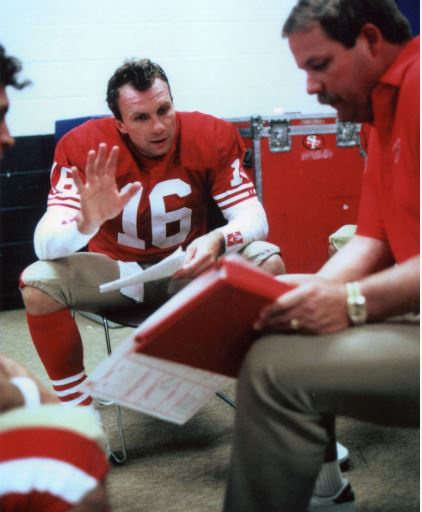
For his career he is tied with Don Shula & George Seifert as the only head coaches to produce 4 NFL MVPs with Brett Favre (1995,96,97) & Shawn Alexander in 2005. Considering 2 of the MVPs won under Seifert, Joe Montana ’89 & ’90, Holmgren was the Offensive Coordinator calling those plays. Winning Super Bowls XXIII and XXIV. The latter a 55-10 blowout in one of the most artistic games ever called. Peyton Manning won his with 3 coaches & Aaron Rodgers won his with 2.
If you’re keeping score at home:

  1. Tied for producing the most NFL MVPs in history with 4.
  2. Coaching tree has produced 22 conference title appearances, 9 Super Bowl appearances winning 6.
  3. 4th in history producing PFHoF players with 6 & Shawn Alexander talk is heating up. Could tie Landry at 3.
  4. Had a 161-111 record as a head coach winning 1 Super Bowl, appearing in 2 more.
  5. Hired to be Packers HC after a 3 year run in SF as OC ’88, ’89, ’90 winning 2 Super Bowls and an NFC Championship Game.

This is the epitome of a Pro Football Hall of Fame coach! In multiple Super Bowls in multiple decades? He needs to be enshrined just as I said to him back in 2016 he would. Well…

Back in 2012 when he was enshrined in The Packers Hall of Fame I was upset Brett Favre wasn’t there as he was still at odds with the organization. By the midnight hour I wrote “The Chancellor’s Take: Green Bay Packers & Brett Favre’s Broken Relationship” pleading they get their act together as the time was coming to immortalize recently retired greats as Favre soon would be. Never once figuring I’d be able to witness history up close.

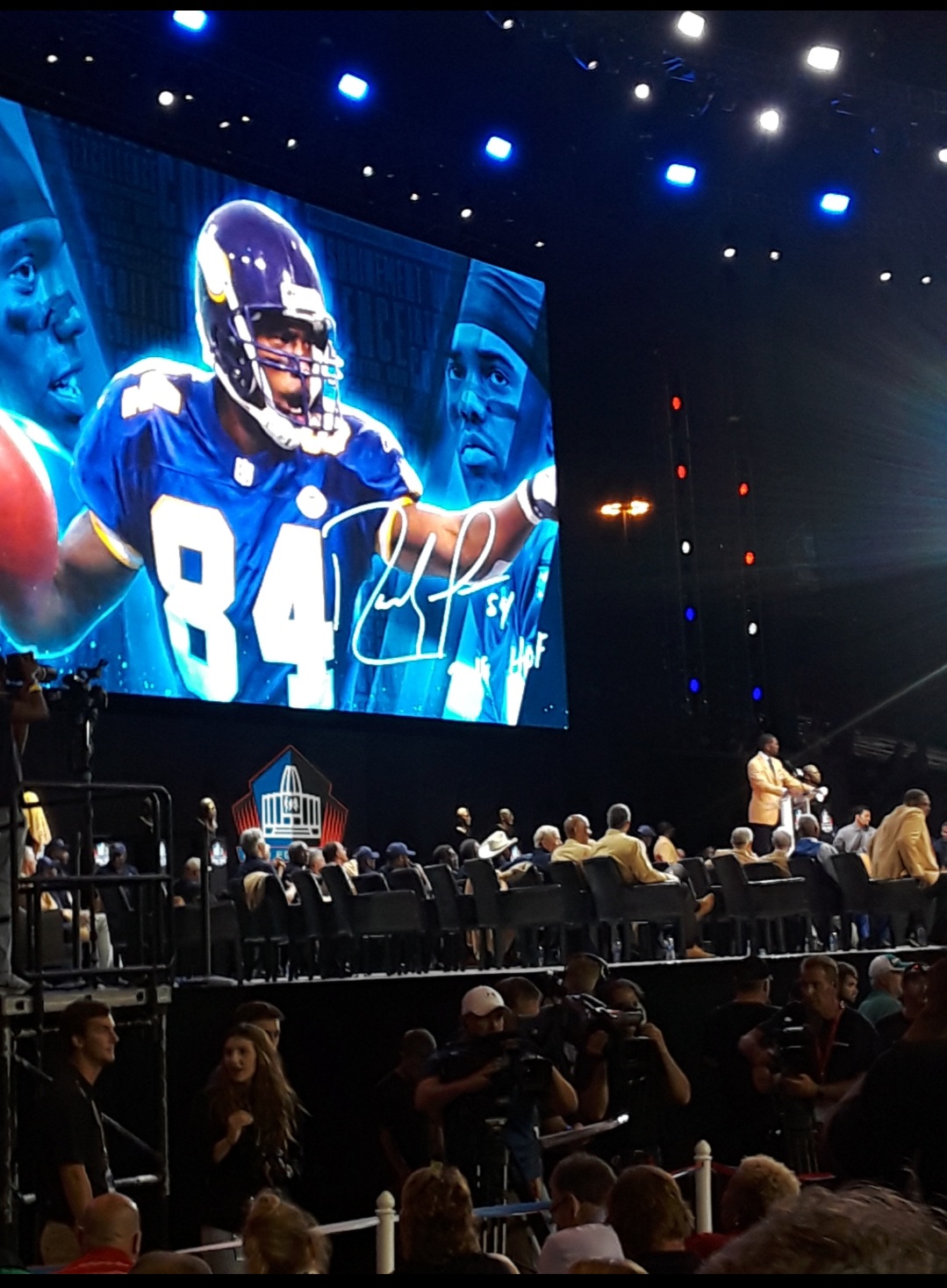
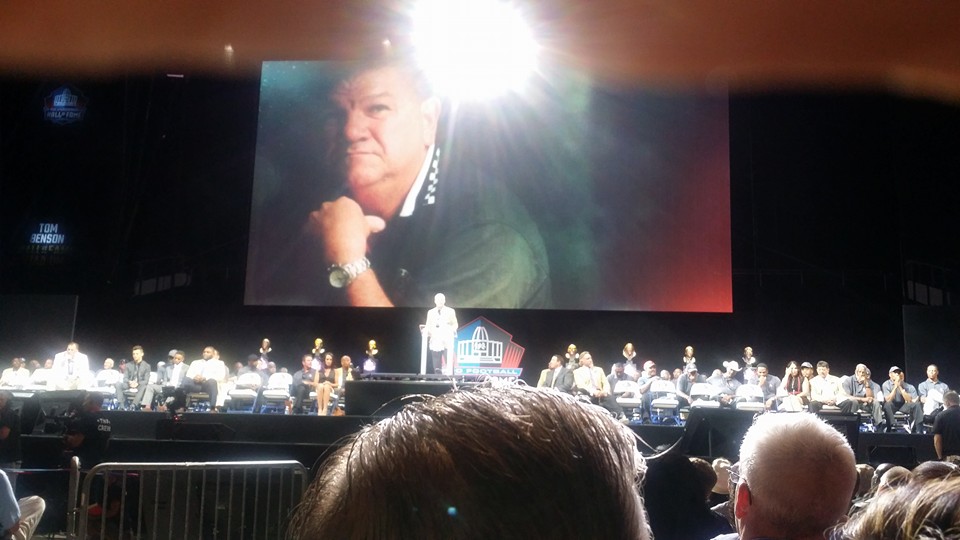
As fate would have it I attended the 2016 Pro Football Hall of Fame enshrinement ceremony as a guest of Kevin Greene, for penning a similar article for him years before. The Favre & Greene contingents were right in front of the stage. When the ceremony ended I walked toward the stage to congratulate Kevin for an awesome speech and hug his wife Tara who sang the national anthem…and right next to me was this old football coach… Mike Holmgren congratulating Favre on his. It was a surreal moment flashing me back to the 2012 Packers HOF ceremony… We greeted and as we were exiting toward the shuttles I told him to get ready as he had to prepare his speech. Of course he thanked me and gave a wry smile “maybe someday”… was gracious and gregarious as we chatted that evening.
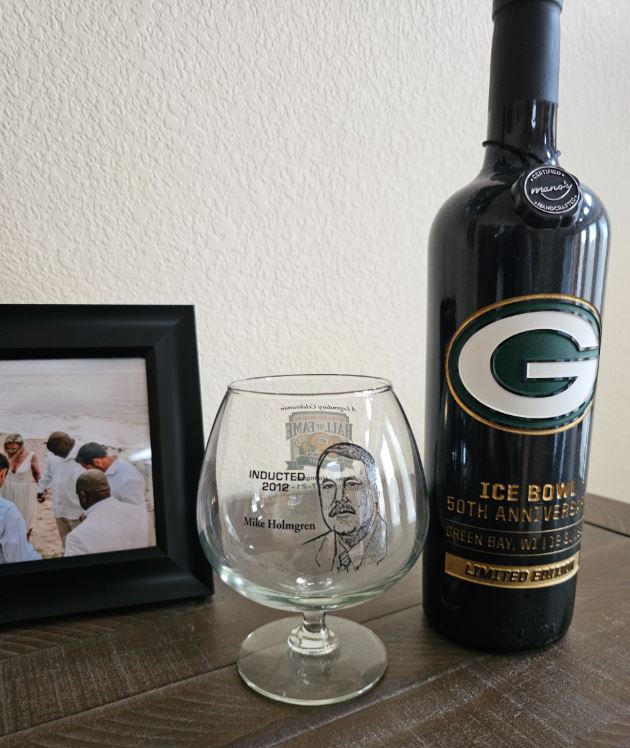
Yet here we are and somehow this man hasn’t been ensrined. If this isn’t a Pro Football Hall of Fame resume I don’t know what one is. its time for the writers to put Mike Holmgren in the hallowed halls of Canton. He had my vote years ago…
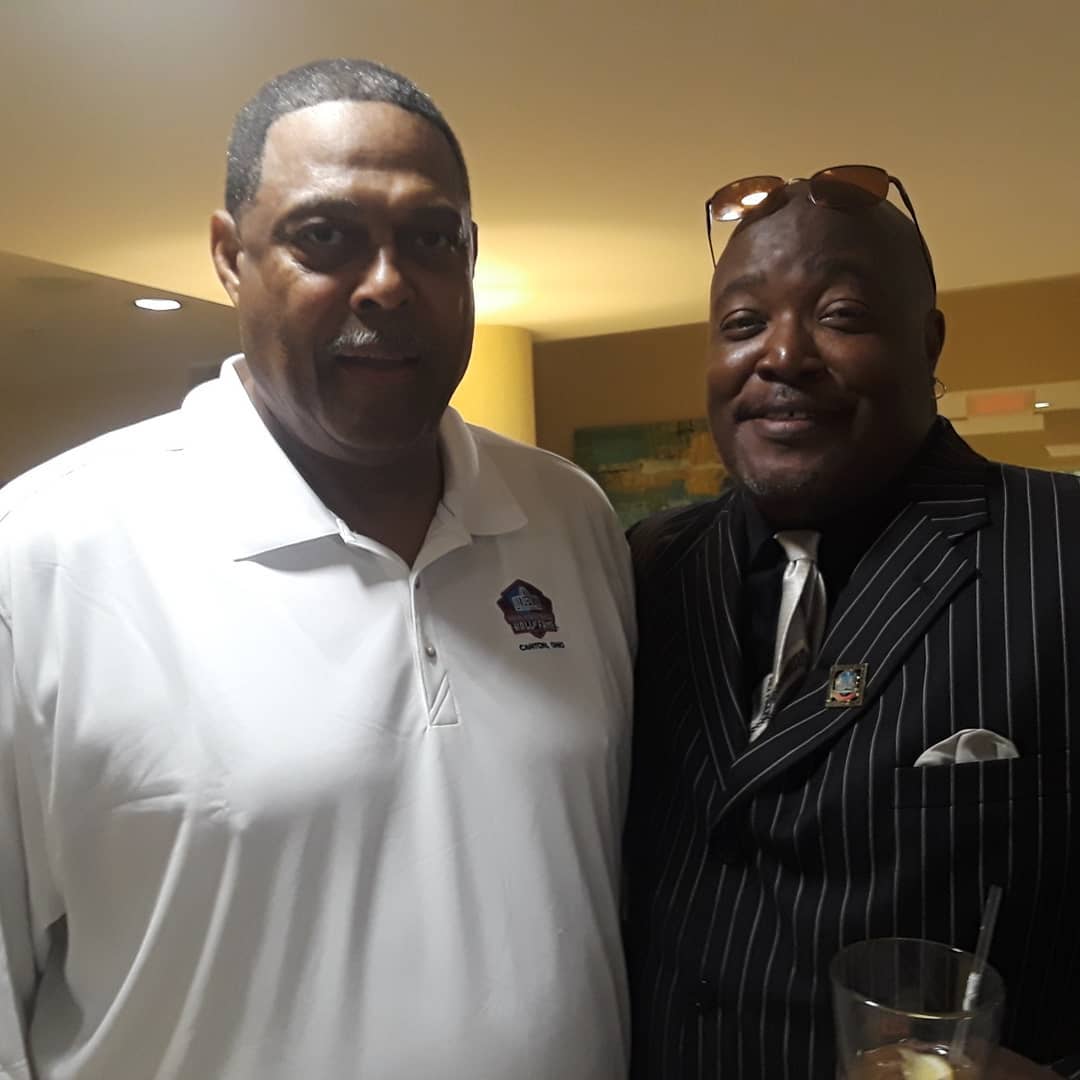
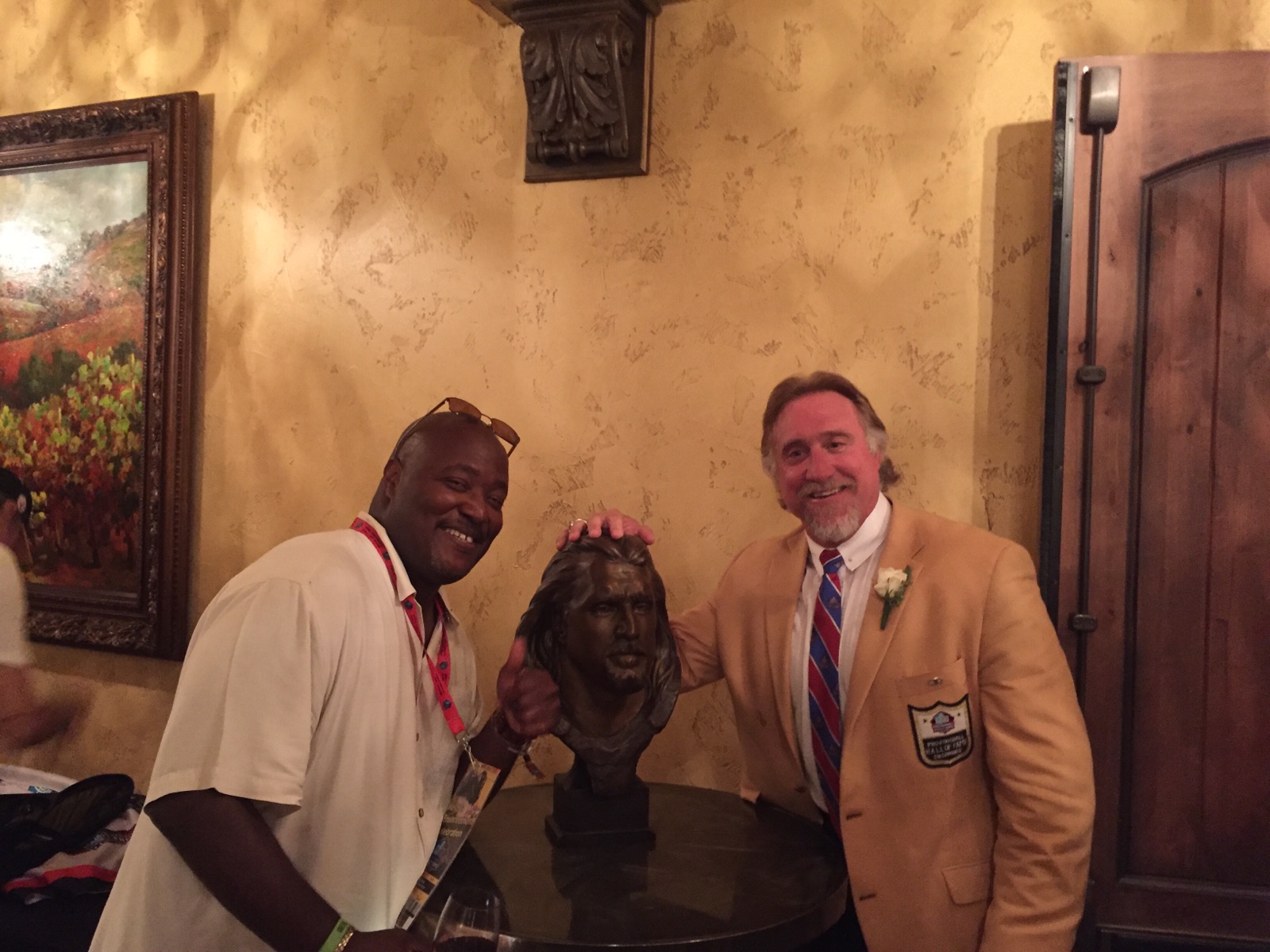
For induction into the Pro Football Hall of Fame, I present to you Mike Holmgren!

Past Hall of Fame Articles:

Robert Brazile 2011 (inducted 2018)

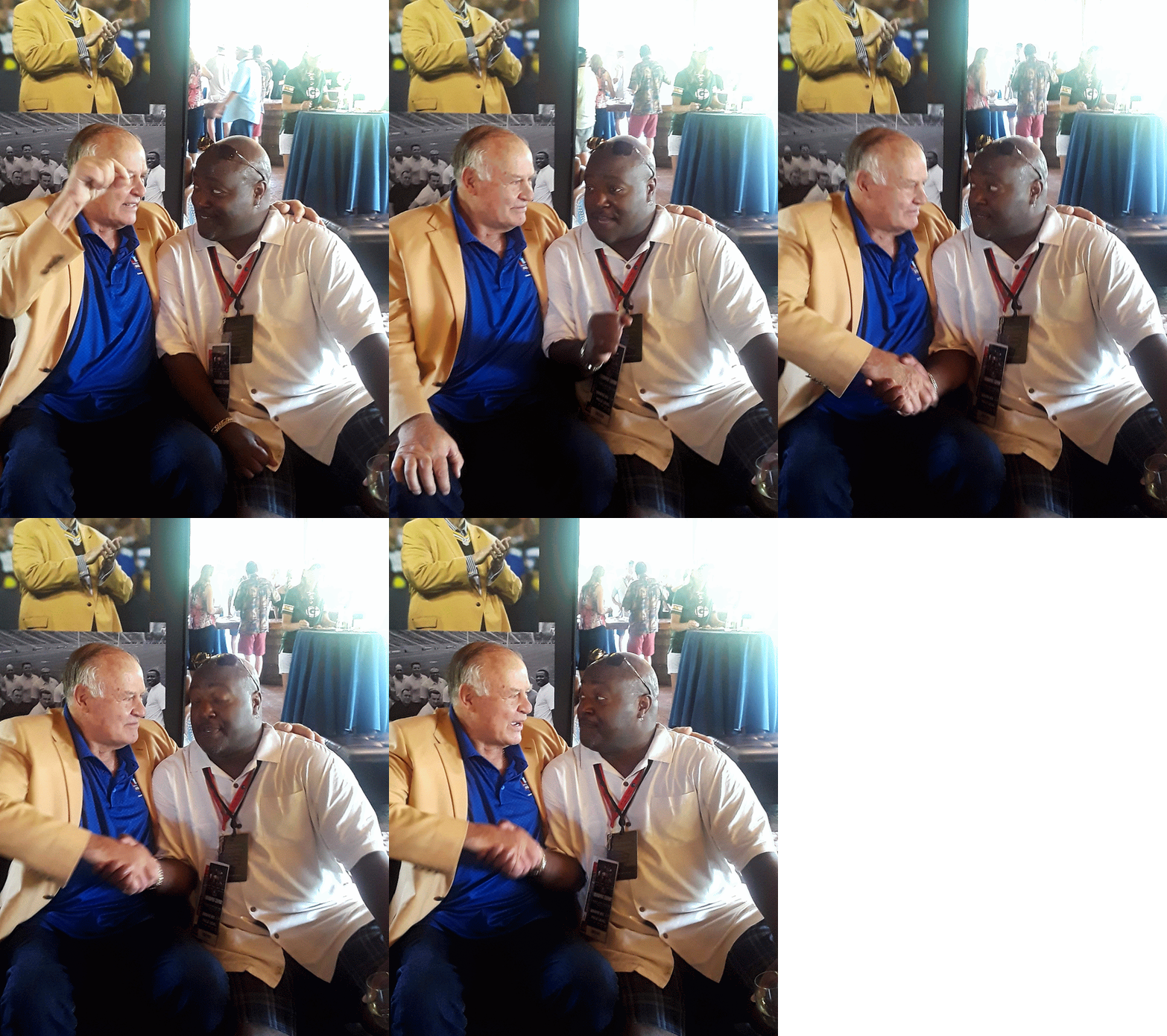
Ran into Robert Brazile after the Gold Jacket Dinner. Great time.

Kevin Greene 2011 (inducted 2016)

With Kevin Greene after the Induction ceremony.

Sterling Sharpe 2011 (will be inducted 2025)

Terrell Davis 2011 (inducted 2017)

Jerry Kramer 2011 (inducted 2018)

“Hey big guy!” ’18 HOF

Everson Walls 2011

Randy Moss 2011 (inducted 2018)

Cris Carter 2011 (inducted 2013)

Tom Flores 2012 (inducted 2021)

Lester Hayes 2012

Chuck Foreman 2012

Edgerrin James 2013 (inducted 2020)

Andre Reed 2013 (inducted 2014) 

Roger Craig 2013

Corey Dillon 2014

Ken Riley 2015 (inducted 2023)

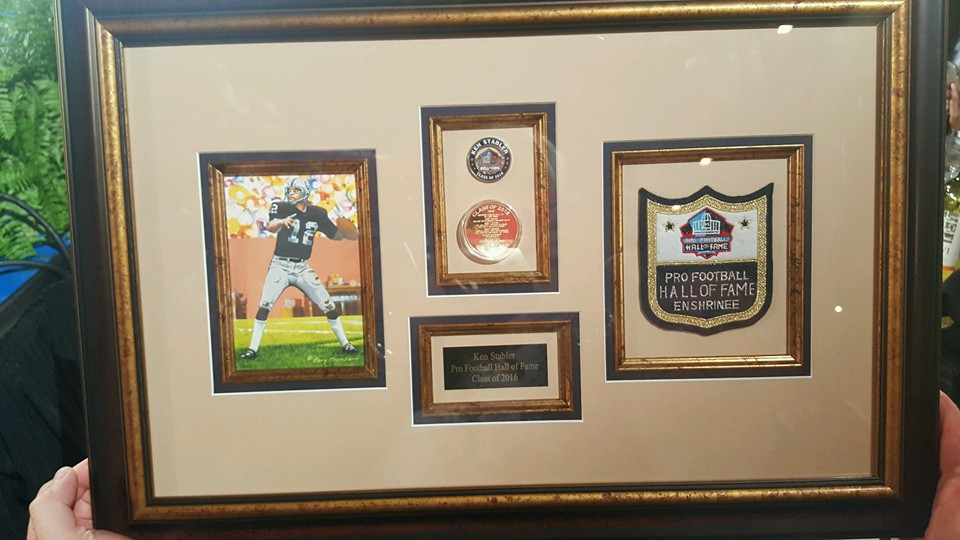
Ken Stabler 2015 (inducted 2016)

Drew Pearson 2016 (inducted 2021) 

Cliff Branch 2016 (inducted 2022)

Todd Christensen 2017

Hardy Nickerson 2020

Wilber Marshall 2024

Legendary Days: The 1981 NFC Championship Game – The Birth of Camelot

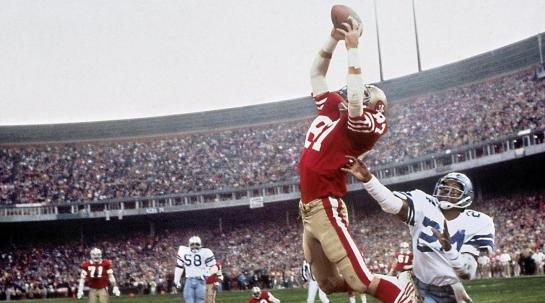
With Dwight Clark’s passing a few weeks ago it was nearly impossible to not think back to his signature play and this game. The Catch ushered in an era where the 49ers became the NFL’s signature franchise and brought Dallas down a notch. A win 2 weeks later in Super Bowl XVI in Pontiac gave Bill Walsh the platform to showcase his genius, The West Coast (Paul Brown’s) Offense, and launch an era he coined “Camelot”. Joe Montana became one of the NFL’s newest faces and would dominate the decade.

Dwight Clark as he will appear forever in the minds of fans everywhere.

Going into the ’81 NFC Championship the 49ers were an organization that not only hadn’t won a championship in their 36 year history. They were 0-3 against Dallas in the postseason. Even worse is they had left 2 NFL Championships on the table by celebrating victory prematurely then succumbing to huge comeback defeats.

In 1957, Y.A. Tittle, Hugh McElhenny and the Million Dollar Backfield bolted to a 27-7 3rd quarter lead in a playoff with the Detroit Lions. Detroit battled back and won 31-27. Then in ’72, a revenge minded 49er team fresh from back to back defeats in the first two NFC Championship Games to Dallas jumped to a 28-13 3rd quarter lead. Amid the taunts and trash talk Landry replaced ineffective QB Craig Morton for Roger Staubach. In another classic meltdown Dallas stormed to win 30-28.

Each of these losses crippled the franchise as they went into a tailspin for a decade both times.

When the 49ers traded for future Hall of Famer Fred Dean #74, the 49ers became a legitimate contender in 1981.

Now here was a 3rd trip to the summit for an organization fighting for respect. Why would this generation’s group get over the hump where previous teams had failed?? This was the dreaded Dallas Cowboys they were 0-3 against in the postseason.

At the time Hall of Fame Coach Tom Landry was the Bill Walsh / Bill Belichick of his era having taken the Cowboys to the postseason 15 of the last 16 years. Not only had he won 2 Super Bowls, his teams was playing in a championship game for the 10th time with this tilt out in Candlestick. The NFL up to this time hadn’t seen this type of extended success. Not nearing 2 decades worth. Well a berth in Super Bowl XVI was at stake and all he had to do was get past this bunch of no names out in California. Consensus at the time by the national media cited that he would:
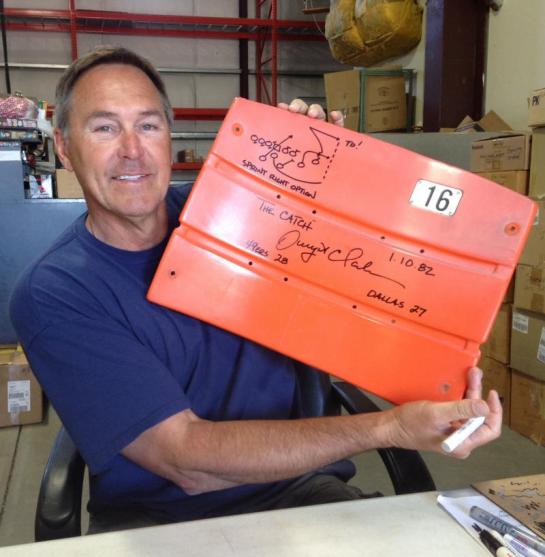
Eric Wright’s clutch tackle on Drew Pearson saved the game but Dwight Clark’s catch remains it’s signature. Prestige is much like momentum. You can’t exactly define it yet you know it once you feel it and see it. The mantle of prestige and esteem the Cowboys held transferred to the 49ers the moment Clark came down with the football. From that point on the buzz from NFL media in print and television began with Bill Walsh and his organization. His West Coast offense became the dominant offensive approach for the next four decades.

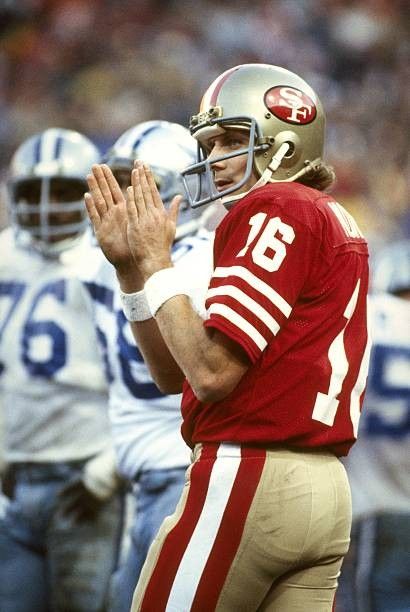
Joe Montana and Bill Walsh are linked forever in football lore.

Epilogue:

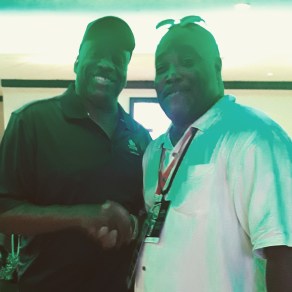
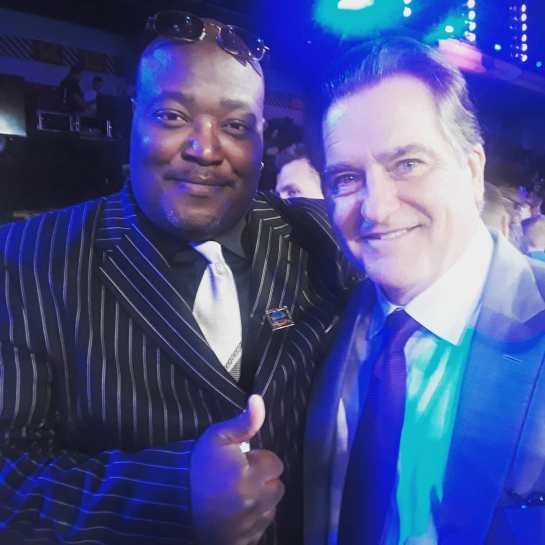
For those of us old enough to have watched this game and remember those years it was a unique time in NFL history. A young Chancellor of Football was watching this frozen in -63 wind chill in Columbus, Ohio. These were bigger than life characters that were shaping how I viewed the game and learned of all those making history. When we lose Dwight Clark, who was one of those figures, a piece of us go with them. Things won’t be the same but thanks for the memories. Thankfully former 49er Coach Steve Mariucci shared this on Twitter and I had the chance to thank Steve in Canton a few weeks later. *see pic at end of article*

Mariucci was a beneficiary of the prestige borne of The Catch. They were a well oiled and running dynasty 16 years in when he succeeded George Seifert in 1997. Hmmmm…isn’t that the same 16 year mark when Landry had the Cowboys in San Francisco back in ’81?? For irony…. Mariucci and the 49ers also lost the NFC Championship Game that year. Yet that story…can be told at another time.

Thanks for the memories Dwight Clark. RIP (January 8, 1957 – June 4, 2018)

Dedicated To The Memories of: Dwight Clark, Bill Walsh, Fred Dean, Tom Landry,  Freddie Solomon, Bob McKittrick, John Ayers, Fred Quillan, Keith Fahnhorst, Ernie Stautner, Larry Bethea, Harvey Martin, Ron Springs, narrator Harry Kalas, Ed Sabol & Steve Sabol

Thanks for reading please share the article.

me.mooch